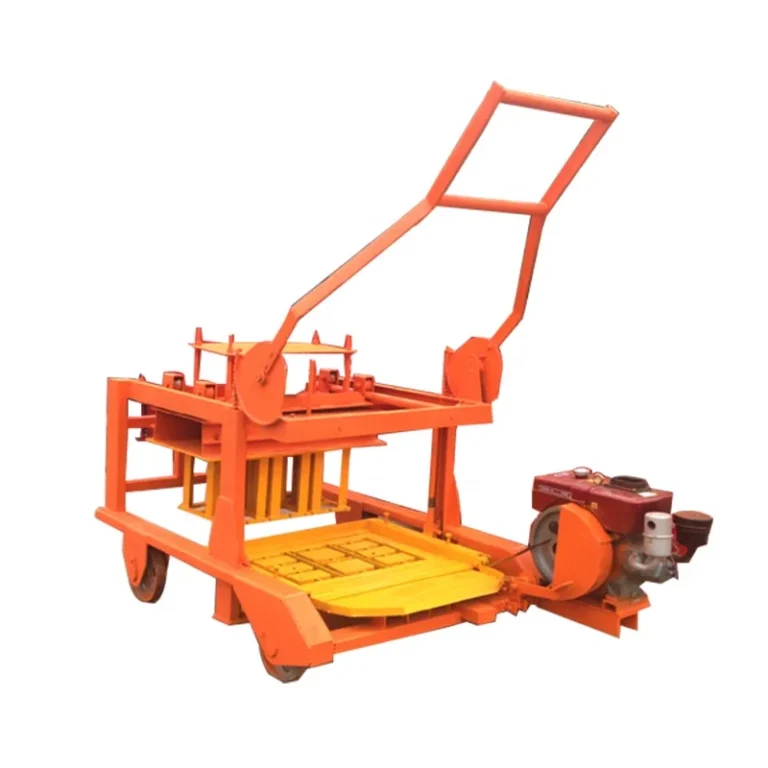
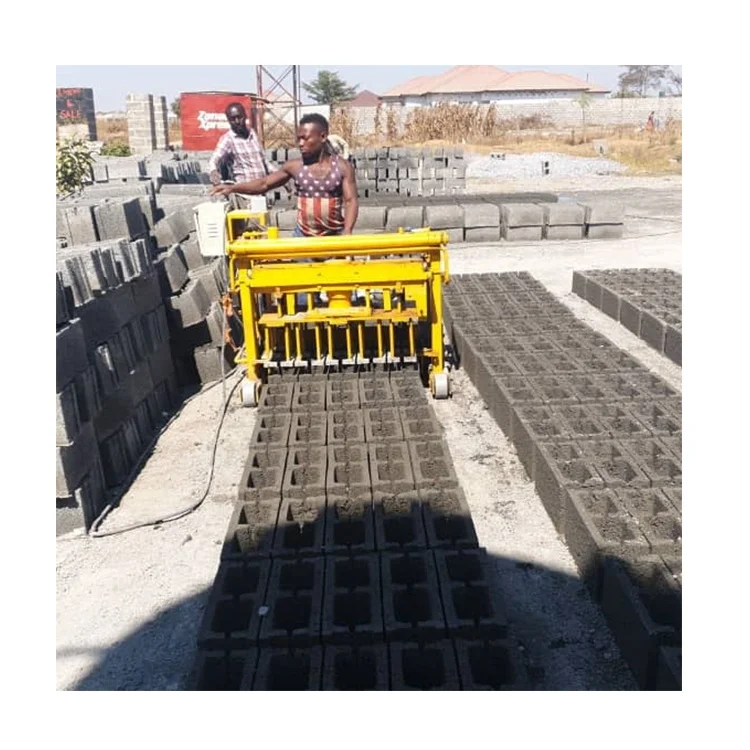
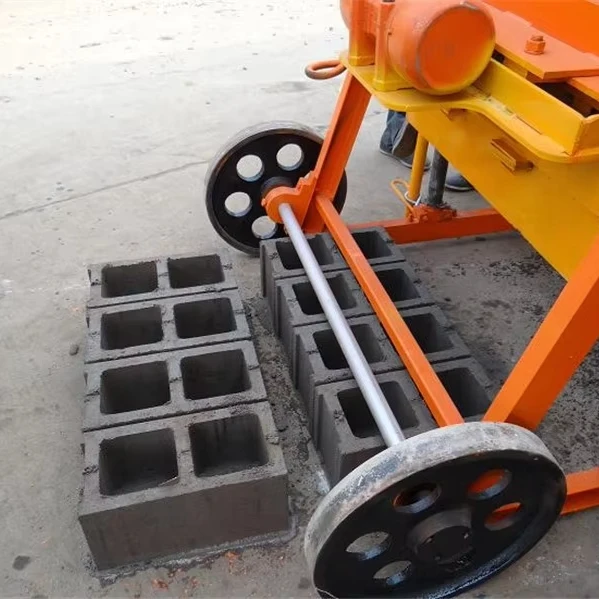
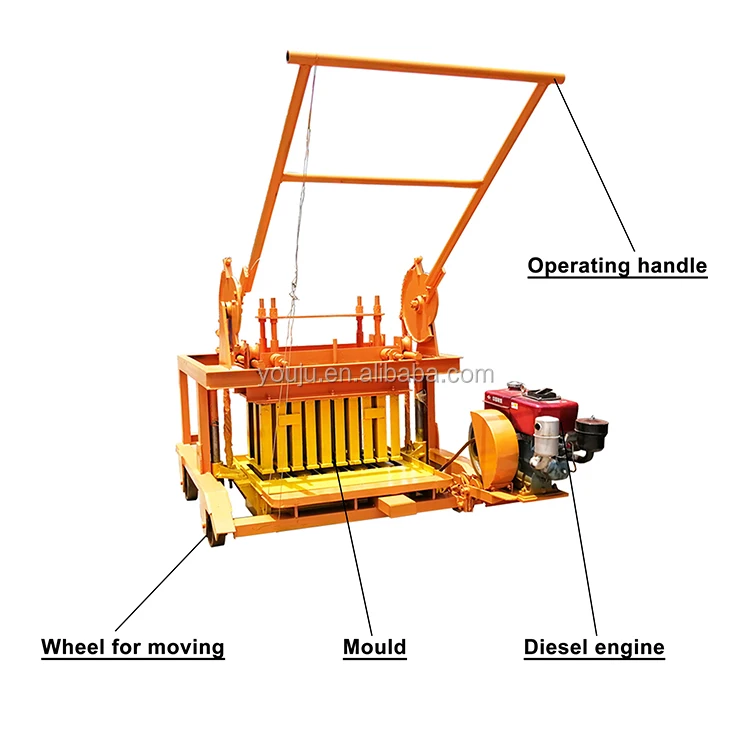
Compact On-Site Production — The QMR4-45 mobile egg laying block machine is built as a single integrated unit, so the press, mould, and power system are specified together against your actual site conditions rather than sourced from separate suppliers.
Technical Specifications
| Parameter |
Value |
| Model |
QMR4-45 |
| Product Type |
Mobile Egg Laying Block Making Machine |
| Overall Dimensions (L×W×H) |
2420×1320×1650 mm |
| Net Weight |
810 kg |
| Moulding Cycle |
40–45 s |
| Rated Power |
6 kW |
| Diesel Engine Option |
6 kW or 6–8 HP |
| Voltage |
220 V or 380 V or configured to client local voltage |
| Pallet Size |
No pallet required (egg laying operation) |
| Automation Level |
Manual / mobile egg laying |
| Mould Format |
Hollow block, solid block, paving brick, standard brick (via mould change) |
| Assembly State |
Fully assembled mobile unit |
| Certification |
CE |
| Warranty |
One year for the whole machine |
Application Suitability
| Application |
Material or Output |
| On-site hollow block production for building contractors |
Cement, crushed stone, sand, water — no fixed plant or concrete floor needed |
| Small-scale solid brick manufacturing |
Local aggregate mixes with standard cement ratios |
| Paving brick production for housing developments |
Interlocking and standard paving formats via mould change |
| Off-grid or low-power construction sites |
Diesel engine configuration where grid electricity is unavailable or unreliable |
| First block plant for entrepreneurs |
Minimal infrastructure — no curing racks, no pallet investment, no batching plant required |
What "3000 Blocks per Day" Actually Means for Your Site
Daily output figures only matter when tied to a specific block format, mould cycle, and material mix — without those, the number is just marketing.
I have seen buyers receive mobile block machines that promised thousands of blocks daily, only to discover the quoted capacity assumed a small solid brick while they needed 400×200×200 mm hollow blocks. The actual output for the format they sell can be significantly lower than the headline figure [NEED_CITE: realistic output calculation methods for egg laying block machines]. The QMR4-45 operates on a 40–45 second moulding cycle, and the daily volume you achieve depends entirely on which block format you run, how your local aggregate behaves in the mix, and how many operating hours your site sustains. This mobile block machine manufacturer always states the block format assumed in every capacity calculation so you know exactly what to expect before the machine ships.

Where the QMR4-45 Sits in the Block Machine Range
The QMR4-45 occupies the entry tier of the mobile block machine range, designed for buyers who need production directly on their building site without investing in a fixed plant. For a construction contractor producing blocks for a single housing project or an entrepreneur testing the local market with minimal capital, this model removes the need for curing racks, pallet circulation systems, and dedicated factory flooring. If your volume requirement grows beyond what a single mobile unit can sustain, semi-automatic and fully automatic lines are available as the next step up the range.
How Diesel Power Changes the Operating Envelope
Many construction sites in developing regions lack reliable three-phase grid power, which is why the QMR4-45 is available with a 6–8 HP diesel engine instead of the standard 6 kW electric motor. This option means the machine can operate on remote sites, road projects, or rural housing developments where connecting to the grid would add weeks of delay and infrastructure cost. The diesel configuration maintains the same moulding cycle and vibration force, so switching power sources does not mean sacrificing block density or daily volume [NEED_CITE: diesel versus electric power in mobile block production].
Reading the Specifications That Actually Affect Your Output
The 2420×1320×1650 mm overall dimensions define how much working space you need around the machine — not just for the press itself, but for the operator to move finished blocks, store raw materials, and allow the machine to travel forward as it lays blocks in rows. The 810 kg net weight is light enough for two workers to reposition the unit across a site, yet heavy enough to provide the downward pressure needed during vibration compaction. The 40–45 second moulding cycle sets the rhythm for the entire operation: faster cycles risk under-compacted blocks with low strength, while slower cycles reduce the daily total your crew can produce. Mould change between formats — say from 400×200×200 mm hollow blocks to standard paving bricks — is a manual process, so the flexibility to produce multiple formats on one machine comes with the time cost of each changeover.
The Cost of Skipping Voltage and Frequency Confirmation
A mobile block machine arriving on site with the wrong motor winding or control panel language sits idle until a transformer is sourced or a new panel is shipped — a delay that can stretch into weeks and stall an entire construction project. I worked on a shipment last year where the buyer’s local supply was 415V/50Hz, but the motor was configured for 380V, and the mismatch was only caught during pre-dispatch inspection. Now every order goes through a triple-check on voltage, frequency, and display language before production starts [NEED_CITE: voltage and frequency standards by export market]. The consequence of getting this wrong is not just a replacement motor — it is idle labour, delayed project milestones, and lost trust with your client.
Why Source This Mobile Block Machine Manufacturer
Block machinery is the single focus here, which means the QMR4-45 press, its moulds, and the diesel or electric power system are specified as one matched set rather than assembled from separate vendors. Every configuration is set against the buyer’s actual mix design and local aggregate, not pulled from a catalogue default. Mould design covers the formats your local market actually buys, and custom mould drawings are available when your project calls for a non-standard block size. The automation level is selectable, so a buyer starting with the QMR4-45 can move to a semi-automatic line later without replacing the entire operation. Installation support, operator training, and mould and wear parts supply continue after the machine is running on your site.
Documentation & Verification
- Line layout showing the QMR4-45 footprint and operating space requirements for your site
- Machine specification sheet with voltage, frequency, and control language confirmed before production
- Mould drawing and format list stating which block sizes are covered by the quoted cycle time
- Factory test record and packing photographs reviewed before the unit leaves the workshop
Installation, Commissioning & Support
- Site ground must be level and firm enough to support the 810 kg unit during vibration without settling
- Electric models require a dedicated circuit matching the confirmed voltage and frequency — diesel units need only fuel supply
- Machine ships fully assembled; on-site setup involves positioning, mould installation, and power connection
- First production run includes mix adjustment and vibration force tuning to match your local aggregate
- Operator training covers mould change procedure, daily maintenance points, and block quality checks
- Wear parts list and mould inventory provided so first replacements are on hand before they are needed
What We Need to Configure Your QMR4-45
To build a proposal that matches your actual site conditions, we need to know which block format you intend to produce as your primary product and your target daily operating hours. Share your local aggregate type and cement availability so the mix can be matched before the mould is built. Confirm your site voltage and frequency — and whether you need the diesel engine option — so the power system is correct when the machine arrives.
Frequently Asked Questions
Q: How is daily output calculated, and which block format does each figure assume?
A: Output depends on the moulding cycle of 40–45 seconds and the specific block format you run. A small solid brick produces more units per hour than a 400×200×200 mm hollow block. Every capacity calculation we provide names the exact block format and assumes sustained operation, so you can compare figures against your actual product mix rather than a generic headline number.
Q: Where does the QMR4-45 sit compared to semi-automatic and automatic machines?
A: The QMR4-45 is the entry tier for on-site production without fixed infrastructure. Semi-automatic lines add pallet feeding and batching for higher volume from a fixed plant. Fully automatic lines include stacking and cubing for large-scale output. Each tier requires a different level of site preparation and investment.
Q: What voltage and frequency options are available, and can the control language be changed?
A: The QMR4-45 is configurable for 220 V, 380 V, or your local supply voltage and frequency. The control panel language is set to your operator’s preference before production. We confirm these details in writing three times before the machine ships to avoid commissioning delays on site.
Q: What ground conditions does this mobile block machine require on site?
A: The machine needs a level, compacted surface — concrete is not required, but loose soil will cause uneven block laying and vibration loss. The 2420×1320 mm footprint plus surrounding workspace for material storage and block curing must be clear. The 810 kg weight provides stability during the moulding cycle on firm ground.
Q: What is the investment difference between a mobile machine and a semi-automatic line?
A: A mobile unit like the QMR4-45 eliminates pallet, curing rack, and fixed plant costs, keeping initial investment low. A semi-automatic line adds batching, pallet circulation, and higher output capacity but requires a dedicated factory area with prepared flooring. The choice depends on your volume target and whether production stays on-site or moves to a fixed location.

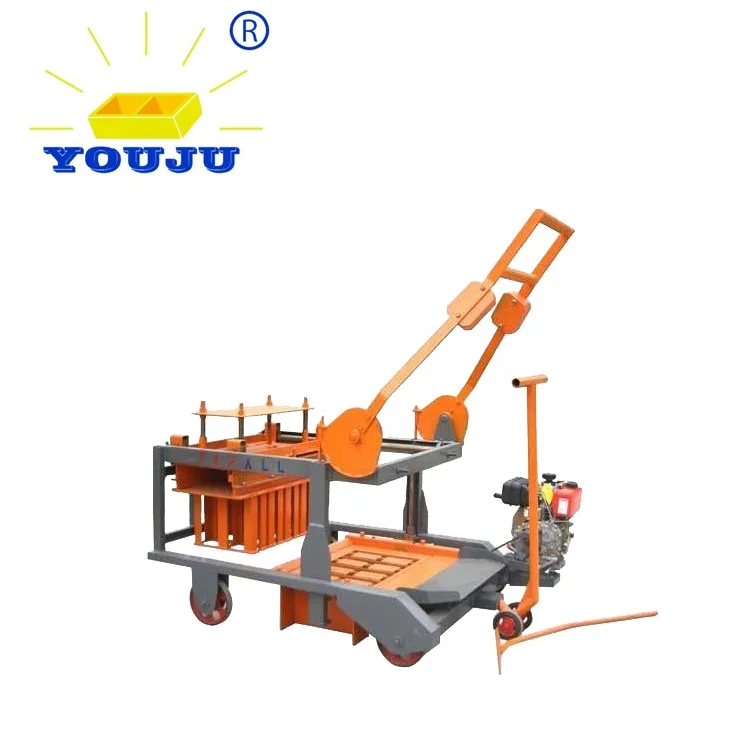
 Mobile block machine