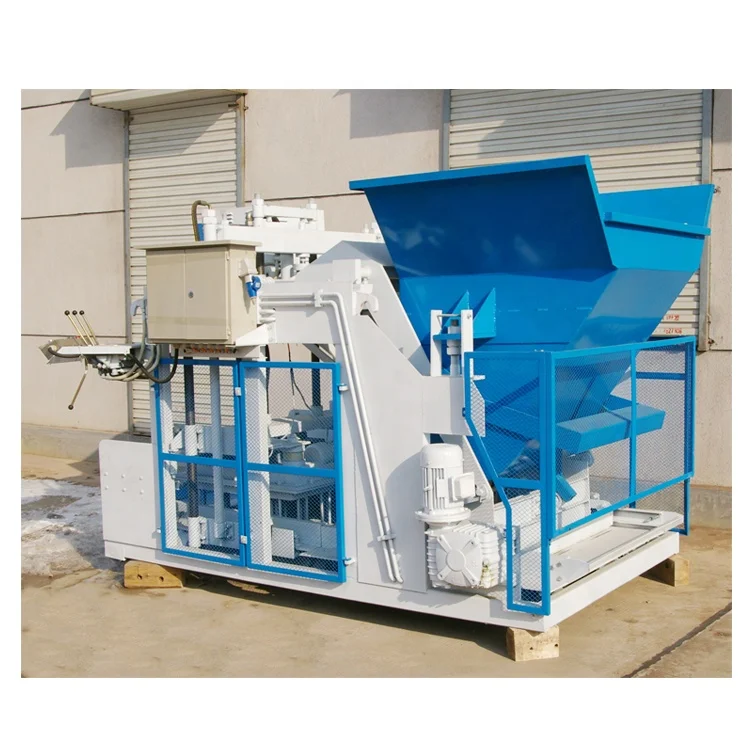
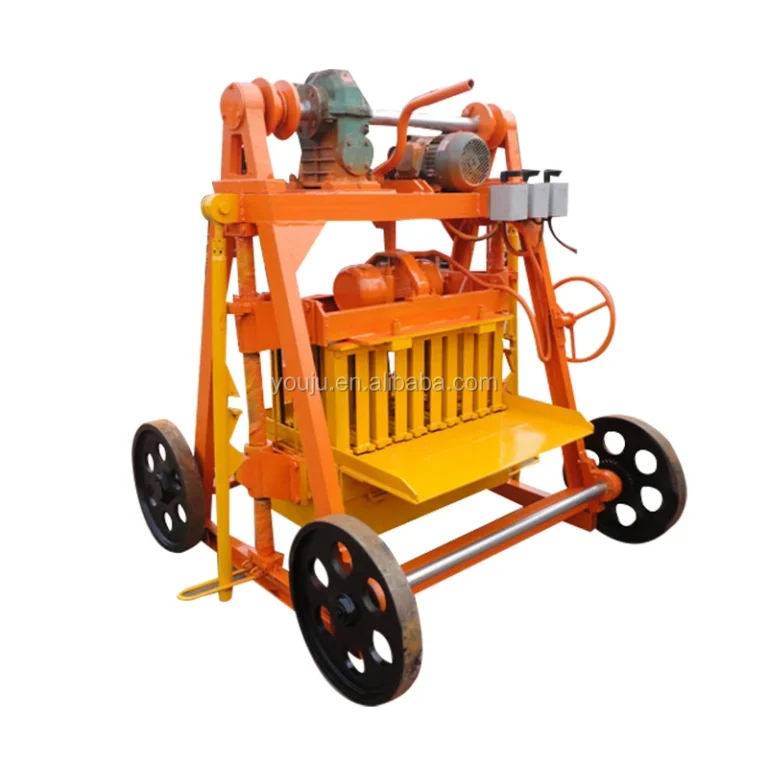
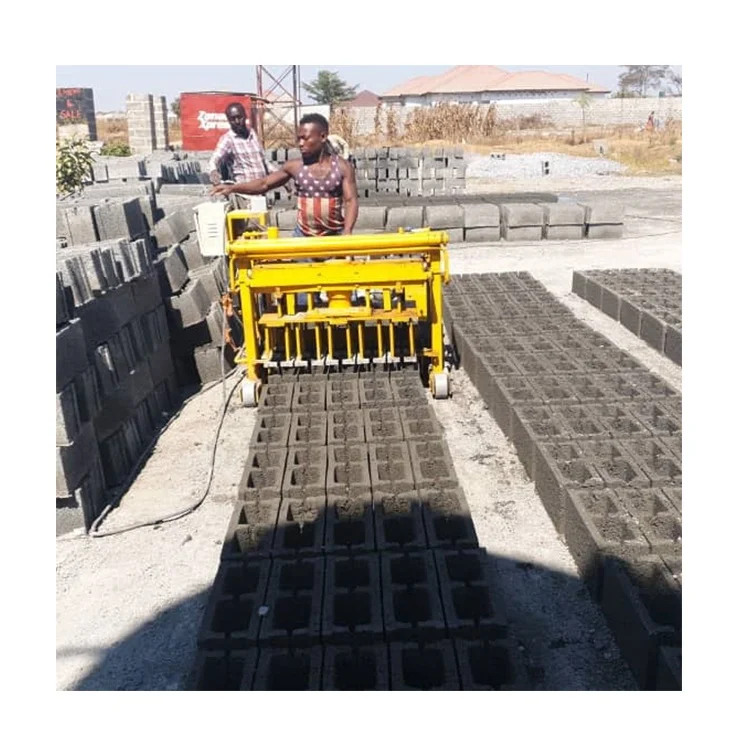
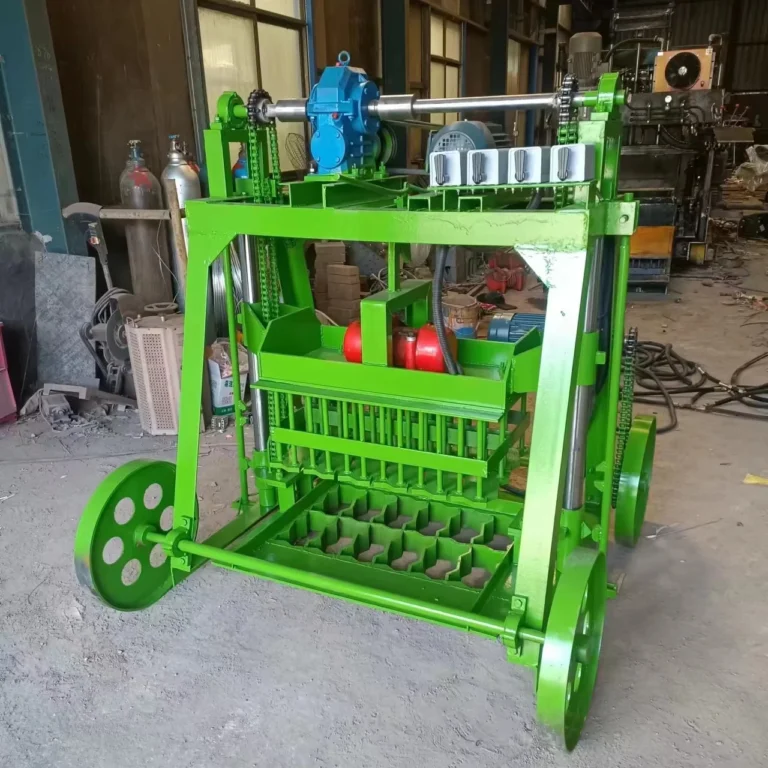
Matched System Configuration — The QMJ2-45 mobile block machine ships with moulds, operation workflow and on-site placement planned as one package, not sourced from separate suppliers and left for the buyer to integrate.
Technical Specifications
| Parameter |
Value |
| Model |
QMJ2-45 |
| Product Type |
Mobile Concrete Block Making Machine |
| Machine Operation |
Manual mobile egg-laying type |
| Pallet Requirement |
None required (egg-laying design) |
| Power Dependency |
No fixed power or diesel dependency; moves freely on-site |
| Labor Requirement |
1 to 3 workers |
| Molding Cycle |
25–30 s across all listed formats |
| Output Capacity (400×200×200 mm) |
160 pcs/h | 1,280 pcs per 8-hour shift (basis: 400×200×200 mm hollow block, 2 cavities/mould) |
| Output Capacity (400×150×200 mm) |
240 pcs/h | 4,800 pcs per 8-hour shift (basis: 400×150×200 mm hollow block, 3 cavities/mould) |
| Output Capacity (400×100×200 mm) |
320 pcs/h | 2,560 pcs per 8-hour shift (basis: 400×100×200 mm hollow block, 4 cavities/mould) |
| Mould Cavities |
2 / 3 / 4 pcs per mould depending on block format |
| Mould Technology |
Heat treatment and carburization |
| Automation Level |
Manual |
| Assembly State |
Mobile / portable |
| Voltage & Frequency |
To be confirmed before commissioning |
| Standards |
ISO 9001:2000, CE |
Application Suitability
| Application |
Material or Output |
| Small-scale on-site hollow block production |
Crushed stone, sand, cement and water mix without a fixed plant |
| Housing project contractors producing blocks at the build location |
400×200×200, 400×150×200 and 400×100×200 mm hollow bricks laid directly on the ground |
| First-time block plant entrepreneurs |
Low-capital entry with minimal workspace and no curing rack infrastructure |
| Remote or off-grid construction sites |
Production in areas with no fixed power infrastructure available |
| Building material distributors adding mobile capability |
Hollow brick formats matched to local market demand in remote regions |
Why "Pieces per Hour" Means Nothing Without the Block Format
Every capacity figure on this page is tied to a specific hollow brick dimension and cavity count.
I have watched buyers sign off on a Mobile Block Machine for Sale quoted at a single hourly number, then discover on arrival that the figure assumed the smallest block in the catalogue. Their actual product — the one their market buys — ran at a fraction of the promised output. The QMJ2-45 lists three distinct capacities: 160 pieces per hour for 400×200×200 mm blocks, 240 for 400×150×200 mm, and 320 for 400×100×200 mm. Each number corresponds to a specific mould cavity count — two, three and four respectively. [NEED_CITE: block machine capacity calculation standards by format] Without this breakdown written into the quotation, you cannot compare machines fairly or plan a realistic production schedule.

Where This Machine Fits on the Range
The QMJ2-45 sits at the entry point of the mobile block machine range. It requires no pallets, no fixed foundation, and no three-phase power connection to begin producing. Buyers who need a machine that can be pushed across a job site and lay blocks directly on the ground start here. As output requirements grow or block formats diversify beyond hollow bricks, the range extends upward through semi-automatic stationary machines and into fully automatic lines with pallet handling and stacking systems.
What Egg-Laying Design Removes from Your Setup
An egg-laying Mobile Block Machine for Sale eliminates the entire pallet loop. There is no pallet purchase cost, no pallet storage area, no curing rack system, and no forklift moving pallets between press and curing zone. The machine lays each block directly onto the ground surface and moves forward to the next position. For contractors working on a housing project where floor space is the build site itself, this removes the infrastructure that a stationary plant demands. The trade-off is that ground preparation — a flat, level concrete surface — becomes the foundation quality factor. [NEED_CITE: ground preparation requirements for egg-laying block machines]
Reading the Specifications That Actually Matter
The 25–30 second molding cycle applies across all three hollow block formats. This consistency matters because it means the operator rhythm does not change when you swap moulds — only the cavity count and block dimensions change. The moulds themselves undergo heat treatment and carburization, which extends wear life when running abrasive mixes containing crushed stone or river gravel. Manual operation means no hydraulic pressure system and no PLC control to maintain, keeping the skill threshold low for a first-time crew. The labor requirement of one to three workers covers one person feeding the mix, one operating the machine, and one handling block alignment after laying. Voltage and frequency are not pre-set because this machine may or may not require an electrical connection depending on the vibration motor configuration chosen — confirming this before shipment prevents the kind of site standstill I witnessed on an African project years ago.
What Happens When Power Specs Are Assumed
I flew to a job site once where a mobile block machine sat idle for three weeks because the local grid could not supply the voltage the machine expected. Nobody had confirmed the requirement before loading the container. With the QMJ2-45, the electrical specification must be resolved during the ordering phase — not at the port of arrival. A mismatch here does not cause gradual problems; it causes the machine to not start at all. [NEED_CITE: voltage and frequency standards by export market] The cost of a site visit to rewire or replace a motor dwarfs the time it takes to confirm these details in writing before production begins.
Why Source the Machine and Moulds Together
The QMJ2-45 is configured as a matched system — the machine frame, the mould set, and the on-site workflow are specified together. Block machinery is our single focus, so the mould cavities, block dimensions and cycle times are validated as one unit rather than assembled from separate suppliers. Configuration is set against your actual mix design and local aggregate, not a catalogue default. Mould design covers the formats your market actually sells, and custom drawings are available if your region demands a dimension outside the standard three. You can start with this manual mobile unit and move to a semi-automatic or automatic line later, with the same supplier understanding your production history. Installation support includes operator training so your crew knows the mould change procedure and daily maintenance before the first production run.
Documentation & Verification
- Line layout and capacity calculation stating the exact hollow block format assumed per output figure
- Mould drawing and format list so you verify cavity count and block dimensions before production
- Voltage and frequency confirmation document signed off before the machine enters production
- Factory test record showing cycle timing on your specified block format
- Packing photographs issued before container loading for your records
Installation, Commissioning & Support
- Flat, level concrete ground surface required for egg-laying operation across the full block production area
- Voltage and frequency confirmed in writing before shipment to match your local grid or generator supply
- Machine arrives in mobile assembly state — no heavy foundation or fixed plant construction needed
- Mould change procedure demonstrated during on-site commissioning with your operator crew
- Heat-treated mould wear schedule provided so you plan replacement before block dimensions drift
What to Include in Your Inquiry
Tell us the hollow block format your market buys most — dimensions and daily volume target. Confirm your local power supply voltage and frequency, even if you believe the machine may not need it. Describe your available production space and whether a flat concrete surface already exists on-site. These details let us confirm the correct mould set and electrical configuration before quoting a lead time.
Frequently Asked Questions
Q: How is output capacity calculated for each block format?
A: Each capacity figure states the block dimension and mould cavity count it assumes. The 160 pieces per hour figure applies to 400×200×200 mm hollow blocks with a 2-cavity mould, while 240 and 320 pieces per hour correspond to the 3-cavity and 4-cavity moulds respectively. The 25–30 second cycle remains constant across formats.
Q: Does the QMJ2-45 require any electrical power connection?
A: This depends on the vibration motor configuration selected. Some setups operate without a fixed power source. We confirm voltage and frequency requirements in writing during the ordering phase so there is no ambiguity when the machine arrives at your site.
Q: How long does a mould change take on this machine?
A: The QMJ2-45 uses interchangeable moulds for different hollow brick formats. The changeover is a manual procedure requiring basic hand tools. We demonstrate the full process during commissioning so your operators can perform it independently.
Q: What mix design does this machine expect?
A: The machine is configured against your local aggregate and target block strength, not a generic default. We ask about your available sand, crushed stone and cement types during the inquiry so the mould and vibration settings match what you can actually source.
Q: What spare parts ship with the machine?
A: A wear parts and mould list is included with every shipment. We confirm which spare moulds and consumables accompany your specific configuration during the quotation stage, along with reorder lead times for future purchases.

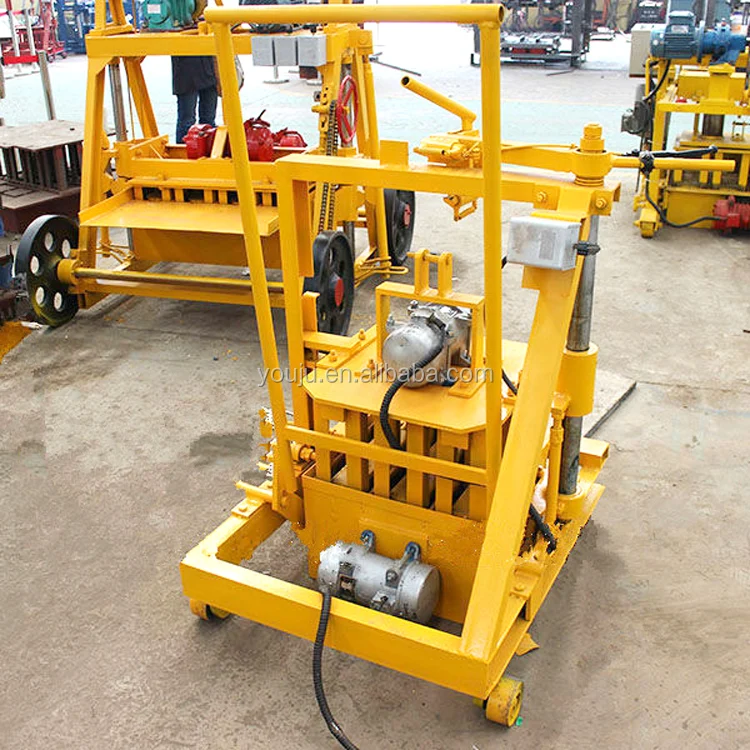
 Mobile block machine