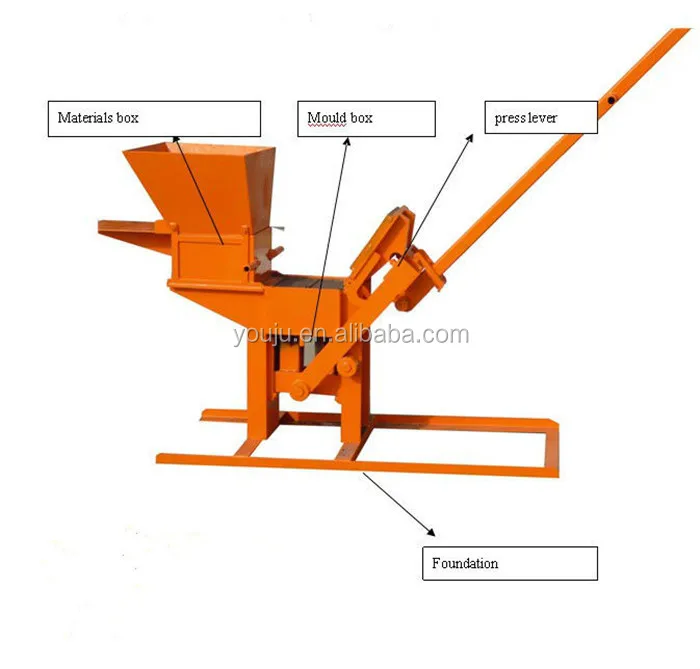
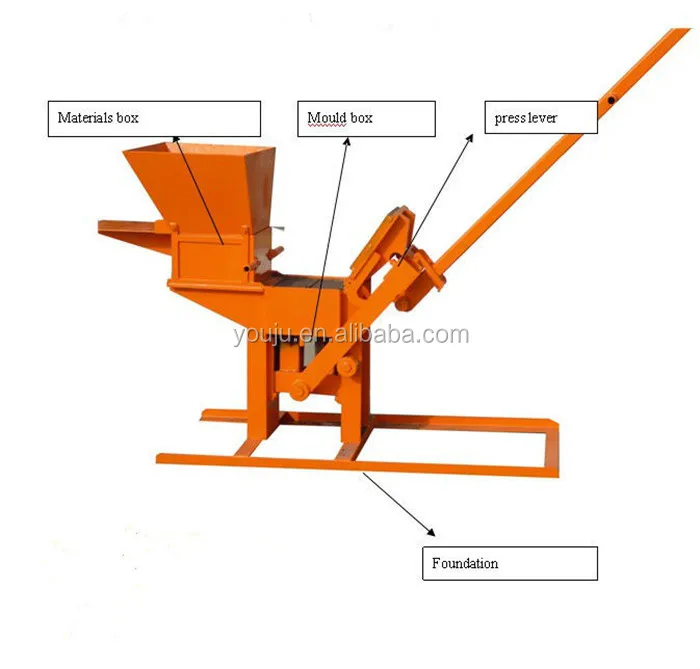
Fully Manual Operation — the LY2-40 runs without grid power or diesel generators, enabling interlocking brick production where electricity is unavailable.
Technical Specifications
| Parameter |
Value |
| Model |
LY2-40 |
| Product Type |
Manual Clay Interlocking Brick Making Machine |
| Power Source |
No Power, Completely Manual |
| Lifting System |
Manual lever operation |
| Mobility |
Steel wheels for mobile operation |
| Molding Cycle |
30–40s |
| Daily Capacity |
400–1000 pcs/day (basis not stated in source — confirm block format, material, thickness) |
| Overall Dimensions (L×W×H) |
1600 × 700 × 1200 mm |
| Total Mass |
200–240 kgs |
| Mould Change System |
Changeable moulds for various block formats |
| Basic Equipment Included |
JFA-1 Mixer or JQ350 Mixer |
| Warranty |
1 Year |
| Automation Level |
Fully manual |
Application Suitability
| Application |
Material or Output |
| Compressed earth interlocking bricks |
Clay and soil-cement mix |
| Off-grid construction sites |
No-power environments |
| Small-scale local housing projects |
Soil-cement homogenization |
| Manual mixing line integration |
Earth-based mix designs |
What "400–1000 Pieces per Day" Actually Means for a Manual Clay Interlocking Brick Machine
Quoted capacity on manual presses almost always assumes the smallest, thinnest brick in the mould range. When buyers switch to a standard 290×140×90mm interlocking format, the cycle stretches and daily volume drops.
I once shipped an LY2-40 to West Africa after a successful factory test with standard soil samples. On arrival, the local red clay had far higher plasticity. The interlocking bricks stuck in the mould cavities, demoulding took twice as long, and the crew produced only a few hundred usable units per shift. Capacity numbers mean nothing without stating the exact block format and mix used to derive them [NEED_CITE: manual press capacity calculation methods]. A Manual Clay Interlocking Brick Machine manufacturer should always tie output claims to a named format.

Where the LY2-40 Fits in the Shiyue Machine Range
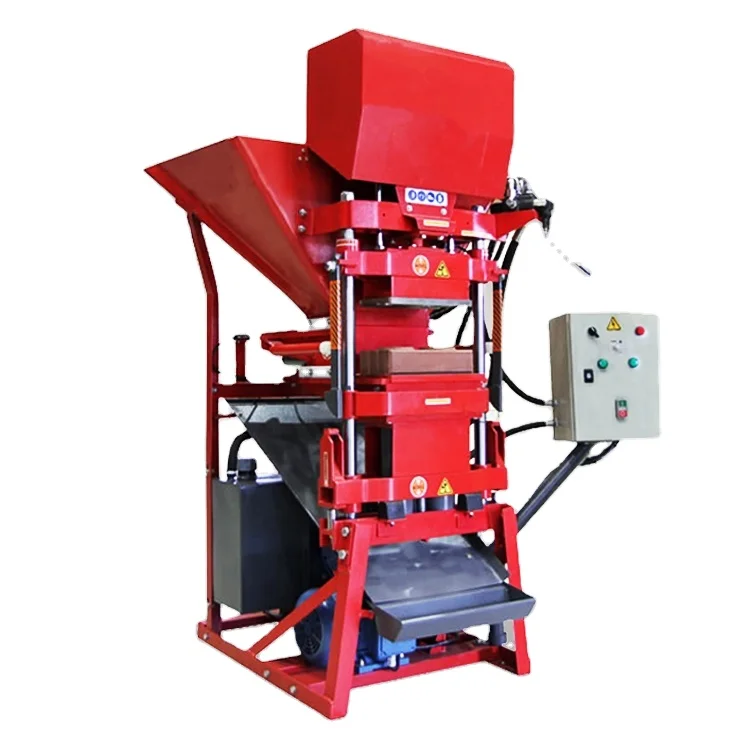
The LY2-40 occupies the entry tier of the Shiyue block machine lineup. It targets buyers who need to begin interlocking brick production with minimal capital, no factory shed, and no grid connection. Above it sit semi-automatic machines with powered vibration and hydraulic pressure, and at the top, fully automatic lines with batching, stacking, and cubing. The Manual Clay Interlocking Brick Machine manufacturer positions this model for entrepreneurs and project contractors who need a machine they can wheel across a building site.
Mobility and Off-Grid Deployment
Steel wheels let the operator move the press between curing areas without a forklift or fixed foundation. Because no electrical supply is required, the LY2-40 operates in remote locations where generators are impractical. The included JFA-1 or JQ350 mixer also runs on minimal power, keeping the entire production cell independent of grid infrastructure. This mobility matters for housing development contractors producing bricks on their own site [NEED_CITE: off-grid construction equipment deployment standards].
Mould Change and Format Flexibility
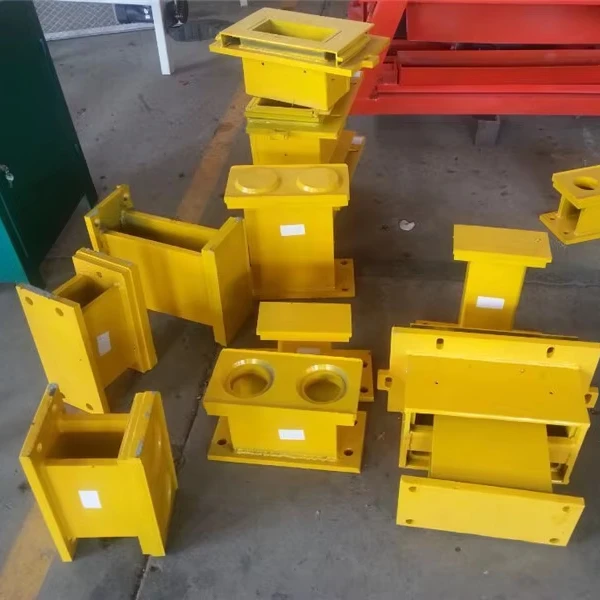
The changeable mould system lets one LY2-40 produce multiple interlocking brick profiles — flat-face, curved-face, or channel-lock — without buying a second press. Mould swap on a manual machine is straightforward: unbolt the worn insert, slide in the new one, and secure. However, the time this takes depends on operator familiarity and bolt condition after weeks of clay exposure. Buyers should confirm which mould formats are in stock and which require custom machining, because a catalogue listing does not guarantee immediate dispatch.
The Hidden Cost of Skipping a Soil Sample Test
A manual interlocking brick press amplifies every mix variable because there is no powered vibration to compensate for poor workability. If the local clay has high montmorillonite content, the soil-cement mix becomes sticky and demoulding force increases beyond what the operator can apply by hand. We have seen crews abandon entire production days because the mix design was guessed rather than tested [NEED_CITE: soil-cement mix design testing protocols]. Sending a representative soil sample before order confirmation lets us run compaction trials and recommend a cement ratio that actually releases from the mould.
Why Buyers Choose This Manual Clay Interlocking Brick Machine Manufacturer
Block machinery is our single focus, so the LY2-40, its mould, and the paired mixer are specified as one matched system. We configure recommendations against the buyer’s actual soil-cement mix and target interlocking format, not a catalogue default. Mould design covers the profiles the buyer’s market actually sells, including custom drawings when local preferences differ. Automation level is selectable, so a buyer starting on the LY2-40 can move to a semi-automatic Shiyue press later without replacing the entire operation. Installation support includes operator training on manual lever technique and mould maintenance.
Documentation & Verification
- Line layout and capacity calculation stating the exact interlocking format assumed for daily output
- Machine specification sheet confirming dimensions, mass, and mould compatibility list
- Mould drawing and format list showing available interlocking profiles and custom options
- Factory test record on buyer-supplied soil sample before dispatch
- Operation and maintenance manual covering lever system and mould change procedure
- Packing photographs and customs documentation support for export
Installation, Commissioning & Support
- Minimal site prep: a level, compacted earth area matching the 1600 × 700 mm footprint
- No electrical connection required for the LY2-40 press itself, simplifying remote deployment
- Machine arrives on steel wheels, ready for immediate positioning without a crane
- First production run supervised to confirm mould release with buyer’s local clay mix
- Operator training on manual lever technique, mould lubrication, and daily bolt inspection
- Wear parts list covering mould liners and lever pivot pins for early replacement planning
Request a Configuration Proposal
Tell us the interlocking brick format your market sells, your local soil type, and your target daily volume. Share any existing mixer or curing rack details so we can confirm compatibility. If you plan to scale later, mention your timeline so we can map an upgrade path within the Shiyue range.
Frequently Asked Questions
Q: What block format does the 400–1000 pcs/day capacity assume, and how does output change with other formats?
A: That range is quoted without a stated format or material basis. In practice, thinner or smaller interlocking profiles yield the upper figure, while standard 290×140×90mm bricks shift output toward the lower end. The 30–40s molding cycle also lengthens when working with high-plasticity clay. We provide a format-specific capacity calculation once you confirm your target brick dimensions and soil-cement ratio.
Q: How do I choose between the LY2-40 manual tier and a semi-automatic machine in the Shiyue range?
A: The LY2-40 suits buyers with no grid power, minimal capital, and modest daily volume. If your site has electricity and you need consistent output above what a hand-operated press can sustain, a semi-automatic model with powered vibration will compress faster and reduce operator fatigue. Consider the semi-automatic tier when your project timeline demands predictable daily counts regardless of crew stamina.
Q: What plant footprint and site preparation does the LY2-40 require compared to larger automatic lines?
A: The LY2-40 needs only a level, compacted area roughly matching its 1600 × 700 mm base plus space for the included mixer and curing racks. There is no fixed foundation, conveyor system, or electrical panel to install. Automatic lines require a concrete slab, power supply, and dedicated curing yard. The manual press lets you start production with a fraction of the site preparation.
Q: Which mixer — JFA-1 or JQ350 — matches my target daily output and local soil-cement mix?
A: The JFA-1 handles smaller batches suited to lower daily targets and lighter soil-cement ratios. The JQ350 offers a larger drum for higher throughput and denser mixes with greater cement content. Your choice depends on the daily volume you plan to sustain and the workability of your local clay. We confirm the match during the configuration proposal stage based on your soil sample test results.
Q: What upgrade path exists from the LY2-40 to a semi-automatic or automatic Shiyue machine as production scales?
A: The mould formats and interlocking profiles you establish on the LY2-40 carry forward to larger Shiyue presses, so your product range stays consistent. When you are ready, a semi-automatic model adds powered vibration and faster cycle times without requiring a complete line redesign. Moving to a fully automatic line later introduces batching, stacking, and cubing while keeping the same block specifications your market already recognizes.

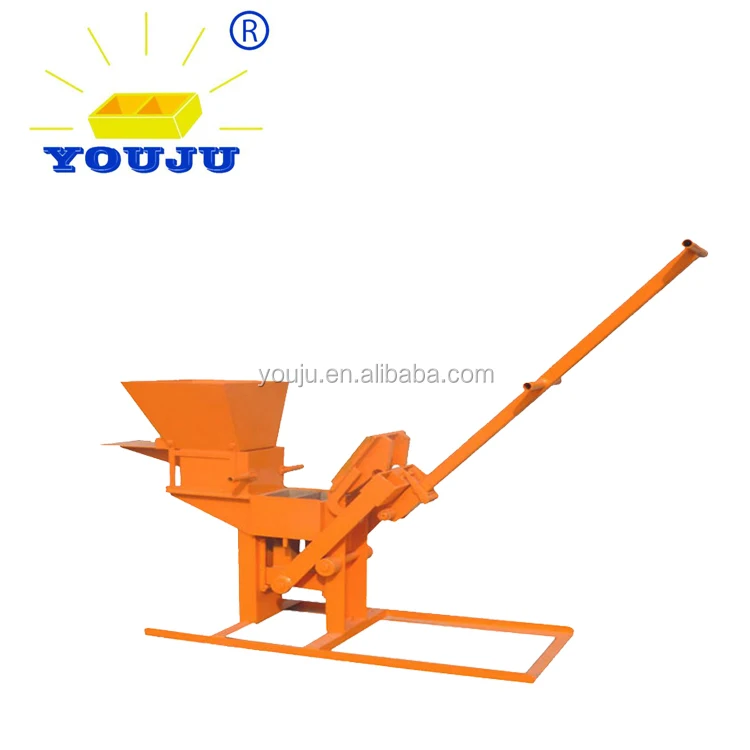
 Clay interlocking brick