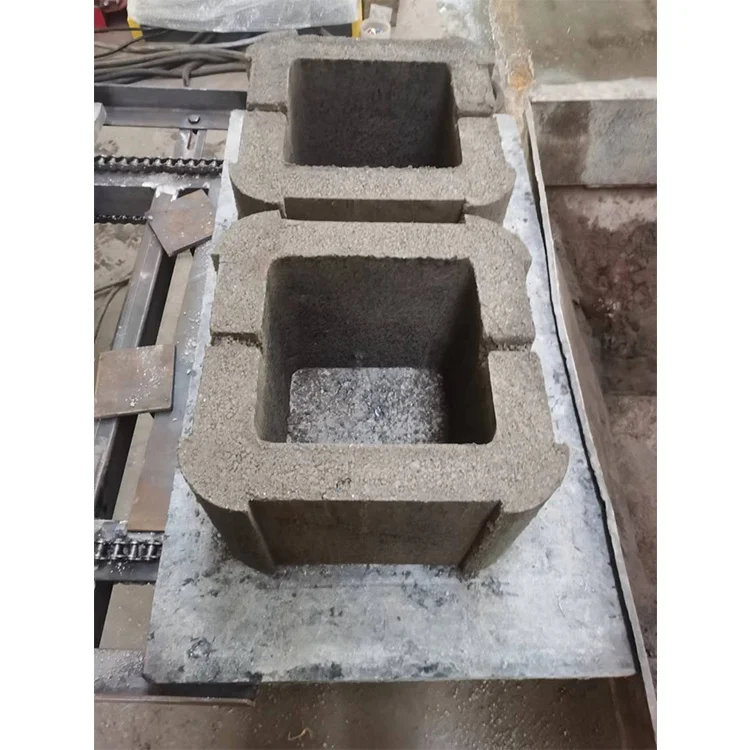
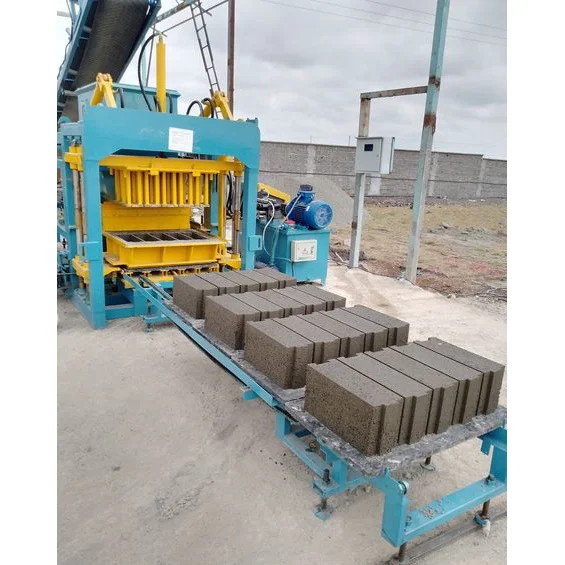
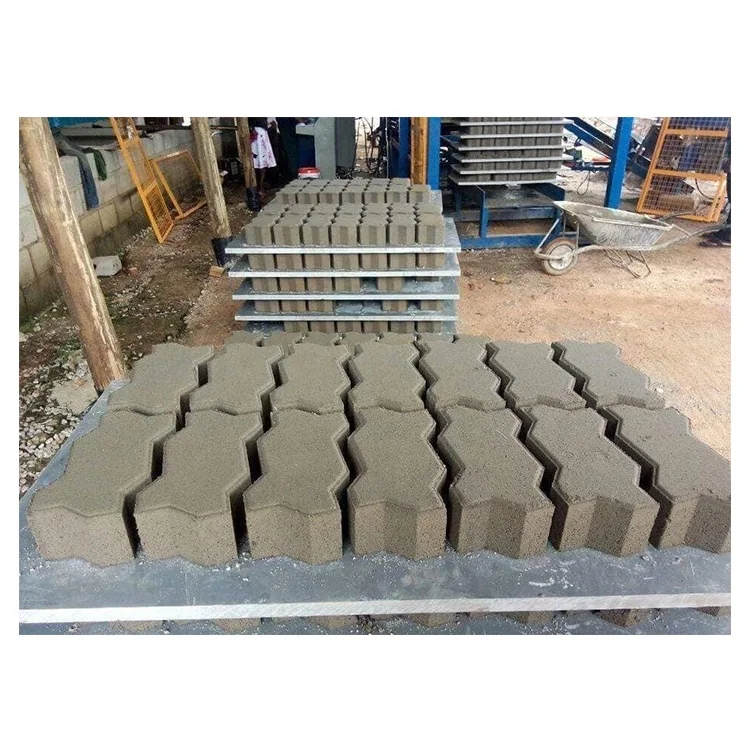
Matched System Configuration — Every QT4-15 line ships with mixer, pallet, stacker and moulds specified against the buyer’s target block format, not assembled from separate catalogue defaults.
Technical Specifications
| Parameter |
Value |
| Model |
QT4-15A |
| Product Type |
Automatic Hydraulic Concrete Block Making Machine |
| Overall Dimensions (L×W×H) |
7100 × 1600 × 2610 mm |
| Total Weight |
3,000 kg |
| Rated Power |
18.45 kW |
| Vibration Frequency |
4,600 r/min |
| Exciting Force (Vibration) |
40–50 kN |
| Molding Cycle |
15–25 s |
| Mixer Model |
JQ350 |
| Pallet Size |
850 × 550 × 25 mm |
| Applied Products |
Hollow block, solid brick, paver, curbstone |
| Raw Materials |
Crushed stone, sand, cement, stone dust, fly ash |
| Output Capacity |
408 pcs/hr (basis: 400×200×200 mm hollow block, 4 pcs/mould) |
| Output Capacity |
510 pcs/hr (basis: 400×150×200 mm hollow block, 5 pcs/mould) |
| Output Capacity |
2,100 pcs/hr (basis: 240×115×53 mm solid brick, 18 pcs/mould) |
| Daily Output (8 hr) |
3,264 pcs (basis: 400×200×200 mm hollow block) |
| Daily Output (8 hr) |
4,080 pcs (basis: 400×150×200 mm hollow block) |
| Daily Output (8 hr) |
17,000 pcs (basis: 240×115×53 mm solid brick) |
| Automation Level |
Semi-automatic |
| Stacking Method |
Automatic stacker included in line configuration |
| Hydraulic Pressure |
(value not stated in source — confirm at inquiry) |
| Control System |
PLC brand and display language (confirm target market requirement) |
| Voltage & Frequency |
(configurable — confirm local supply before production) |
Application Suitability
| Application |
Material or Output |
| 4", 5", 6", 8" hollow block production for housing and commercial walls |
Crushed stone, sand, cement, fly ash blends |
| Solid brick manufacturing for load-bearing and partition masonry |
Stone dust and cement mixes |
| Interlocking and rectangular paver production for walkways and driveways |
Fine aggregate with pigment layers |
| Kerbstone and curb unit forming for road and site perimeter works |
Coarse aggregate with high cement content |
| On-site block production for construction contractors |
Locally sourced aggregate matching project mix design |
What "408 Blocks per Hour" Actually Means on Site
A capacity figure without the block format attached is just a number on a brochure.
When buyers read a QT4-15 automatic block machine manufacturer quote stating "high output", the first question should be: output of what? A mould producing four 400×200×200 mm hollow blocks per cycle yields a very different daily volume than one producing eighteen 240×115×53 mm solid bricks. The vibration force and hydraulic pressure that work well for hollow blocks may not compact a solid brick mix to the required strength, and cycle times shift depending on the depth of draw and the stiffness of the concrete. I have watched operators on a South African site run a machine at catalogue speed only to find half the blocks cracked at demoulding because the local crushed stone carried more clay fines than the test mix [NEED_CITE: effect of clay content in aggregate on block green strength]. Matching the press to the actual product format prevents that gap between expectation and reality.

Placing the QT4-15 on the Full Machine Range
The QT4-15 sits between small workshop machines and high-capacity fully automatic lines, making it a practical choice for a buyer setting up a first block plant or replacing a manual operation. The semi-automatic configuration keeps the initial investment contained while the automatic stacker removes the heaviest manual task from the production floor. A buyer can later add a batching system or upgrade to full pallet cubing without replacing the press itself. This tier positioning means the machine footprint — roughly seven metres long by two and a half metres high — fits inside a standard industrial bay without requiring a dedicated building.
Where the Line Stops if Stations Are Not Balanced
A block press is only as fast as the slowest station feeding it. The JQ350 mixer must discharge a batch before the next mould cycle begins, the pallet feeder must place a clean pallet in time, and the stacker must clear finished blocks before the press waits. On the QT4-15 line, these stations are specified together so cycle times align. If the mixer is undersized for the chosen block format, the press sits idle every few cycles [NEED_CITE: line balancing principles in block production]. Specifying the complete line from one supplier avoids the finger-pointing that happens when separate vendors each blame the other for a bottleneck.
Reading the Numbers Behind the Press
Vibration frequency at 4,600 r/min and exciting force in the 40–50 kN range determine how densely the concrete settles into the mould cavity. Higher vibration compacts the mix faster but can segregate coarse aggregate if the amplitude is not tuned to the material. The hydraulic station provides the upper mould compression that works together with bed vibration to produce consistent block density from top to bottom. Moulding cycle times of 15–25 seconds reflect the range between thin solid bricks and deeper hollow blocks, where concrete must flow further into the cavity. The 850 × 550 mm pallet size must match the curing rack spacing and the forklift tine width already on site; a mismatch here means buying new handling equipment or leaving pallets stacked by hand.
The Cost of Skipping the Mix Sample
Sending a kilogram of local aggregate before the order goes to production takes a week and saves months of on-site troubleshooting. When the stone dust or sand contains clay, silt, or shell fragments, the water demand changes, the vibration parameters need adjustment, and the block strength at seven days can fall below specification. I once spent three days beside a press in southern Africa re-tuning vibration and pressure after the local quarry changed its crushing screen, which altered the fines content in ways no catalogue could predict [NEED_CITE: variability of crushed stone aggregate properties]. A factory test using the buyer’s actual material removes that risk before the machine is crated.
Why Buyers Source This Range from a Single-Focus Maker
Block machinery is the only product category here, so the press, mould, pallet, and handling equipment are designed as one system rather than assembled from separate vendors. Machine configuration starts from the buyer’s target block format and local raw material, not a default catalogue page. Mould design covers every format the buyer’s market requires, including custom drawings when standard sizes do not apply. Automation level is selectable, meaning a plant can open semi-automatic and add stacking or cubing modules as demand grows. Documentation includes a capacity calculation that states which block format each output figure assumes, leaving no room for surprise on the first production day.
Documentation & Verification
- Line layout with capacity calculation tied to each specific block format and mould cavity count
- Machine specification sheet confirming voltage, frequency and PLC display language before production starts
- Mould drawing and format list covering every block type in the buyer’s product plan
- Pallet specification matched to the buyer’s existing curing rack spacing and forklift capacity
- Factory test record using the buyer’s aggregate sample where available
- Packing photographs showing dismantling state and container loading arrangement
Installation, Commissioning & Support
- Foundation pad must accommodate 7,100 × 1,600 mm footprint with level tolerance for vibration isolation
- Dedicated power circuit sized for 18.45 kW continuous draw plus mixer starting surge
- Machine arrives partially dismantled; reassembly and alignment completed on site by installation team
- First-run parameter tuning covers vibration force, hydraulic pressure and cycle time for the buyer’s mix
- Operator training covers mould change procedure, daily greasing points and pallet inspection routine
- Wear parts and mould inventory list provided with recommended reorder intervals
Before You Request a Quote
A few details up front let the proposal come back with the right configuration instead of a generic catalogue sheet. Send the block formats your market actually sells, including dimensions and daily volume targets for each. State your local voltage and frequency, and confirm whether the PLC display needs to run in English, French, Spanish or another language. If you already have a curing yard and forklift, share the pallet dimensions and rack spacing so the line is specified around your existing handling setup.
Frequently Asked Questions
Q: How is daily output calculated — which block format does each capacity figure assume?
A: Every output number on this page is tied to a specific block size and mould cavity count. For example, 3,264 hollow blocks per eight-hour shift assumes 400×200×200 mm blocks with four cavities per mould. Switch to a solid brick mould with eighteen cavities and the same press yields around 17,000 units per shift. Always check the format stated beside any capacity figure.
Q: What voltage, frequency and PLC language options are available for my market?
A: The QT4-15 automatic block machine manufacturer configures electrical systems to match local supply — common options include 380V/50Hz, 415V/50Hz and 440V/60Hz. The PLC display language is confirmed before production begins, so operators see instructions in a language they read. State your site supply and preferred language at inquiry stage.
Q: How long does a mould change take between hollow block and paver formats?
A: Mould change time depends on the operator’s familiarity with the clamping system and whether the new mould is pre-staged beside the press. On the QT4-15, the mould is bolted to the vibration table and upper head, so a practiced team can complete a swap within a single shift break. Exact timing varies by format complexity.
Q: What automation level does the QT4-15 start at and what is the upgrade path?
A: The base configuration is semi-automatic, with an automatic stacker handling finished pallets to reduce manual lifting. Buyers can later add a pallet cubing system, automatic batching, or remote diagnostics without replacing the host press. This staged approach lets a new plant control capital outlay while keeping the upgrade route open.
Q: How are pallet size and material selected to match my curing yard and handling equipment?
A: The standard pallet measures 850 × 550 × 25 mm, but the material — bamboo, PVC or steel — is chosen based on the curing environment and expected service life. Pallet dimensions must align with the curing rack spacing and forklift tine width already on site, so share your yard layout before the order is finalized.

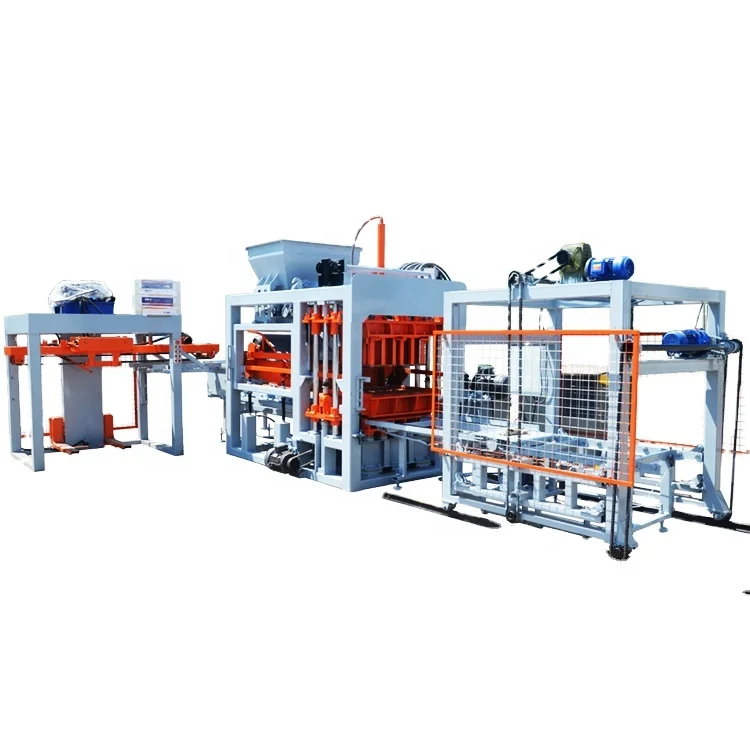 High quality block machine