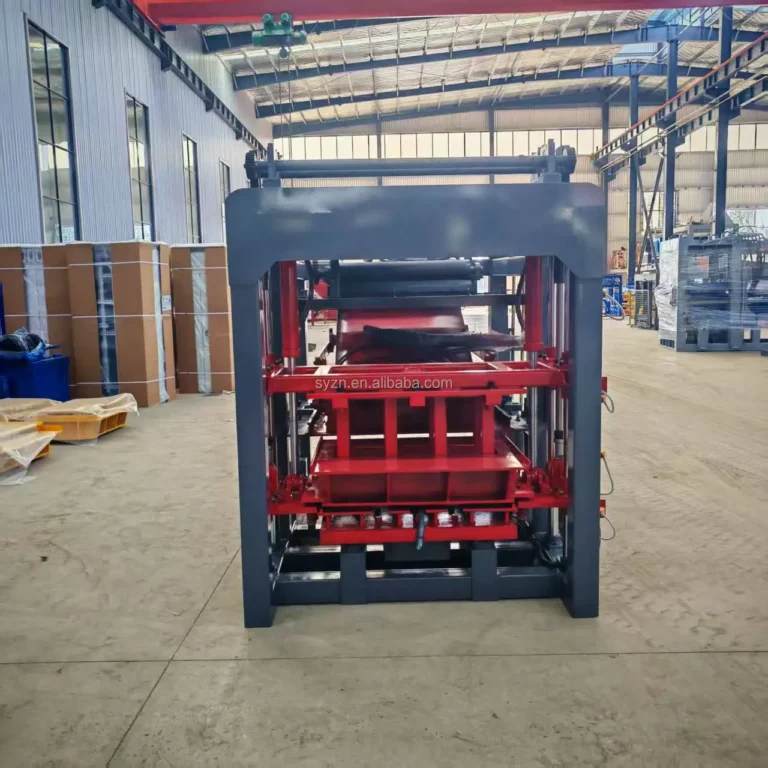
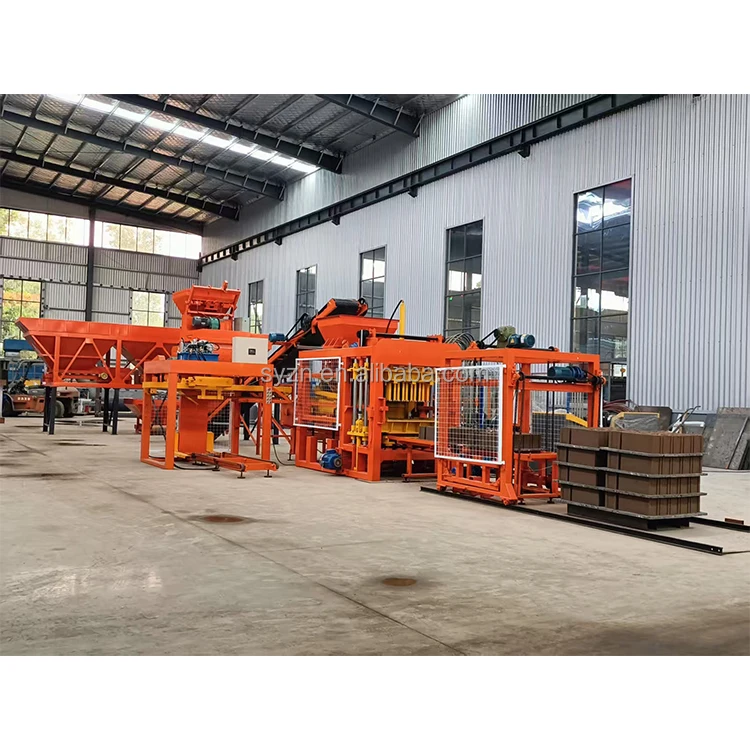
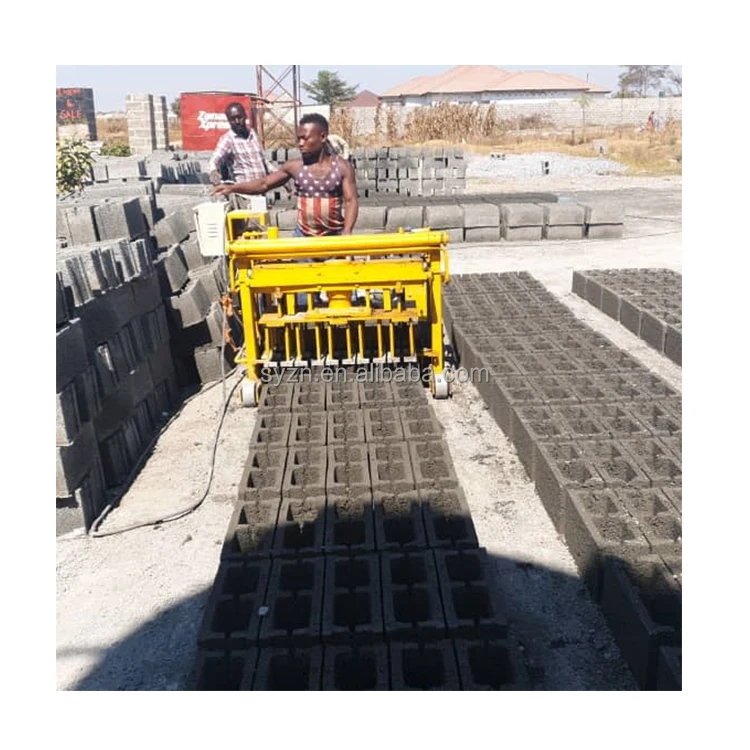
Matched System Design — every QT4-15 block making machine is specified with its mould, pallet and handling stations as one coordinated unit, not a collection of separate purchases.
Technical Specifications
| Parameter |
Value |
| Model |
QT4-15A |
| Product Type |
Hydraulic Concrete Block Making Machine |
| Overall Dimensions (L×W×H) |
7100 × 1600 × 2610 mm |
| Molding Cycle |
15–25 s (basis not stated in source — confirm block format and material) |
| Vibration Frequency |
4600 r/min |
| Vibration Force |
40–50 kN |
| Total Power |
18.45 kW |
| Mixer Model |
JQ350 |
| Pallet Size |
850 × 550 × 25 mm |
| Total Weight |
3 T |
| Control System |
PLC control system |
| Hydraulic Station |
Included |
| Output — Hollow Block |
408 pcs/hr based on 400×200×200 mm, 4 pcs/mould |
| Output — Hollow Block |
510 pcs/hr based on 400×150×200 mm, 5 pcs/mould |
| Output — Solid Brick |
2100 pcs/hr based on 240×115×53 mm, 18 pcs/mould |
| Automation Level |
Semi-automatic with pallet feeder; manual hydraulic trolley included |
| Applied Products |
Paver, solid brick, hollow block, curbstone (via mould change) |
| Raw Materials |
Crushed stones, sand, cement, dust, fly ash |
Application Suitability
| Application |
Material or Output |
| Small-to-medium block plant |
Hollow blocks from crushed stone, sand and cement |
| On-site contractor production |
Solid bricks and pavers using locally sourced aggregate |
| First block plant setup |
Mixed formats — hollow blocks, curbstones, pavers — via mould change |
| Building material distributor |
Format variety from one QT4-15 line without full automatic investment |
What "408 Pieces per Hour" Actually Means on the QT4-15 Block Making Machine Manufacturer Floor
Every capacity figure on this page is tied to a specific block size and mould cavity count — no cycle-per-hour claims without the format assumption.
I have watched buyers sign off on a block machine because the brochure said "high output," only to discover the number assumed a hollow block their market does not buy. The QT4-15 block making machine manufacturer rate of 408 pieces per hour assumes a 400×200×200 mm hollow block at four cavities per mould. Switch to a 400×150×200 mm block at five cavities and the figure changes to 510 per hour. Go to a 240×115×53 mm solid brick with eighteen cavities and you see 2,100 per hour. These are not interchangeable numbers [NEED_CITE: block format assumptions in capacity quotations]. Without the format stated, the cycle time of 15–25 seconds is just a range with no anchor to daily production planning.

Where the QT4-15 Sits Across the Full Machine Range
The QT4-15 block making machine manufacturer occupies the mid-tier of the SHIYUE range. Below it sits the mobile egg-laying class — lower investment, no fixed plant, but limited format options and no pallet system. Above it sits the high-capacity automatic line with full stacking and cubing. The QT4-15 bridges these two worlds by offering a hydraulic press, PLC-controlled cycle and pallet feeder as a semi-automatic starting point that leaves room for automation upgrades later.
Matching the Machine Tier to Your Plant Footprint
A mobile egg-layer needs only a flat concrete floor. A fully automatic line demands a dedicated curing area, forklift circulation lanes and a stacking zone. The QT4-15 requires a middle ground: the 7,100 mm machine length plus mixer and conveyor space, a pallet return path, and a curing rack area sized for the 850×550 mm pallet. Buyers who already operate a forklift and curing yard can often absorb this footprint without major civil work [NEED_CITE: typical plant layout requirements for semi-automatic block lines]. The investment sits between a first-plant mobile setup and a high-volume automatic installation, making it a practical choice for contractors and distributors who know their market but are not yet running continuous shifts.
How Vibration Force and Hydraulic Pressure Shape Block Density
The 40–50 kN vibration force at 4,600 r/min works together with the hydraulic station to compact the mix into the mould. Vibration settles the aggregate into position; hydraulic pressure locks it there. If vibration dominates without enough pressure, blocks leave the mould with surface cracks and low compressive strength. If pressure dominates without adequate vibration, the mix does not fill the mould corners and you get dimensional variation. The QT4-15 pairs both forces so that the 15–25 second molding cycle produces consistent density across formats — but only when the mix design matches the local aggregate. A fly-ash-heavy mix behaves differently from a crushed-stone mix under the same vibration frequency, which is why trial blocks with your actual raw material should come before the machine order is finalized.
The Cost of Skipping the Pallet and Voltage Conversation
When pallet size is chosen without checking the buyer’s existing curing racks and forklift, the result is a yard full of pallets that do not stack properly and a forklift that cannot clear the rack height. The 850×550×25 mm pallet on the QT4-15 must align with the curing infrastructure already on site — or the buyer ends up replacing racks after the machine arrives. Voltage and frequency carry a similar risk. The PLC control system must be configured for the target market’s electrical standard before production starts [NEED_CITE: voltage and frequency standards by export market]. Arriving with the wrong voltage means a transformer purchase or a rewinding job that delays commissioning by weeks and adds cost the original quotation never mentioned.
Why Buyers Source This Machine Here
Block machinery is the single production focus, so the QT4-15 press, its moulds, pallets and the JQ350 mixer are specified as one matched system rather than assembled from unrelated suppliers. Configuration starts from the buyer’s actual mix design and local aggregate, not a catalogue default — which prevents the vibration and pressure mismatch that causes inconsistent block strength. Mould design covers the formats the buyer’s market sells, with custom drawings available for non-standard shapes. The automation level is selectable: a buyer can begin with the included semi-automatic pallet feeder and manual hydraulic trolley, then add automatic stacking and cubing when volume justifies it. Installation support includes on-site commissioning and operator training so the first production run does not become a learning experiment.
Documentation & Verification
- Line layout showing QT4-15 placement with capacity per block format
- Machine specification sheet confirming vibration force and hydraulic pressure
- Mould drawing and cavity list matched to your target block sizes
- Pallet specification aligned with your curing rack and forklift dimensions
- Voltage, frequency and PLC language confirmation before production
- Factory test record with photographs before container loading
Installation, Commissioning & Support
- Foundation must support 3 T machine weight plus dynamic vibration load across the 7,100 mm frame length
- Power supply must meet 18.45 kW total draw with dedicated circuit for the hydraulic station motor
- Machine ships partially assembled; on-site reassembly includes pallet feeder and conveyor alignment
- PLC control system configured to buyer’s language before dispatch, verified during first-week commissioning
- Operator training covers mould change procedure across hollow block, solid brick and paver formats
- Wear parts list and hydraulic seal kit provided with recommended replacement intervals
Before You Send an Inquiry
To match the right QT4-15 configuration to your project, we need to know the block formats your market demands and the daily volume you plan to sustain. Share your local aggregate type and cement source so we can run trial blocks and confirm the vibration and pressure settings. Confirm your site’s voltage, frequency and the PLC display language your operators will read. If you already have curing racks and a forklift, send their dimensions so the pallet and line layout fit your existing yard.
Frequently Asked Questions
Q: How does the QT4-15 fit within the broader SHIYUE block machine range?
A: It occupies the mid-tier between mobile egg-layers and high-capacity automatic lines. Below it, mobile machines need no fixed plant but limit format variety. Above it, automatic lines add stacking and cubing for continuous high-volume output. The QT4-15 offers hydraulic pressing, PLC control and a pallet feeder as a semi-automatic foundation that supports future automation upgrades.
Q: Which block format does the hourly capacity assume?
A: Each output figure is tied to a specific format. The 408 pcs/hr rate assumes a 400×200×200 mm hollow block at four cavities. Switching to a smaller solid brick at eighteen cavities raises the figure to 2,100 pcs/hr. Always confirm which format your capacity calculation references before comparing quotations.
Q: Can I start semi-automatic and add full automation later?
A: Yes. The QT4-15 ships with a pallet feeder and manual hydraulic trolley as a semi-automatic configuration. Automatic stacking and cubing modules can be integrated later when production volume justifies the investment, without replacing the press or PLC system.
Q: What plant footprint does a QT4-15 line require compared to a mobile machine?
A: Beyond the 7,100 mm machine length, you need space for the JQ350 mixer, conveyor, pallet return path and a curing rack area sized for 850×550 mm pallets. This is more than a mobile egg-layer requires but considerably less than a full automatic line with cubing station.
Q: Which mould formats are available, and can I order a custom design?
A: Standard moulds cover hollow block, solid brick, paver and curbstone formats. Custom moulds are designed to buyer drawings, with cavity count and dimensions matched to your market requirements. Mould drawings and format lists are provided for approval before production begins.

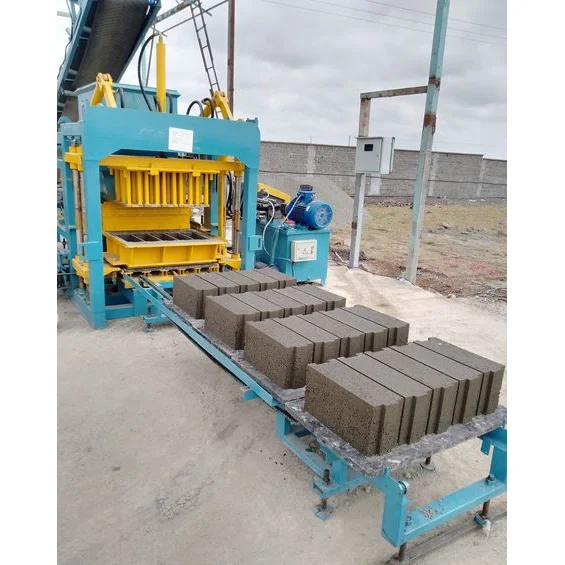
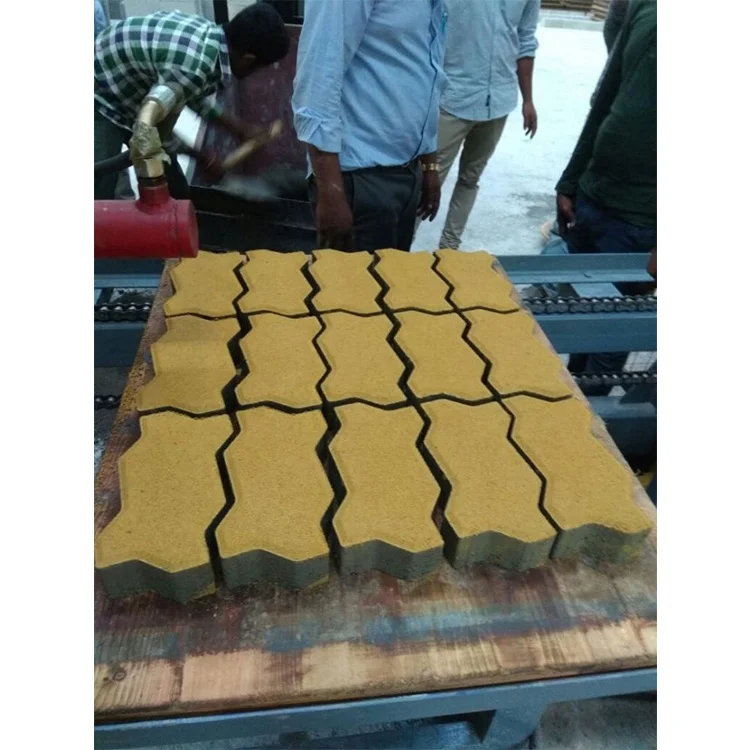 High quality block machine