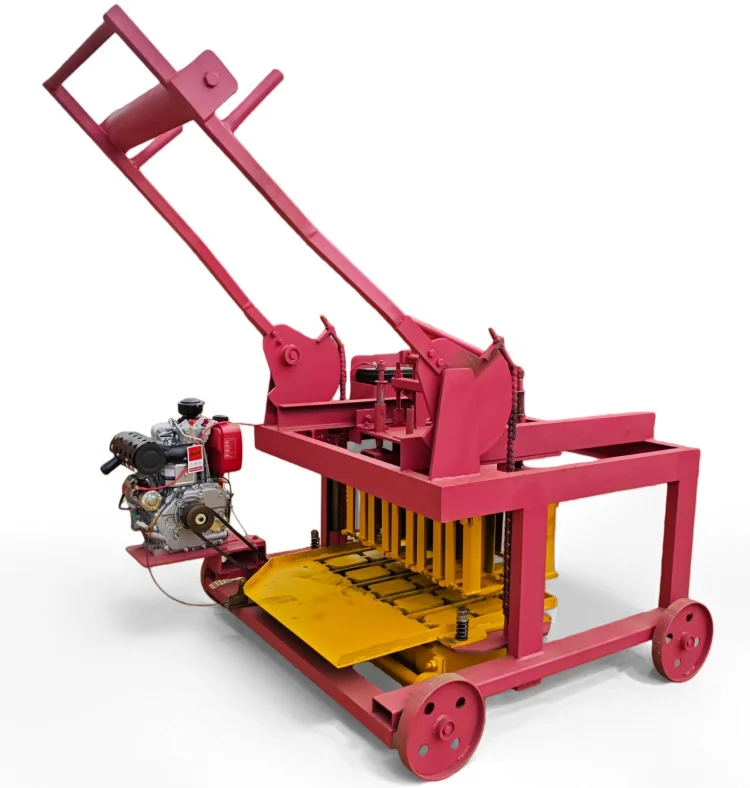
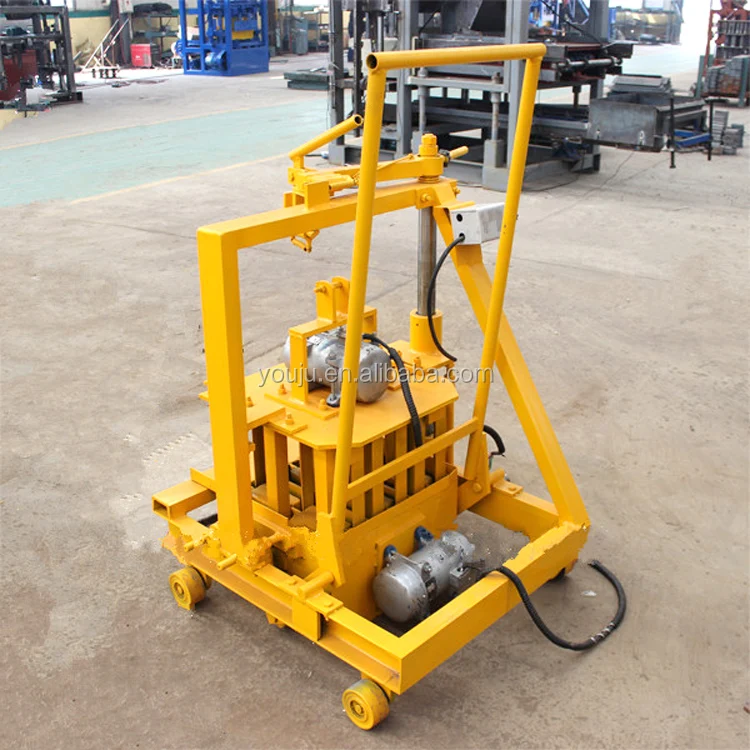
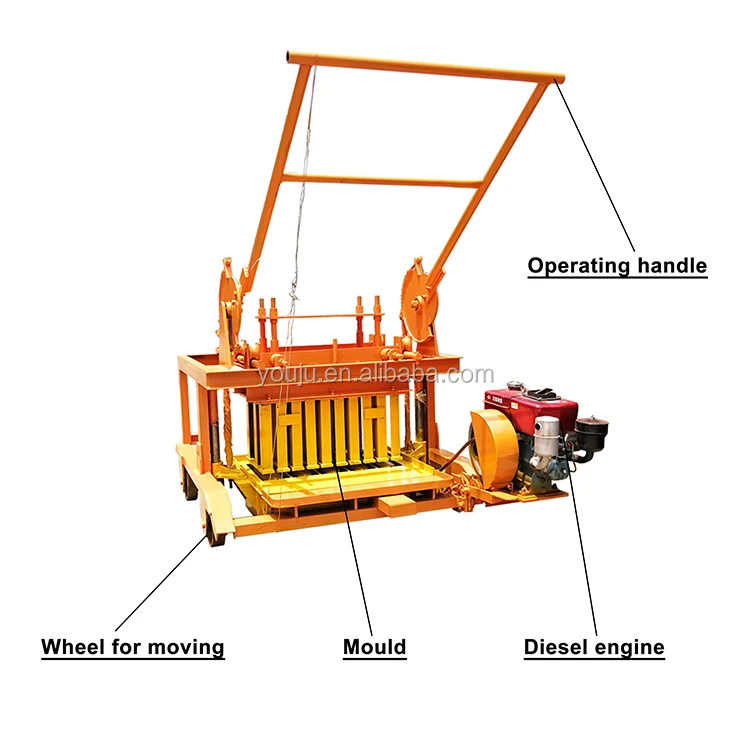
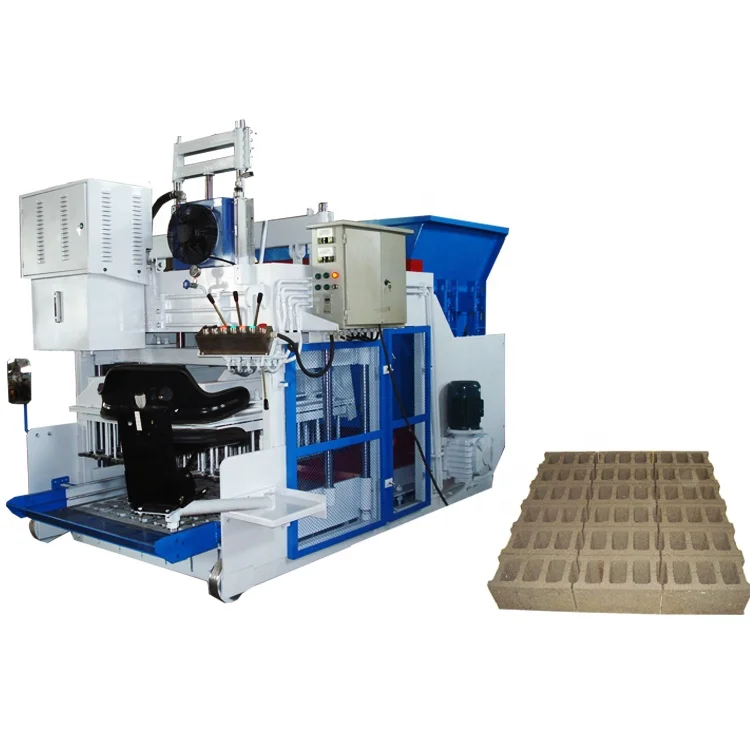
Matched System Design — the QMR4-45 is specified as a complete mobile unit with mixer, power source and trolley, not a bare press assembled from separate suppliers.
Technical Specifications
| Parameter |
Value |
| Model |
QMR4-45 |
| Product Type |
Mobile Egg-laying Block Making Machine |
| Overall Dimensions (L×W×H) |
1100 × 950 × 2100 mm |
| Net Weight |
810 kg |
| Molding Cycle |
30–45 s |
| Power Source |
Diesel / Petrol Engine / Electric (configurable) |
| Output Capacity |
2560 pcs/day (basis not stated in source — block format and thickness to be confirmed) |
| Pallet Requirement |
None (egg-laying / mobile type) |
| Mobility |
Wheel-mounted, movable on-site |
| Block Formats |
Paver brick, hollow block, concrete block, solid brick, fly ash brick |
| Basic Equipment Included |
JZC350 or JQ350 Diesel Concrete Mixer with Electric Generating Unit; Trolley |
| Warranty |
1 Year |
| Control System |
Manual / semi-automatic (to confirm) |
| Voltage & Frequency |
To confirm against target market supply |
| Hydraulic Pressure |
To confirm with manufacturer |
| Vibration Force |
To confirm with manufacturer |
| Mould Change Time |
To confirm with manufacturer |
| Stacking Method |
Manual (egg-laying on ground) |
Application Suitability
| Application |
Material or Output |
| On-site hollow block production for housing projects |
Crushed stone, sand, cement, water |
| Solid brick and paver production for small contractors |
River sand, fly ash, cement blends |
| Remote or off-grid block making |
Diesel or petrol engine option for sites without reliable grid supply |
| Entry-level block plant for first-time entrepreneurs |
Locally available aggregates with cement binder |
| Fly ash brick production near thermal power plants |
Fly ash, lime, gypsum, sand mixes |
What "2,560 Pieces per Day" Actually Means for a Mobile Block Machine
Capacity figures on mobile machines are only meaningful when tied to a specific block format, mix design, and shift length.
Many buyers receive a single daily output number and assume it applies across every block format they plan to produce. In practice, a hollow block takes a longer cycle and more material than a solid paver, so the real daily count shifts considerably between formats. I have seen contractors arrive on site expecting one throughput level and then spend weeks trying to reconcile what the machine actually delivers against their project schedule. Before any mobile block machine manufacturer quotes you a capacity number, insist on seeing it broken down per format and per shift [NEED_CITE: block format impact on cycle time and daily output calculations].

Where the QMR4-45 Sits in the Mobile Range
The QMR4-45 occupies the entry tier of Shiyue’s mobile and egg-laying lineup. It is designed for buyers who need block production capability without investing in a fixed plant, pallet inventory, or curing racks. The egg-laying principle means the machine forms each block and leaves it on the ground to cure, removing the entire pallet handling loop that stationary machines require. For a small contractor or a first-time block producer, this eliminates a significant portion of the upfront capital that a conventional block line demands.
Power Source Flexibility for Unpredictable Sites
One of the defining choices on this mobile block machine is the triple power-source configuration. Buyers can specify a diesel engine, a petrol engine, or a standard electric motor depending on what the job site actually offers. In regions where grid electricity is intermittent or entirely absent, the diesel option keeps production running without a separate generator investment. The included JZC350 or JQ350 mixer with its own electric generating unit means the entire mixing and pressing operation can function independently of site infrastructure [NEED_CITE: diesel versus electric power source considerations for remote block production].
Reading the Specs That Matter on a Mobile Press
The 30–45 second molding cycle governs how fast the QMR4-45 moves through each block. On an egg-laying machine, this cycle includes the vibration and compression phase plus the time the operator needs to reposition the unit for the next block. The actual vibration force and compression method — whether mechanical or hydraulic — directly determine the density and strength of the finished block. Without confirmed vibration and pressure ratings, a buyer cannot verify that the machine will produce blocks meeting local building codes for load-bearing applications.
The 810 kg net weight and 1100 × 950 mm footprint make the machine movable by one or two operators using the included trolley. This matters on sites where production needs to follow the building area rather than stay fixed in one yard. However, ground preparation still matters: the surface must be level and firm enough to support wet blocks without settling or tilting during the curing period.
The Hidden Cost of Skipping Ground Preparation
Buyers who focus entirely on the machine itself sometimes overlook what egg-laying operation demands from the ground surface. If the soil is soft, uneven, or poorly compacted, blocks will settle before they gain initial strength, leading to dimensional inconsistency and cracking. I once visited a site where the contractor had placed a mobile machine directly on freshly backfilled soil and wondered why half the day’s output was rejected by the site engineer. Proper ground preparation — a compacted sand bed or a thin concrete screed — is not optional for this type of machine [NEED_CITE: ground preparation standards for egg-laying block machines].
Why Source the QMR4-45 Through This Range
Shiyue treats block machinery as a single focus, meaning the QMR4-45 arrives with its mixer, trolley, and power source matched to the press rather than assembled from unrelated suppliers. The configuration is set against the buyer’s actual mix design and local aggregate, not pulled from a catalogue default. Mould design covers the formats the buyer’s market actually sells, and custom mould drawings are available when standard formats do not match local demand. The automation level is selectable, so a buyer starting with the QMR4-45 can transition to a semi-automatic or automatic tier later without replacing the entire operation. Installation support and operator training are included so that the first production run happens under guidance, not guesswork.
Documentation & Verification
- Line layout with capacity calculation stating the block format assumed for the QMR4-45 output figure
- Machine specification sheet confirming power source, molding cycle, and included mixer model
- Mould drawing and format list showing exact block dimensions shipped with the machine
- Voltage and control language confirmation recorded before dispatch
- Operation and maintenance manual with wear parts list specific to the QMR4-45
Installation, Commissioning & Support
- Confirm power source selection (diesel, petrol, or electric) and matching voltage before production begins
- Prepare a level, compacted ground surface across the planned egg-laying production area
- Verify included mixer model (JZC350 or JQ350) matches your aggregate size and batch volume
- Receive operator training on molding cycle timing and machine repositioning technique
- Establish a wear parts and mould replacement schedule based on your local abrasive aggregate
What to Include in Your Inquiry
To receive a configuration that matches your actual site conditions, provide the block formats you plan to produce along with their target dimensions, your local aggregate type and source, and whether your site has reliable grid electricity or requires a diesel or petrol power source. Specify the daily output you need per format so the capacity calculation can be prepared against realistic assumptions rather than a single generic number.
Frequently Asked Questions
Q: What block format does the 2,560 pieces per day output figure assume?
A: The published daily output for the QMR4-45 is based on conditions that have not been stated in the source documentation. A realistic capacity calculation must specify the exact block format, dimensions, wall thickness, and shift length. Request a per-format breakdown before comparing this mobile block machine against alternatives for your project.
Q: How do I choose between diesel and electric power for the QMR4-45?
A: If your site has stable grid electricity with the correct voltage and frequency, the electric option keeps running costs predictable. For remote sites, new developments without connected power, or locations where outages are frequent, the diesel or petrol engine option keeps production independent of the grid. Fuel cost and availability in your area should drive the decision.
Q: Which block formats can one QMR4-45 produce, and how is the mould changed?
A: The machine covers hollow blocks, solid bricks, pavers, and fly ash bricks from a single frame. Each format requires its own mould, and the changeover process depends on the mould mounting system fitted. Request the mould format list and changeover procedure so you can plan production runs and minimize downtime between formats.
Q: What ground preparation is needed for egg-laying operation?
A: Egg-laying machines place blocks directly on the ground, so the surface must be level, firm, and well-compacted. A sand bed or thin concrete screed provides a consistent base. Soft or uneven ground causes blocks to settle and crack before gaining initial strength, so preparation directly affects your usable output and rejection rate.
Q: When should a buyer step up from the QMR4-45 to a semi-automatic machine?
A: The QMR4-45 suits buyers starting block production with minimal capital and no pallet inventory. When daily output requirements grow beyond what a single mobile unit can deliver, or when block quality demands from the market tighten, a semi-automatic stationary machine with pallets and controlled vibration offers higher consistency and throughput at the next investment tier.

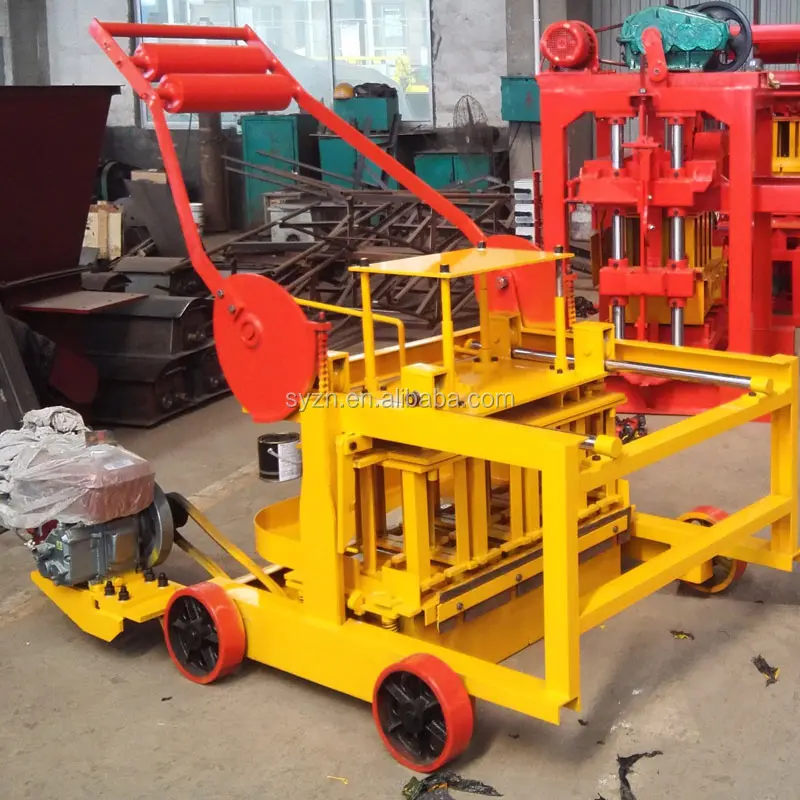
 Mobile block machine