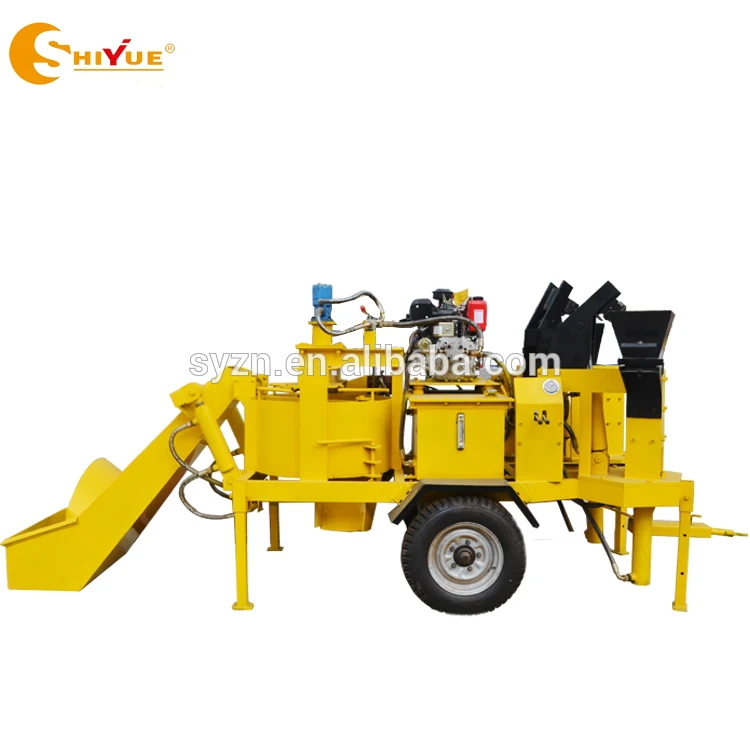
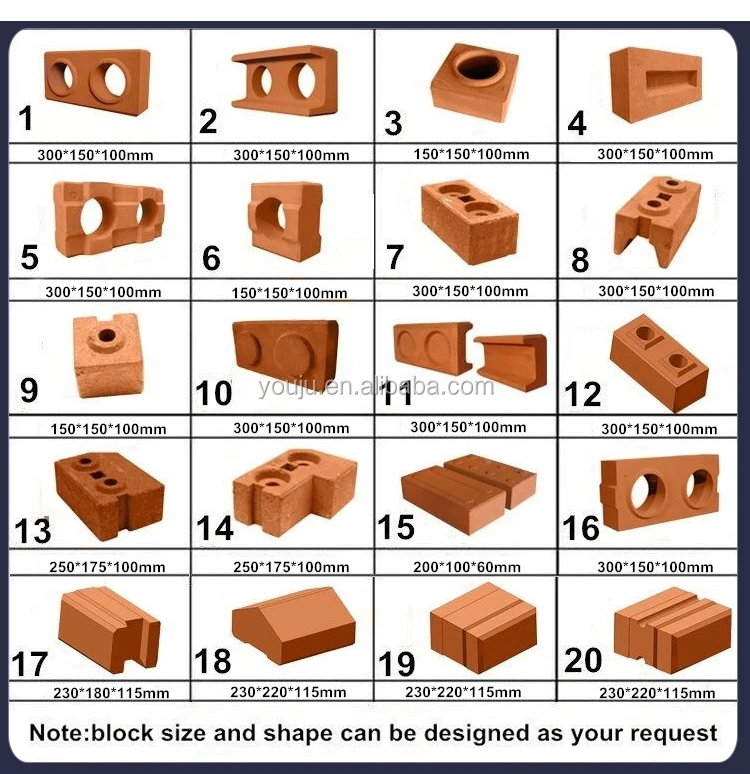
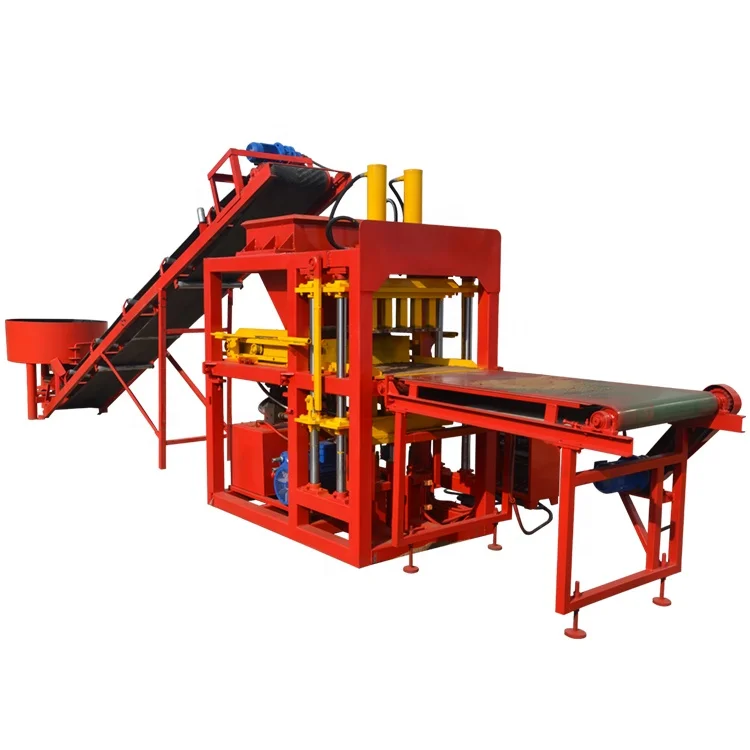
Matched System Configuration — machine, mould, pallet and handling specified together for your local clay and target interlocking format, not assembled from separate catalogue defaults.
Technical Specifications
| Parameter |
Value |
| Model |
ECO2700 |
| Product Type |
Hydraulic Press Clay Interlocking Block Making Machine |
| Overall Dimensions (L×W×H) |
1000×1000×1800 mm |
| Shaping Cycle |
15-20 seconds (basis not stated in source — confirm block format / material / thickness) |
| Rated Power |
5.5 kW |
| Hydraulic Pressure |
16 MPa |
| Net Weight |
1000 kg |
| Voltage & Frequency |
380V, 3-phase, 50Hz (customizable to local voltage) |
| Mould Format |
Interlocking brick (specific dimensions not stated in source) |
| Automation Level |
Manual operation |
| Warranty |
1 year |
Application Suitability
| Application |
Material or Output |
| Small-scale interlocking clay brick production |
Local clay soil mixed with stabilizer or cement |
| On-site brick making for construction projects |
Excavated site soil with binder addition |
| Low-investment brick manufacturing workshops |
Naturally available clay with manual batching |
| Rural and remote area brick production |
Variable clay compositions where grid power is limited |
Why "Cycle Time" Tells You Almost Nothing About Real Output
A 15-second cycle means nothing if your clay sticks to the mould and every fifth stroke jams.
When I first started sending machines overseas, I quoted cycle times straight off the test bench. The press would run smoothly on our standard sand-clay mix in Shandong, and the numbers looked convincing on paper. Then the machine arrived at a site where the local clay had much higher plasticity, the bricks would not release cleanly, and operators spent more time scraping moulds than pressing bricks. Daily output dropped to a fraction of what the buyer expected. That gap between quoted capacity and actual throughput is where projects stall and contractors lose money [NEED_CITE: clay plasticity and mould release challenges in interlocking brick production].

Where the ECO2700 Fits in the Full Machine Range
The ECO2700 sits at the entry point of our clay interlocking brick lineup. It is a single-unit hydraulic press built for workshops that need to produce interlocking bricks without committing to a full automatic line. For a hydraulic clay interlocking brick machine manufacturer, placing each model clearly on the range matters — this unit serves buyers who are proving their market before scaling up. The compact footprint and 5.5 kW power draw mean you can run it in a modest space without heavy electrical infrastructure.
Understanding the Step Up to Semi-Automatic
Once daily demand grows beyond what manual pallet handling can sustain, the next tier adds powered pallet feeding and basic stacking assistance. The press itself does not change, but the material flow around it does — reducing the operator count and keeping cycle intervals consistent. This is the logic behind how we position each tier: you buy the capacity you need today with a clear path forward. Every hydraulic clay interlocking brick machine manufacturer should explain where one tier ends and the next begins, so buyers are not guessing at upgrade costs later [NEED_CITE: block machine automation tier definitions and upgrade paths].
Reading the Specs That Actually Matter
The 16 MPa hydraulic pressure rating determines how densely the clay is compressed into the interlocking profile. Higher pressure produces a denser brick with greater load-bearing capacity, but only if the clay mix has the right moisture content and binder ratio to hold together under that force. The 15-20 second shaping cycle is measured on a reference mix — your actual clay may require longer dwell time or adjusted pressure to achieve clean demoulding. The 1000×1000×1800 mm overall dimensions and 1000 kg net weight mean this is a floor-standing unit that can be repositioned with a pallet jack, suitable for job sites where the production area shifts as construction progresses. The 380V 3-phase supply is standard, but voltage must be confirmed before production to match your local grid.
The Cost of Skipping the Soil Sample
I once configured a press for a buyer who described his clay as "normal red soil." The machine arrived, the bricks came out soft, edges crumbled on the interlocking shoulders, and the site engineer called us frustrated. We had set the hydraulic pressure and cycle time for a medium-plasticity mix that did not match what was actually in the ground. A simple soil sample sent before production would have flagged the issue, let us adjust the pressure range and recommend a binder percentage, and the machine would have produced usable bricks from day one [NEED_CITE: impact of clay composition on block density and demoulding].
Why Buyers Choose This Range
We treat the press, mould, pallet and handling as one matched system rather than quoting a bare machine and leaving the rest to chance. Configuration is set against your actual clay composition and target interlocking format, not a generic catalogue default. Mould design covers the specific interlocking profile your local construction market uses, including custom drawings when standard profiles do not match. Automation level is selectable, so you can start with the ECO2700 as a manual press and move to a higher tier without replacing the entire line. Installation support includes on-site commissioning and operator training so your team knows how to adjust pressure and cycle settings for different clay batches.
Documentation & Verification
- Line layout and capacity calculation stating the interlocking brick format assumed
- Machine specification sheet with hydraulic pressure matched to your clay mix
- Mould drawing and format list confirming the interlocking profile you need
- Voltage and control language confirmation before production begins
- Factory test record on your specified clay composition before dispatch
- Operation and maintenance manual with wear parts and mould list
Installation, Commissioning & Support
- Floor-mounted unit requiring a level concrete pad to support the 1000 kg net weight
- Dedicated 380V 3-phase circuit for the 5.5 kW motor with appropriate breaker rating
- Single-unit assembly — no line integration required for standalone operation
- On-site pressure and cycle adjustment based on your local clay sample results
- Operator training covering mould cleaning, hydraulic pressure setting and daily checks
- Wear parts list and mould maintenance schedule provided at handover
What We Need to Configure Your Machine
To give you an accurate proposal, we need to know the specific interlocking brick profile your market demands and the clay soil characteristics at your site. Share your target daily volume, available workshop or site dimensions, and local voltage and frequency. If you can send a soil sample or a geotechnical description of your clay, we can set the hydraulic pressure and recommend a mix ratio before the machine enters production.
Frequently Asked Questions
Q: What daily output can the ECO2700 realistically achieve for standard interlocking brick formats?
A: The shaping cycle is listed at 15-20 seconds, but actual daily output depends on your specific interlocking brick dimensions, clay mix behaviour, and whether pallet handling is manual. We provide a capacity calculation document that states the assumed format so you know exactly what to expect before ordering.
Q: Where does the ECO2700 sit in the full machine range, and when should I step up?
A: It is our entry-level hydraulic press for interlocking clay brick production, aimed at small workshops and on-site use. When daily demand outgrows what manual pallet handling can sustain, the next tier adds powered feeding and stacking to maintain consistent output without increasing operator count.
Q: How do I confirm the hydraulic pressure suits my local clay?
A: Send us a soil sample or a description of your clay composition and target block strength. We adjust the 16 MPa system pressure and cycle parameters to match, then run a factory test on your mix before dispatch to verify density and clean demoulding.
Q: What supporting equipment does this compact press require?
A: The ECO2700 operates as a standalone unit within its 1000×1000 mm footprint. You will need a mixer for preparing the clay-binder blend, a curing area with adequate space for the interlocking bricks to gain strength, and a 380V 3-phase power supply confirmed to your local grid standards.

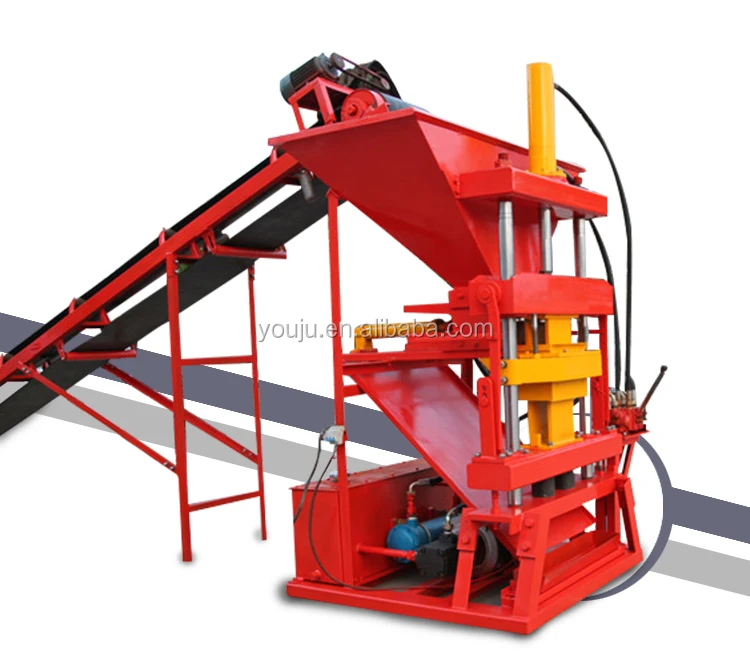
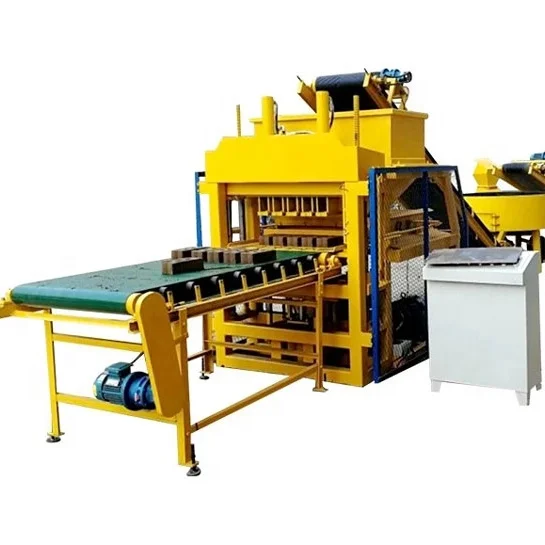 Clay interlocking brick