

Buy QT12-15 Block Machine Best Price 2026 | Wholesale Supplier
The cheapest QT12-15 block machine price on the quotation sheet is rarely the one that actually runs when it lands at your site.
In 2026, the real QT12-15 block machine price is determined not by the host unit alone, but by how well the hydraulic station, frequency conversion cabinet, mould package, and batching system match your local voltage grid, raw material moisture, and daily output target. A mismatch in any of these can turn a bargain into a mid-six-figure loss through extended downtime and emergency retrofitting.
I still remember a shipment we sent to a private block plant investor near Lagos. He had previously bought a QT12-15 line from a smaller workshop purely on the host machine price. When the container arrived, the hydraulic power pack was wired for a voltage band that did not exist in his industrial zone. The entire line sat idle for months. By the time he reached out to us for a reconfigured frequency conversion cabinet and on-site commissioning, the retrofit cost had eaten up the savings he thought he had locked in. That kind of story repeats itself across West Africa, the Middle East, and Latin America every year [NEED_CITE: common voltage mismatch failure patterns in emerging market block plants].
If you are comparing a QT12-15 block machine price across suppliers right now, the rest of this guide will walk you through where the real cost sits, which configuration choices move the needle, and what to check before you sign.
What Is the Real Price Range of QT12-15 Block Machine in 2026?
The gap between a bare-host quotation and a turnkey QT12-15 block machine price that actually produces blocks on your site can be substantial, often shifting the final landed cost by a noticeable margin.
Most first-time buyers focus on the host machine number because it is the easiest figure to compare. But the host is only the core of the line. A working QT12-15 setup also includes a batching and mixing system, belt or bucket conveyors, a pallet circulation system, a stacker or cross-conveyor, the hydraulic power unit, and the PLC control cabinet. When you add these, the final QT12-15 block machine price moves into a different bracket entirely.
| Configuration Level | Host Unit | Batching & Mixing | Conveyors & Pallet System | Hydraulic & PLC Cabinet | Mould Package |
|---|---|---|---|---|---|
| Basic Entry | Included | None | Manual pallet handling | Standard local voltage | One mould set |
| Standard Turnkey | Included | Semi-auto batcher | Belt conveyor + basic pallet loader | Fixed frequency, single voltage | Two to three mould sets |
| Full Automatic Line | Included | Fully auto batcher with silo | Automated pallet circulation + stacker | Frequency conversion, multi-voltage ready | Full mould package with spare cavities |
A government contractor bidding on a public housing project will typically need the full automatic line tier, while a private investor starting out may begin with the standard turnkey tier and upgrade later [NEED_CITE: typical configuration tiers for QT-class block lines in emerging markets]. The QT12-15 block machine price you see in an email subject line is almost never the number you should be planning your budget around.
A distributor in Latin America once asked us to quote a batch of QT12-15 lines for OEM branding. The first offer he received from another workshop looked attractive until he realized the control cabinets were not certified for his destination country’s import rules. Rebuilding those cabinets to meet local certification requirements pushed the per-unit cost well past the initial gap. When we reconfigured the cabinets with the correct certification and matched the voltage range, the per-unit price was higher on paper, but the lines cleared customs and started production without delay.
Which Configuration Factors Most Affect the Final Quotation?
The hydraulic station, frequency conversion cabinet, mould quantity, and batching system are the main drivers that shift a QT12-15 block machine price up or down, far more than the host frame itself.
The host machine is a welded steel structure with a vibrating table and a mould box. Once the design is finalized, its cost is relatively fixed. The real variability sits in the subsystems around it.
The hydraulic power unit is one of the biggest cost movers. A basic hydraulic station with standard valves will keep the QT12-15 block machine price lower, but it may struggle with the cycle time consistency needed for high-volume production. A proportional valve system with pressure feedback delivers smoother mould filling and more uniform block density, which directly affects your reject rate on site [NEED_CITE: hydraulic system impact on block density consistency in automatic block lines].
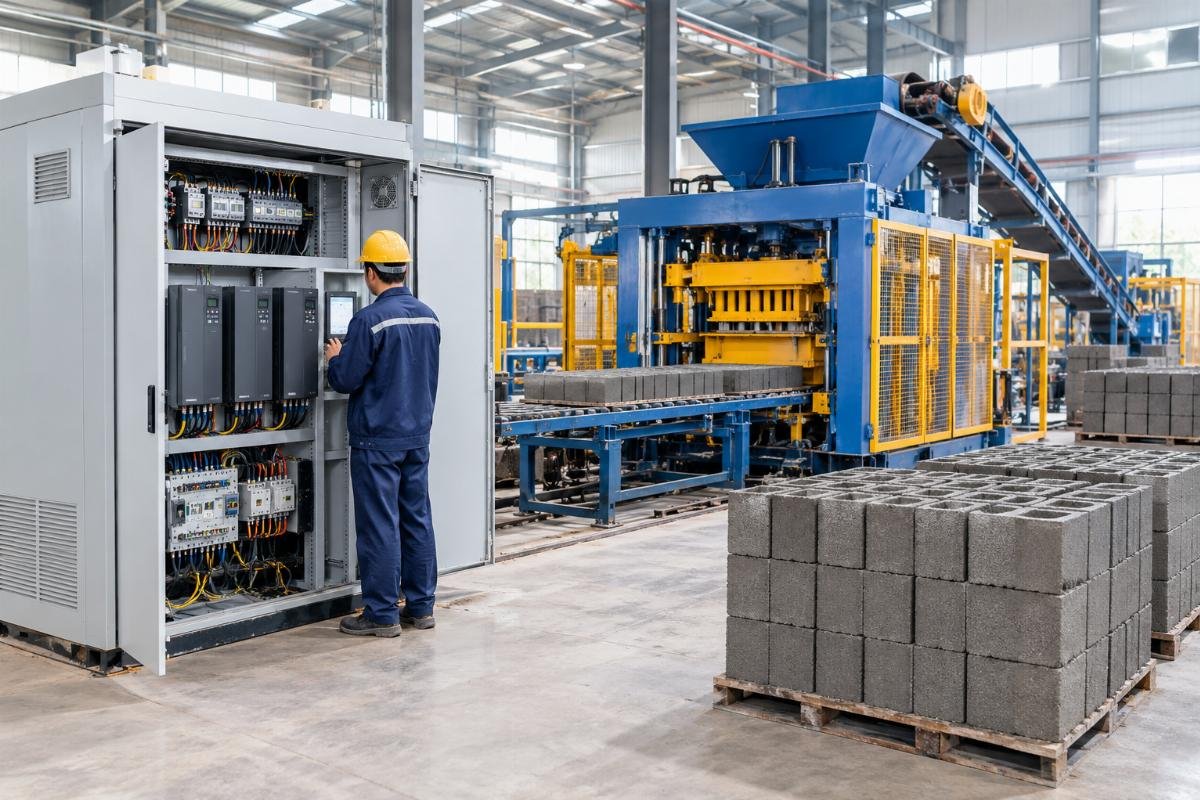
The frequency conversion cabinet is another major variable. A fixed-frequency cabinet is cheaper to build, but it locks the vibration motor to a single speed. A full frequency conversion cabinet allows the vibration frequency and amplitude to be adjusted per mould type, which is essential when you are switching between hollow blocks, solid blocks, and interlocking pavers on the same line. This flexibility is what separates a line that runs all day from one that needs constant manual tweaking.
The mould package is often underestimated. A single mould set keeps the initial QT12-15 block machine price down, but if your market demands multiple block sizes, you will be ordering additional moulds later at a higher per-set cost because of separate shipping and customs clearance. Bundling the full mould package at the start usually lowers the overall cost.
The batching and mixing system rounds it out. A manual batching setup is the cheapest option, but it introduces moisture and ratio inconsistency that shows up as block strength variation. A fully automatic batching plant with cement silo and moisture sensor keeps the mix ratio tight and reduces cement waste, which pays for itself over time [NEED_CITE: batching accuracy impact on cement consumption in concrete block production].
How to Avoid Voltage and Power Grid Mismatches That Kill Your Line?
Before you confirm any QT12-15 block machine price, make sure the supplier has verified your site voltage range and customized the control cabinet accordingly. This single step prevents the most expensive type of failure in emerging market block plants.
Voltage instability is not a rare edge case. In many parts of West Africa, the Middle East, and Southeast Asia, industrial zone voltage can swing noticeably within a single shift. A control cabinet designed for a stable grid will trip repeatedly under these conditions, and the PLC board can be damaged beyond repair.
The correct approach is to provide the supplier with the actual voltage range measured at your site, not just the nominal national standard. If your nominal voltage is 380V but the real range drops to 340V during peak hours, the cabinet must be built to tolerate that lower bound without tripping. This means specifying a wider input tolerance on the frequency converters, adding voltage stabilizers where needed, and using contactors rated for the actual operating conditions [NEED_CITE: voltage tolerance requirements for industrial control cabinets in unstable grid environments].
A buyer in the Middle East upgraded his old semi-automatic line to a full QT12-15 setup. The supplier he originally chose wired the cabinet for a tight voltage band. Within weeks, the main contactor burned out during a voltage dip. The replacement part had to be air-freighted, and the line was down for an extended period. When he switched to a reconfigured cabinet built with wider tolerance components and on-site voltage monitoring, the line ran continuously through the same grid conditions.
| Grid Condition | Cabinet Approach | Outcome |
|---|---|---|
| Stable industrial grid, tight tolerance | Standard fixed-frequency cabinet | Reliable operation |
| Unstable grid, wide voltage swing | Standard fixed-frequency cabinet | Frequent tripping, component damage |
| Unstable grid, wide voltage swing | Frequency conversion cabinet with wide input tolerance and stabilizer | Continuous operation with adjustable vibration |
When you are comparing a QT12-15 block machine price, ask the supplier to show you the cabinet schematic and confirm the voltage range it covers. If they cannot answer this clearly, walk away.
QT12-15 vs Other Models: Which One Gives You the Best ROI?
The QT12-15 block machine price only makes sense when measured against your daily output target. For smaller operations, a lower-tier model may deliver a faster payback, while for large-scale contractors, the QT12-15 is the right capacity bracket.
The QT12-15 is designed for medium to large production volumes. Its mould box accommodates a high cavity count, and its cycle time is optimized for continuous operation with an automatic pallet return system. If your market demand is in the range of tens of thousands of blocks per day, this is the model that matches.
For a private investor setting up a first block plant with limited capital and a smaller local market, a QT6-15 or QT4-15 may be a better entry point. The initial QT12-15 block machine price is higher, and if the line runs at partial capacity because local demand cannot absorb the output, the return on investment stretches out unnecessarily.
| Model | Typical Daily Output Range | Best Suited For |
|---|---|---|
| QT4-15 | Lower volume | Small private investors, rural markets |
| QT6-15 | Medium volume | Growing private plants, regional distributors |
| QT10-15 | Medium to high volume | Established plants expanding capacity |
| QT12-15 | High volume | Government contractors, large-scale distributors |
| QT15-15 | Maximum volume | Mega projects, national-scale production |
An established manufacturer in Southeast Asia was running two older QT6-15 lines and could not keep up with growing orders for interlocking pavers. They considered adding a third QT6-15, but after reviewing the floor space, labor cost, and pallet consumption of running three lines versus one QT12-15, they chose the QT12-15 instead. The QT12-15 block machine price was higher than a single QT6-15, but the total operating cost per block dropped noticeably because of lower labor and pallet wear per unit of output [NEED_CITE: operating cost comparison between single large block line and multiple smaller lines].
What Should You Check Before Signing the Purchase Contract?
The QT12-15 block machine price you agree on is only as good as the contract terms that surround it. Certification documents, spare parts lists, installation scope, and after-sales response must all be written in, not promised verbally.
Start with certification. If your country requires CE, SGS, or other import certification for machinery, confirm that the supplier can provide the correct certificate for the exact configuration you are buying, not a generic certificate from a different model. Customs authorities in many African and Latin American countries have tightened inspections, and a mismatched certificate can hold the entire container at port [NEED_CITE: machinery import certification requirements across African and Latin American markets].
Next, the spare parts list. A QT12-15 line has wearing parts: vibration motor bearings, hydraulic seals, mould box liners, conveyor belt sections. The initial order should include a commissioning spare parts package sized for at least the first production cycle. Without it, a single failed seal can stop the line while you wait for a replacement to clear customs.
The installation and commissioning scope must also be explicit. Confirm whether the supplier sends engineers to your site, how long they will stay, and whether operator training is included. A line that is mechanically sound but operated incorrectly will still produce reject blocks and waste material.
Finally, the after-sales response clause. Ask what the remote support channel is, how quickly spare parts can be dispatched, and whether the PLC program can be updated remotely if needed. These terms are what keep your line running long after the container has been unloaded.
Conclusion
The real QT12-15 block machine price is the total cost of a line that matches your voltage, your raw material, and your daily output, not the lowest number on a quotation sheet. Configuration choices in the hydraulic station, control cabinet, mould package, and batching system are what move the final cost, and getting these right from the start avoids the expensive retrofits and downtime that turn a cheap purchase into a costly lesson. Check your contract for certification, spare parts, installation scope, and after-sales terms before you sign, and the line you receive will be the line that actually runs.

Industry expert sharing insights about concrete machinery, block making technology and turnkey production solutions.
View all posts →
Leave a Reply