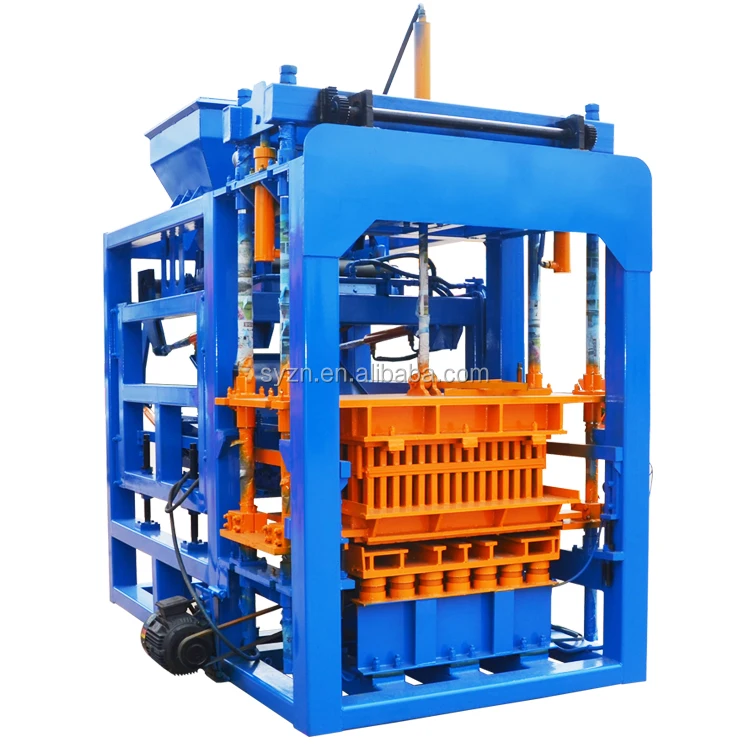
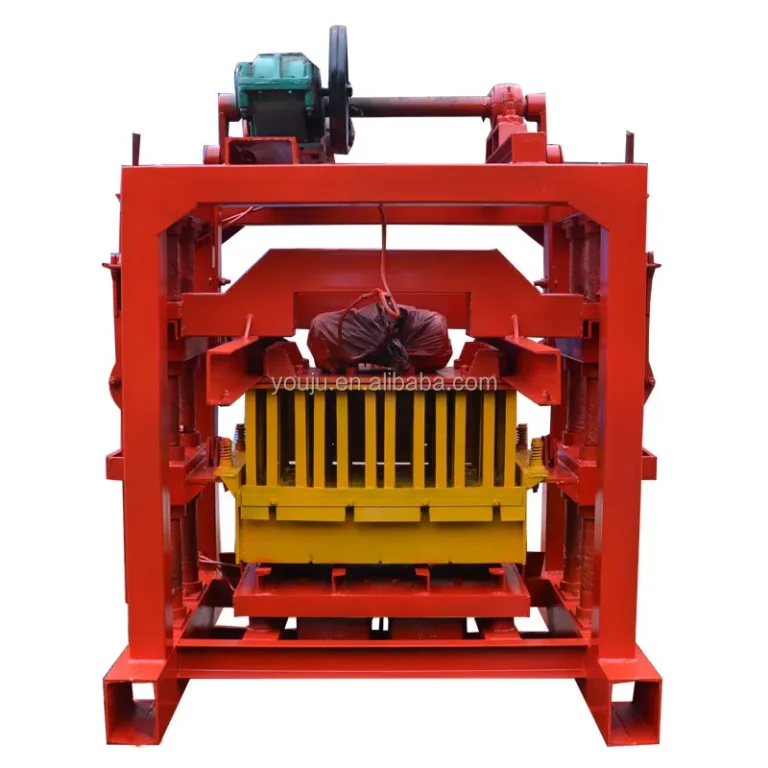
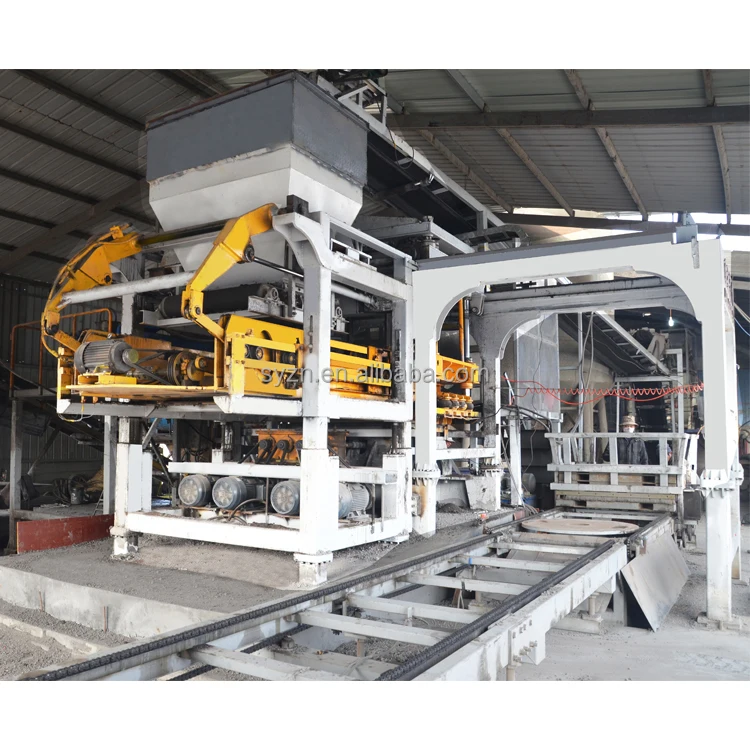
Single-Focus Block Machine Engineering — we configure the QTJ4-25 against your actual block format and local aggregate instead of quoting a catalogue default.
Technical Specifications
| Parameter |
Value |
| Model |
QTJ4-25 |
| Product Type |
Stationary Concrete Block Making Machine |
| Machine Category |
Semi-automatic, motor-driven with hydraulic station |
| Molding Cycle |
25 seconds |
| Output Capacity |
960 pcs/h, 7,680 pcs/day (based on 400×200×200 mm hollow block, 4 pcs/mould) |
| Exciting Force |
60 KN |
| Vibration Frequency |
2,800 r/min |
| Vibration Method |
Bed mould vertical vibration + upper mould compression vibration |
| Rated Power |
17.9 kW |
| Overall Dimensions (L×W×H) |
6,400 × 1,500 × 2,700 mm |
| Pallet Size |
850 × 550 × 20 mm |
| Total Mass |
2,500 kg |
| Mould Formats |
Hollow, solid, paver, curbstone (changeable mould) |
| Standard Configuration |
Host machine 1 set, block mould 1 set, JQ350 mixer |
| Automation Level |
Semi-automatic (manual pallet handling and stacking) |
| Voltage & Frequency |
To be confirmed per buyer’s site requirement |
| PLC / Control System |
To be confirmed (control type and display language) |
Application Suitability
| Application |
Material or Output |
| Hollow block production for residential and commercial walls |
Crushed stone, sand, cement, water — 400×200×200 mm, 4 pcs per cycle |
| Solid block manufacturing for load-bearing structures |
Dense aggregate mix, standard and custom dimensions |
| Paving block runs for driveways and walkways |
Fine aggregate and pigment blends, interlocking and rectangular formats |
| Kerbstone and curb production for road infrastructure |
High-strength concrete mix, changeable mould profiles |
| Contractor on-site block production at project pace |
Locally sourced aggregate, semi-automatic operation with manual stacking |
| First-plant entrepreneurs entering the block market |
Lower initial investment tier, scalable within the Shiyue range |
What "960 Blocks per Hour" Actually Means for Your Plant
That figure assumes a 400×200×200 mm hollow block at four pieces per mould — change the format and the number changes with it.
Many quotations list an hourly output without naming the block format behind it. Buyers arrive at the job site expecting a certain daily tally, only to find that the six-inch solid block or the interlocking paver their market actually buys cuts the real throughput significantly. I have watched contractors in Colombia and Peru plan entire project timelines around a headline number that was never valid for their product. The QTJ4-25 block making machine manufacturer capacity calculation we provide always states which block format each output figure assumes, so you can recalculate before you commit [NEED_CITE: block output calculation standards for concrete masonry units].

Where the QTJ4-25 Sits in the Shiyue Range
Shiyue’s block machine lineup spans mobile egg-laying units, semi-automatic stationary presses, and fully automatic lines with pallet stackers and cubing systems. The QTJ4-25 occupies the semi-automatic stationary tier, designed for buyers who need a fixed plant with consistent output but are not yet ready for full automation. This tier keeps the investment manageable while still delivering matched vibration, hydraulics, and mould design as a single system. For a first-plant entrepreneur or a contractor producing blocks at project pace, this is the entry point that leaves room to grow.
Matching the Machine Tier to Your Daily Volume
A semi-automatic tier makes sense when your target daily output fits within a single shift of manual pallet handling. With the QTJ4-25, pallets are fed and collected by hand, which keeps the electrical and mechanical complexity lower but does place a ceiling on sustainable output per operator. If your market demands multiple block formats in short runs, the changeable mould system gives flexibility without requiring a full automatic line. Buyers evaluating this tier should compare their curing area capacity against the 850×550 mm pallet footprint to avoid a bottleneck downstream of the press [NEED_CITE: pallet handling and curing area planning for block plants].
Vibration, Pressure, and What They Mean for Block Density
The dual vibration system — bed mould vertical vibration at 2,800 r/min combined with upper mould compression vibration — works alongside the 60 KN exciting force to compact the concrete mix into the mould cavity. Higher vibration frequency alone does not guarantee stronger blocks; the force must be matched to the specific aggregate gradation and cement ratio in your mix. The 25-second molding cycle gives the vibration enough dwell time to consolidate a standard hollow block, but denser mixes or larger formats may require adjustment. Pallet thickness at 20 mm supports the vibration transmission without flexing under load, which matters for maintaining dimensional accuracy across thousands of cycles.
The Cost of Skipping the Voltage Conversation
A semi-automatic machine arriving at a job site with the wrong motor winding does not produce a single block until the electrical mismatch is resolved. I shipped a QTJ4-25 to a buyer in Peru operating on 440V/60Hz and the motor specification had not been locked before production. The machine sat idle for over two weeks while a variable frequency drive was sourced locally. That delay cost more than any line-item saving on the quotation. Every QTJ4-25 block making machine manufacturer proposal we issue now confirms voltage, frequency, and control language in writing before the build order is released [NEED_CITE: voltage and frequency standards by export market].
Why This Tier Exists in the Shiyue Lineup
Shiyue focuses exclusively on block machines, moulds, pallets, and handling equipment, so the QTJ4-25 is specified as a matched system rather than assembled from unrelated suppliers. Configuration decisions — vibration force, pallet size, mixer capacity — are set against your actual mix design and target block format, not pulled from a generic catalogue. The mould is designed for the formats your market sells, and custom drawings are available when standard profiles do not match. The semi-automatic tier is structured so that a buyer can start here and move to a higher automation level within the same product family when volume justifies it. Factory testing is completed with your specified mould installed before the machine leaves Linyi, so the test record reflects your actual product rather than a generic sample.
Documentation & Verification
- Line layout showing QTJ4-25 placement with curing area sized to 850×550 mm pallets
- Capacity calculation sheet stating output per block format, not a single headline number
- Mould drawing and format list matched to your specified hollow, solid, or paver profiles
- Voltage, frequency, and control language confirmation signed before production release
- Factory test record on your block format with packing photographs for shipment verification
Installation, Commissioning & Support
- Foundation pad sized to 6,400×1,500 mm footprint with level tolerance for vibration stability
- Dedicated electrical circuit rated for 17.9 kW draw at your confirmed voltage and frequency
- Host machine and JQ350 mixer delivered as separate assemblies for container loading efficiency
- First-run commissioning with mould change procedure demonstrated on your block formats
- Operator training covering vibration timing, pallet feeding rhythm, and mix consistency checks
- Wear parts and mould maintenance list provided with reorder part numbers
Planning Your Block Line Inquiry
When you are ready to discuss a QTJ4-25 installation, the most useful starting points are your target block formats with dimensions, your available curing area, and the local voltage and frequency at the plant site. If you have an existing forklift or pallet racking system, share the specifications so the 850×550 mm pallet can be validated against your handling equipment. Let us know whether you plan to run a single format or change moulds during the shift, as this affects the configuration we recommend.
Frequently Asked Questions
Q: How is the 960 pcs/h output calculated, and does it apply to every block size?
A: That figure is based on the 400×200×200 mm hollow block at four pieces per mould with a 25-second cycle. Smaller solid blocks or pavers fit more pieces per mould, which can raise the hourly count, while larger formats reduce it. We provide a per-format capacity sheet with every quotation so you see the number that matches your actual product.
Q: Where does the QTJ4-25 sit compared to Shiyue’s automatic and mobile machines?
A: It occupies the semi-automatic stationary tier. Mobile egg-laying units produce blocks on open ground without pallets but at lower consistency. Fully automatic lines add pallet stacking and cubing for higher sustained output. The QTJ4-25 gives fixed-plant consistency at a lower investment, with an upgrade path available within the Shiyue range.
Q: How many pallets should I budget for with this machine?
A: Pallet quantity depends on your curing cycle length and daily output. With the 850×550 mm pallet size and semi-automatic handling, pallets remain in the curing area until blocks are stripped. Plan enough pallets to cover your longest curing period plus a rotation buffer so the press never waits for an empty pallet to return.
Q: Can I start semi-automatic and add automation later?
A: The Shiyue range is structured so buyers can begin at the semi-automatic tier and move to higher automation when volume justifies it. The mould interface and pallet dimensions carry across tiers, so your existing tooling remains usable. Discuss your growth plan during the initial inquiry so we can confirm the upgrade path for your configuration.
Q: What voltage and control language options are available?
A: Voltage, frequency, and control display language are confirmed per buyer site before production. We lock these in writing during the proposal stage to avoid the motor mismatches that delay commissioning. Share your local electrical standard and preferred operator language when you submit your inquiry.

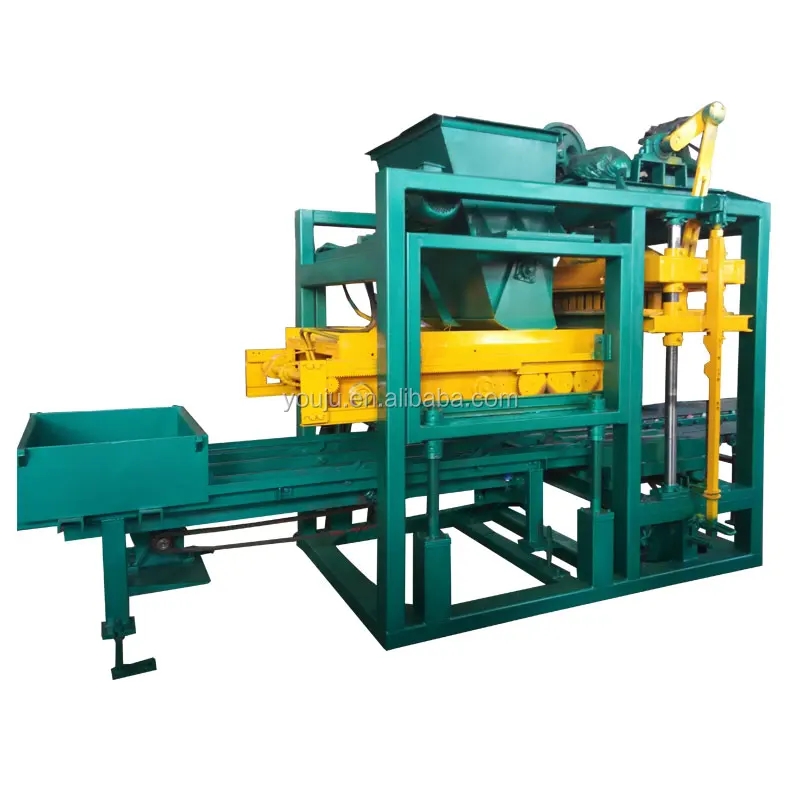
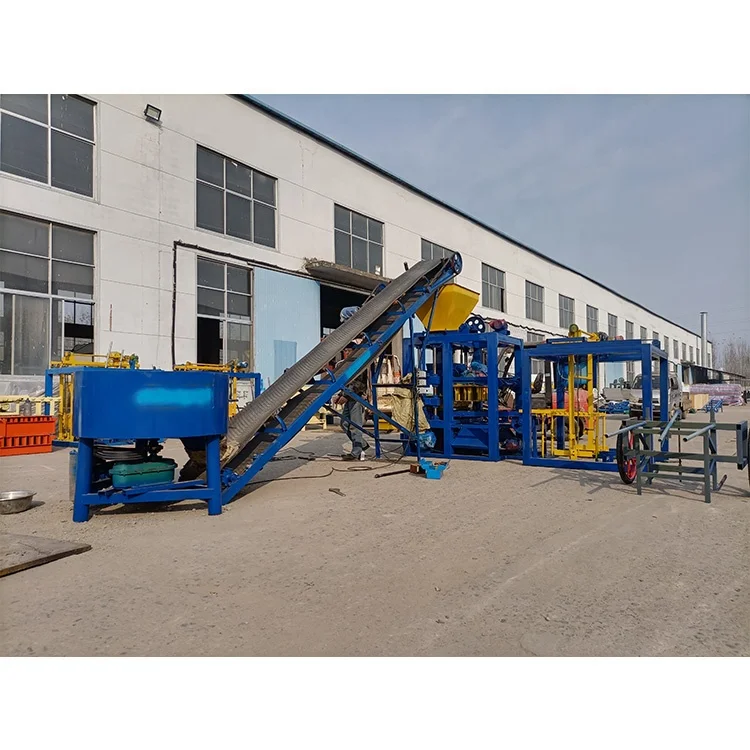 Stationary block machine