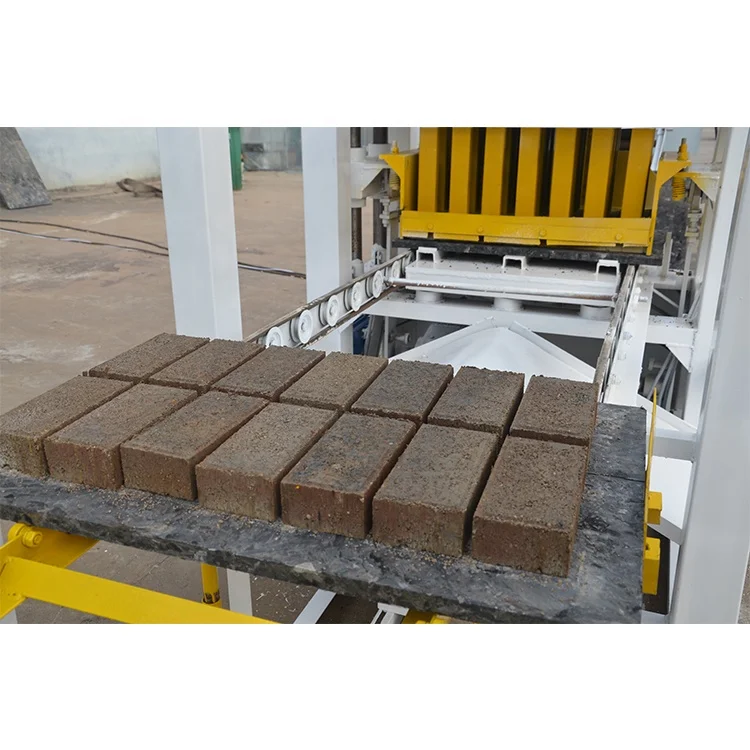
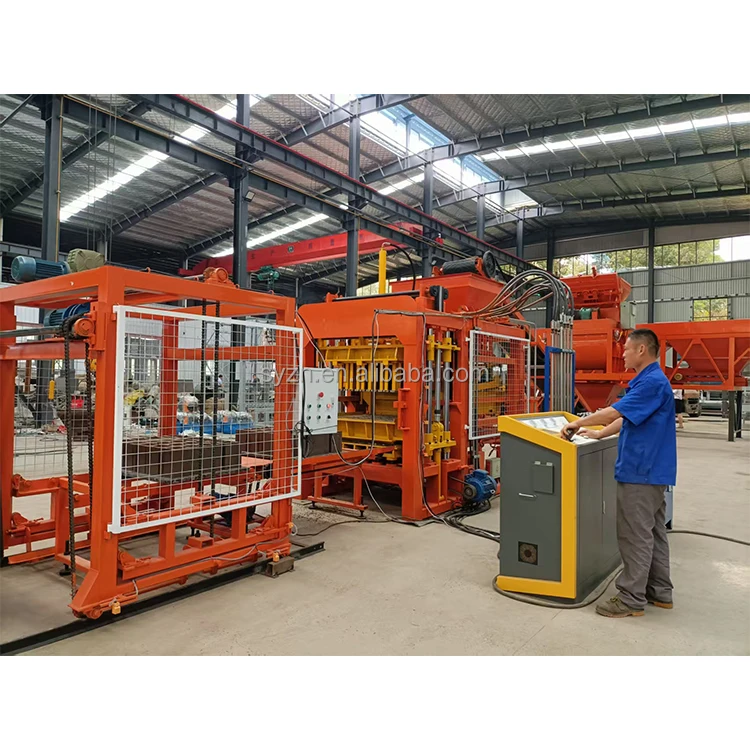
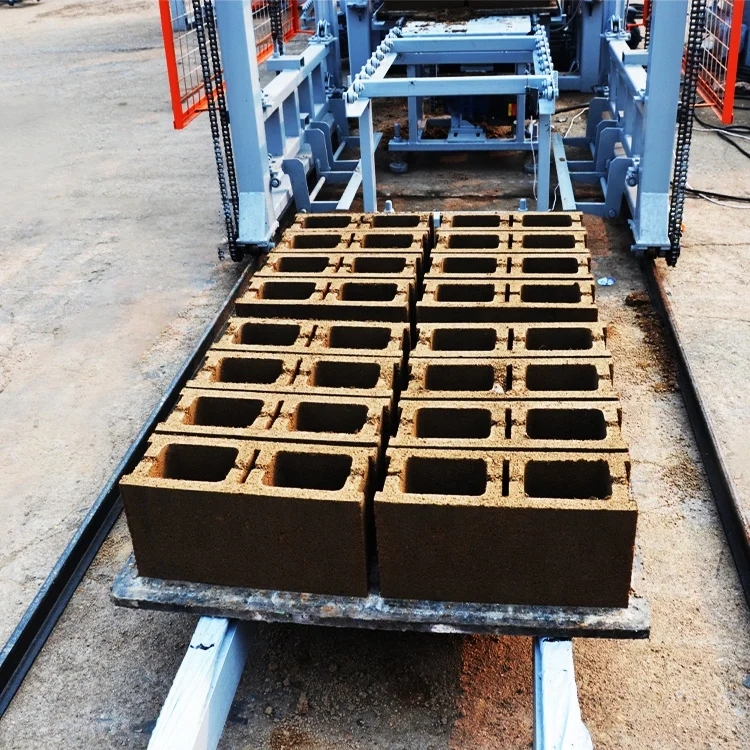
Matched System Sizing — The QT6-15 is specified as a complete press, pallet and handling package calibrated to your actual block format, not quoted as a standalone cycle rate.
Technical Specifications
| Parameter |
Value |
| Model |
QT6-15 |
| Product Type |
Automatic Concrete Block Making Machine |
| Overall Dimensions (L×W×H) |
8200 × 1700 × 2950 mm |
| Total Mass |
7 T |
| Pallet Size |
880 × 850 mm |
| Vibration Form |
Platform Vibration |
| Vibration Frequency |
0–60 Hz (adjustable) |
| Vibration Force |
45 kN |
| Molding Cycle |
15–20 s |
| Moulding Mode |
Load automatically, vibration moulding |
| Demolding Method |
Hydraulic |
| Hydraulic System |
Independent integrated hydraulic station |
| Control System |
PLC (Programmable Controller) with touch screen |
| Overall Power |
37 kW |
| Required Factory Area |
1200 m² |
| Output Capacity (Hollow Block 400×200×200 mm) |
1080–1440 pcs/h, 8640–11520 pcs/8hr |
| Output Capacity (Hollow Block 400×150×200 mm) |
1440–1920 pcs/h, 11520–15360 pcs/8hr |
| Output Capacity (Solid Brick 240×115×53 mm) |
5760–7680 pcs/h, 46080–61440 pcs/8hr |
| Output Capacity (Rectangular Paving Brick 200×100×60 mm) |
2160–2880 pcs/h, 17280–23040 pcs/8hr |
| Output Capacity (Zigzag Paving Brick 225×112.5×60 mm) |
2160–2880 pcs/h, 17280–23040 pcs/8hr |
| Mould Format |
Hollow block, solid brick, rectangular paving brick, zigzag paving brick |
| Automation Level |
Automatic (PLC controlled, automatic loading, fault diagnosis system) |
| Raw Material Adaptability |
Waste ash, slag, various aggregates (source value — verify specific mix compatibility with manufacturer) |
| Block Compressive Strength |
>15 MPa (basis not stated in source — confirm block format / material / thickness) |
| Standards |
CE (where applicable, verify for specific order) |
| Warranty |
1 year for whole machine (excluding spare parts) |
Application Suitability
| Application |
Material or Output |
| Hollow block production for masonry walls |
Crushed stone, sand, cement and fly ash blends |
| Solid brick manufacturing for load-bearing structures |
Dense aggregate and cement mixes |
| Rectangular paving brick for driveways and walkways |
Fine aggregate with pigment and cement |
| Zigzag interlocking paving brick for heavy-traffic areas |
High-strength aggregate blend with cement |
| On-site block production for housing projects |
Locally sourced aggregate matched to site mix design |
What "Pieces per Hour" Actually Means for Your Block Format
A quoted cycle rate is meaningless until it is tied to the exact block size your market buys.
I have seen buyers sign for an automatic block making machine manufacturer promising high hourly output, only to discover the figure assumed a small solid brick while their daily sales were large hollow blocks. The QT6-15 cycles at 15–20 seconds, but what that delivers in eight hours shifts dramatically depending on format. A 400×200×200 mm hollow block yields 8,640–11,520 pieces per shift, while the same machine running 240×115×53 mm solid bricks reaches 46,080–61,440. The press does not change — only the mould and the math. [NEED_CITE: capacity calculation methods for concrete block machines by format]

Placing the QT6-15 Within the Automatic Range
The QT6-15 sits in the mid-tier of the Shiyue automatic lineup, bridging the gap between entry-level semi-automatic machines and high-capacity fully automatic lines. Buyers moving off manual pallet handling find the PLC-controlled loading and fault diagnosis a practical step up, while those planning larger output can use this model as a foundation before scaling to higher tiers. The 880×850 mm pallet size defines the upper limit of what this press can form in a single cycle, making it suitable for plants targeting moderate daily volumes across multiple block formats.
Automation That Removes Variables, Not Operators
The independent integrated hydraulic station sits isolated from the main vibration and dust, keeping pressure consistent across molding cycles. Combined with platform vibration adjustable from 0 to 60 Hz, the control system maintains compaction force within a narrow band throughout a shift. This matters because consistency in block density directly affects compressive strength and breakage rates during handling. [NEED_CITE: relationship between vibration frequency and concrete block density] An automatic block making machine manufacturer that isolates these systems reduces the number of variables an operator must monitor, which is where batch-to-batch uniformity comes from.
Reading the Specs That Determine Real Output
The 45 kN vibration force and hydraulic demolding work together: vibration consolidates the mix into the mould cavity while hydraulic pressure locks the density before the block leaves the press. If either force is mismatched to the aggregate weight, blocks emerge under-compacted or over-stressed. The 37 kW overall power must cover vibration motors, hydraulic pump and conveyor drives simultaneously, so undersized electrical supply at the plant causes cycle delays. The 1200 m² factory area requirement accounts for the press, raw material staging, pallet return path and initial curing space — not just the machine footprint. [NEED_CITE: factory layout considerations for concrete block production lines]
When the Wrong Pallet Size Costs You a Second Forklift
The 880×850 mm pallet is fixed for this model. If your existing curing racks and forklift were set up for a different pallet dimension, every block coming off the line must be manually restacked before it enters your curing area. That restacking step introduces handling damage and adds labour the quotation never accounted for. Buyers who confirm pallet compatibility before ordering avoid discovering this mismatch when the first container arrives. [NEED_CITE: pallet handling integration in block production plants]
Why Specify Here Rather Than Assemble From Catalogues
The QT6-15 is quoted as a matched system — press, mould, pallet and handling equipment specified together against your target block format and local aggregate. Mould drawings are provided for every format your market requires, including custom profiles to your dimensions. Voltage, frequency and PLC display language are confirmed before production starts, so commissioning is not delayed by a control panel in the wrong language. The factory test record documents actual cycle times on your specified block size, not a generic sample. Installation support covers operator training on the specific automation features of this tier.
Documentation & Verification
- Line layout showing press placement within 1200 m² factory area
- Capacity calculation table stating output per block format
- Mould drawing and format list for every block type ordered
- PLC display language and voltage confirmation sheet before production
- Factory test record on specified block format and cycle time
- Hydraulic and electrical schematic for on-site maintenance reference
Installation, Commissioning & Support
- Foundation must support 7 T total mass with vibration isolation for 45 kN force
- Dedicated 37 kW electrical circuit with confirmed voltage and frequency
- Machine arrives dismantled for container loading, reassembled on-site
- PLC touch screen calibrated to confirmed display language during commissioning
- Operator training covers automatic loading, fault diagnosis and mould change procedure
- Wear parts list and mould maintenance schedule provided at handover
What to Prepare Before Requesting a Quotation
Share the block formats your market currently sells along with daily volume targets per format. Confirm your local aggregate type, cement source and any admixtures in your mix design. Provide your plant’s voltage and frequency, available factory area, and whether existing curing racks and forklifts dictate a specific pallet size. This information determines which configuration of the QT6-15 matches your actual production conditions.
Frequently Asked Questions
Q: How do I verify the real daily output for my specific block format?
A: Request a capacity calculation that states the output per block size, not a single headline figure. The QT6-15 output ranges from 8,640 hollow blocks to over 61,000 solid bricks per eight-hour shift depending on format and cycle time. The correct number for your plant depends entirely on which mould is installed.
Q: Where does the QT6-15 sit compared to semi-automatic and higher-tier models?
A: It occupies the mid-tier automatic range, offering PLC-controlled operation with automatic loading and fault diagnosis. Buyers starting from semi-automatic gain consistency and reduced manual handling, while those needing higher capacity can move to larger pallet sizes and faster cycle tiers within the same range.
Q: What plant footprint does the QT6-15 require?
A: The machine itself measures 8200 × 1700 × 2950 mm, but the required factory area is 1200 m² to accommodate raw material staging, pallet circulation, initial curing space and operator access around the press and supporting equipment.
Q: Can I start with the QT6-15 and add automation later?
A: The machine is designed within a range that supports automation upgrades. Starting with PLC-controlled semi-automatic operation is possible, with pallet feeding, stacking and cubing systems available as additions when production volume justifies the investment.
Q: How long does a mould change take on this model?
A: Mould change time depends on the format and the clamping system configured for your order. The hydraulic demolding system is designed for format flexibility, but exact changeover duration is confirmed during the specification stage based on the mould types included in your package.


![QT10-15 Cement Block Machine for Hollow Block | Manufacturer8 + 2 + 9 + 4 + 7 = 30 30 mod 6 = 0 → 句式:[品类词] for [应用或物料] – [站点修饰词] 目标站 shiyueblockmachine.com → 全品类目录类角色 → 池:Manufacturer / Factory Supply / Full Range 30 mod 3 = 0 → Manufacturer Cement Block Machine for Hollow Block – Manufacturer (50) → 刚好50字符 Cement Block Machine for Hollow Block – Manufacturer](https://shiyueblockmachine.com/wp-content/uploads/2026/04/Hb41b33f9751e441c8a35b36846992f0bP.webp) High quality block machine
High quality block machine