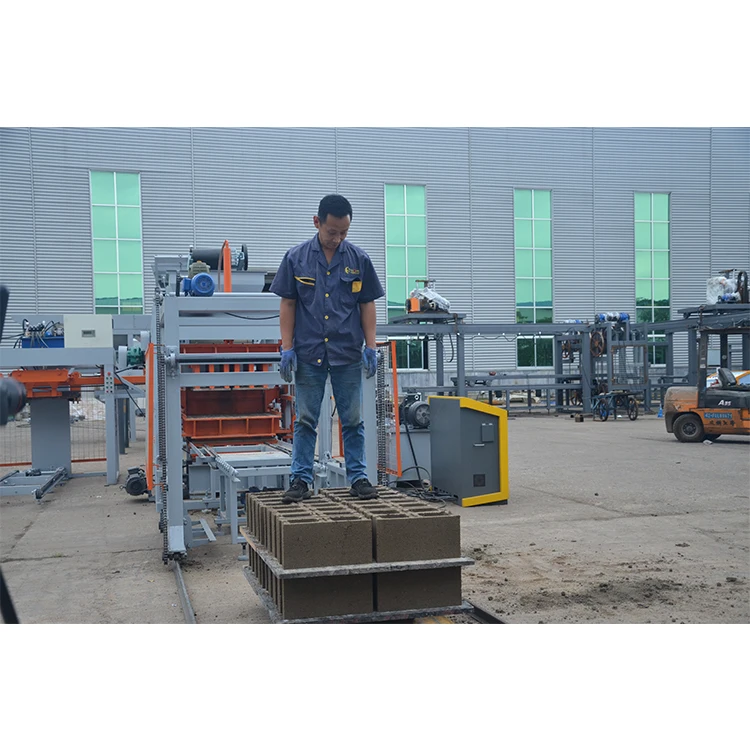
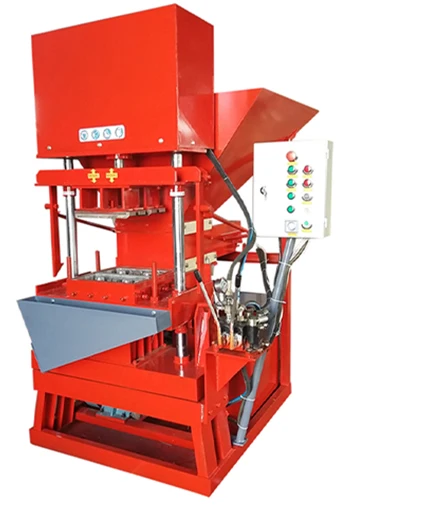
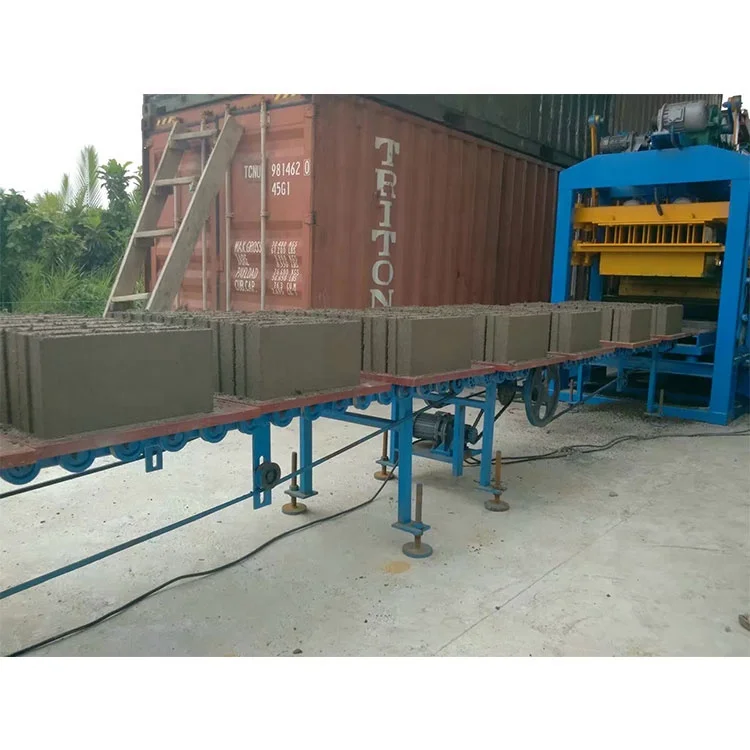
Matched system configuration — every component from press to pallet feeder is sized against your actual block format and curing area, avoiding the mismatch that leaves semi-automatic plants underperforming.
Technical Specifications
| Parameter |
Value |
| Model |
QT4-18 |
| Product Type |
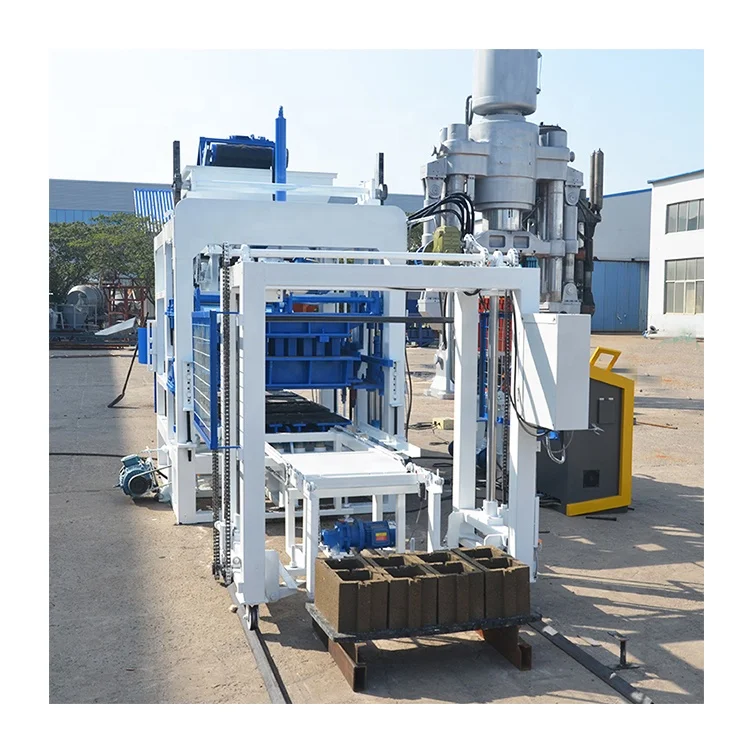
Semi-Automatic Concrete Block Making Machine |
| Overall Dimensions (L×W×H) |
2500×1750×2200mm |
| Rated Pressure |
16MPa |
| Vibration Form |
Platform Vibration |
| Pallet Size |
950×550mm |
| Molding Cycle |
18–25s (basis not stated in source — confirm block format / material / thickness) |
| Overall Power |
27.5kW |
| Control System |
PLC with frequency converter; machine-to-person interface |
| Electrical Components |
Schneider |
| Mould Lifting Mechanism |
Double-sided synchronous gears |
| Material Feeder |
Distribution belt hopper |
| Automation Level |
Semi-automatic (hydraulic-driven pallet feeder, manual or machinery transfer to curing yard) |
| Included Mould |
One free hollow mould (extra moulds customizable) |
| Key Features |
Frequency converter control, synchronous gear lifting, selectable supporting equipment (mixer, conveyor, stacker, pallets) |
Application Suitability
| Application |
Material or Output |
| Hollow block production for masonry walls |
Cement, fly ash, crushed stone, sand |
| Solid brick manufacturing for load-bearing structures |
Cement, aggregate, stone dust |
| On-site block production for housing projects |
Locally sourced aggregate and cement |
| Small-to-medium plant startup operations |
Standard concrete mix components with regional aggregate variations |
| Format expansion for existing product manufacturers |
Custom mould designs based on buyer drawings |
What "18–25 Seconds per Cycle" Leaves Out When Sizing Your Plant
Cycle time means nothing without the block format it assumes.
I’ve watched buyers sign contracts based on a cycle figure, only to find their actual daily output falls far short once their specific block size and local aggregate enter the equation. The QT4-18 quotes an 18–25 second molding cycle, but that range depends entirely on whether you’re pressing a standard hollow block, a thinner paver, or a dense solid brick. A semi-automatic block machine manufacturer worth talking to will tell you which format that number was measured on. [NEED_CITE: how cycle time varies by block format and aggregate moisture content in hydraulic block presses]
Placing the QT4-18 Within a Full Block Machine Range
Before committing capital, a buyer needs to understand where this machine sits relative to higher and lower tiers. The QT4-18 occupies the semi-automatic tier — meaning the press cycle is automated through PLC control with a frequency converter, but pallet transfer to the curing yard remains a manual or assisted step. This positions it between mobile egg-laying machines, which produce directly on the ground with no pallet system, and fully automatic lines where stacking and cubing happen without operator intervention. For a semi-automatic block machine manufacturer offering a full lineup, this model serves buyers who want consistent pressing quality without the investment and floor space a fully automatic line demands.
How the Range Informs Your First or Next Purchase
A first-time plant owner often benefits from starting semi-automatic. You learn the mix behavior, the pallet handling rhythm, and your local market’s format preferences before scaling automation. Contractors producing blocks on a project site value the smaller footprint and simpler maintenance profile. Meanwhile, established manufacturers adding a new format to their catalog can use this tier to test market demand before integrating full automatic stacking. The critical step is matching the machine to your real production scenario rather than choosing on paper capacity alone. [NEED_CITE: considerations for selecting automation level in concrete block production]
Pressure, Vibration, and Pallet Size — What They Actually Control
The 16MPa rated pressure works together with platform vibration to compact the concrete mix into the mould cavity. Higher pressure alone does not guarantee a stronger block — the vibration must fluidize the mix so particles settle densely before the hydraulic force locks them in place. If your local aggregate is angular and coarse, you need more vibration energy to achieve the same density that a rounded river sand would reach at lower amplitude. The 950×550mm pallet size determines how many blocks you produce per cycle and must align with your curing rack dimensions and the forklift you already operate. Choosing a pallet size without checking your curing area leads to wasted floor space or awkward double-handling. The double-sided synchronous gear lifting mechanism keeps the mould box level during demoulding, reducing block edge damage that often plagues machines with single-side lifting. Frequency converter control on the PLC regulates vibration intensity across the cycle, giving operators a way to adjust for different mix consistencies without mechanical changes.

The Hidden Cost of a Mismatched Configuration
When vibration force and hydraulic pressure are not matched to the buyer’s mix design, block strength becomes inconsistent across batches. I’ve seen plants where half the day’s output fails a simple drop test because the machine was configured for a sand type the buyer could not source locally. The result is material substitution that the original settings never accounted for. Pallet size chosen without regard to the curing area means operators are restacking blocks by hand before they even leave the press zone, eliminating any throughput advantage the machine itself provides. Voltage and frequency confirmed too late can delay commissioning by weeks while transformers or motor replacements ship overseas. [NEED_CITE: common commissioning delays caused by unconfirmed electrical specifications in exported machinery]
Why Source This Machine Through a Single-Focus Block Machinery Supplier
Block machinery is the only product category here, so the press, mould, pallet, and handling equipment are specified as one matched system. Configuration decisions are set against your actual mix design and target block format rather than a catalog default. Mould design and supply cover the formats your market sells, including custom drawings when standard options don’t fit. The automation level is selectable — you can start with the QT4-18 semi-automatic setup and add stacking or cubing automation later without replacing the press. Installation and commissioning support includes operator training on your specific mould set and material mix.
Documentation & Verification
- Line layout and capacity calculation stating the block format assumed for the molding cycle
- Machine specification sheet with voltage, frequency, and PLC display language confirmed before production
- Mould drawing and format list covering the included hollow mould and any custom extras
- Factory test record on your target block format before dispatch
- Packing photographs showing dismantling arrangement for container loading
Installation, Commissioning & Support
- Foundation requirements based on 2500×1750mm footprint and vibration isolation for 16MPa pressing force
- Dedicated electrical circuit for 27.5kW overall power with confirmed voltage and frequency before wiring
- Press arrives partially dismantled; reassembly covers mould box alignment and synchronous gear calibration
- First-run parameter setting adjusts vibration duration and pressure hold to your local aggregate and mix
- Operator training on PLC interface language, mould change procedure, and daily lubrication points
- Wear parts list for hydraulic seals and mould liners with reorder specifications
What to Share With Your semi-automatic block machine manufacturer Before Quoting
Provide the exact block formats you intend to produce, including dimensions and target compressive strength. Share a sieve analysis or description of your local aggregate so the vibration and pressure settings can be matched to your material. Confirm your site’s voltage, frequency, and preferred PLC display language to avoid commissioning delays. Let us know your curing area dimensions and existing forklift capacity so the 950×550mm pallet specification can be validated or adjusted.
Frequently Asked Questions
Q: How is the QT4-18 daily output calculated, and which block format does the 18–25s cycle assume?
A: The cycle range is a starting point that must be validated against your specific block dimensions and mix. A hollow block with larger voids typically cycles faster than a dense solid brick. We provide a capacity calculation that names the exact format assumed, so you can compare it against your production target rather than guessing from a generic number.
Q: Where does the QT4-18 sit compared to automatic and mobile tiers?
A: It occupies the semi-automatic tier, automating the press cycle while leaving pallet transfer to curing as a manual or assisted step. Buyers step up to full automatic when daily volume justifies the added stacking and cubing investment. Mobile machines suit project-site production where a fixed pallet system isn’t practical.
Q: What pallet size is recommended, and how does it relate to my curing setup?
A: The standard 950×550mm pallet must align with your curing rack spacing and forklift tine width. If your existing racks are sized differently, a custom pallet dimension avoids double-handling. Pallet material — bamboo, steel, or PVC — is chosen based on your climate and expected lifespan.
Q: Can the automation level be upgraded from semi-automatic later?
A: Yes. The QT4-18 can be paired with automatic stacking and cubing modules as your output grows, without replacing the core press. The upgrade path depends on your pallet size and the handling equipment already in place, so planning the transition early avoids compatibility issues.
Q: What supporting equipment is included versus sourced locally?
A: The quotation can include a pan mixer, belt conveyor, stacker, and extra moulds as a matched set. Items like cement silos and aggregate batching may be sourced locally to reduce shipping volume. We clarify which stations are included and which interfaces you need to prepare before the machine arrives.

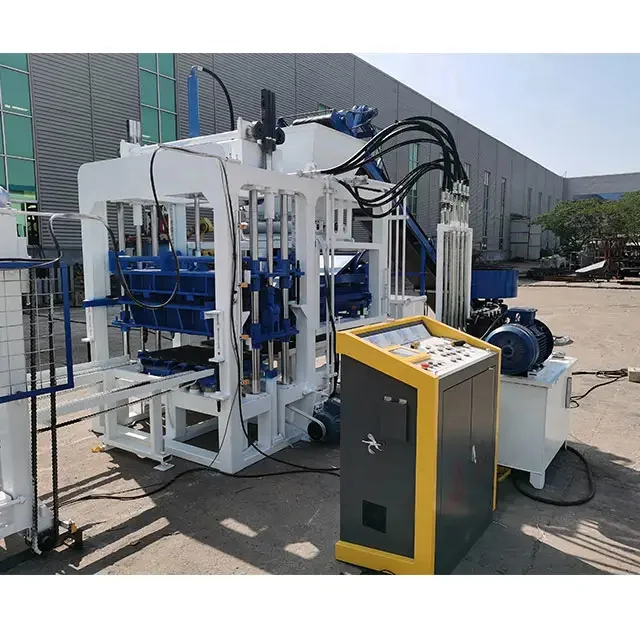
 Semi automatic block