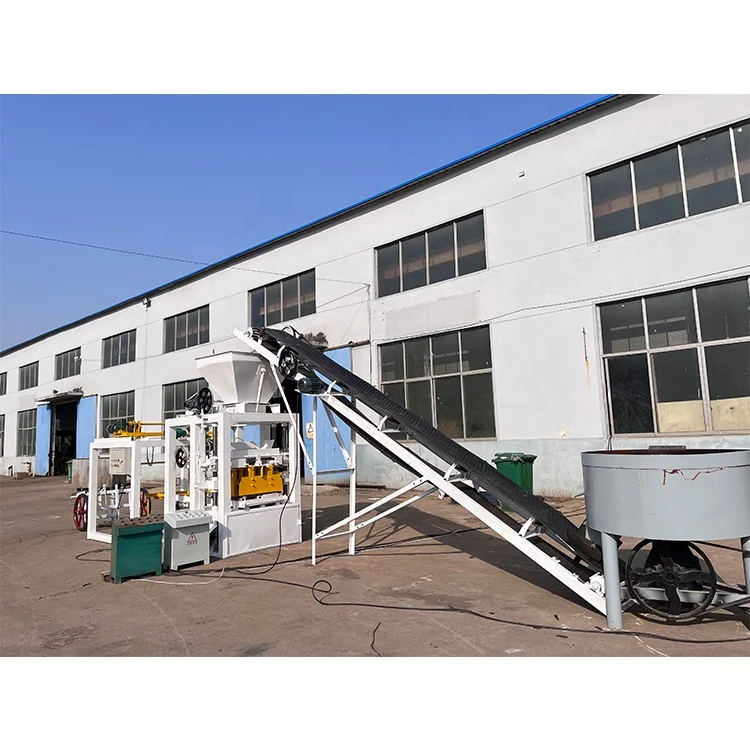
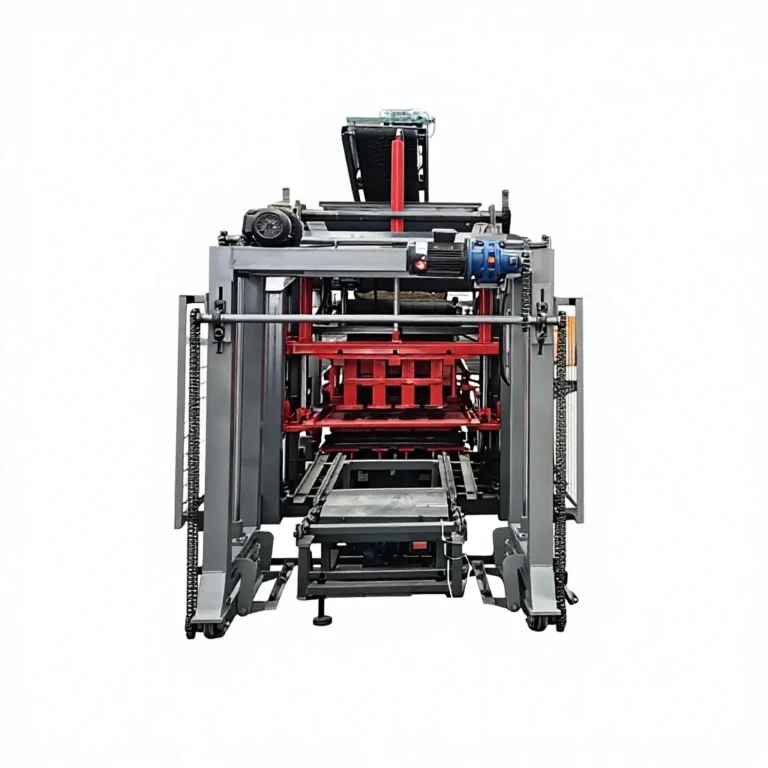
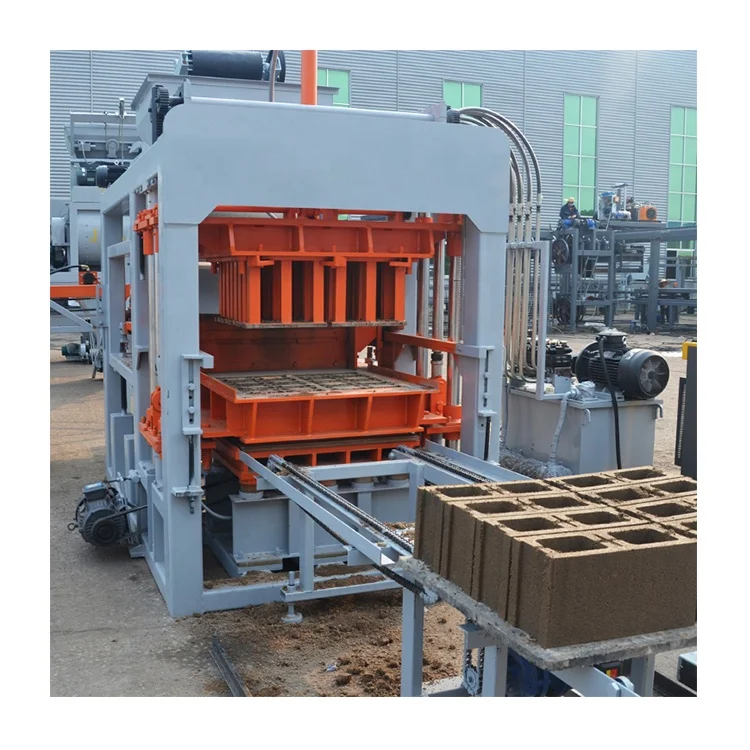
Matched System Supply — the QT10-15 press, mould, pallet and handling are specified together against your local aggregate, so capacity figures reflect what the line actually produces on your site.
Technical Specifications
| Parameter |
Value |
| Model |
QT10-15 |
| Product Type |
Automatic Block Making Machine |
| Control System |
PLC control cabinet |
| Hydraulic System |
Independent integrated hydraulic station |
| Vibration Mode |
Vertical station mode resonance, automatic FM-AM |
| Component List |
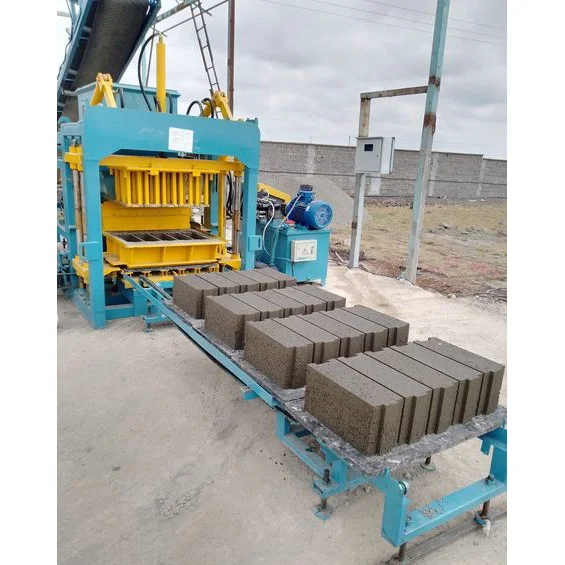
Pallet feed machine, block making machine, storage hopper, conveyor, hydraulic unit, PLC control cabinet |
| Cycle Time (400×200×200mm hollow block) |
15–20 s |
| Output (400×200×200mm hollow block) |
10 pcs/mould, 1800–2400 pcs/h, 14400–19200 pcs/8 hr |
| Cycle Time (400×150×200mm hollow block) |
15–20 s |
| Output (400×150×200mm hollow block) |
12 pcs/mould, 2160–2880 pcs/h, 17280–23040 pcs/8 hr |
| Cycle Time (240×115×53mm solid brick) |
15–20 s |
| Output (240×115×53mm solid brick) |
62 pcs/mould, 8928–11160 pcs/h, 71424–89280 pcs/8 hr |
| Cycle Time (200×100×60mm paving block) |
20–25 s |
| Output (200×100×60mm paving block) |
27 pcs/mould, 5184–6480 pcs/h, 41472–51840 pcs/8 hr |
| Cycle Time (225×112.5×60mm interlocking brick) |
20–25 s |
| Output (225×112.5×60mm interlocking brick) |
24 pcs/mould, 4032–5040 pcs/h, 32256–40320 pcs/8 hr |
| Warranty |
1 year for the whole machine (excluding spare parts) |
Application Suitability
| Application |
Material or Output |
| Hollow block production plants |
Concrete mixes with crushed stone, gravel, and cement for structural and infill blocks |
| Paving block manufacturing |
High-strength face-mix or mono-layer mixes for driveways, walkways, and public areas |
| Solid brick output |
Dense aggregate blends for load-bearing and partition standard bricks |
| Interlocking brick supply |
Interlocking profile production for retaining walls and landscape projects |
| On-site contractor production |
Local aggregate and cement blended on the project site to reduce transport costs |
What "2400 Pieces per Hour" Leaves Out on an Automatic Block Making Machine
Every capacity figure must name the block format it assumes.
Catalogue sheets often quote the highest possible number and leave the buyer to discover that a paving block cycle runs slower and fills fewer cavities per stroke. I watched a project contractor in East Africa lose weeks because the daily plan was built on a hollow block throughput applied to paving formats [NEED_CITE: capacity calculation assumptions by block format]. The automatic block making machine manufacturer should provide a capacity table tied to each specific format, cycle time, and pieces-per-mould figure before any order is confirmed. Without that document, the output claim is only a starting point for negotiation.

Placing the QT10-15 on the Shiyue Range
The QT10-15 occupies the high-capacity tier of the Shiyue full machine range, above semi-automatic models and small mobile units. Buyers stepping up from a workshop-scale press find the jump in pallet size and hydraulic pressure demands a larger curing yard and a forklift that can handle the loaded racks. This tier suits plants targeting continuous multi-format output where the press runs through most of the shift.
How the Stations Connect Around the Press
A block line stalls when the mixer or pallet feeder cannot keep pace with the press cycle. On this model, the storage hopper, conveyor, and pallet feed machine are specified to match the 15–25 second press cycle across formats [NEED_CITE: line station synchronization in block plants]. When any station is undersized, the press waits and the real daily output drops regardless of the nameplate rating.
Pressure, Vibration, and the Aggregate You Actually Have
Hydraulic pressure compacts the mix while vertical station mode resonance with automatic FM-AM vibration settles fines into the voids left by coarse aggregate. If the vibration force is too low for a heavy volcanic or basalt aggregate, the block leaves the mould with internal gaps and fails the drop test. Conversely, a fine sand mix needs less amplitude or the surface spalls [NEED_CITE: vibration amplitude selection by aggregate type]. The independent integrated hydraulic station sits away from the main vibration and dust, which keeps seal life predictable over long production runs. Pallet size must also align with the curing racks the buyer already has on site.
When the Wrong Pallet and Automation Level Cost More Than the Machine
A buyer who chooses a pallet material without checking local humidity can see warping within the first season, forcing unplanned downtime for replacements. If the automation level skips pallet stacking and curing rack handling, the output piles up on the floor and must be moved by hand, erasing the labour savings the press was supposed to deliver. Voltage and PLC display language left to chance can delay commissioning until a transformer or programmer arrives from overseas [NEED_CITE: electrical specification mismatches in exported block lines].
Why Source This Automatic Block Making Machine Manufacturer
The machine, mould, pallet, and handling equipment are specified as one matched system rather than assembled from separate suppliers. Each configuration is set against the buyer’s actual mix design and local aggregate, not a catalogue default. Mould design covers the formats the buyer’s market sells, including custom drawings where required. Automation level is selectable so a plant can start semi-automatic and add stacking or cubing later. Installation support includes operator training and a wear parts list from day one.
Documentation & Verification
- Line layout and capacity calculation stating the block format assumed for each output figure
- Machine specification sheet confirming voltage, frequency, and PLC display language
- Mould drawing and format list for every block type on the order
- Hydraulic and electrical schematic matching the as-built configuration
- Factory test record and packing photographs before container loading
Installation, Commissioning & Support
- Foundation plan matched to the QT10-15 footprint and vibration load
- Dedicated electrical circuit sized to the PLC cabinet and hydraulic unit draw
- Pallet feed machine aligned to curing rack height on arrival
- First-run parameter setting for the buyer’s local aggregate and target block strength
- Operator training covering mould change procedure and PLC fault reading
- Wear parts list covering hydraulic seals and vibration springs
Start the Inquiry with the Right Details
Send the target block formats, the daily output you need for each, and the local aggregate source you plan to use. Confirm the voltage, frequency, and PLC language your operators will read. Tell us the curing yard area and the forklift capacity you already have so the pallet and handling spec fits your site from the first day of production.
Frequently Asked Questions
Q: How is capacity verified for each block format on the QT10-15?
A: Every output figure is tied to a specific block size, pieces-per-mould count, and cycle time. For the 400×200×200mm hollow block, the press produces 10 pieces per mould in a 15–20 second cycle, yielding 1800–2400 pieces per hour. Other formats have their own cycle and cavity count, so a paving block figure is never borrowed from a hollow block calculation.
Q: Where does the QT10-15 sit compared to semi-automatic tiers?
A: It sits in the high-capacity automatic tier, above semi-automatic and mobile models. Buyers moving up should check that their curing yard and forklift can handle the larger pallet size and higher daily output. The automation level remains selectable so stacking and cubing can be added as the plant grows.
Q: What voltage and PLC language options are confirmed before production?
A: Voltage, frequency, and PLC display language are confirmed in writing before the machine enters production. This step prevents commissioning delays caused by mismatched electrical standards or an interface the operators cannot read on site.
Q: Which mould formats are included and how does a mould change work?
A: The standard scope covers hollow block, solid brick, paving block, and interlocking brick moulds sized to the buyer’s market. Mould change involves simple replacement of the mould assembly, and the exact procedure is covered during operator training so format flexibility is usable from the first shift.
Q: What plant footprint and supporting equipment does the QT10-15 line require?
A: The line includes the block making machine, pallet feed machine, storage hopper, conveyor, and hydraulic unit. The total footprint depends on pallet size and curing rack layout. A site plan showing yard dimensions and existing forklift capacity allows us to confirm the supporting equipment spec before the order.

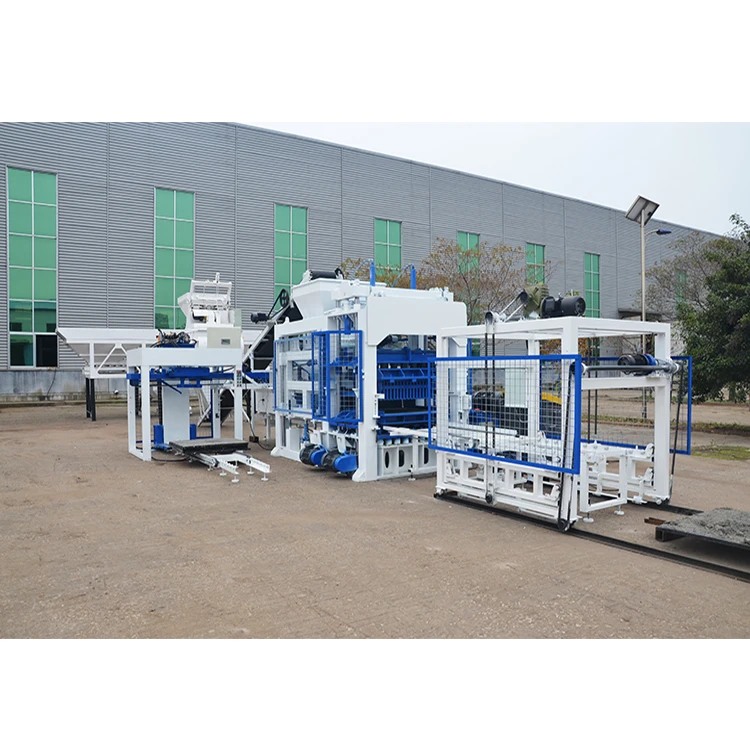
 High quality block machine