Matched System Focus — Machine, mould, power source and mixer are specified together against your site conditions, not quoted as separate line items.
Technical Specifications
| Parameter |
Value |
| Model |
QMR4-45 |
| Product Type |
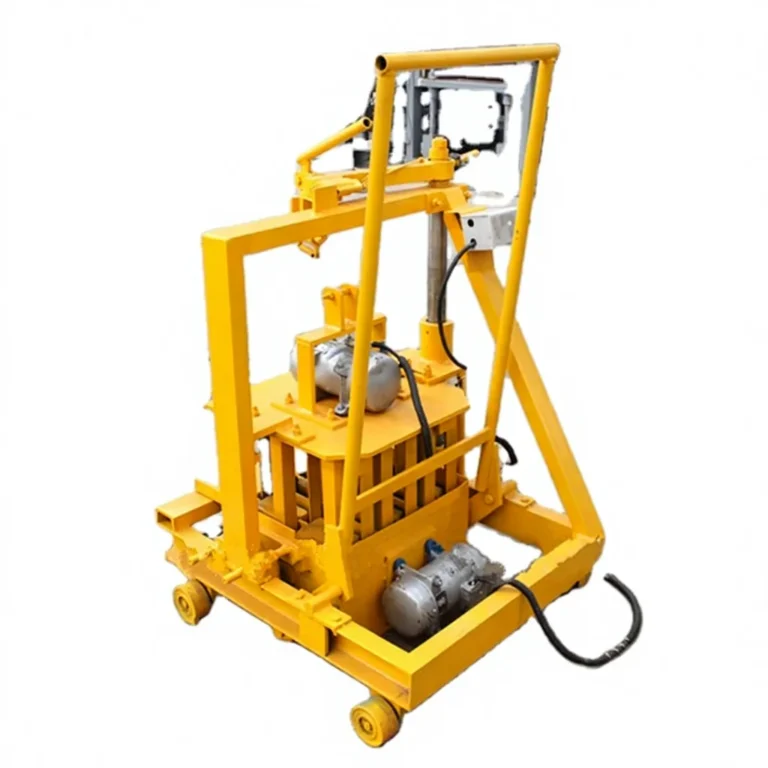
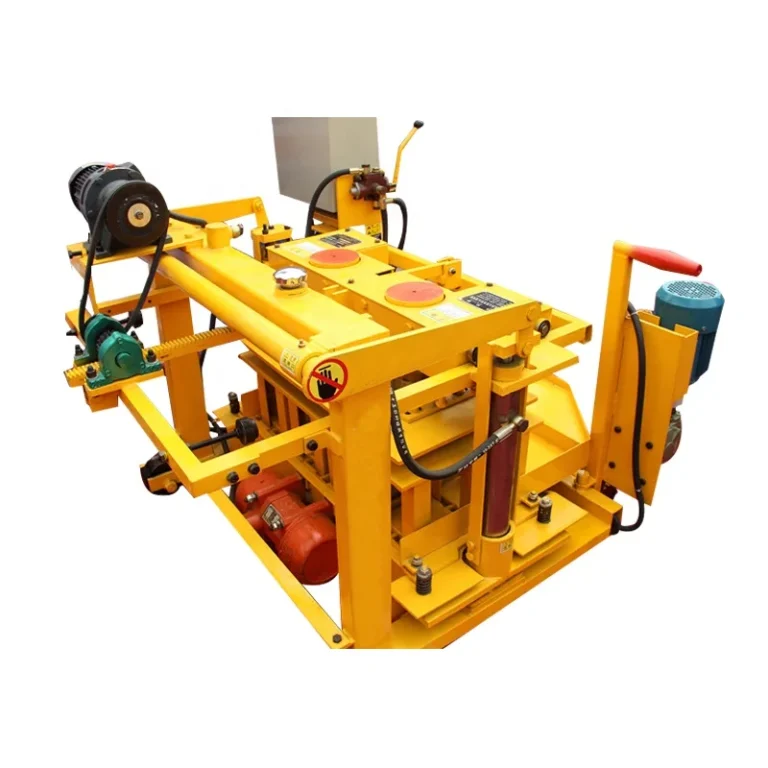
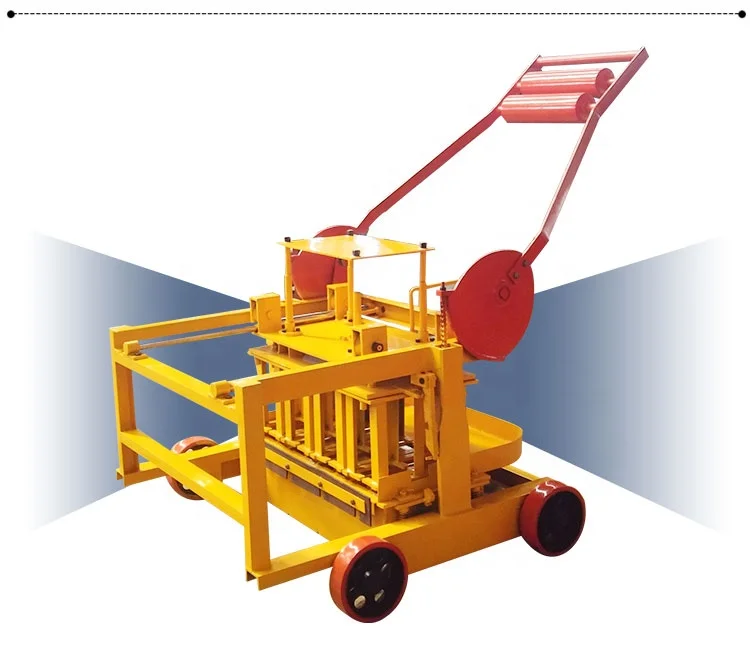
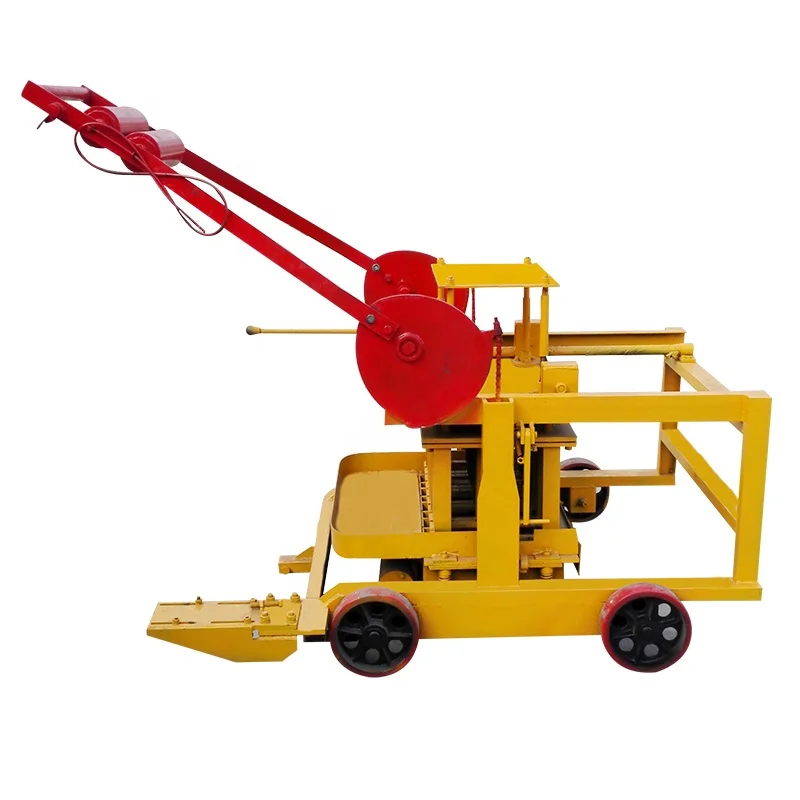
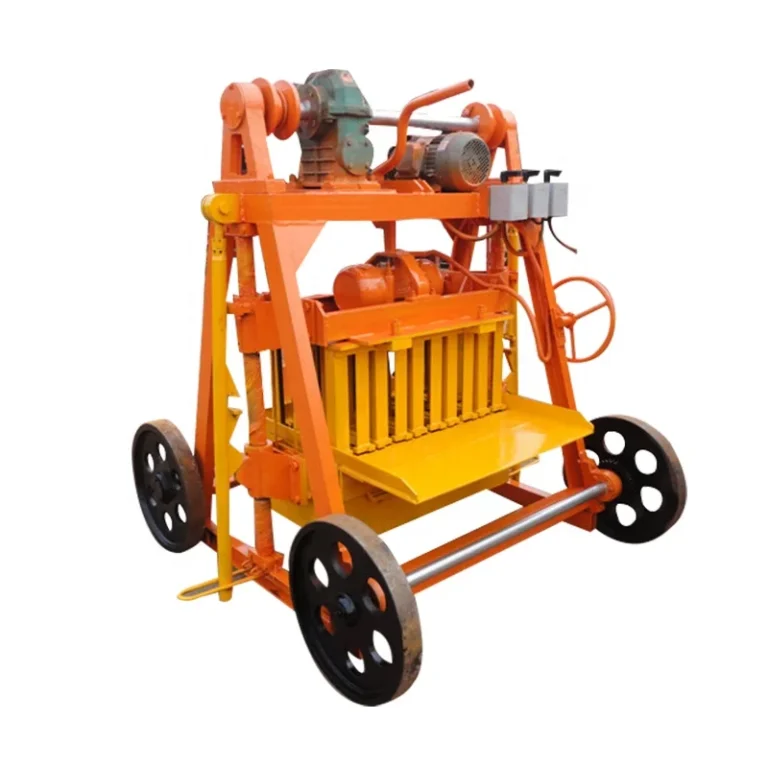
Mobile Block Making Machine |
| Overall Dimensions (L×W×H) |
1100 x 950 x 2100 mm |
| Net Weight |
810 kgs |
| Molding Cycle |
30-45 s |
| Power Source |
Diesel / Petrol Engine / Electric (configurable) |
| Output Capacity |
2560 pcs/day (basis not stated in source — confirm block format / material / thickness) |
| Pallet Requirement |
No pallet required (egg-laying design) |
| Mobility |
Movable / egg-laying type |
| Basic Equipment Included |
JZC350 Diesel Concrete Mixer or JQ350 Diesel Concrete Mixer (with Electric Generating Unit); Trolley |
| Block Formats |
Paver brick, hollow block, concrete block, solid brick, fly ash brick |
| Structure |
Linear type, simple structure |
| Automation Level |
Manual / semi-manual operation |
| Warranty |
1 Year |
Application Suitability
| Application |
Material or Output |
| On-site housing project production |
Concrete and solid bricks laid directly on the ground slab |
| Remote infrastructure sites without grid power |
Diesel-powered hollow block and concrete block runs |
| Small-scale fly ash brick manufacturing |
Fly ash, cement and local aggregate blends |
| Paver production for local market supply |
Interlocking and standard paver formats on prepared beds |
| First-time entrepreneur block plant |
Low-investment start with movable egg-laying layout |
Why "Pieces per Day" Can Mislead a Mobile Block Making Machine Buyer
Capacity only means something once you know which block size it was measured against.
A mobile block making machine manufacturer quoting a single daily number without naming the format is leaving out the most important variable. I have watched contractors receive a QMR4-45 on site and discover that the 2560 pcs/day figure assumed a small solid brick, while their actual order book was for 200mm hollow blocks where the cycle count and material volume per piece cut real throughput significantly. The machine itself was fine; the expectation was wrong from the start. [NEED_CITE: block format assumptions and daily output calculations in mobile block production]

Where the QMR4-45 Sits on the Range
The QMR4-45 occupies the entry tier of our mobile block machine range, built around a linear structure that one or two operators can run without fixed plant infrastructure. Buyers surveying options typically compare it against semi-automatic stationary lines when their project does not justify a curing yard, pallet inventory, or permanent foundation. As a mobile block making machine manufacturer, we position this model for contractors who must move the press between pours or housing blocks as the site progresses.
Egg-Laying Mobility Without Pallet Overhead
Because the machine lays blocks directly onto the ground and moves forward on its own wheels, there is no pallet purchase, no pallet return loop, and no curing rack to build. This removes a recurring material cost that stationary lines carry from day one. The trade-off is that the ground surface must be level and strong enough to bear wet concrete without settling, which is why site preparation matters more here than on a pallet-fed press. [NEED_CITE: ground preparation standards for egg-laying mobile block machines]
Reading the Specs That Actually Shape Output
The 30-45 second molding cycle tells you how many presses an operator can complete per shift, but that range depends on the block format and the stiffness of the mix being fed. A wetter fly ash mix may release faster but needs longer before the next block can be laid beside it without contact damage, while a drier concrete mix with coarse local aggregate may require the full 45 seconds to consolidate under vibration. Power source selection — diesel, petrol, or electric — determines whether the QMR4-45 can run continuously on a remote site or depends on a generator that may introduce voltage fluctuation. The included JZC350 or JQ350 mixer must be matched to the power choice so the press is never waiting for the next batch, and the 810 kg net weight keeps the machine movable by hand trolley without sacrificing the vibration mass needed for block density.
What Happens When Power and Mix Are Guesswork
I once saw a mobile press arrive at a West African housing site where the buyer had not confirmed grid stability, and the electric motor burned out within the first week from repeated voltage drops. The contractor switched to a local diesel generator, but the frequency mismatch meant the vibration motor ran slower than designed, producing blocks that crumbled at the edges during handling. The machine was not defective; the power specification had simply been left to chance. [NEED_CITE: voltage and frequency standards by export market] A second common failure mode is mix design: when the local river sand carries higher clay content than the trial material, the vibration force that works in the factory produces weak, flaking blocks on site. Neither problem shows up in a catalogue, and both can be caught before the machine ships.
Why Buyers Specify the Full System Here
We treat the QMR4-45 as one element in a matched system: the press, the mixer, the trolley, the mould, and the power source are confirmed together against your local aggregate and site conditions. Capacity calculations state the block format assumed, so you know what the daily number actually means before you commit. Mould design covers the formats your market sells, including custom drawings when standard sizes do not match local building codes. Voltage, frequency, and control language are locked down before production, preventing the commissioning delays that strand machines at port. The result is a mobile block making machine manufacturer delivering a setup that runs on day one, not after weeks of on-site troubleshooting.
Documentation & Verification
- Line layout showing block format assumed for the stated daily output
- Mould drawing and format list confirming available block dimensions
- Power source and voltage confirmation sheet matched to your site supply
- Factory test record on your specified mix and block format before dispatch
- Operation and maintenance manual with wear parts and mould replacement list
Installation, Commissioning & Support
- Level ground area of at least 20 x 10 m prepared before the QMR4-45 arrives for continuous egg-laying runs
- Diesel or electric power source confirmed to match local voltage and frequency before the mixer is wired
- Machine delivered in compact linear structure, assembled on site without heavy foundation work
- First production run supervised to set molding cycle and vibration timing against your local aggregate
- Operator training covers mould change procedure, daily greasing points, and belt tension checks
- Wear parts list and mould supply channel established before first replacement falls due
What to Include in Your Inquiry
Send us the block formats and dimensions your project or local market requires, along with the daily output you need to hit. Tell us whether grid electricity is stable on site or whether a diesel-powered setup is necessary, and share any local aggregate details you have, such as sand type and stone size. If you already have curing space or a trolley pathway in mind, include those dimensions so the layout fits.
Frequently Asked Questions
Q: How is the 2560 pcs/day capacity calculated, and which block format does it assume?
A: That figure requires confirmation of the block format, material thickness, and mix design used during testing. We provide a revised capacity calculation stating the exact format assumed — whether solid brick, hollow block, or paver — so you can compare it directly against your daily requirement before placing an order.
Q: Diesel vs. electric power source — which should I choose for my site conditions?
A: Choose diesel when grid supply is unreliable or absent, which is common on remote housing and infrastructure sites. Choose electric when stable three-phase power is available, as running cost per block is typically lower. We confirm voltage, frequency, and motor rating to your site supply before production begins.
Q: What block formats and mould sizes are available for the QMR4-45?
A: The machine supports hollow block, solid brick, paver brick, concrete block, and fly ash brick formats through interchangeable moulds. Custom mould drawings can be produced to match local building codes and buyer specifications, with format dimensions confirmed before manufacture.
Q: What supporting equipment is included, and what do I need to source separately?
A: The QMR4-45 package includes either a JZC350 diesel concrete mixer or a JQ350 diesel mixer with electric generating unit, plus a trolley. You provide the raw materials, a level production area, and any additional curing or stacking arrangements your project requires.
Q: Where does this machine sit on the Shiyue range — when should I step up?
A: The QMR4-45 is our entry mobile tier, suited for on-site production without fixed infrastructure. When your daily volume grows beyond what a single egg-laying unit can sustain, or when pallet-based curing and automatic stacking become necessary, stepping to a semi-automatic or automatic stationary line is the logical next move.

 Mobile block machine