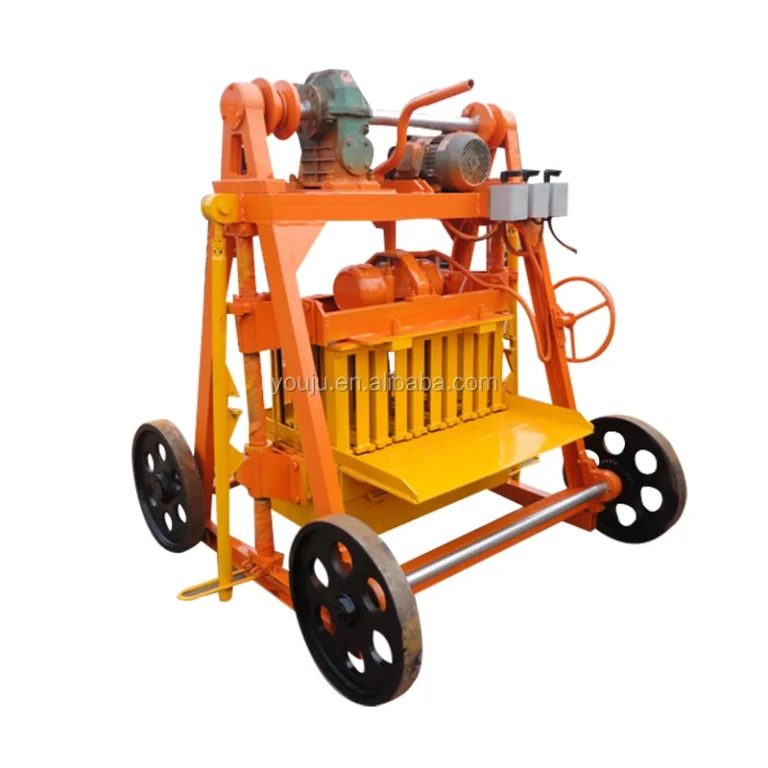
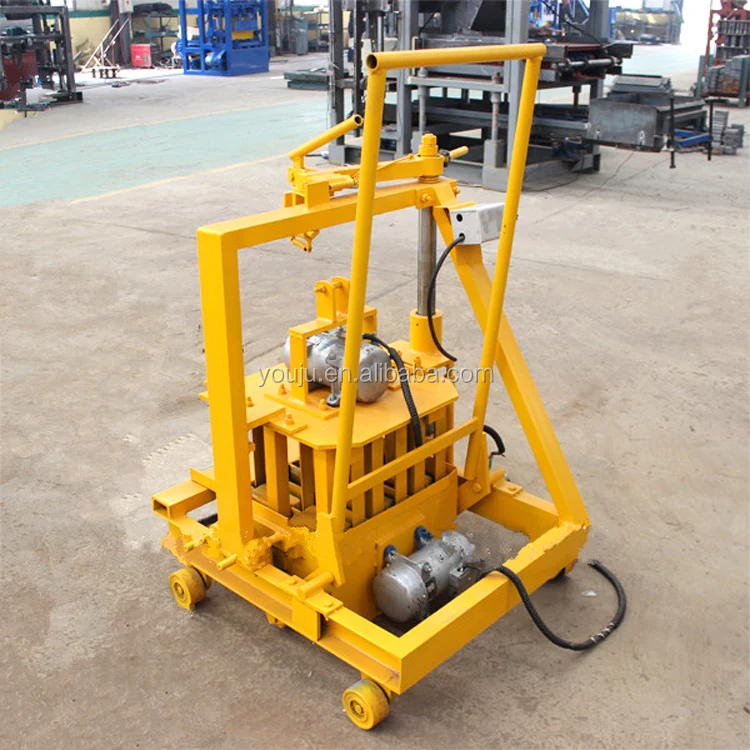
Matched System Focus — machine, mould and hydraulic power are specified together against the buyer’s actual block format and site conditions, not pulled from separate catalogues.
Technical Specifications
| Parameter |
Value |
| Model |
QMR4-45 |
| Product Type |
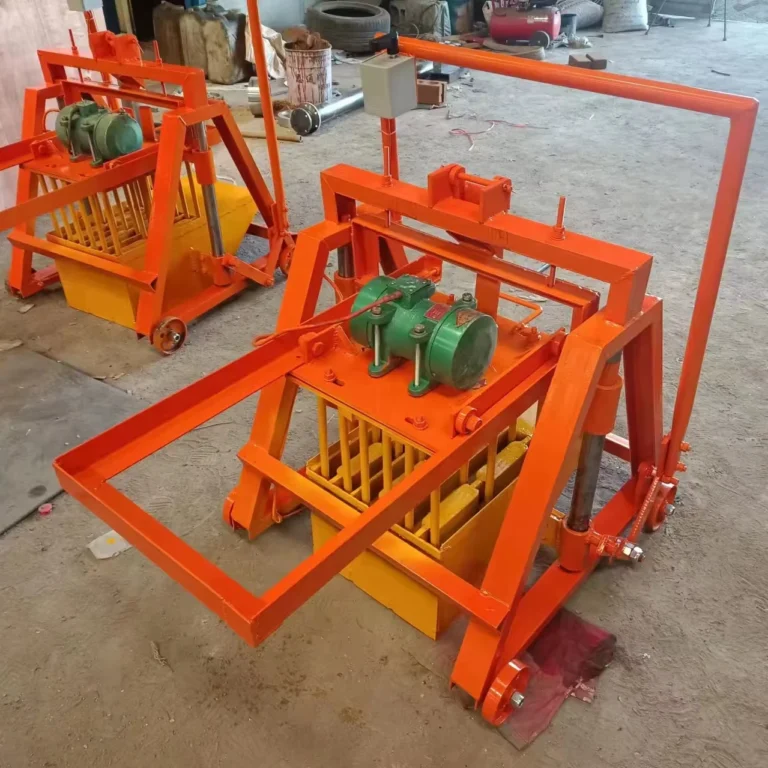
Diesel Movable Egg-Laying Concrete Block Machine |
| Overall Dimensions (L×W×H) |
2420×1320×1650 mm |
| Net Weight |
810 kg |
| Diesel Engine |
6 kW or 6-8 HP |
| Rated Power |
6 kW |
| Voltage & Frequency |
220 V or 380 V or according to client local voltage (frequency not stated in source — confirm Hz) |
| Control System |
Manual / mechanical operation |
| Moulding Cycle |
40-45 s |
| Pallet Requirement |
No pallet required (egg-laying type, lays blocks directly on ground) |
| Output Capacity |
3000 pcs/day based on 400×200×200 mm hollow block, 4 pcs/mould, 8-hour shift |
| Output Capacity (150 mm) |
3500 pcs/day based on 400×150×200 mm hollow block, 5 pcs/mould, 8-hour shift |
| Output Capacity (120 mm) |
4500 pcs/day based on 400×120×200 mm hollow block, 6 pcs/mould, 8-hour shift |
| Mould Formats Included |
400×200×200 mm / 400×150×200 mm / 400×120×200 mm hollow blocks |
| Assembly State |
Fully assembled, mobile unit |
| Warranty |
One year guarantee for the whole machine |
Application Suitability
| Application |
Material or Output |
| On-site hollow block production for contractors |
Crushed stone, river sand and cement mix laid directly on compacted ground |
| Housing projects in off-grid areas |
Hollow block production powered by onboard diesel engine where grid supply is absent |
| First block plant for entrepreneurs |
Three hollow block formats from a single mobile unit with minimal site preparation |
| Remote construction camp supply |
400×200×200 mm, 400×150×200 mm or 400×120×200 mm blocks produced without pallet logistics |
What "3000 Blocks a Day" Actually Means on a Diesel Movable Block Machine Manufacturer Quotation
The daily output figure only holds when you know which block format, moulding cycle and shift length it assumes.
A diesel movable block machine manufacturer quote that reads "3000 pieces per day" without naming the block size is setting the buyer up for a shortfall the moment the machine lands on site. The QMR4-45 produces 4 pcs per mould cycle for a 200 mm hollow block, 5 pcs for a 150 mm, and 6 pcs for a 120 mm — so the same machine, same shift, yields 3000, 3500 or 4500 blocks depending entirely on format. A 40-45 second cycle is the basis for each calculation. [NEED_CITE: block machine output calculation standards by format]

Where This Diesel Movable Block Machine Manufacturer Tier Sits in the Range
The QMR4-45 occupies the entry-mobile tier: a single-operator, pallet-free machine that moves between pours on its own wheels. Above it sit semi-automatic static lines that require pallets, curing racks and a fixed concrete floor. Below it are purely manual hand-mould operations. For a buyer deciding between building a plant and producing on-site, this diesel movable block machine manufacturer model removes the entire pallet and curing-rack investment. The trade-off is that output volume stays in the low thousands per day, suited to project-tied production rather than continuous commercial supply.
Pallet-Free Operation Changes the Site Logistics Entirely
Egg-laying design means the press advances forward after each cycle, depositing a row of blocks directly onto the ground surface. No pallets need purchasing, storing, rotating or repairing. No curing rack system is required — blocks cure in place under covers or hessian. This collapses the capital outlay for a first-time block producer to the machine itself plus raw materials. The trade-off is ground preparation: the surface must be level, compacted and clean enough that freshly moulded blocks hold dimensional tolerance. [NEED_CITE: ground preparation requirements for egg-laying block machines on construction sites]
Reading the Specifications That Matter for Daily Output
The 6-8 HP diesel engine drives hydraulic pressure for mould compaction, which directly determines block density and therefore compressive strength. A higher clay or silt content in local sand reduces compaction effectiveness, so the same hydraulic force yields a weaker block unless the mix is adjusted — a diesel movable block machine manufacturer should confirm this against the buyer’s actual aggregate sample before shipping. The 40-45 second moulding cycle is mechanical, not PLC-governed, so consistency depends on operator rhythm. Net weight at 810 kg keeps the unit towable between sites by a small tractor or pickup, while overall dimensions of 2420×1320 mm fit within a standard flatbed without oversize load permits. The three mould formats share the same press frame, and changeover involves unbolting and repositioning the mould box.
The Hidden Cost of Ordering Without Naming Your Block Format
Buyers who approve a quotation without specifying which hollow block size the capacity figure assumes will discover on arrival that their local market demands a format not included in the shipped mould set. [NEED_CITE: mould change compatibility and lead time for replacement block moulds] Sourcing a replacement mould after shipment adds weeks of downtime and air-freight cost. Equally, confirming voltage and frequency only matters if the buyer selects the electric motor option — the diesel engine variant bypasses the grid entirely, but buyers sometimes tick both boxes without realising the diesel unit needs no electrical supply at all.
Why Source This Mobile Tier from a Focused Block Machinery Supplier
Block machinery is our single product focus, so the QMR4-45 is configured as a matched system — engine, mould and hydraulic pressure are selected together against the buyer’s stated mix design and target block format, not assembled from separate supplier catalogues. Mould design and supply covers the formats the buyer’s local market actually sells, and custom drawings are accepted. The automation level on this machine is manual by design, but buyers who later move to a static line can step up to semi-automatic or fully automatic without retraining on an unfamiliar control philosophy. Installation support covers on-site commissioning with operator instruction on mix ratios, cycle rhythm and mould change procedure.
Documentation & Verification
- Capacity calculation sheet stating output per block format with moulding cycle and shift length named
- Mould drawing and format list confirming the three hollow block sizes included in the shipment
- Diesel engine specification sheet with power curve and fuel consumption data
- Operation and maintenance manual with wear parts list specific to the QMR4-45
- Factory test record showing block density and dimensional check on the buyer’s chosen format
- Voltage and frequency confirmation document for the electric motor variant where applicable
Installation, Commissioning & Support
- Compacted, level ground area of at least 10×3 m required for continuous egg-laying operation
- Diesel engine arrives fuel-system tested; buyer provides diesel and engine oil for first run
- Fully assembled unit — no structural erection, only mould installation and control lever check
- On-site commissioning covers mix trial with buyer’s local sand and aggregate sample
- Mould change training included, covering the three supplied formats and bolt sequence
- Wear parts list supplied with recommended replacement intervals for hydraulic seals and mould liners
What to Include with Your Inquiry
Send the target block format and size your local market sells, the daily volume you need to meet your project schedule, and whether your site has any grid electricity at all. A sample or description of your locally available sand and aggregate — particularly the clay or silt content — allows the mix to be adjusted before the machine ships. If you plan to tow the unit between sites, confirm the vehicle and hitch available.
Frequently Asked Questions
Q: How is the 3000-4500 blocks per day figure calculated for this machine?
A: Each capacity figure states a specific block format, mould cavity count and shift length. The 3000 pcs/day figure assumes 400×200×200 mm hollow blocks at 4 pcs per mould, the 3500 figure assumes 400×150×200 mm at 5 pcs, and 4500 assumes 400×120×200 mm at 6 pcs, all based on an 8-hour shift at a 40-45 second moulding cycle.
Q: What ground preparation does egg-laying operation require on a typical site?
A: The surface must be compacted, level and free of standing water so freshly moulded blocks maintain dimensional accuracy. A layer of fine sand or cement dust swept over the ground before production helps prevent blocks from bonding to the soil. The machine advances forward each cycle, so the prepared area must extend along the production path.
Q: Can this machine run on electric motor instead of the diesel engine?
A: An electric motor option is available at 220 V or 380 V, configurable to the buyer’s local voltage. Frequency in Hz must be confirmed before production, as it affects motor speed and therefore the hydraulic pump output. The diesel variant remains the standard choice for sites with no grid connection.
Q: How long does a mould change take, and can other block sizes be supplied?
A: Mould changeover involves unbolting the current mould box and fitting the replacement, which a trained operator completes within the shift. Additional mould formats beyond the three supplied can be manufactured to buyer drawings, provided they fit within the press frame envelope and moulding cycle timing.

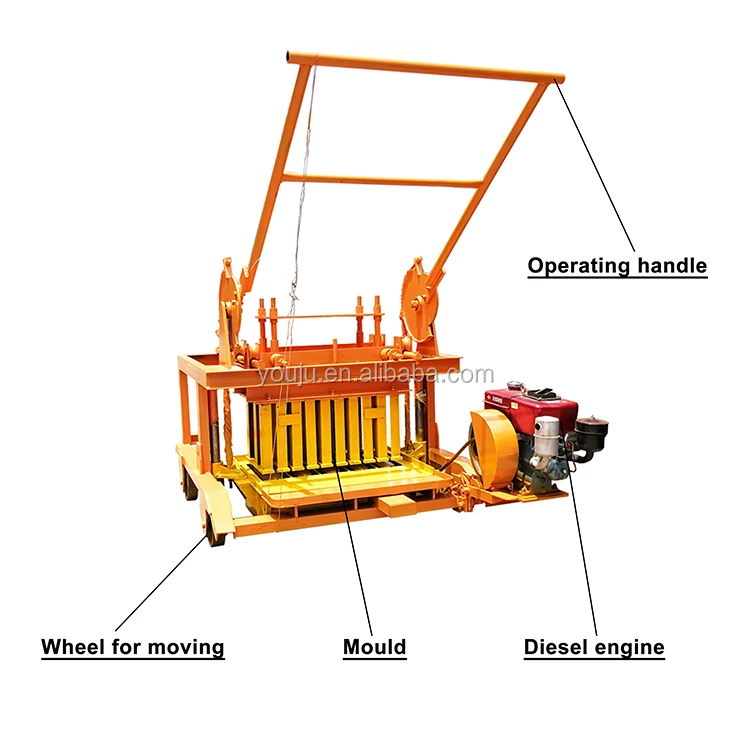
 Mobile block machine