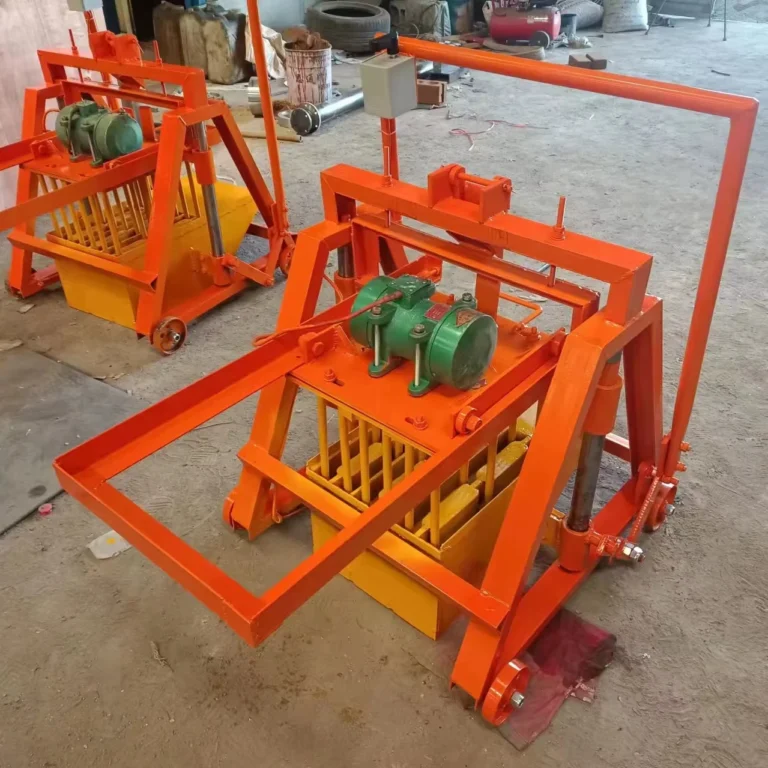
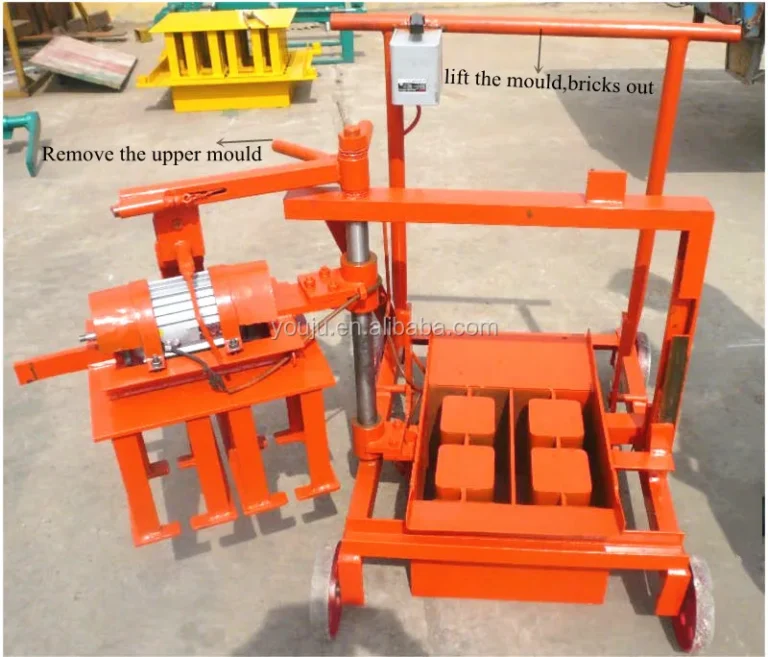
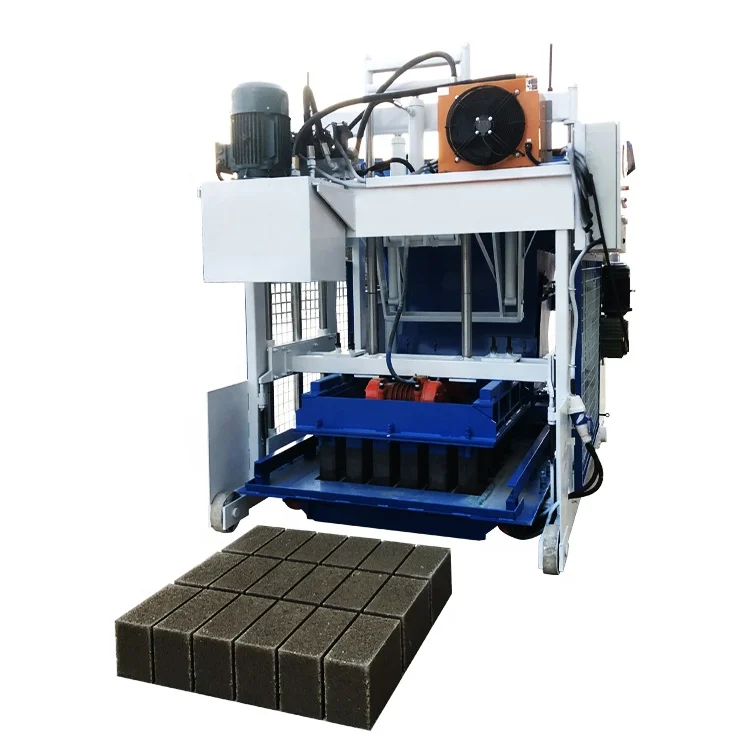
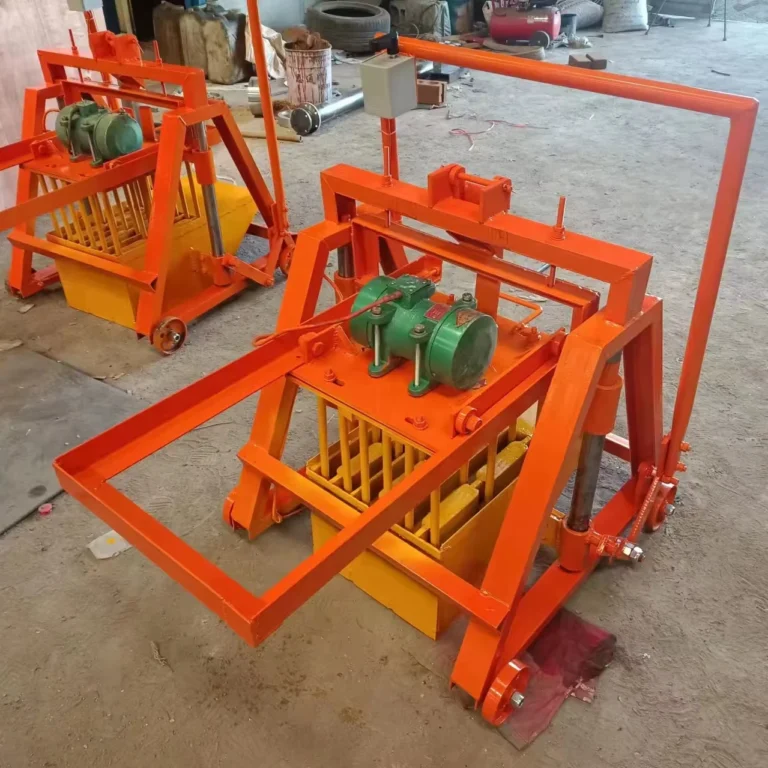
Mobile Block Making Machine Manufacturer — The QMJ4-45 sits at the entry tier of a complete block machine range, letting buyers start with pallet-free egg-laying production on a project site and scale upward to semi-automatic or fully automatic lines from the same supplier when volume demands grow.
Technical Specifications
| Parameter |
Value |
| Model |
QMJ4-45 |
| Product Type |
Mobile Cement Block Making Machine |
| Rated Power |
7.4 kW |
| Voltage & Frequency |
Configurable to buyer’s local voltage (confirm before production) |
| Control System |
Manual force control with jog control |
| Overall Dimensions (L×W×H) |
1550 × 1335 × 1580 mm |
| Net Weight |
1 T |
| Cycle Time |
45 s |
| Output Capacity (400×200×200 mm) |
2400 pcs / 8 h, basis: 400×200×200 mm hollow block, 4 pcs per mould |
| Output Capacity (400×150×200 mm) |
3200 pcs / 8 h, basis: 400×150×200 mm block, 5 pcs per mould |
| Pallet Size |
No pallets required (egg-laying operation) |
| Guide Mechanism |
Four-pole oriented with ultralong orientation bearing |
| Mould Formats Included |
400×200×200 mm (4 pcs/mould); 400×150×200 mm (5 pcs/mould); additional formats via mould change |
| Automation Level |
Semi-automatic (manual force control + jog control) |
| Stacking Method |
Manual (blocks laid on ground) |
| Electrical Components |
Imported electrical appliances, sealing parts and hydraulic components |
| Raw Materials |
Concrete, sand, cement, fly ash, lime, gypsum |
Application Suitability
| Application |
Material or Output |
| Housing project on-site production |
Hollow blocks from crushed stone, sand and cement laid directly on prepared ground |
| First block plant for entrepreneurs |
Solid and hollow blocks with minimal fixed infrastructure |
| Remote infrastructure job sites |
Curb stones and road blocks produced adjacent to the work area |
| Building material distributors |
Multiple concrete product formats added via mould change on a single mobile unit |
Why the Block Format Assumption Changes Your Daily Output
Every capacity number must be tied to the exact block size and mould cavity count, otherwise the figure on paper never reaches the site.
When a mobile block making machine manufacturer quotes "up to 3200 pieces per shift" without stating which block format that figure assumes, the buyer often discovers on commissioning day that their primary product — say a 200 mm hollow block with four cavities — yields considerably less. The gap between catalogue capacity and real daily output is one of the most frequent reasons buyers feel misled after taking delivery. I have watched contractors in Southeast Asia plan labour and cement orders around a number that silently assumed a smaller block size, then scramble to renegotiate supply contracts when actual output fell short. [NEED_CITE: block output capacity assumptions by format and mould cavity count]

Where the QMJ4-45 Sits in a Full Machine Range
The QMJ4-45 occupies the mobile, egg-laying tier — the lowest-footprint entry point in a complete block machine range that extends through semi-automatic pallet-based machines and up to high-capacity automatic lines with stacking and cubing. Buyers who start here can later move to a pallet-based semi-automatic tier from the same mobile block making machine manufacturer without relearning an entirely different control philosophy. This tiered structure matters when a housing contractor wins a larger phase of the same development and needs to scale output without scrapping the first machine.
Pallet-Free Production and What It Removes from Your Budget
Egg-laying operation means blocks are deposited directly onto a level concrete floor, eliminating the need for production pallets, pallet return conveyors, and the curing-area pallet logistics that a fixed plant demands. For a contractor working a twelve-month housing project, this removes a significant line-item from the initial equipment purchase and simplifies daily operation to mixing, moving the machine along the casting bed, and collecting cured blocks the following day. The trade-off is that block density relies entirely on the machine’s vibration and the operator’s mix consistency rather than hydraulic compression against a pallet. [NEED_CITE: comparison of pallet-based versus egg-laying block production methods]
Reading the Specs That Actually Shape Your Output
The 45-second cycle time governs how fast the QMJ4-45 can complete one moulding sequence, but real throughput also depends on how quickly the operator can reposition the machine and refill the hopper between cycles. The four-pole guide mechanism with ultralong orientation bearing keeps the pressure head aligned with the mould box throughout each stroke; without this precision, blocks on one side of the mould can emerge shorter or less dense than the other, creating inconsistent wall thickness in hollow formats. The 7.4 kW rated power drives the vibration motor and jog control simultaneously, which is adequate for a mobile unit of this size but means the machine is not designed to run high-amplitude vibration alongside heavy hydraulic pressure — a deliberate trade-off that keeps weight and footprint low for on-site mobility. Imported electrical and sealing components contribute to cycle-to-cycle reliability in dusty, hot environments where locally sourced contactors might degrade within weeks. [NEED_CITE: four-pole guide bearing alignment in mobile block machines]
The Hidden Cost of Skipping Voltage and Language Confirmation
I once spent four days in a Jakarta workshop rewriting PLC interface labels line by line into Bahasa Indonesia because the machine arrived with an English-only display that local operators could not navigate. With a jog-control machine like the QMJ4-45 the risk is different but equally costly: if the voltage and frequency are not confirmed before production, the vibration motor may run at the wrong speed, producing blocks with lower density than the mix design intended. Buyers who skip this conversation at the inquiry stage often discover the mismatch only when the first batch of blocks crumbles during demoulding. [NEED_CITE: industrial voltage and frequency standards by export market]
Why Source This Machine Here
Block machinery is the single focus of this manufacturing operation, so the QMJ4-45 is specified as part of a matched system — machine, mould, and ground preparation guidance — rather than assembled from unrelated component suppliers. Mould design covers the hollow block, road block, and curb stone formats the buyer’s market actually sells, with custom mould drawings available when a project specifies a non-standard dimension. Configuration is set against the buyer’s local aggregate and mix design, not a catalogue default, so the vibration force and cycle time align with the materials actually available on site. The automation level is selectable within the broader range, meaning a buyer can start with the QMJ4-45 and transition to a pallet-based semi-automatic machine later without changing supplier. Factory testing is completed before dispatch, and the test record is shared with the buyer along with packing photographs so there are no surprises at container opening.
Documentation & Verification
- Machine specification sheet confirming voltage, frequency, and control language before production begins
- Mould drawing and format list for every mould included in the QMJ4-45 quotation
- Capacity calculation stating the exact block size and cavity count behind each output figure
- Factory test record on the buyer’s target block format provided before dispatch
- Packing photographs of the QMJ4-45 and all moulds taken at the factory before container loading
Installation, Commissioning & Support
- Level concrete casting bed required; the 1550 × 1335 mm footprint fits within a standard single-bay workshop
- Dedicated electrical circuit matching confirmed voltage and frequency must be in place before the 7.4 kW motor is energised
- Machine arrives fully assembled; operator positions it along the casting bed using built-in wheels
- First-day commissioning includes jog-control familiarisation and cycle timing verification with the buyer’s actual mix
- Operator training covers mould change procedure and four-pole guide inspection for alignment wear
- Wear parts list and mould maintenance schedule provided for ongoing production support
What to Include in Your Inquiry
Share the exact block dimensions your market sells, the daily volume you need to meet, and the aggregate materials available within a practical transport radius of your site. Confirm your local voltage, frequency, and the language your operators read, so the control components are specified correctly before the QMJ4-45 enters production. If you already operate upstream mixers or downstream curing racks, describe their capacity so the mobile unit can be positioned within your existing workflow.
Frequently Asked Questions
Q: How is the QMJ4-45’s daily output verified and which block format does each figure assume?
A: Output is stated per format: 2400 pieces per eight-hour shift based on a 400×200×200 mm hollow block with four cavities per mould, and 3200 pieces per shift based on a 400×150×200 mm block with five cavities. The 45-second cycle time applies to each moulding sequence, and actual daily totals depend on operator repositioning speed and hopper refill intervals between cycles.
Q: Where does the QMJ4-45 sit in the full range, and what is the upgrade path?
A: The QMJ4-45 occupies the mobile, egg-laying tier — the lowest-footprint entry point. Buyers can later move to semi-automatic pallet-based machines or fully automatic lines with stacking and cubing from the same manufacturer, keeping control philosophy and mould compatibility consistent across tiers.
Q: What voltage, frequency, and control language are confirmed before production?
A: Voltage and frequency are set to the buyer’s local grid specification before the machine enters production. The jog-control system is configured with labelling in the buyer’s preferred language so operators can navigate start, stop, and cycle functions without translation barriers on commissioning day.
Q: Which block formats are available, and can custom moulds be designed?
A: Standard moulds cover 400×200×200 mm hollow blocks and 400×150×200 mm blocks. Additional formats including road blocks, curb stones, and interlocking pavers are available through mould change, and custom moulds can be designed to buyer-supplied drawings for project-specific dimensions.
Q: What ground conditions does mobile egg-laying operation require?
A: A level, cured concrete floor is needed as the casting bed. Unlike a fixed pallet-based line, no pallet inventory or pallet return system is required. The floor must be large enough to accommodate the day’s output laid end to end, with space for the operator to walk the machine along the bed between cycles.

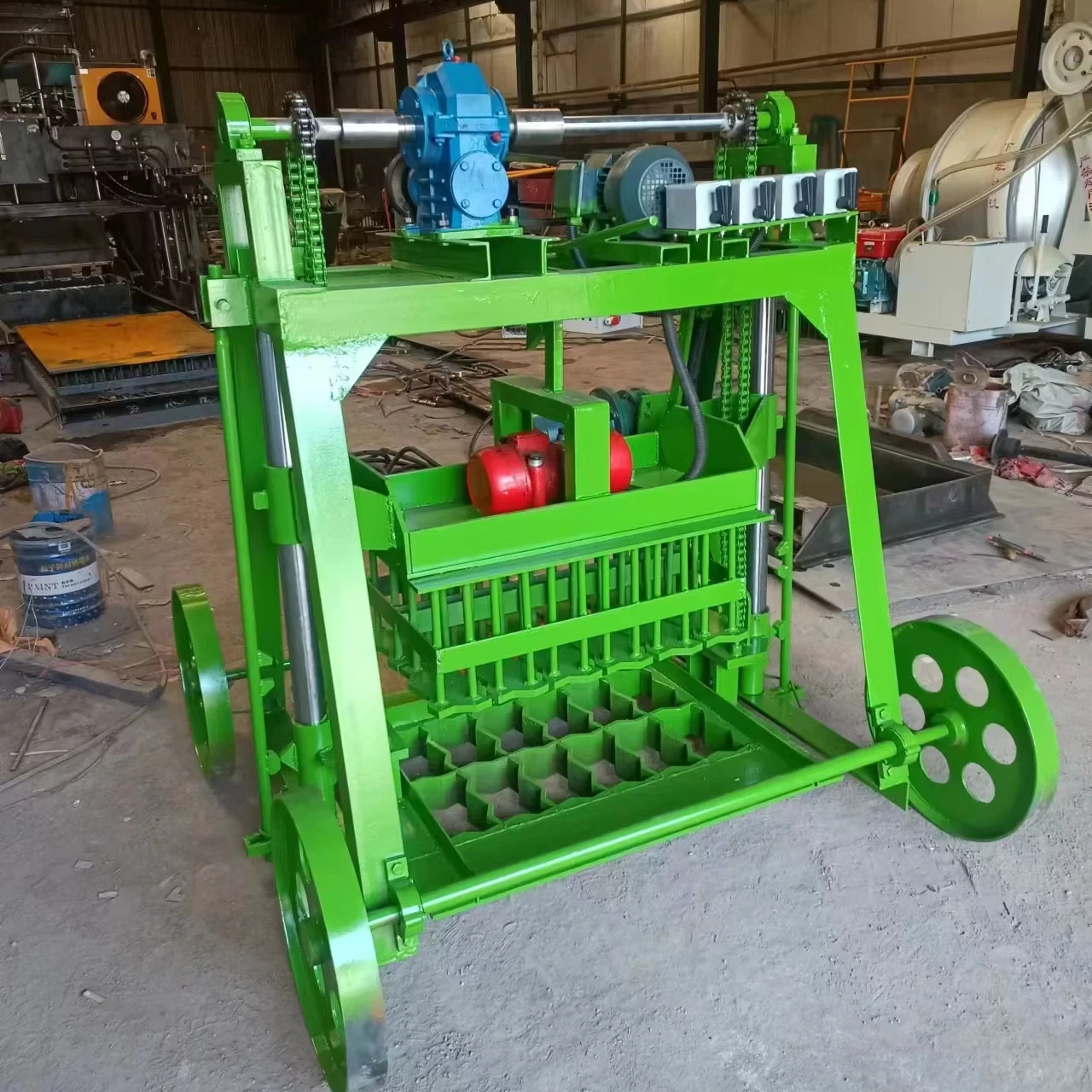
 Mobile block machine