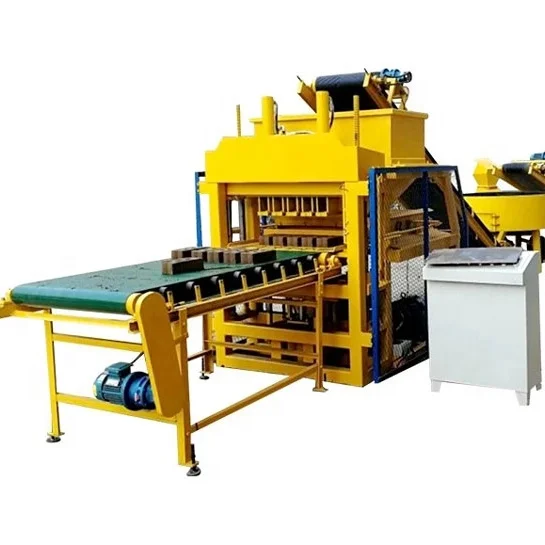
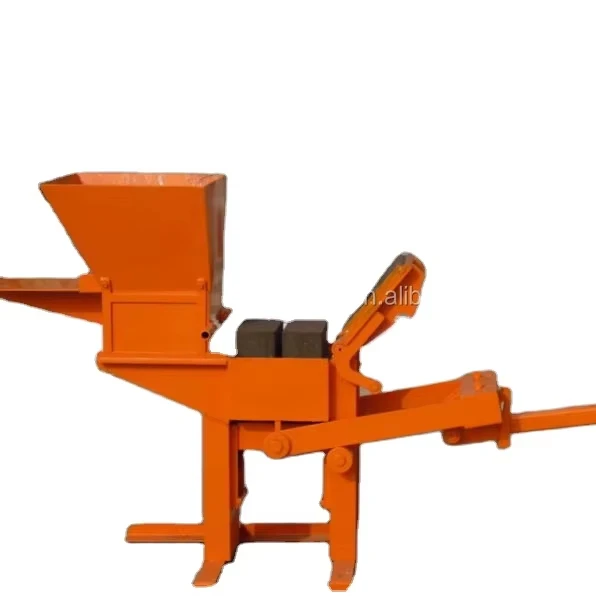
Entry-Tier Manual Press — the LY2-40 anchors the complete block machine range as the no-power starting point for buyers evaluating clay interlocking brick production before committing to higher tiers.
Technical Specifications
| Parameter |
Value |
| Model |
LY2-40 |
| Product Type |
Manual Clay Interlocking Brick Making Machine |
| Overall Dimensions (L×W×H) |
1600 x 700 x 1200 mm |
| Net Weight |
200–240 kg |
| Total Power |
None — completely manual operation |
| Molding Cycle |
30–40 seconds |
| Output Capacity |
400–1000 pcs/day (basis not stated in source — confirm block format, material, and thickness) |
| Operation Mode |
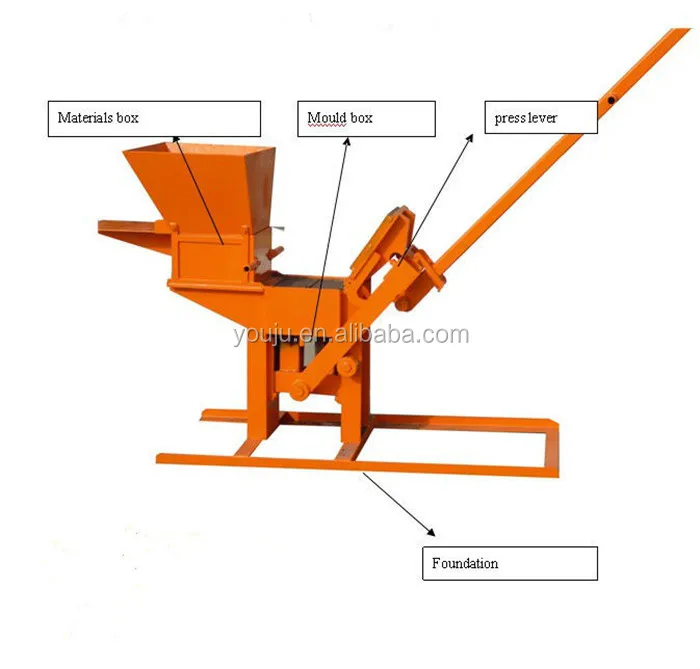
Manual lever and lifting system |
| Mobility |
Steel-wheel mounted for on-site repositioning |
| Moulds |
Changeable for various interlocking brick profiles |
| Basic Equipment Included |
JFA-1 or JQ350 pan mixer |
| Voltage & Frequency |
Not applicable |
| Control System |
Not applicable |
| Automation Level |
Completely manual |
| Warranty |
1 Year |
Application Suitability
| Application |
Material or Output |
| Off-grid clay interlocking brick production |
Local soil blended with cement, no electrical supply required |
| On-site brick manufacturing for housing projects |
Clay-soil mix pressed directly at the construction location |
| Small workshop interlocking brick runs |
Soil-cement blends with manual batching via included pan mixer |
| First-time producer evaluation |
Low-volume clay interlocking brick formats before scaling to semi-automatic lines |
What "400 to 1000 Pieces Per Day" Actually Means on the Ground
The quoted daily range depends entirely on which interlocking brick format, wall thickness, and soil-cement ratio you are running.
Most manual brick machines on the market list a single output number that assumes ideal conditions — a specific block size, a cooperative mix, and a crew that never stops. In reality, a thicker interlocking brick profile takes longer to compress and demould, and a high-moisture clay slows the cycle well beyond the stated 30–40 seconds. I once watched a contractor in Southeast Asia lose half a shift because the local clay held too much water, turning every pressing into a soft brick that crumbled on the curing rack. Before you size a crew or commit to a project timeline, the capacity calculation needs to name the exact block format and mix being used [NEED_CITE: typical soil-cement stabilization ratios for interlocking brick production].

Where the LY2-40 Sits in the Full Machine Range
The LY2-40 occupies the very first tier of the block machine lineup. It is the manual clay interlocking brick making machine manufacturer recommendation for buyers who have no grid power, limited capital, or simply want to test a local market before investing in a semi-automatic or fully automatic line. The machine demands no electrical connection, which makes it practical for remote project sites and regions where generator fuel costs would otherwise erase the margin on every brick produced.
What a No-Power Manual Press Removes — and What It Demands
Operating without electricity removes an entire layer of complexity: no voltage compatibility questions, no PLC language settings, no hydraulic hose failures, no frequency mismatch on arrival. The trade-off is that every pressing cycle, every mould lift, and every brick transfer depends on the operator. For a small crew producing interlocking bricks in a controlled daily run, this is manageable. For a buyer who expects to scale volume quickly, the manual tier reveals its ceiling fast. The steel-wheel mobility means you can follow the build site, but repositioning a 240 kg press across uneven ground still takes two people and a plank [NEED_CITE: manual brick press labour requirements on remote construction sites].
Reading the Specs That Matter for Clay Interlocking Work
The 30–40 second moulding cycle is the number that drives everything downstream. At that rate, a single operator completing one pressing every 40 seconds can produce roughly 90 bricks per hour under continuous work — but that assumes no pauses for mix loading, mould cleaning, or brick transfer. The 200–240 kg net weight keeps the press portable, yet heavy enough that the frame resists rocking during manual lever operation. The included JFA-1 or JQ350 pan mixer handles the soil-cement blend upstream; its batch size must match the pressing rhythm so that the operator is never waiting on fresh mix. Mould changeability across interlocking profiles gives format flexibility, but each swap requires the crew to stop production entirely — a detail that matters when a project specifies two or three different brick types.
When the Wrong Mix Turns a Manual Press Into a Paperweight
A manual clay interlocking brick making machine has no hydraulic pressure or vibration force to compensate for a poor mix. If the local soil has a high clay content and the moisture level is not controlled, the lever effort increases, the brick sticks in the mould, and demoulding tears the edges. The result is a reject rate that quietly doubles the real cost per brick. I have seen operators add extra cement to force a stiff mix through, which raises material cost and still does not fix the underlying water problem. Sending a soil sample before ordering allows the mix to be matched to the machine rather than discovered on the first production day [NEED_CITE: soil stabilization testing methods for compressed earth blocks].
Why Buyers Source This Machine Here
Block machinery is the single focus, which means the LY2-40 press, its moulds, the pan mixer, and the pallet specification are treated as one matched system rather than sourced from separate suppliers. Configuration is set against the buyer’s actual soil type, local aggregate, and the interlocking brick format the market demands — not a catalogue default. Mould design and supply covers the profiles the buyer sells, including custom interlocking drawings when standard formats do not match local building codes. Automation level is selectable upward, so a buyer who starts with the LY2-40 can transition to semi-automatic and then automatic tiers without replacing the entire operational knowledge base. Installation and commissioning support includes operator training on manual lever technique, mix ratios, and mould maintenance.
Documentation & Verification
- Line layout showing LY2-40 placement with mixer and curing area dimensions
- Capacity calculation stating the exact interlocking brick format assumed for daily output
- Mould drawing and format list for each available interlocking profile
- Machine specification sheet confirming dimensions, weight, and included mixer model
- Operation manual covering manual lever system and steel-wheel maintenance
- Wear parts and mould replacement schedule from day one
Installation, Commissioning & Support
- Level compacted ground required — no concrete foundation for the 240 kg manual press
- No electrical supply needed; verify mixer circuit if using the JQ350 powered model
- Press arrives assembled on steel wheels; uncrating and positioning within hours
- First-run commissioning covers lever stroke adjustment and mould release technique
- Operator training on soil-cement mixing ratios and manual cycle pacing
- Mould wear parts list with reorder references for interlocking profile edges
What to Include in Your Inquiry
Share the interlocking brick format and dimensions you plan to produce, along with the wall thickness your local market requires. Provide a description or sample of the local soil so the mix can be evaluated before configuration. State your target daily output and whether the site has any electrical supply for the mixer. Mention any existing curing racks or pallets so compatibility can be confirmed.
Frequently Asked Questions
Q: How is the 400–1000 pieces per day capacity calculated, and which interlocking brick format does it assume?
A: That range is a general reference and the specific block format behind it is not stated in the base specification. Before quoting, we calculate daily output against your exact interlocking brick dimensions, wall thickness, and soil-cement mix to give you a realistic number rather than a catalogue maximum.
Q: What local soil and cement mix ratios work with this manual press, and how does that affect block strength?
A: Suitable ratios depend on the clay content and moisture level of your local soil. We ask buyers to send a soil sample so the blend can be tested. Too much water makes the brick soft and slows the cycle; too little makes lever effort excessive and causes edge cracking on demoulding.
Q: Which mould formats are available for the LY2-40, and can custom interlocking profiles be supplied?
A: The press accepts changeable moulds for various interlocking brick profiles. Standard formats are available, and custom interlocking drawings can be supplied to match local building codes or specific project requirements. Mould change stops production during the swap.
Q: Where does the LY2-40 sit if I later move to a semi-automatic or automatic block machine?
A: The LY2-40 is the entry point of the range. Moving to semi-automatic adds powered vibration and hydraulic assist, increasing cycle speed and reducing operator effort. Moving to automatic adds PLC control, pallet feeding, and stacking. The operational knowledge from the manual tier carries forward through each step.
Q: What is included in the basic equipment, and what do I need to source separately?
A: The package includes the LY2-40 press and either a JFA-1 or JQ350 pan mixer. Pallets, curing racks, and any covering for the curing area are not included and must be arranged locally or specified separately so dimensions match the brick format and your site layout.

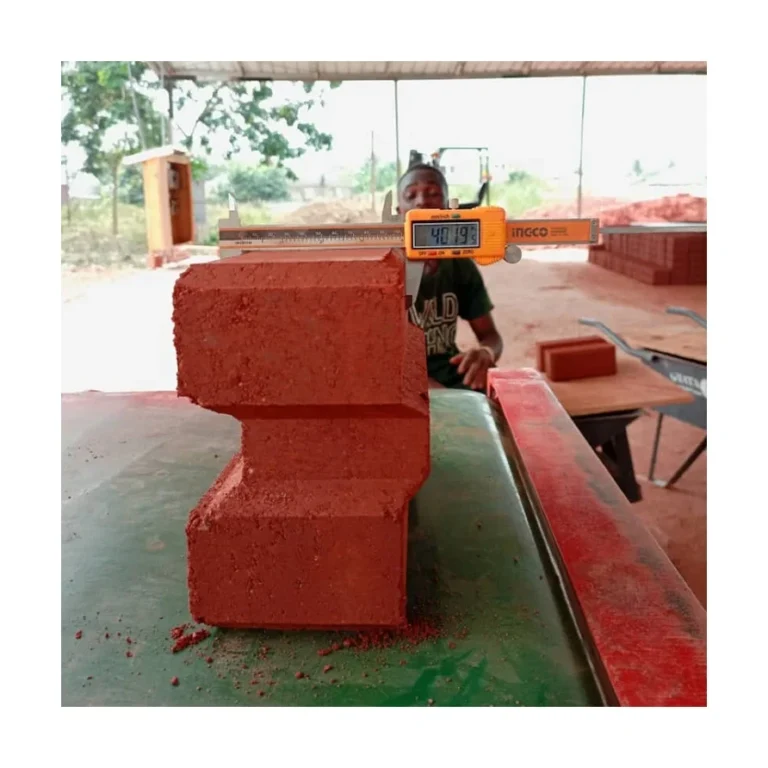 Clay interlocking brick