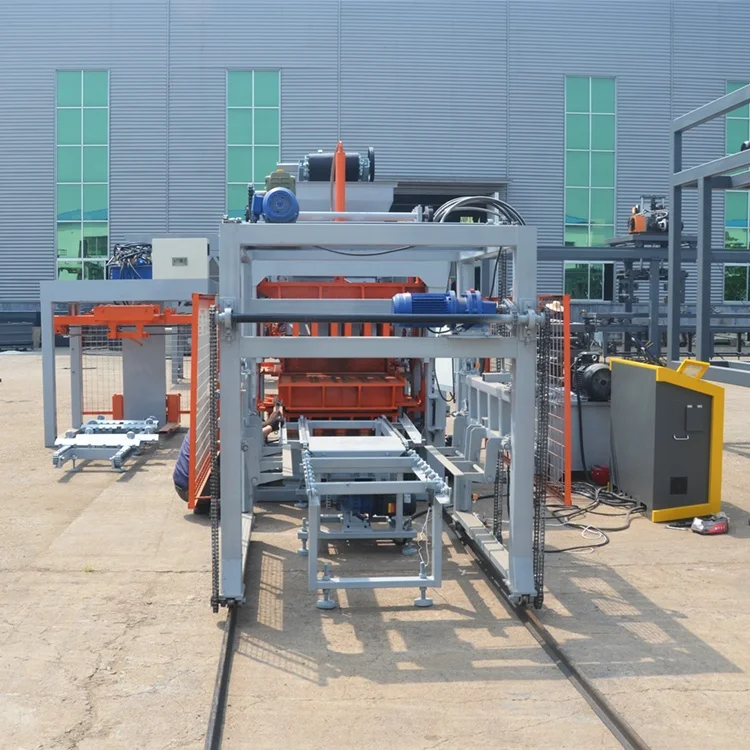
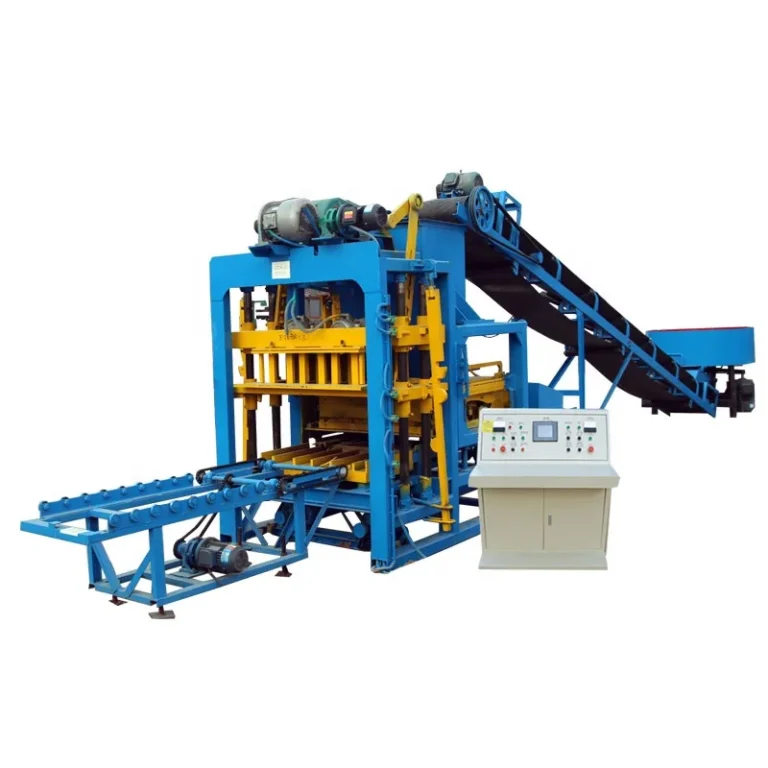
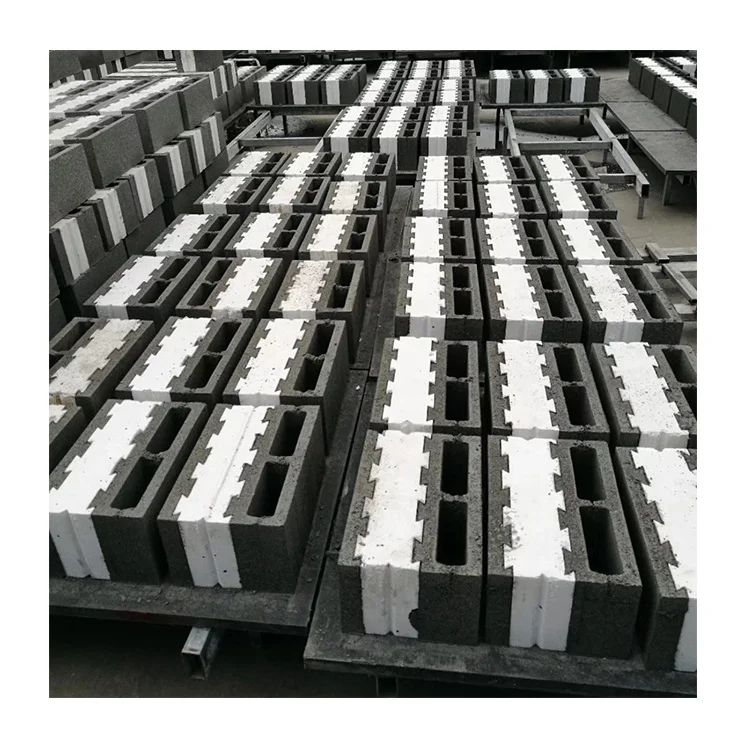
Matched System Sizing — the QTJ4-25 block press, pallet format, and automation tier are specified together against your local aggregate rather than pulled from a catalogue default.
Technical Specifications
| Parameter |
Value |
| Model |
QTJ4-25 |
| Product Type |
Automatic Concrete Block Making Machine |
| Overall Dimensions |
6400×1500×2700 mm |
| Molding Cycle |
25 s |
| Vibration Frequency |
2800–5100 r/min |
| Exciting Force |
60 kN |
| Rated Power |
17.9 kW |
| Mixer Model |
JQ350 |
| Pallet Size |
850×550×20 mm |
| Net Weight |
2500 kg |
| Control System |
PLC |
| Automation Level |
Automatic plate-supplying, material-disturbing, brick-discharging |
| Applied Products |
Concrete hollow blocks (8-inch, 6-inch), solid bricks |
| Output Capacity |
4 pcs/mould, 480 pcs/h, 3800 pcs/8 hr (Hollow block 390×190×190 mm) |
| Output Capacity |
5 pcs/mould, 600 pcs/h, 4800 pcs/8 hr (Hollow block 400×150×200 mm) |
| Output Capacity |
18 pcs/mould, 2100 pcs/h, 17000 pcs/8 hr (Solid brick 240×115×53 mm) |
| Voltage & Frequency |
Configurable to buyer’s local supply (basis to be confirmed) |
| Hydraulic Pressure |
Dependent on block format and material (basis to be confirmed) |
| Stacking Method |
Dependent on block format and automation tier (basis to be confirmed) |
| Language Options |
Dependent on PLC configuration (basis to be confirmed) |
| Certification |
CE / ISO or other applicable (basis to be confirmed) |
Application Suitability
| Application |
Material or Output |
| Wall construction hollow blocks |
8-inch and 6-inch formats from crushed stone, sand, and cement |
| Masonry and structural solid bricks |
Standard 240×115×53 mm format using local sand and fly ash |
| First-stage block plant setup |
Small to medium volume from locally available aggregates |
| Contractor on-site production |
Housing project blocks from site-sourced dust and crushed stone |
Why "480 Pieces Per Hour" Rarely Means 480 Pieces Per Hour
Capacity figures only matter when they name the exact block format and material assumed.
The QTJ4-25 is rated for a 25-second molding cycle, but that cycle time holds only when the mix design flows consistently into the mould and the vibration frequency matches the aggregate size. In practice, I have seen automatic block making machine manufacturer output claims fall apart because the buyer’s local river sand carried high clay content, which slowed material feeding and forced operators to extend the cycle manually. When the cycle stretches, the hourly drop is immediate and compounds across every shift [NEED_CITE: effect of aggregate clay content on block press cycle time].

Where the QTJ4-25 Sits in the Full Machine Range
The QTJ4-25 occupies the mid-tier of our automatic block making machine manufacturer lineup, bridging semi-automatic simplicity and full-line automation. Buyers moving up from manual pallet handling find the automatic plate-supplying and brick-discharging functions remove the two most labor-intensive steps without requiring a complete plant redesign. The machine footprint at roughly 6.4 meters long keeps it workable in workshops that cannot yet accommodate a high-capacity line with integrated stacking and cubing.
Matching Automation Tier to Your Actual Workforce
Choosing the right automation level is less about maximum output and more about what your crew can sustainably operate and maintain. The QTJ4-25 automates plate-supplying, material-disturbing, and brick-discharging, but pallet return and stacking still depend on the supporting equipment you configure around the press. A buyer with reliable local labor may run this press with manual stacking initially, then add an automatic stacker once production volume justifies the investment [NEED_CITE: automation tier selection for block production plants].
How Vibration Force and Pallet Size Shape Block Density
The 60 kN exciting force combined with a vibration frequency range of 2800–5100 r/min compacts the concrete mix through both flat vibration and squeeze compression. This dual action is what determines whether hollow blocks leave the mould with uniform wall thickness and consistent density across every cavity. The 850×550×20 mm pallet size is not arbitrary — it is matched to the mould configuration so that vibration energy transfers evenly across the entire block surface. A pallet that is too thin absorbs vibration rather than transmitting it, producing blocks with weak edges that crack during curing. The JQ350 mixer paired with this press handles the standard crushed stone and sand ratios typical in Southeast Asian markets, though the exact water-to-cement ratio must be dialed in during commissioning based on your aggregate’s absorption rate.
The Real Cost of Skipping the Material Trial
I once configured a QTJ4-25 for an Indonesian buyer based on sample capacity charts, and the machine arrived on schedule. Within the first week, the buyer’s river sand — high in silt and clay — caused the mix to cling inside the mould, and the actual cycle time nearly doubled. The daily output dropped well below what the buyer had promised his construction client, and the trust gap took months to rebuild. Now I require a material sample and trial pressing before confirming any configuration. The cost of shipping a few kilograms of sand is nothing compared to the cost of a machine that cannot meet its own capacity claim on your site [NEED_CITE: importance of material testing before block machine commissioning].
Why Buyers Source the QTJ4-25 Through This Range
Every configuration starts from the block format you actually sell, not a default catalogue line. The QTJ4-25 is matched with moulds sized for your market’s hollow block and solid brick demand, and the pallet specification accounts for the curing racks and forklifts you already have on site. Voltage, frequency, and PLC display language are confirmed in writing before production begins, so commissioning does not stall over a wiring mismatch. Automation is selectable — you can start with the QTJ4-25’s automatic plate-supplying and add stacking or cubing modules later as volume grows.
Documentation & Verification
- Line layout showing QTJ4-25 placement with capacity stated per block format
- Machine specification sheet confirming 60 kN exciting force and 25-second cycle
- Pallet drawing matched to 850×550×20 mm size and curing rack compatibility
- Voltage and PLC language confirmation signed before production starts
- Factory test record with actual output measured on your specified block format
Installation, Commissioning & Support
- Foundation plan sized to 6400×1500 mm footprint with vibration isolation requirements
- Dedicated power circuit confirmed for 17.9 kW rated load at your local voltage
- Mixer JQ350 calibrated on-site to match local aggregate absorption characteristics
- PLC language and control parameters set to operator preference during commissioning
- Operator training covering mould change procedure and cycle time adjustment
- Wear parts list with reorder intervals for vibration components and mould liners
What to Prepare Before Requesting a Quote
To give you a configuration that holds up on day one, we need your target block formats with dimensions, the type and source of your sand and aggregate, and your workshop’s available length and ceiling height. Include your local voltage and frequency so the electrical system is built correctly from the start. If you are replacing an existing press, note the pallet size your curing system currently uses.
Frequently Asked Questions
Q: How is the QTJ4-25 capacity calculated and which block format does each figure assume?
A: Each output figure is tied to a specific block dimension and a 25-second molding cycle. For example, 480 pieces per hour applies to 390×190×190 mm hollow blocks at 4 pieces per mould, while 2100 pieces per hour applies to 240×115×53 mm solid bricks at 18 per mould. These figures assume a mix that flows within the standard cycle without manual extension.
Q: Where does the QTJ4-25 sit in the full range and when should I step up?
A: The QTJ4-25 is a mid-tier automatic press suited for buyers transitioning from semi-automatic operation. If your daily target exceeds what a single QTJ4-25 shift can deliver, or if you need fully integrated stacking and cubing from the start, a higher-tier automatic line with larger pallet size and shorter cycle time is the appropriate step.
Q: What voltage and PLC language options are available?
A: Voltage and frequency are configured to match your local supply before production begins, and the PLC display language is set to your operator’s preference. Both are confirmed in writing during the quotation stage to avoid commissioning delays upon arrival.
Q: What plant footprint do I need alongside the QTJ4-25?
A: The press itself occupies approximately 6400×1500 mm, but you must also allocate space for the JQ350 mixer, raw material storage, pallet return path, and a curing area sized to hold at least one full day’s output on 850×550 mm pallets.
Q: Can I start with the QTJ4-25 and add automation or moulds later?
A: Yes. The machine supports additional mould formats as your market demand expands, and automation modules such as automatic stacking can be added to the line once production volume justifies the investment.

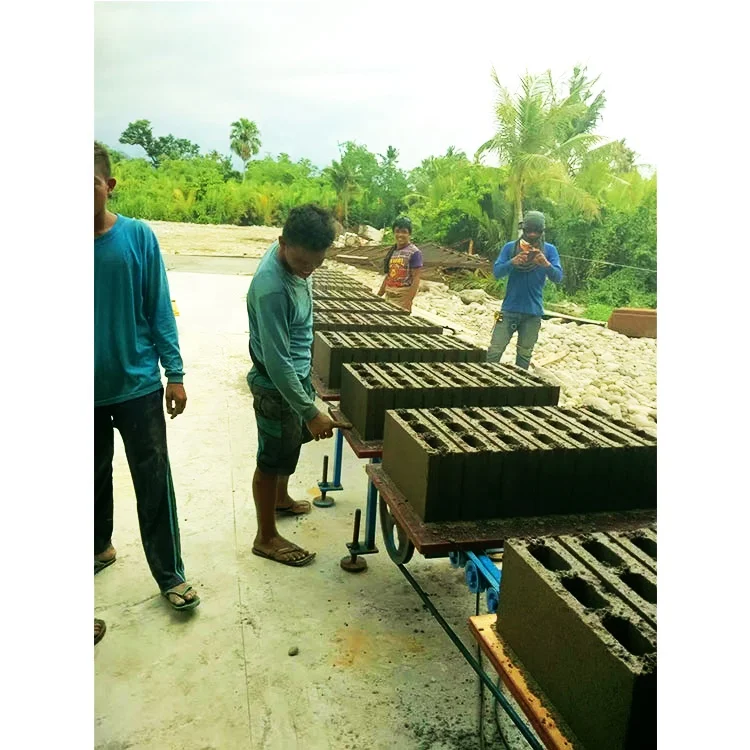
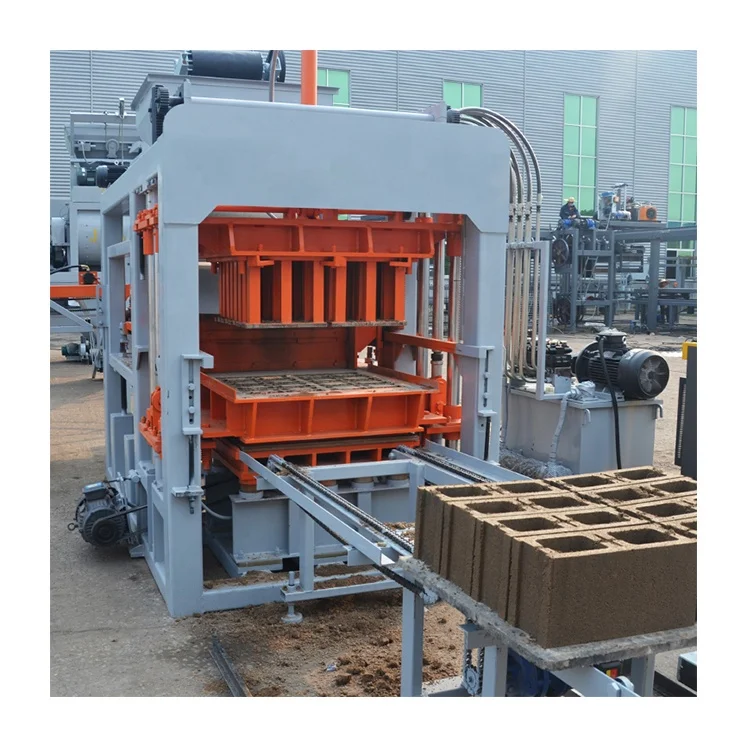 High quality block machine