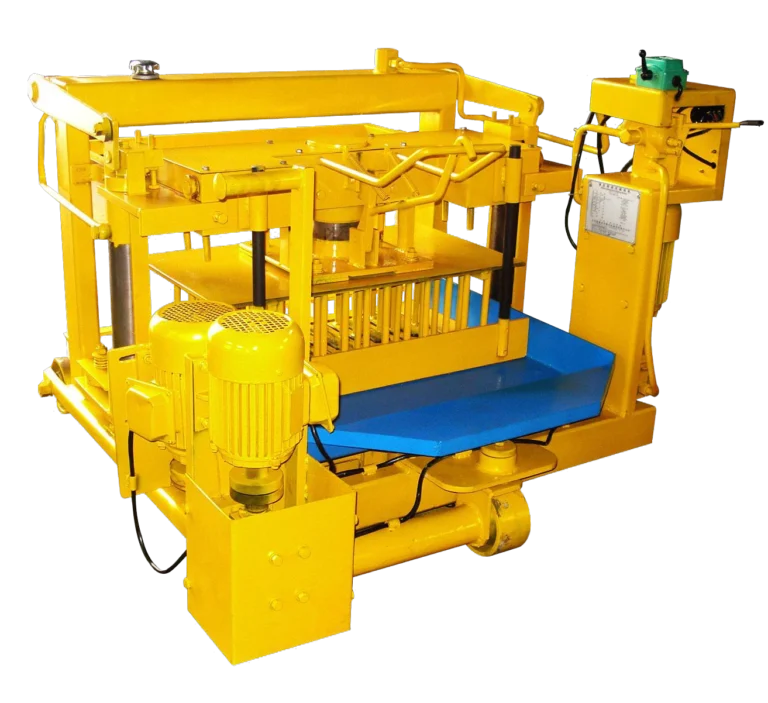
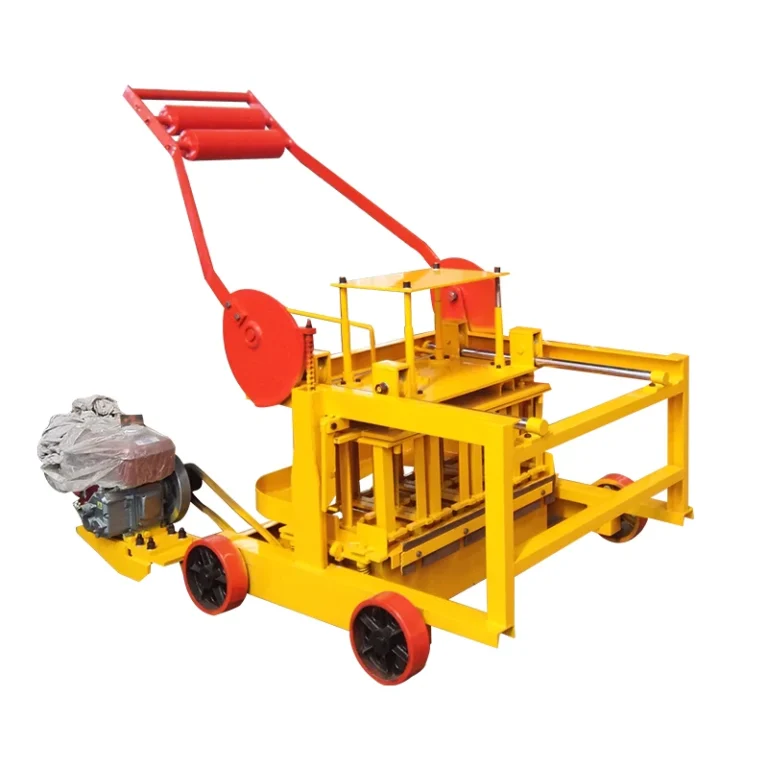
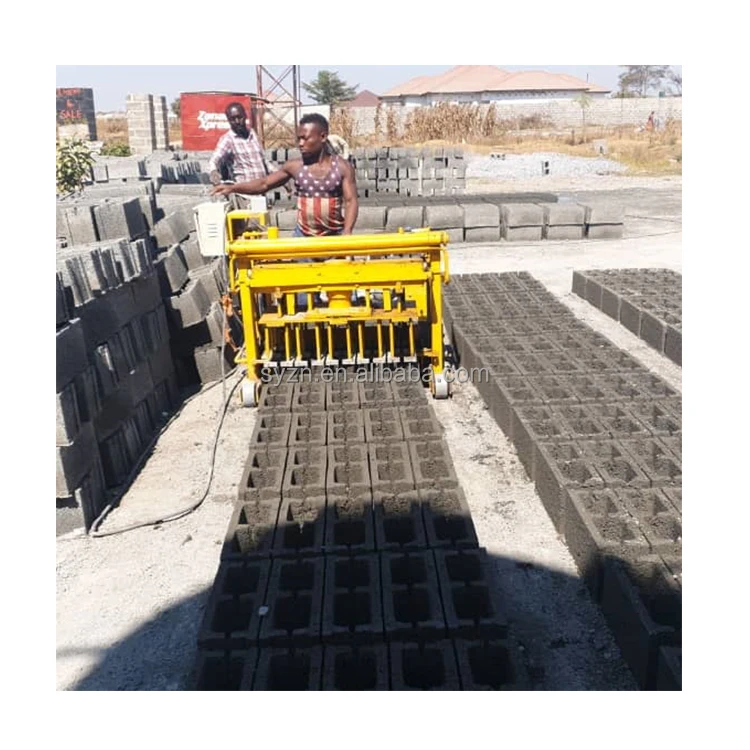
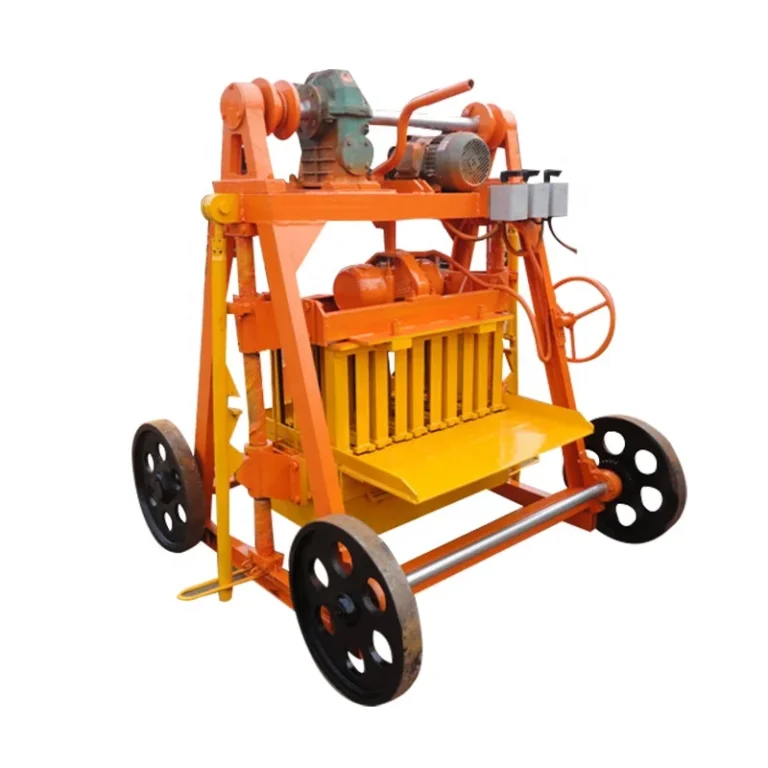
Pallet-Free Design — the QMR4-45 egg-laying mobile block machine deposits blocks directly on the ground, removing pallet investment and letting you relocate across job sites without fixed infrastructure.
Technical Specifications
| Parameter |
Value |
| Model |
QMR4-45 |
| Product Type |
Mobile Diesel Block Making Machine |
| Molding Cycle |
45s (basis to be confirmed — depends on block format and material) |
| Power Source |
Diesel |
| Rated Power |
8hp |
| Molding Form |
Vibration and Pressure |
| Vibration Force |
60KN |
| Total Weight |
800kg |
| Overall Dimensions (L×W×H) |
2420×1320×1650mm |
| Automation Level |
Manual / Egg-laying mobile operation |
| Pallet Requirement |
No pallet required |
| Basic Equipment Included |
JZC350 Diesel Concrete Mixer or JQ350 Diesel Concrete Mixer (Electric Generating Unit); Trolley |
| Stacking Method |
Manual (on-ground egg-laying) |
| Mould Format Options |
Paver brick, hollow block, concrete block, solid brick, fly ash brick (specific dimensions to be confirmed) |
Application Suitability
| Application |
Material or Output |
| On-site hollow block production for building contractors |
Cement, sand, gravel and crushed stone aggregates |
| Remote housing project block supply |
Fly ash, cement and local aggregate blends without grid electricity |
| Entry-level block plant for entrepreneurs |
Standard concrete mix designs for solid bricks and paver bricks |
| Mobile production across multiple project phases |
Concrete block and interlocking brick formats relocated per site |
What "45-Second Cycle" Actually Means for Your Daily Count
Cycle time only matters when you know which block format and material thickness it was measured on.
I spent years on installation sites across Africa and South Asia, and the most common argument I witness between buyers and suppliers starts with a simple question: "The brochure says 45 seconds per cycle — why am I not getting the daily output I calculated?" The answer is almost always that the cycle figure was measured on a small solid brick, while the buyer is running 200mm hollow blocks that need longer vibration and settling time. With the QMR4-45 mobile block machine for sale, the 45-second figure is a starting reference — your actual daily count depends on the block format, your local aggregate gradation, and how your mix holds together under vibration. [NEED_CITE: typical cycle time variation across block formats in egg-laying machines]

Where the QMR4-45 Fits in the SHIYUE Range
The QMR4-45 sits at the entry tier of the full SHIYUE mobile block machine lineup. It is built for buyers who need production capability without committing to a fixed plant — construction contractors working a housing development, project teams operating in areas without reliable grid power, or entrepreneurs testing local block demand before scaling. Because it runs on diesel and lays blocks directly on prepared ground, the footprint is essentially the machine itself plus curing space.
When to Stay Mobile and When to Move Up
If your project demands format changes multiple times per week, or your daily volume requirement outpaces what a single operator can manage with manual stacking and trolley-fed material, that is the signal to look at semi-automatic or automatic tiers in the SHIYUE range. The mobile block machine for sale here is the right starting point — but knowing where the ceiling sits prevents you from buying a machine you will outgrow within a single project cycle. [NEED_CITE: typical output comparison between egg-laying mobile and semi-automatic stationary lines]
Vibration Force, Diesel Power, and What They Mean On-Site
The 60KN vibration force on the QMR4-45 works together with mechanical pressure to consolidate the concrete mix inside the mould. For hollow blocks made with coarse local gravel, this force level is adequate for standard wall thicknesses — but if your aggregate is particularly angular or your mix runs lean on fines, the consolidation pattern changes and block corners may need mould adjustment. The 8hp diesel engine removes any dependence on local voltage and frequency, which matters when your job site is a cleared plot with a generator as the only power source. At 800kg total weight and 2420×1320×1650mm dimensions, the machine can be loaded onto a flatbed and moved between sites as project phases shift — a practical advantage over any stationary line that needs a poured foundation.
The Hidden Cost of Skipping the Mix Trial
I once shipped a machine configured and tested on standard quartz sand, only to find the buyer’s local material was volcanic ash with completely different absorption and particle shape. The first week of production yielded blocks that crumbled under handling. Every mix has a different water demand, vibration response, and demoulding strength curve. When you skip sending your actual material sample before the machine leaves the factory, you are paying for a configuration that matches a laboratory assumption — not your ground reality. [NEED_CITE: impact of aggregate type on block compressive strength consistency]
Why Source This Machine Through SHIYUE
Block machinery is our single focus, which means the QMR4-45 machine, its moulds, the mixer, and the trolley are specified together as a matched system — not assembled from separate catalogue pages. We configure the vibration and pressure settings against your actual mix design and target block format, not a default that assumes material you cannot source locally. Mould design covers the formats your market actually buys, including custom drawings when standard sizes do not match local building codes. The automation level is selectable, so you can start with this mobile tier and move to semi-automatic when your volume justifies it. Every machine goes through a factory test with your material before dispatch, and our installation team stays on-site through commissioning and operator training.
Documentation & Verification
- Line layout showing curing area required for the QMR4-45 egg-laying footprint
- Machine specification sheet confirming 60KN vibration force and 8hp diesel rating
- Mould drawing and format list for hollow, solid, paver and fly ash brick options
- Factory test record run on your submitted material sample before shipment
- Packing photographs documenting machine condition at container loading
Installation, Commissioning & Support
- Ground preparation: level compacted surface required for the 2420×1320mm machine footprint
- Diesel fuel specification and engine break-in procedure for the 8hp power unit
- On-site assembly of trolley, mixer, and mould change components after delivery
- First-run vibration tuning matched to your local aggregate and mix water content
- Operator training covering mould swap, daily greasing points, and diesel maintenance schedule
- Wear parts list with mould liner and vibration spring replacement intervals
What We Need to Quote Accurately
To size the QMR4-45 correctly for your operation, send us your target block format and dimensions, the daily output you need to hit, and a description of your local raw materials including aggregate type and source. If you are choosing between this mobile tier and a semi-automatic line, tell us your curing area size and whether you plan to relocate the machine between project phases.
Frequently Asked Questions
Q: How is the QMR4-45 daily output calculated and which block format does the cycle time assume?
A: The 45-second cycle is a reference figure that varies depending on the block format, wall thickness, and material being used. Hollow blocks typically require longer vibration and settling time than small solid bricks. We provide a capacity calculation sheet that states the daily output for each specific format you intend to produce, so your expectation matches what the machine actually delivers on your material.
Q: Where does the QMR4-45 sit in the full SHIYUE range?
A: It is the entry-level mobile tier, designed for buyers who need on-site production without a fixed plant. If your daily volume requirement or format-change frequency grows beyond what manual egg-laying operation supports, SHIYUE offers semi-automatic and fully automatic tiers with pallet-based production, automatic stacking, and higher throughput. The mobile block machine for sale here is the starting point in that progression.
Q: What block formats and mould options are available for this machine?
A: The QMR4-45 supports hollow block, solid brick, paver brick, concrete block, and fly ash brick formats. Specific block dimensions depend on the mould installed, and custom mould designs are available to match your local building standards. We confirm the format list and provide mould drawings before production begins.
Q: Is the machine configured for my local aggregate, or is it a catalogue default?
A: We request a sample of your actual raw material before the machine leaves the factory. The vibration force, mix water ratio, and mould clearances are then adjusted to match your aggregate’s particle shape and absorption characteristics. This factory trial prevents the strength and finish problems that arise when a machine is set up on standard sand but runs on volcanic ash or crushed coral on-site.

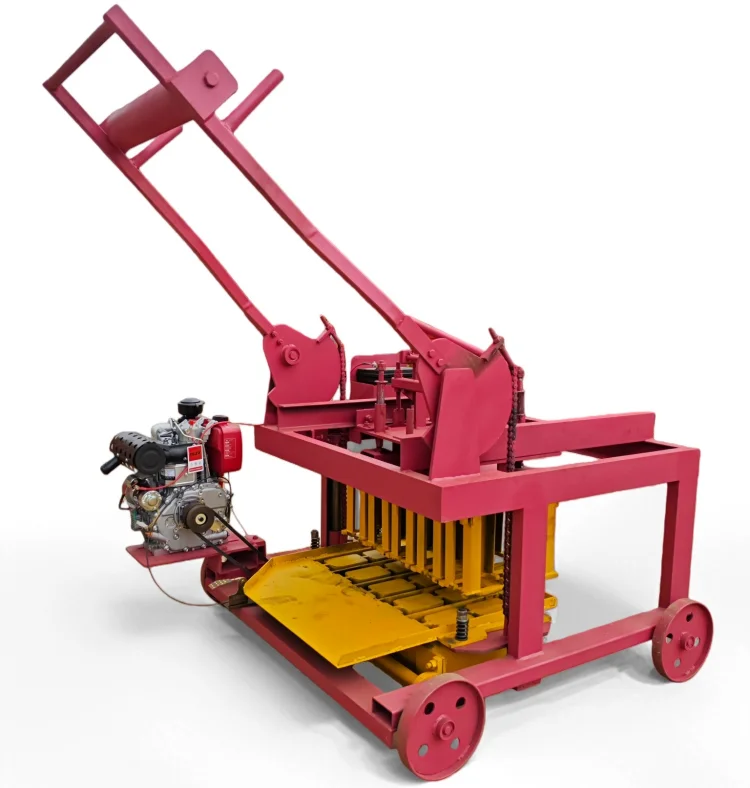
 Mobile block machine