

Concrete Mixer for Block Line: Factory Price, MOQ & Container Load
A bigger mixer does not guarantee faster production. In fact, an oversized concrete mixer for block line often creates idle time for the host machine, destroying your return on investment before the first brick is laid.
To avoid operational bottlenecks, match the mixer’s hourly output to at least 1.2 times the block machine’s theoretical capacity, select bin configurations based on raw material variety rather than habit, and plan container loading around strategic disassembly points to maximize 40ft HQ space utilization.
I still remember the humidity in Lagos when I watched a client’s new production line sit silent. The QT6-15 block maker was ready, the molds were oiled, but the aggregate bins were empty. The issue was not a lack of raw materials, but a mismatch in the feeding system. The client had ordered a standard two-bin batching system, assuming it would suffice for their multi-color paver project. However, the switching time between different colored aggregates caused the mixer to wait, and the block machine to wait for the mixer. That day, we lost nearly a third of the scheduled output. Since then, I have learned that the concrete mixer for block line is not just an accessory; it is the heartbeat of the entire plant. If the heart beats out of rhythm with the body, the whole system fails. [NEED_CITE: impact of batching cycle time on overall plant efficiency]
Understanding this synchronization is the first step toward a profitable operation. Let us break down how to select the right equipment, avoid common logistical pitfalls, and ensure your investment pays off from day one.
Why Does Mixer Capacity Dictate Your Line’s ROI?
Many buyers assume that purchasing the largest available mixer will future-proof their business. This is a costly misconception. The true constraint in a block production line is not the mixing speed, but the discharge cycle and the coordination with the block machine’s hopper capacity.
If the mixer discharges too slowly, the block machine starves. If it discharges too quickly without adequate buffering, the material may segregate or overflow. The goal is a continuous flow where the mixer completes its cycle just as the block machine is ready for the next batch. [NEED_CITE: standard cycle time calculations for automatic block machines]
Consider the difference between a PL800 and a PL1200 series mixer. While the model numbers suggest a simple capacity increase, the internal geometry and discharge gate mechanisms differ significantly. A PL1200 is designed for higher throughput, but if paired with a QT4-15 machine, it will spend most of its time waiting. Conversely, pairing a small mixer with a QT10-15 forces the high-speed host to idle, wasting energy and labor costs.
| Parameter | Small Scale Line (QT4-15/QT5-15) | Medium Scale Line (QT6-15/QT8-15) | Large Scale Line (QT10-15/QT12-15) |
|---|---|---|---|
| Recommended Mixer Type | Standard Twin-Shaft | Heavy-Duty Twin-Shaft | Industrial High-Capacity |
| Bin Configuration | 2-Bin Standard | 3-Bin or 4-Bin Optional | 4-Bin Mandatory for Complex Mixes |
| Discharge Cycle Focus | Simplicity | Balance of Speed and Volume | High-Speed Continuous Flow |
| Bottleneck Risk | Low if matched correctly | Moderate if bins are insufficient | High if mixer output lags |
In a project in Southeast Asia, a startup investor opted for a larger mixer to "be safe." However, they neglected the conveyor belt capacity leading into the mixer. The result was a bottleneck at the intake, not the discharge. The mixer sat empty while the conveyor struggled to keep up. By recalibrating the entire feeding sequence and selecting a concrete mixer for block line that matched the conveyor’s throughput rather than just the block machine’s demand, they stabilized production. [NEED_CITE: principles of balanced production line design]
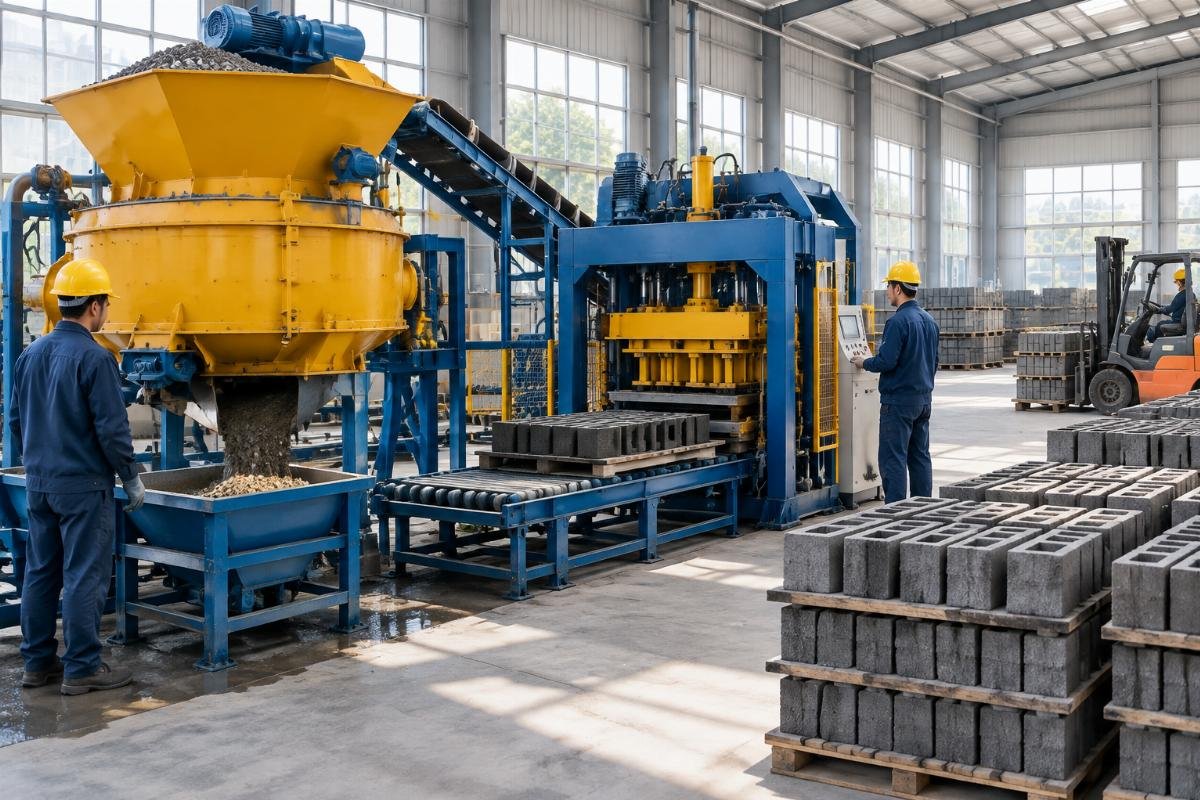
The lesson is clear: capacity must be balanced across the entire chain, not just at the mixing stage.
How to Choose the Right Binning System for Your Blocks?
The binning system is often overlooked, yet it determines the versatility of your product range. A common mistake is choosing a bin configuration based on the number of aggregates available today, rather than the products you plan to manufacture tomorrow.
For standard grey concrete blocks, a two-bin system is usually sufficient. One bin holds coarse aggregate, and the other holds sand or fine aggregate. However, if you intend to produce colored pavers, interlocking bricks with face mixes, or specialized curbstones, you need more flexibility.
A four-bin system allows for separate storage of cement, sand, coarse aggregate, and a dedicated color aggregate or additive. This separation prevents cross-contamination and enables rapid changeovers between product types. In a Latin American expansion project, a manufacturer attempted to produce colored paving stones using a two-bin system by manually swapping materials. This led to inconsistent color batches and significant material waste. Switching to a four-bin configuration resolved the quality issues and reduced setup time between batches. [NEED_CITE: best practices for multi-color concrete production]
When evaluating a concrete mixer for block line, ask yourself:
- Will I produce single-color or multi-color products?
- Do I need to add special admixtures or fibers separately?
- How much floor space is available for the batching plant?
A four-bin system requires more footprint and a more complex control system, but it unlocks higher-margin products. If your market demands decorative interlocking pavers, the extra investment in bins pays for itself through product diversity.
Do not let the initial cost of additional bins deter you if your business plan includes premium products. The flexibility they provide is crucial for adapting to market trends.
What Are the Real Constraints of Container Loading?
Shipping a full turnkey block plant is a logistical puzzle. Many buyers assume that all equipment will fit neatly into standard containers, but irregular shapes like hoppers, mixer drums, and palletizers often lead to wasted space.
A 40ft High Cube container offers substantial volume, but inefficient loading can result in paying for air. In one instance, a shipment to Nigeria was delayed because the mixer and batching plant were loaded without strategic disassembly. The curved surfaces of the mixer drum created voids that could have been filled with smaller components like motors, control panels, and spare parts. Instead, these items were shipped separately via air freight due to lack of space, doubling the logistics cost. [NEED_CITE: optimization techniques for industrial machinery container loading]
To maximize space utilization:
- Disassemble Protrusions: Remove hoppers and chutes from the mixer and batching plant. These can be nested or stacked flat.
- Utilize Void Spaces: Place electrical cabinets, hydraulic stations, and small spare parts inside the hollow sections of larger frames or inside the mixer drum if clean and dry.
- Custom Crating: For irregular items like palletizers, custom wooden crates can be designed to stack efficiently, saving up to a significant portion of sea freight volume compared to standard crating.
When planning your order for a concrete mixer for block line, request a detailed packing list and loading diagram from the manufacturer. This allows you to visualize how the equipment will fit and identify potential space-saving opportunities before the goods leave the factory.
Proper planning here does not just save money; it prevents customs delays caused by incomplete shipments or damaged goods due to poor stacking.
How to Define MOQ for Spare Parts vs Full Lines?
Understanding Minimum Order Quantity (MOQ) is essential for managing cash flow and ensuring long-term operational stability. For full production lines, the MOQ is typically one complete set, including the block machine, mixer, batching plant, and palletizer. However, for spare parts, the dynamics are different.
Ordering spare parts individually via express courier is expensive and slow. It is more cost-effective to bundle critical spares with your initial equipment order. Common items include mold liners, vibration motors, hydraulic seals, and PLC components. By including these in the main shipment, you avoid high international shipping rates and ensure you have backups ready when needed.
For distributors or agents, the MOQ for spare parts may be defined by container volume rather than unit count. Ordering a mixed container of various spare parts allows for better pricing and consolidated shipping. This approach is particularly beneficial for maintaining service levels in remote locations where supply chains are long.
When discussing a concrete mixer for block line, clarify the MOQ for both the main equipment and the associated spare parts package. This ensures you are not caught off guard by minimum purchase requirements later. [NEED_CITE: standard industry MOQ practices for construction machinery spare parts]
Strategic ordering of spares reduces downtime and protects your production schedule from unexpected failures.
Conclusion
Success in block manufacturing depends on synchronization, not just individual machine power.
Choosing the right concrete mixer for block line involves balancing capacity with the host machine, selecting bins that match your product strategy, and planning logistics to minimize waste. By focusing on these integrated details, you build a plant that runs smoothly and profitably from the start.

Industry expert sharing insights about concrete machinery, block making technology and turnkey production solutions.
View all posts →
Leave a Reply