

QT10-15 Block Machine Manufacturer | CE Certified for Sale
Most buyers assume Indian block machines are cheaper, but the real cost gap hides in single-brick output and hydraulic reliability — not the invoice price.
When sourcing a Chinese vs Indian Block Machine, the fundamental divide is automation depth: India dominates entry-level manual and semi-automatic units suited for small retail yards, while China leads in fully-automatic PLC-controlled lines delivering turnkey capacity for government tenders and large-scale housing projects. The choice hinges on daily output targets, total cost of ownership over five years, and whether the supplier provides on-site commissioning with certified documentation. [NEED_CITE: global block machine trade flow distribution by automation tier]
Understanding this landscape requires looking past catalog prices and examining what actually drives profitability on the ground — from mould compatibility and cycle times to spare parts logistics and voltage adaptation for unstable grids.
What Are the Key Spec Differences Between Chinese and Indian Block Machines?
Output capacity, automation architecture, and mould interchangeability define the real technical gap between the two sourcing corridors.
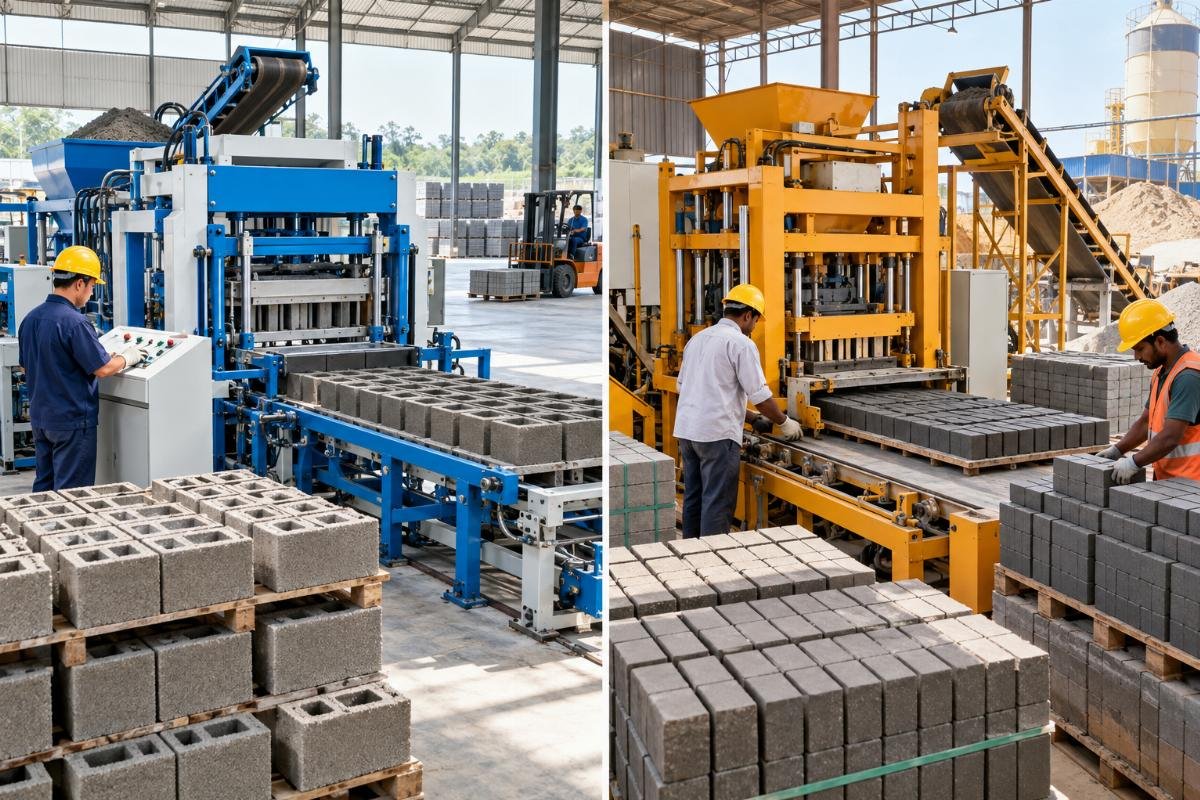
The specification divide becomes visible when comparing machines across three automation tiers: manual, semi-automatic, and fully-automatic. Indian manufacturers concentrate heavily on the first two tiers, offering egg-laying mobile units and static semi-auto presses that rely on mechanical vibration and manual material feeding. Chinese manufacturers, by contrast, have scaled production around PLC-controlled hydraulic systems with automated pallet circulation, batch mixing, and stacking — the kind of integrated lines required for high-volume contract work.
| Specification Parameter | Indian Manual/Semi-Auto | Chinese Semi-Auto | Chinese Fully-Auto |
|---|---|---|---|
| Automation Level | Mechanical / Basic Electrical | Partial PLC Integration | Full PLC with Touchscreen HMI |
| Vibration System | Single Motor Mechanical | Dual Motor with Frequency Control | Multi-Point Hydraulic Vibration |
| Mould Changeover | Manual Bolt Removal | Quick-Release Frame | Hydraulic Mould Cartridge System |
| Daily Output Range | Low Volume Retail | Medium Batch Production | High Volume Continuous |
| Pallet Handling | Manual Placement | Semi-Auto Conveyor | Fully-Auto Loader and Stacker |
| CE/SGS Certification | Rarely Available | Selectively Offered | Standard for Export Models |
[NEED_CITE: block machine technical specification comparison by country of origin per industry exhibition data]
A housing contractor in East Africa evaluated both corridors side by side. The Indian semi-automatic line quoted a lower upfront price, but the Chinese fully-automatic line — specifically the QT10-15 configuration — delivered a substantially higher daily output ratio because the cycle time per moulding press was noticeably shorter and the pallet return system eliminated manual bottlenecks. The payback period compressed accordingly, and the installation commissioning timeline was completed within weeks rather than dragging across months.
The mould compatibility question also matters. Chinese fully-automatic lines typically accept standardized mould cartridges that can be swapped for hollow blocks, solid bricks, interlocking pavers, and curbstones within a single shift. Indian semi-auto machines often require dedicated mould frames bolted in place, meaning product diversification demands additional capital expenditure and extended downtime.
How Does Total Cost of Ownership Compare Beyond the Purchase Price?
Shipping weight, spare parts lead time, energy consumption, and mould lifespan determine true ROI — not the factory gate quotation.
A common procurement mistake is comparing only the FOB invoice. The Chinese vs Indian Block Machine decision becomes clearer when buyers model total cost of ownership across five operational years. This model must include ocean freight by container volume, import duty differentials, mould replacement cycles, hydraulic fluid and seal consumption, electrical energy per thousand blocks, and the cost of production downtime when critical components fail.
Indian manual and semi-auto machines are lighter and sometimes fit into shared container loads, reducing initial freight. However, their mould lifespan tends to be noticeably shorter due to lower-grade wear plate steel, meaning replacement moulds arrive more frequently — each shipment adding customs clearance cost and production interruption.
Chinese fully-automatic lines ship as complete turnkey packages occupying full containers, but the per-brick energy cost drops substantially because hydraulic vibration systems transfer energy more efficiently than mechanical eccentric motors. Mould lifespan extends meaningfully when manufacturers use controlled heat treatment on wear surfaces rather than untreated mild steel.
| TCO Component | Indian Manual/Semi-Auto | Chinese Fully-Auto |
|---|---|---|
| Initial Equipment Price | Lower Entry Point | Moderate Investment |
| Freight per Container | Lower Weight | Full Container Load |
| Mould Replacement Frequency | Noticeably Higher | Substantially Extended |
| Energy per Thousand Blocks | Higher Consumption | Efficient Hydraulic Transfer |
| Spare Parts Lead Time | Extended Remote Shipping | Regional Warehouse Availability |
| Downtime Risk per Year | Vulnerable | Resistant |
[NEED_CITE: total cost of ownership model for concrete block production equipment across emerging markets]
A West African distributor evaluating dual sourcing found that Indian manual machines worked for retail walk-in customers buying small batches, but Chinese automatic lines won project tenders because the certification documentation — CE, SGS, ISO — was verifiable and the spare parts supply chain had regional nodes. The lead time for critical hydraulic seals and PLC modules from Chinese tier-one suppliers was noticeably shorter than waiting for remote dispatch from South Asian factories without local service infrastructure.
Voltage adaptation also enters the TCO calculation. Many emerging market sites suffer from grid instability, with fluctuations that damage sensitive electronic controls. Chinese manufacturers with export experience build in voltage regulation and surge protection as standard for unstable grid environments, whereas Indian machines often arrive configured for stable industrial power — meaning buyers must add external stabilizers at additional cost.
Which Market Segments Does Each Country Serve Best?
India leads entry-level manual production for micro-enterprises; China dominates fully-automatic turnkey lines for scale-oriented contractors and government projects.
The market segmentation between the two sourcing countries is not accidental — it reflects decades of industrial specialization. Indian block machine manufacturers evolved alongside a massive domestic informal construction sector, where small entrepreneurs produce blocks by hand or with minimal mechanization for neighborhood-level housing. The machines are designed for simplicity, low capital outlay, and operation without trained technicians.
Chinese manufacturers, conversely, scaled up to serve domestic infrastructure booms and government-subsidized housing programs that demanded high-volume automated production. This experience translated directly into export offerings: complete turnkey plants with batching systems, conveyor networks, pallet circulation, and stacking — all controlled from a central PLC cabinet.
For private investors setting up a new block business in emerging markets, the decision depends on target market size. A retail yard serving individual homebuilders may find Indian manual or semi-auto equipment sufficient, with lower entry barriers and simpler maintenance. But a contractor bidding on government housing tenders, road paving projects, or large commercial developments needs the output consistency and certification documentation that Chinese fully-automatic lines provide.
A MENA entrepreneur upgrading from manual production to automatic evaluated quotes from both corridors. The Indian quotation covered standalone machines without integrated site layout planning. The Chinese turnkey package — including the QT10-15 line — included site layout customization, operator training duration planning, and voltage adaptation engineering for local grid conditions. The scope difference was substantial: one was a machine purchase, the other was a production system deployment.
The certification question also segments buyers. Government tenders across Africa, the Middle East, and Latin America increasingly require CE marking, SGS inspection reports, and ISO quality management documentation as mandatory bid prerequisites. Chinese tier-one manufacturers include these certifications as standard deliverables with export machines. Indian manufacturers, serving primarily domestic informal markets, often lack these certifications — disqualifying their equipment from formal tender processes.
[NEED_CITE: certification requirements for construction equipment in government procurement across emerging economies]
What After-Sales and Certification Support Can Buyers Expect?
On-site installation, operator training, and verifiable CE/SGS documentation separate tier-one Chinese suppliers from the rest of the market — and from most Indian manufacturers.
After-sales support is where the Chinese vs Indian Block Machine comparison reveals its sharpest contrast. Indian manufacturers typically provide remote technical guidance via video calls and ship spare parts on demand — a model that works when machines are simple and operators are experienced. But for fully-automatic lines with hydraulic systems, PLC programming, and integrated material handling, remote support creates extended downtime when faults occur.
Chinese tier-one manufacturers have built regional service infrastructure across key export markets. Engineers are available for on-site installation supervision, commissioning, and operator training — often included in the turnkey package rather than billed as expensive add-ons. This field presence means that when a hydraulic valve fails or a PLC parameter needs adjustment, local or regional technicians respond within days rather than weeks.
| After-Sales Element | Typical Indian Supplier | Tier-One Chinese Supplier |
|---|---|---|
| Installation Supervision | Remote Video Guidance | On-Site Engineer Deployment |
| Operator Training | Basic Manual Provided | Structured On-Site Program |
| Spare Parts Logistics | International Shipping Only | Regional Warehouse Nodes |
| CE/SGS Documentation | Rarely Provided | Standard Export Deliverable |
| Voltage Adaptation Support | Buyer Responsibility | Engineered to Site Conditions |
| Dust and Heat Protection | Not Standard | Field-Tested for Harsh Environments |
[NEED_CITE: after-sales service infrastructure comparison for construction machinery exporters]
A construction equipment distributor in Latin America evaluated dual sourcing for his territory. Indian machines were competitively priced for manual and semi-auto segments, but when government tenders required CE certification and on-site commissioning guarantees, only Chinese tier-one suppliers could meet the requirements. The distributor established a partnership where Indian machines served retail walk-in customers while Chinese automatic lines won institutional contracts — a segmentation that maximized market coverage without overcommitting to a single sourcing corridor.
The certification documentation itself deserves attention. CE marking for machinery exported to markets recognizing European standards requires technical file compilation, risk assessment documentation, and declaration of conformity — not just a sticker on the control panel. Tier-one Chinese manufacturers maintain these files and provide them with shipment, enabling buyers to present complete compliance packages to inspectors and tender committees. Indian manufacturers serving informal domestic markets rarely invest in this documentation infrastructure.
How Should Buyers Validate Suppliers Before Committing?
Factory audit, reference site visits, and trial production verification separate serious manufacturers from trading companies repackaging equipment.
Before committing to a Chinese vs Indian Block Machine purchase, buyers must validate that the supplier controls actual manufacturing capacity rather than brokering equipment from unknown workshops. The validation process should cover three dimensions: production facility audit, operational reference verification, and trial production under buyer-specified conditions.
A production facility audit confirms that the manufacturer controls critical processes — steel cutting, welding, machining, hydraulic assembly, electrical cabinet wiring, and paint finishing — rather than outsourcing to uncontrolled subcontractors. Buyers should request video walkthroughs or arrange third-party inspection covering weld quality on main frames, machining precision on mould surfaces, and assembly cleanliness in hydraulic stations.
Operational reference verification means contacting buyers who have installed the same machine model in similar conditions — same automation level, same product range, same climate and grid environment. A supplier confident in their equipment will provide reference contacts across multiple regions. A supplier who cannot provide references, or offers only domestic installations, raises red flags about export readiness.
Trial production verification is the most conclusive step. Serious manufacturers allow buyers to witness trial runs using buyer-specified raw material recipes — local cement, local aggregate gradations, local water-cement ratios — to confirm that the machine produces blocks meeting target strength and dimensional tolerances. This trial also reveals cycle time consistency, vibration uniformity across mould cavities, and hydraulic system stability under continuous operation.
For buyers evaluating Chinese suppliers specifically, verification should confirm that the manufacturer customizes equipment for local conditions rather than shipping standard configurations. Voltage adaptation for unstable grids, dust protection for arid environments, and raw material recipe adjustment for local aggregate characteristics all require engineering input — not just sales promises. Manufacturers with genuine export experience maintain engineering teams dedicated to these customizations, while brokers simply ship catalog-standard machines and leave adaptation problems to the buyer.
[NEED_CITE: supplier validation best practices for capital equipment procurement in emerging markets]
A private investor in West Africa followed this validation sequence before purchasing a complete production line. The factory audit confirmed controlled welding and machining processes. Reference calls with buyers in neighboring countries confirmed that spare parts arrived within acceptable timeframes and that on-site commissioning engineers completed installation professionally. The trial production run using local materials confirmed block strength targets and cycle time promises. This systematic validation eliminated supplier risk before capital commitment.
Conclusion
The Chinese vs Indian Block Machine decision resolves to automation depth and total system support — not catalog price alone.
Indian manufacturers serve the entry-level manual and semi-automatic segment effectively, offering low-cost machines for small-scale retail production. Chinese manufacturers dominate the fully-automatic turnkey segment, delivering high-output PLC-controlled lines with certification documentation, on-site commissioning, and regional after-sales infrastructure required for government tenders and large-scale housing projects. Buyers must model total cost of ownership across five years — including freight, mould lifespan, energy consumption, spare parts logistics, and downtime risk — rather than comparing only the factory gate quotation. Supplier validation through factory audit, reference verification, and trial production eliminates procurement risk before capital commitment.

Industry expert sharing insights about concrete machinery, block making technology and turnkey production solutions.
View all posts →
Leave a Reply