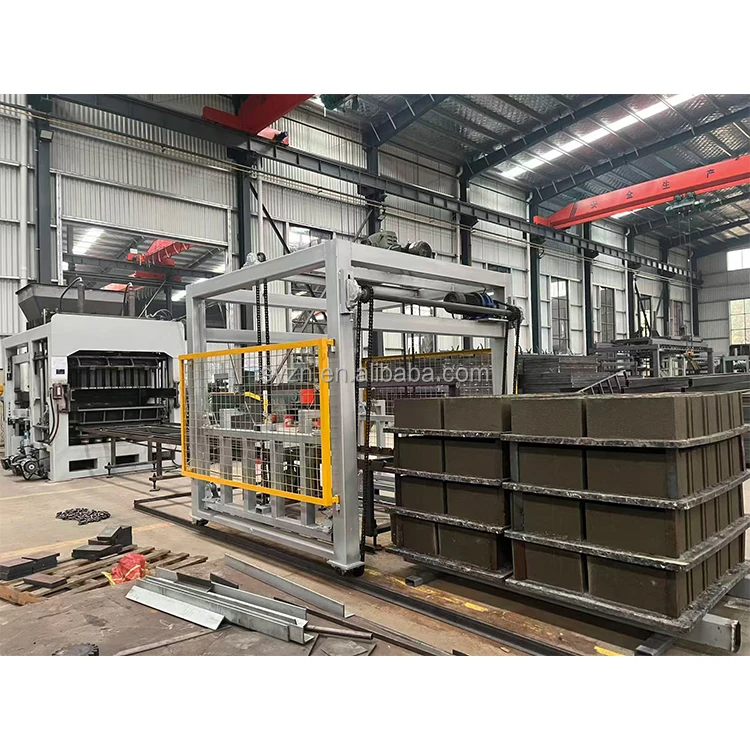
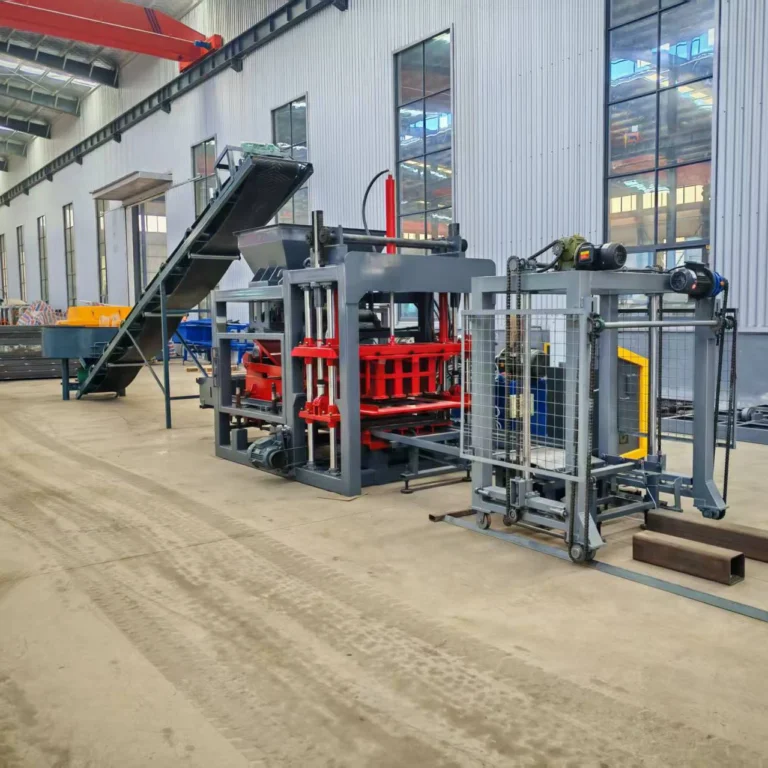
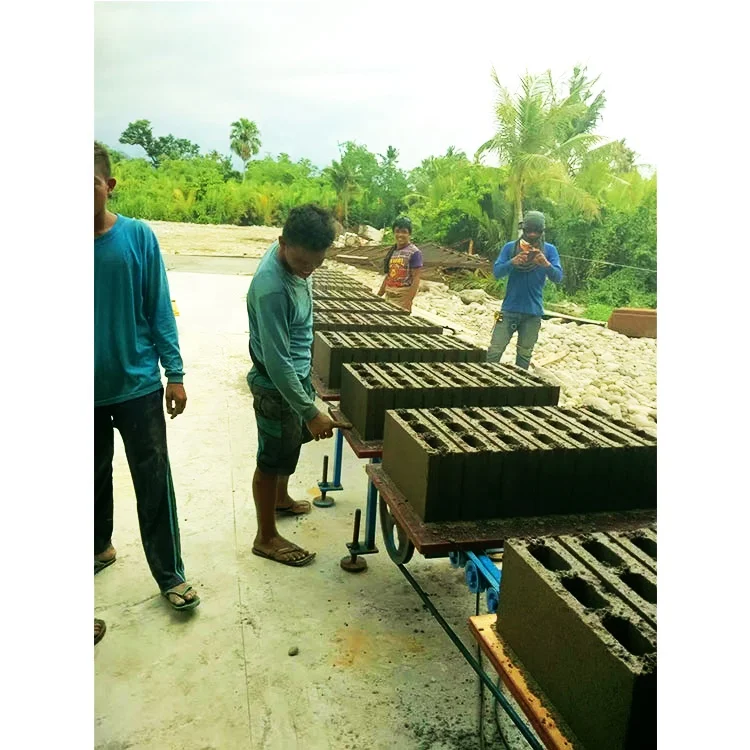
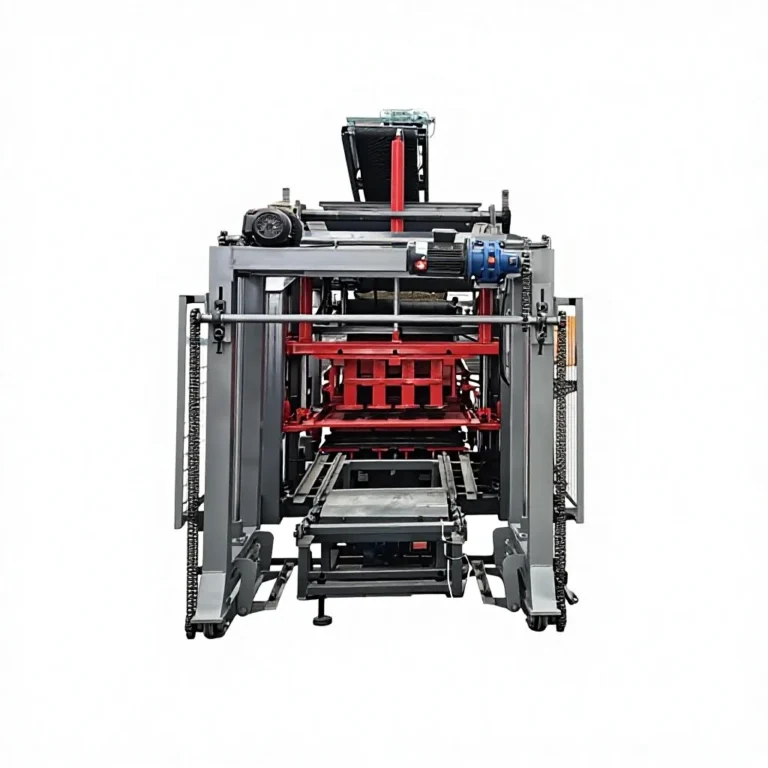
Matched System Sizing — Every QTJ4-40 semi-automatic concrete block machine is configured around the buyer’s actual block format, pallet size, and local aggregate rather than a catalogue default.
Technical Specifications
| Parameter |
Value |
| Model |
QTJ4-40 |
| Product Type |
Semi-Automatic Concrete Block Making Machine |
| Machine Power |
10.4 kW |
| Molding Cycle |
40 s |
| Theoretical Output (400×200×200 mm hollow block, 4 pcs/mould) |
360 pcs/h, 2800 pcs/day (basis to be confirmed with buyer mix and curing conditions) |
| Theoretical Output (400×150×200 mm hollow block, 5 pcs/mould) |
450 pcs/h, 3600 pcs/day (basis to be confirmed) |
| Theoretical Output (225×112.5×60 mm solid brick, 9 pcs/mould) |
800 pcs/h, 6400 pcs/day (basis to be confirmed) |
| Raw Materials |
Concrete, sand, cement, fly ash, lime, gypsum |
| Vibration System |
Bed mould vertical vibration + upper mould compression vibration |
| Automation Level |
Semi-automatic (top die push/pull, automatic scraper) |
| Pallet Size |
850 × 450 mm |
| Overall Dimensions (L×W×H) |
1350 × 1460 × 1800 mm |
| Machine Weight |
1 T |
| Voltage |
Configured to local voltage and frequency (confirmed before production) |
| Control System |
To be confirmed (PLC / relay / manual) |
Application Suitability
| Application |
Material or Output |
| First-time block plant for entrepreneurs |
Hollow blocks and solid bricks from locally sourced sand, cement, and fly ash |
| On-site production for housing contractors |
Hollow blocks using crushed stone aggregate and cement on project sites |
| Small building material producers expanding range |
Solid bricks and paving formats added to existing hollow block output |
| Low-investment workshop production |
Compact footprint operation with semi-automatic cycle at moderate daily volume |
What "2800 Pieces per Day" Actually Depends On
Capacity is only honest when the block format behind the number is stated upfront.
A semi-automatic block machine manufacturer quoting daily output without naming the mould format is leaving out the variable that matters most. The QTJ4-40 cycles every 40 seconds, but a 4-piece hollow block mould and a 9-piece solid brick mould produce vastly different totals over an eight-hour shift. Buyers who compare machines on a single headline number often find their actual output sits well below expectation once the correct mould is installed. I have seen project contractors in East Africa commit to delivery schedules based on solid brick capacity, only to discover the machine was configured for hollow blocks. [NEED_CITE: common causes of capacity shortfall in small block plants]

Where the QTJ4-40 Fits in the Range
The QTJ4-40 occupies the semi-automatic tier, positioned between purely manual egg-laying machines and fully automatic lines with pallet feeding and stacking systems. For a buyer surveying options, this model offers a middle ground: the top die push/pull mechanism and automatic scraper reduce manual handling compared to hand-operated presses, while the compact 1350 × 1460 mm footprint keeps workshop space requirements modest. This semi-automatic block machine manufacturer supplies the QTJ4-40 as an entry point for buyers who need more consistency than a manual machine delivers but are not yet ready to invest in full automation.
Semi-Automatic Operation and the Upgrade Path
Starting with a semi-automatic configuration does not lock a buyer into that tier permanently. The pallet handling, mixing, and curing stages around the press can be upgraded independently as production volume grows. A buyer might begin with manual pallet transfer and later add an automatic pallet feeder once daily output justifies the investment. The QTJ4-40’s mould change system and vibration platform remain compatible with higher-tier supporting equipment, so the press itself does not need replacement when the line expands. [NEED_CITE: typical upgrade sequence for small block production lines]
How Vibration and Pressure Interact at This Scale
The dual vibration system — vertical vibration on the bed mould combined with compression vibration on the upper mould — determines how densely the concrete mix packs into each cavity. At 10.4 kW total machine power, the vibration force is matched to small and medium mould formats rather than large paver moulds that demand higher energy input. The 40-second molding cycle allows the vibration to consolidate the mix fully before the top die retracts. The 850 × 450 mm pallet size sets the curing area layout: buyers need to plan rack spacing and forklift access around that dimension before the machine arrives, not after. [NEED_CITE: relationship between vibration force and block compressive strength in semi-automatic presses]
The Hidden Cost of Skipping Pallet and Voltage Confirmation
When pallet size is chosen without checking the buyer’s existing curing racks and forklift dimensions, the first week of production turns into a logistics problem rather than a manufacturing one. Pallets that do not fit the curing area force manual restacking, which slows the entire cycle. Similarly, voltage and frequency left unconfirmed until the machine arrives can delay commissioning by weeks while transformers or motor replacements are sourced locally. These are not engineering failures — they are specification gaps that surface only after the container is opened. [NEED_CITE: voltage and frequency standards by export market]
Why Source This Machine From a Single-Focus Manufacturer
Block machinery is our only product line, which means the QTJ4-40 is specified alongside its mould, pallet, and handling equipment as one matched system rather than assembled from separate suppliers. The configuration is set against the buyer’s actual mix design and target block format, not pulled from a catalogue default. Mould design covers the formats the buyer’s market actually sells, including custom drawings when standard formats do not match local demand. Factory testing runs the machine on the buyer’s specified material before dispatch, so cycle time and block density are verified — not assumed. Installation support includes operator training on mould change procedure and daily maintenance intervals specific to this model.
Documentation & Verification
- Line layout drawing showing QTJ4-40 placement with pallet flow and curing area dimensions
- Capacity calculation sheet stating block format assumed for each output figure
- Mould drawing and format list covering hollow block, solid brick, and paver options
- Pallet specification matched to 850 × 450 mm size with material grade confirmed
- Voltage and control language confirmation document signed before production starts
- Factory test record showing actual cycle times on buyer-specified mix before shipment
Installation, Commissioning & Support
- Foundation pad leveled to 1350 × 1460 mm footprint with anchor bolt pattern provided
- Dedicated 10.4 kW circuit with voltage and frequency matched to local grid specification
- Machine shipped as single unit with mould removed for container loading
- First-run commissioning includes vibration tuning to buyer’s mix density target
- Operator training covers 40-second cycle timing, mould change, and scraper adjustment
- Wear parts list supplied with hydraulic seal and vibration motor replacement intervals
Before You Request a Quote
To configure the QTJ4-40 for your production environment, share the block formats your market requires, the daily output you need per format, and the raw materials available locally including aggregate type and cement grade. Confirm your site voltage, frequency, and preferred control display language so the electrical package is built correctly from the start. If you have existing pallets or curing racks, provide their dimensions to ensure compatibility with the 850 × 450 mm pallet system.
Frequently Asked Questions
Q: How is daily output calculated for each block format on the QTJ4-40?
A: Each output figure is based on the 40-second molding cycle multiplied across an eight-hour shift, using the specific piece count per mould. The 400×200×200 mm hollow block produces 4 pieces per cycle, while the 225×112.5×60 mm solid brick produces 9. Actual daily totals depend on mix consistency, operator pace, and pallet handling speed.
Q: Where does the QTJ4-40 sit compared to fully automatic and mobile block machines?
A: The QTJ4-40 is the semi-automatic tier, offering more consistency than manual egg-laying machines through its automatic scraper and top die mechanism, while requiring lower investment than fully automatic lines. Mobile machines suit on-site production without a fixed plant, whereas the QTJ4-40 is designed for stationary workshop or small plant operation.
Q: What voltage and frequency options are available for African markets?
A: The electrical system is configured before production to match the buyer’s local grid. Common configurations include 380V/50Hz for Ethiopia and Tanzania, and 415V/50Hz for Zimbabwe. Voltage and control display language are confirmed in writing before manufacturing begins to prevent commissioning delays.
Q: How does the 850 × 450 mm pallet size affect my curing area layout?
A: Pallet dimensions determine curing rack spacing, stacking height, and forklift fork width. Buyers should measure their existing curing area and handling equipment against this pallet size before ordering. Mismatched pallets force manual restacking, which reduces effective daily output and increases labor requirements on the production floor.
Q: Can I start with the QTJ4-40 and add automation later?
A: Yes. The QTJ4-40’s mould platform and vibration system remain compatible with automatic pallet feeders and stacking equipment added later. Many buyers begin with manual pallet handling to keep initial investment lower, then upgrade supporting equipment as daily volume and market demand grow beyond semi-automatic capacity.

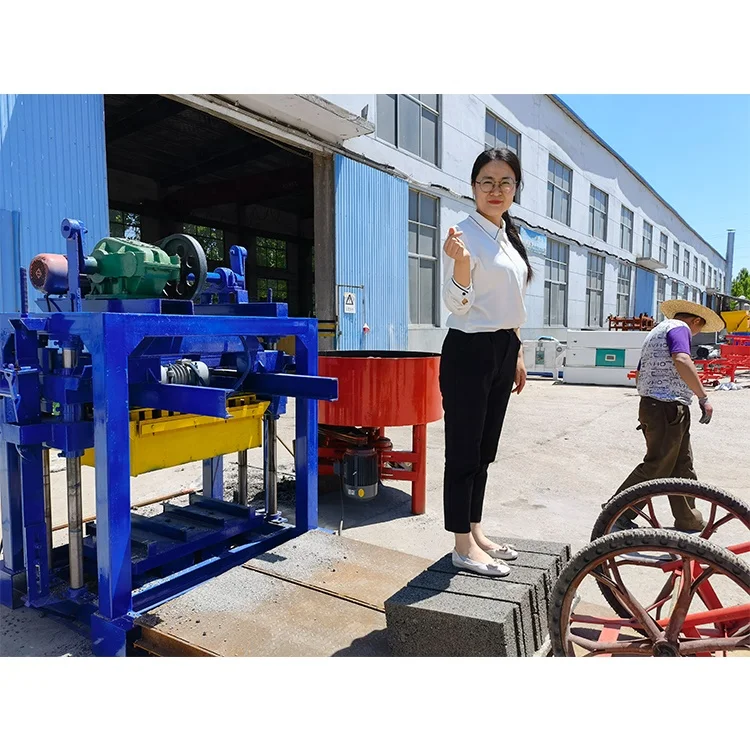
 High quality block machine