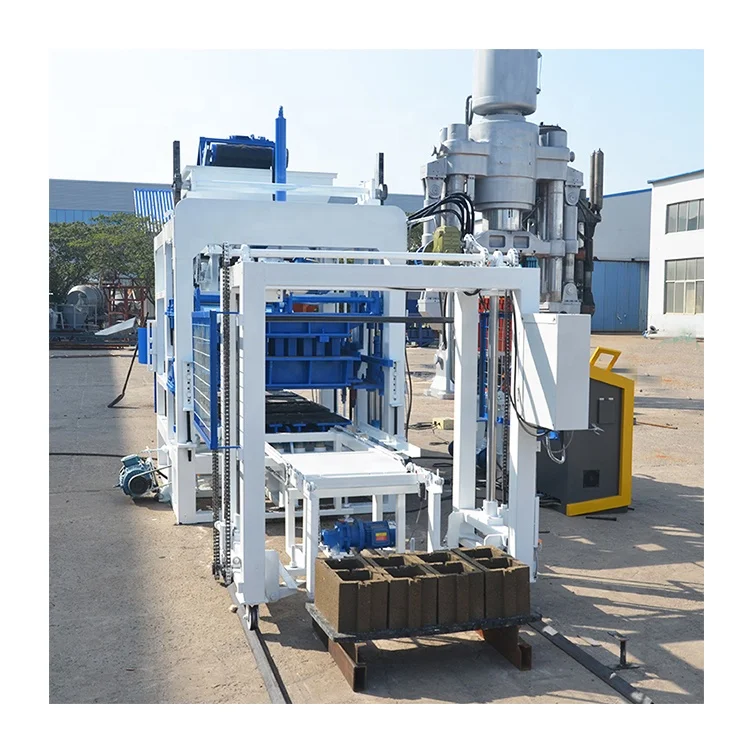
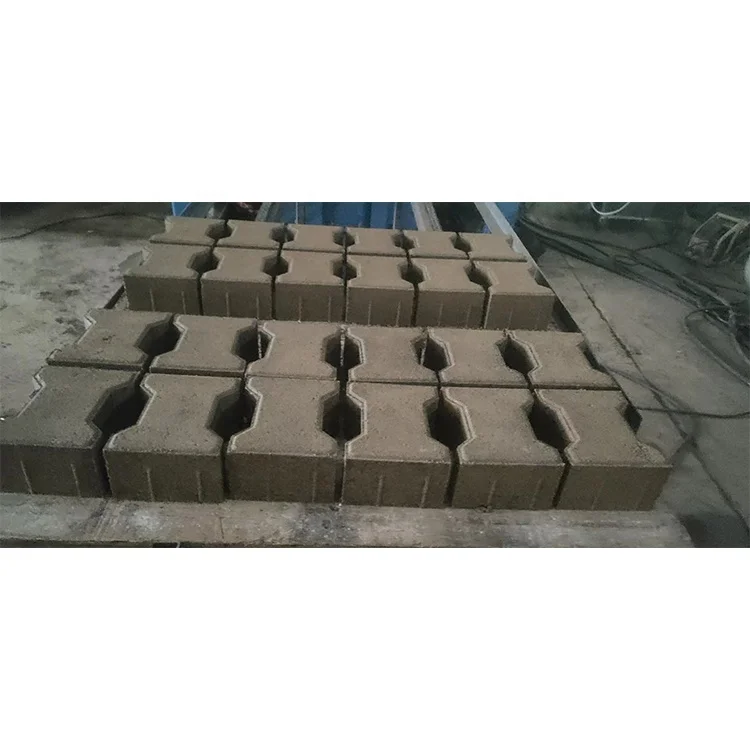
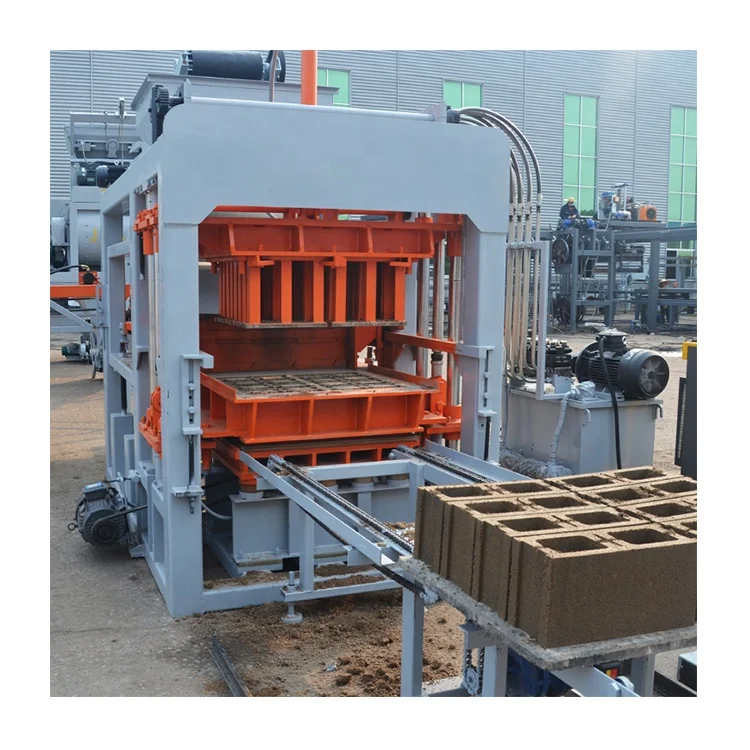
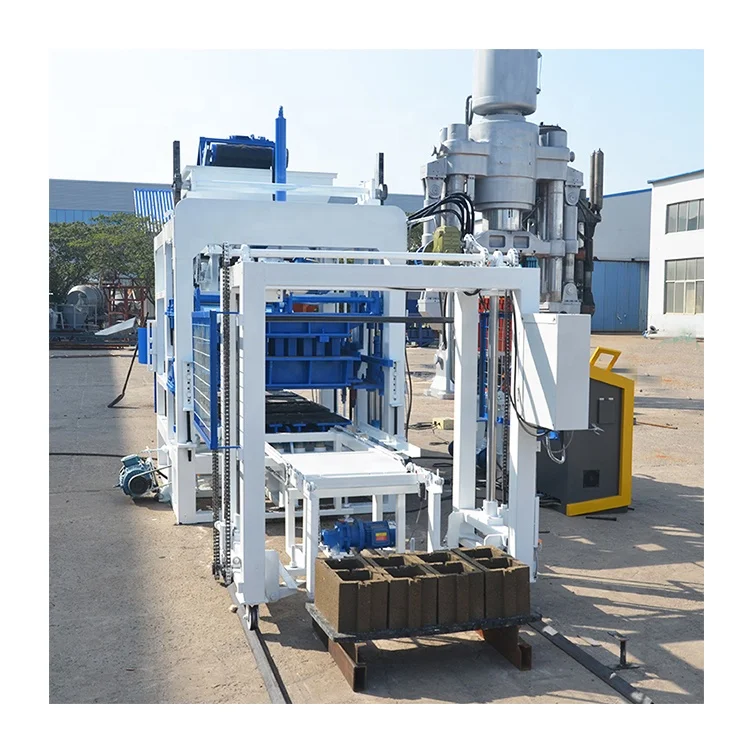
Matched System Configuration — the QTJ4-25 semi-automatic block machine is specified alongside its mould, pallet, and handling equipment as one coordinated line rather than a standalone press.
Technical Specifications
| Parameter |
Value |
| Model |
QTJ4-25 |
| Product Type |
Semi-Automatic Concrete Block Making Machine |
| Overall Dimensions |
3000 × 1800 × 2680 mm |
| Total Mass |
3.5 T |
| Overall Power |
16.58 kW |
| Vibration Force |
60 kN |
| Main Vibration Form |
Platform Vibration |
| Vibration Frequency |
2800–4500 r/min |
| Pallet Size |
850 × 480 mm |
| Molding Cycle |
25 s |
| Demolding Method |
Mechanical |
| Guide Column |
Four-column overlong guide, chrome-plated |
| Frame Material |
National standard manganese steel |
| Surface Treatment |
Chrome-plated |
| Automation Level |
Semi-automatic (mechanical demolding, manual pallet handling) |
| Output – 400×200×200 mm hollow block |
4 pcs/mould, 580 pcs/hour, 4640 pcs/day (8 h) |
| Output – 240×115×90 mm multi-cellular brick |
9 pcs/mould, 1400 pcs/hour, 11200 pcs/day (8 h) |
| Output – 240×115×53 mm solid brick |
21 pcs/mould, 3300 pcs/hour, 26400 pcs/day (8 h) |
| Applied Products |
Hollow/solid blocks, pavers, interlocking blocks, curbstone, colored pavers |
| Raw Materials |
Crushed stone, sand, cement, fly ash, gravel, slag, dust |
| Factory Area Required |
300 m² (basis not stated in source — confirm block format and material) |
| Warranty |
1 year for the whole machine (excluding spare parts) |
Application Suitability
| Application |
Material or Output |
| Small-to-medium block plant startup |
Hollow and solid blocks from crushed stone, sand, and cement |
| On-site production for housing projects |
Interlocking blocks and pavers using locally available aggregate |
| Building material distributor expanding range |
Multiple formats — hollow, solid, porous, paver — on one machine frame |
| Contractor producing curbstones locally |
Curbstone and colored paver runs with format-specific moulds |
| Entrepreneur establishing a first block plant |
Semi-automatic operation with manageable investment and room to scale |
What "Pieces per Hour" Really Means on a Semi-Automatic Block Machine Manufacturer’s Datasheet
Every output figure here is tied to a specific block size, mould cavity count, and 25-second cycle.
Many quotations in this industry list a single hourly number without disclosing which block format it assumes. A buyer sees a high figure, signs the order, and then discovers the actual daily output for their target product falls far short. With the QTJ4-25, the 580-piece hourly rate applies only to 400×200×200 mm hollow blocks at four per mould, while solid brick output at twenty-one per mould reaches 3300 per hour. The difference matters when you are planning curing space, pallet inventory, and shift scheduling. I have seen buyers arrive at a factory expecting one throughput number and leaving with a very different reality because nobody clarified the format behind the headline figure [NEED_CITE: block machine capacity quoting conventions and format assumptions].

Where the QTJ4-25 Sits in the Full Machine Range
The QTJ4-25 occupies the mid-entry tier of our semi-automatic block machine manufacturer lineup. Below it sits the mobile egg-layer class for on-site work without a fixed plant, and above it are fully automatic lines with pallet feeding, stacking, and cubing. This model gives buyers a step up in daily volume while keeping the investment and operator skill requirement within reach of a first-time plant owner. The semi-automatic block machine manufacturer range is structured so that each tier has a clear footprint, power demand, and automation boundary, making it straightforward to compare before narrowing down.
Scaling from Workshop Volume to Mid-Capacity Output
A small workshop producing a few thousand hollow blocks a day can run the QTJ4-25 on a single shift with manual pallet handling. When demand grows, the same machine frame accepts additional mould formats — pavers, interlocking bricks, porous blocks — without replacing the press itself. The 850×480 mm pallet size stays constant across formats, so curing racks and forklift attachments do not need to change when you add a new product line. This approach lets a plant expand its catalogue while protecting the initial capital outlay [NEED_CITE: typical block plant expansion paths from semi-automatic to automatic lines].
Vibration Force, Cycle Time, and What They Mean for Block Density
The 60 kN vibration force delivered through platform vibration at 2800–4500 r/min works together with the upper mould vibration motor to compact the mix uniformly. On lightweight aggregates — volcanic scoria, expanded clay, or low-density fly ash blends — the vibration frequency must be tuned to match the material’s response; too high and the mix segregates, too low and the block leaves the mould under-compacted. The 25-second molding cycle is a mechanical constant across formats, meaning throughput differences come entirely from cavity count per mould. The four-column overlong guide with chrome-plated surfaces keeps the upper and lower mould halves aligned over thousands of cycles, which directly affects wall thickness consistency on hollow blocks.
The Cost of Skipping the Pallet and Voltage Conversation
Pallet size seems like a minor line item until the machine arrives and the buyer’s existing curing racks are fifty millimetres too narrow. The 850×480 mm pallet was chosen to balance mould area with standard forklift tine spacing, but if the buyer’s curing yard uses non-standard racking, every pallet must be rehandled manually. Voltage and frequency carry a similar hidden cost: a machine wired for 380 V/50 Hz shipped to a 440 V/60 Hz market will run, but the vibration motor speed shifts, cycle behaviour changes, and the PLC display may show unreadable text. These issues surface during commissioning, not during the quotation stage, which is why confirming them before production avoids expensive on-site rework [NEED_CITE: voltage and frequency standards by export market].
Why Source This Model Through a Dedicated Block Machinery Supplier
Block machinery is our single focus, so the QTJ4-25 is specified as part of a matched system — press, mould, pallet, and handling — rather than assembled from separate vendors. Configuration is set against the buyer’s actual mix design and local aggregate, not a catalogue default. Mould design covers the formats the buyer’s market sells, with custom drawings available when standard options do not match. The automation level is selectable: a buyer can start with the QTJ4-25’s semi-automatic setup and move to a higher tier later without scrapping the press. Installation support includes operator training so the team understands mould change procedures, vibration tuning, and daily maintenance from the first shift.
Documentation & Verification
- Line layout and capacity calculation stating the block format behind each output figure
- Mould drawing and format list so you can verify included block sizes before order
- Voltage, frequency, and control language confirmation sheet signed before production
- Factory test record showing the QTJ4-25 running with your specified mix design
- Hydraulic and electrical schematic for local maintenance teams
- Packing photographs and customs documentation support for shipment
Installation, Commissioning & Support
- Foundation slab sized for the 3000 × 1800 mm footprint and 3.5 T operating mass
- Dedicated power circuit rated for the 16.58 kW total draw with voltage confirmed pre-shipment
- Machine shipped in dismantled state with reassembly guidance on site
- First-run commissioning covers vibration frequency tuning to your local aggregate
- Operator training on 25-second cycle management and mechanical demolding sequence
- Wear parts list with reorder codes for guide columns, vibration box, and mould liners
Before You Request a Quote
To configure the QTJ4-25 accurately, we need your target block formats and daily volume per format, the raw materials available locally with a gradation report if possible, and your site’s voltage, frequency, and preferred PLC display language. If you already have curing racks or forklifts in place, share the dimensions so the pallet specification aligns from the start.
Frequently Asked Questions
Q: How is output capacity calculated and which block format does each figure assume?
A: Each capacity figure is based on a specific block size and mould cavity count running a 25-second cycle. For example, 580 pieces per hour applies to 400×200×200 mm hollow blocks at four per mould. Solid brick output is 3300 per hour at twenty-one per mould. We provide a capacity calculation document that states the format behind every number so there is no ambiguity at the planning stage.
Q: Where does the QTJ4-25 sit compared to fully automatic and mobile machines?
A: It occupies the mid-entry semi-automatic tier — higher volume than a mobile egg-layer but without the pallet feeding, stacking, and cubing of a fully automatic line. Buyers choose it when they need consistent daily output from a fixed location but want to keep investment and operator complexity manageable. The range above it adds automation stations one by one.
Q: What pallet size is specified and how does it align with my curing setup?
A: The standard pallet is 850×480 mm, sized to match common forklift tine spacing and curing rack dimensions. If your existing racks or handling equipment use a different size, we confirm the match before production so pallets move smoothly from press to curing area without manual rehandling.
Q: Can I start with this semi-automatic model and add automation later?
A: Yes. The QTJ4-25 frame and control architecture allow pallet feeding and stacking modules to be added as separate upgrades. This lets a plant begin with manual pallet handling and move toward higher automation as volume grows, without replacing the core press or moulds already in use.
Q: What voltage and control language options are confirmed before shipment?
A: Voltage, frequency, and PLC display language are confirmed in writing before production begins. This covers motor winding specification, heater ratings if applicable, and the language shown on the operator interface. Confirming these details upfront prevents commissioning delays caused by electrical mismatch or unreadable controls on arrival.

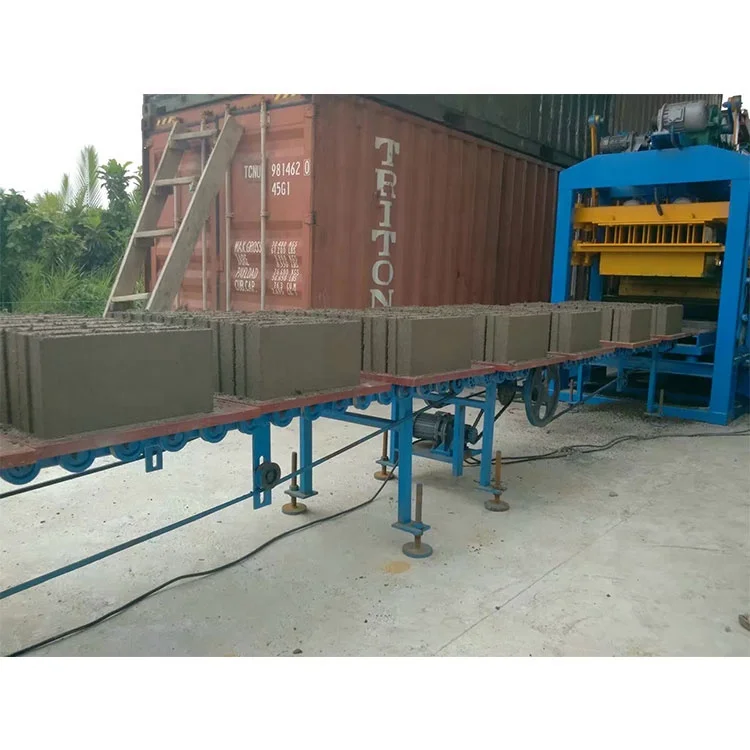
 Semi automatic block