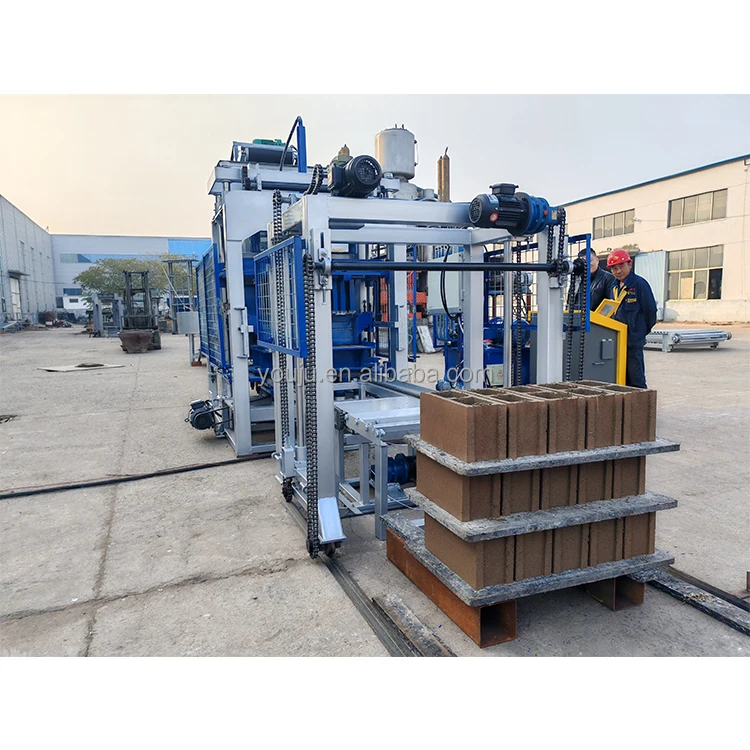
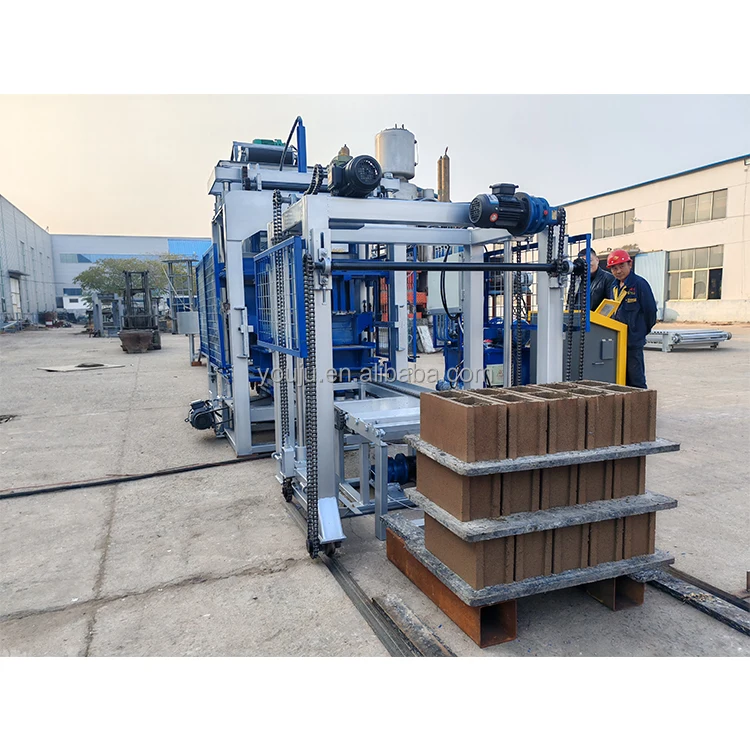
Full Range Configuration — we specify the QTJ4-24 semi-automatic block machine as one coherent system including press, mixer, conveyor and pallet handling, so a buyer surveying their first plant sees exactly where this tier fits before narrowing down.
Technical Specifications
| Parameter |
Value |
| Model |
QTJ4-24 |
| Product Type |
Semi-Automatic Concrete Block Making Machine |
| Machine Type |
Stationary, Platform Vibration |
| Overall Dimensions (L×W×H) |
3600mm × 1700mm × 2560mm (working state) |
| Total Mass |
1750 kgs |
| Molding Type |
Platform Vibration (lower and upper) |
| Pallet Size |
850mm × 450mm |
| Overall Power |
14.25 kW |
| Vibration System |
Lower platform (2 × 3 kW high-speed motors) + Upper platform (1.5 kW attached vibrator) |
| Elevating System |
Cone-shape motor with JZQ250 speed reducer, V-belt drive |
| Delivery Device |
Cycloidal pin wheel speed reducer, chain and V-belt drive |
| Mould Format Examples |
390mm × 190mm × 190mm (4 pcs/mould) / 240mm × 115mm × 53mm (21 pcs/mould) |
| Cycle Time |
24 seconds (basis not stated in source — confirm block format and material) |
| Automation Level |
Semi-automatic |
| Supporting Equipment (Basic) |
JQ350 pan mixer, 6m belt conveyor, trolley |
| Supporting Equipment (Optional) |
Auto stacker (3–6 layers depending on block height) |
| Control System |
Electronic controlling part (PLC type to be confirmed) |
| Voltage & Frequency |
Configurable to buyer requirement (to be confirmed before production) |
Application Suitability
| Application |
Material or Output |
| Hollow block production |
Crushed stone, sand, cement, water — standard concrete mix |
| Solid block production |
Dense aggregate mix for load-bearing walls |
| Standard brick production |
Fine sand and cement blend for masonry units |
| Small-scale block plants |
Workshop-level daily output for local supply |
| On-site contractor production |
Fixed-location manufacturing at construction project sites |
| First block plant startups |
Entry-level investment for entrepreneurs entering the market |
What "24-Second Cycle Time" Actually Means for Your Output
A cycle time is only meaningful when tied to the block format and material you will actually run.
Buyers often receive quotations quoting a single cycle time without specifying which mould or mix design it assumes. When the machine arrives and the operator loads a different format or a stickier local aggregate, the real cycle stretches well beyond the quoted figure, and daily output disappoints. I have seen this gap cause serious friction on commissioning day, especially when the buyer has already committed to supply contracts based on the original number [NEED_CITE: common disputes over quoted versus actual block machine output]. The QTJ4-24 is a semi-automatic block machine manufacturer staple at the entry-to-mid tier, and its 24-second cycle must be verified against your specific hollow block or solid brick mould and your local raw material behaviour before it becomes a planning figure.

Where the QTJ4-24 Sits in the Full Stationary Range
The stationary block machine range spans from small workshop units to high-capacity fully automatic lines. The QTJ4-24 occupies the entry-to-mid position, aimed at buyers who need a dependable daily output without the capital outlay of a fully automatic plant. It is a genuine production machine, not a portable egg-layer, meaning it requires a prepared foundation and a curing yard sized around the 850mm × 450mm pallet. For a buyer surveying options, this tier is the starting point when you know your market demands consistent block quality and you are ready to invest in a fixed installation.
Understanding the Automation Level and Upgrade Path
Semi-automatic operation means the press cycles automatically through vibration and compression, but pallet feeding and product removal involve manual or trolley-assisted handling. This keeps the initial investment lower and the operator skill requirement manageable. The optional auto stacker, capable of stacking three to six layers depending on block height, offers a clear upgrade path when labour costs or production volume justify it [NEED_CITE: automation upgrade considerations for block plants]. A buyer starting with the basic configuration can add stacking later without replacing the press itself, which is an important consideration when comparing tiers across the semi-automatic block machine manufacturer range.
Reading the Vibration and Power Specifications
The dual vibration system pairs two 3 kW high-speed motors on the lower platform with a 1.5 kW attached vibrator on the upper platform. This combination compacts the concrete mix from both directions, which directly influences block density and early strength. The total installed power of 14.25 kW is modest for a stationary press, meaning electrical supply requirements are manageable in locations with limited grid capacity. The JZQ250 speed reducer on the elevating system and the cycloidal pin wheel reducer on the delivery device are standard industrial components, which matters for spare parts availability in markets far from the factory [NEED_CITE: availability of standard industrial reducers in West African markets]. The 850mm × 450mm pallet size should be checked against the curing yard racking and forklift tine spacing the buyer already has on site.
The Cost of Skipping the Pallet and Mixer Match
When the quotation covers the press alone and the buyer sources a mismatched mixer or incorrect pallet size locally, the consequences surface during commissioning. A mixer that cannot deliver a consistent, workable mix within the press cycle time forces the operator to slow down or accept poor compaction. Pallets that are too thin warp under vibration, causing uneven block bases and breakage during handling. I have watched a first-day production run stall because the locally purchased pallets did not sit flat on the platform, creating a gap that bled vibration energy and produced blocks that crumbled at the edges [NEED_CITE: pallet specification impact on block quality]. These are not machine faults — they are configuration gaps that a complete semi-automatic block machine manufacturer proposal should prevent.
Why Buyers Source This Tier From a Dedicated Block Machinery Supplier
Block machinery as a single focus means the QTJ4-24 is not bundled with unrelated equipment from separate supply chains. The press, JQ350 pan mixer, 6m belt conveyor and trolley are specified as one matched set, so cycle times and material flow align. Mould design covers the formats your local market actually buys, with custom drawings available when standard formats do not match. The automation level is selectable — start semi-automatic and add the auto stacker when volume justifies it. Installation support includes operator training on the specific mix and mould configuration, not a generic walkthrough. Factory test records and packing photographs are provided before the machine leaves the workshop, so you see exactly what ships.
Documentation & Verification
- Line layout showing QTJ4-24 footprint with mixer and conveyor placement
- Capacity calculation stating the specific block format assumed per mould
- Mould drawing and format list matched to your local market demand
- Voltage, frequency and control language confirmation before production
- Factory test record with photographs before dispatch
- Operation and maintenance manual with wear parts list
Installation, Commissioning & Support
- Prepared concrete foundation required for the 3600mm × 1700mm working footprint
- Dedicated electrical circuit sized for 14.25 kW total draw at confirmed voltage
- Machine ships in working-state dimensions; on-site assembly covers mixer and conveyor placement
- First-day commissioning includes vibration tuning to your local aggregate mix
- Operator training covers mould change procedure and daily maintenance checkpoints
- Wear parts list identifies replacement vibration motor bearings and platform liners
- Ongoing mould and hydraulic part support available after initial production run
Preparing Your Inquiry
To size the QTJ4-24 accurately within the stationary range, share the block formats your market sells and the daily volume you need to hit. Confirm your local aggregate type — whether crushed stone, river sand, or a local laterite — because mix behaviour under vibration determines realistic cycle time. Provide your site voltage and frequency so the motor and control panel are wound correctly before the machine enters production.
Frequently Asked Questions
Q: How is the output capacity of the QTJ4-24 verified and which block format does it assume?
A: Output depends entirely on the mould format and mix design. The 24-second cycle must be confirmed against the specific block you will produce — for example, a 390mm × 190mm × 190mm hollow block at four pieces per mould yields a different daily figure than a 240mm × 115mm × 53mm solid brick at twenty-one per mould. We calculate capacity per format and share the assumption in writing before you commit.
Q: Where does the QTJ4-24 sit in the full machine range — when should a buyer step up?
A: This model is the entry-to-mid tier for buyers who need a fixed stationary press but do not yet require fully automatic stacking and cubing. When daily volume targets exceed what semi-automatic pallet handling can sustain, or when labour costs make manual handling uneconomic, stepping to a higher automation tier in the range becomes the logical move.
Q: What voltage, frequency and control language options are available for my market?
A: Voltage and frequency are configured to match your site supply before the machine enters production. The control panel display language is confirmed at the same stage. Providing these details early prevents commissioning delays that happen when a machine arrives wired for a different grid standard than the destination country uses.
Q: Can I upgrade from semi-automatic to include automatic stacking later?
A: Yes. The QTJ4-24 accepts an optional auto stacker that handles three to six layers depending on block height. Adding it later does not require replacing the press. This lets buyers start with lower capital outlay and add automation as production volume and market demand grow.
Q: What plant footprint and installation conditions does this machine require?
A: The QTJ4-24 occupies approximately 3600mm × 1700mm in working state, plus space for the JQ350 mixer and 6m belt conveyor. A level concrete foundation, a dedicated electrical circuit for the 14.25 kW load, and a curing yard arranged around the 850mm × 450mm pallet size are the basic site requirements before the machine arrives.

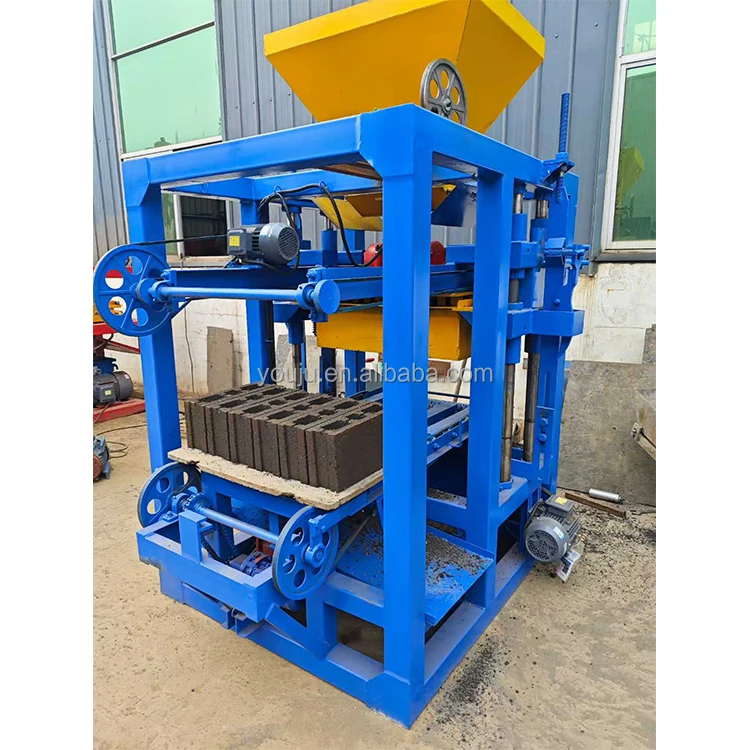
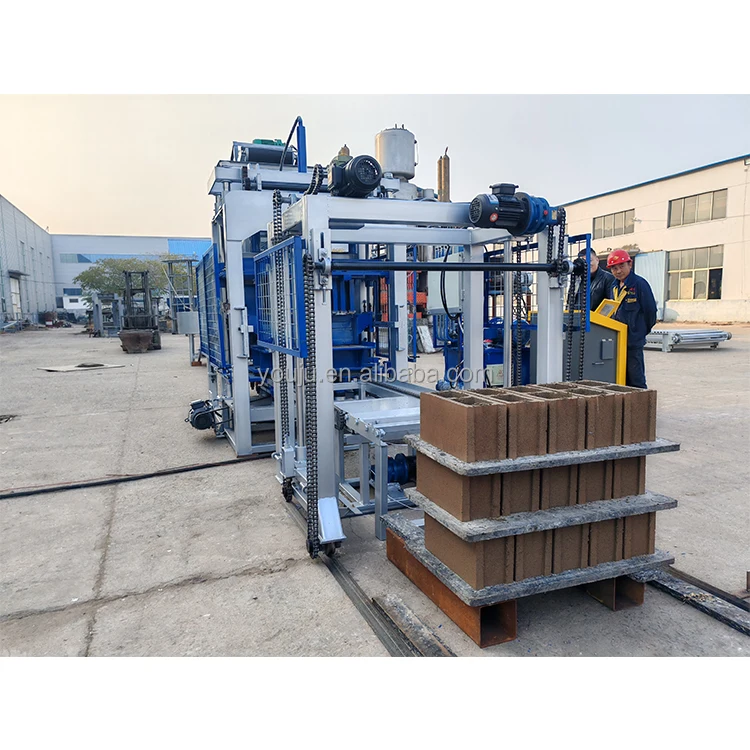 Stationary block machine