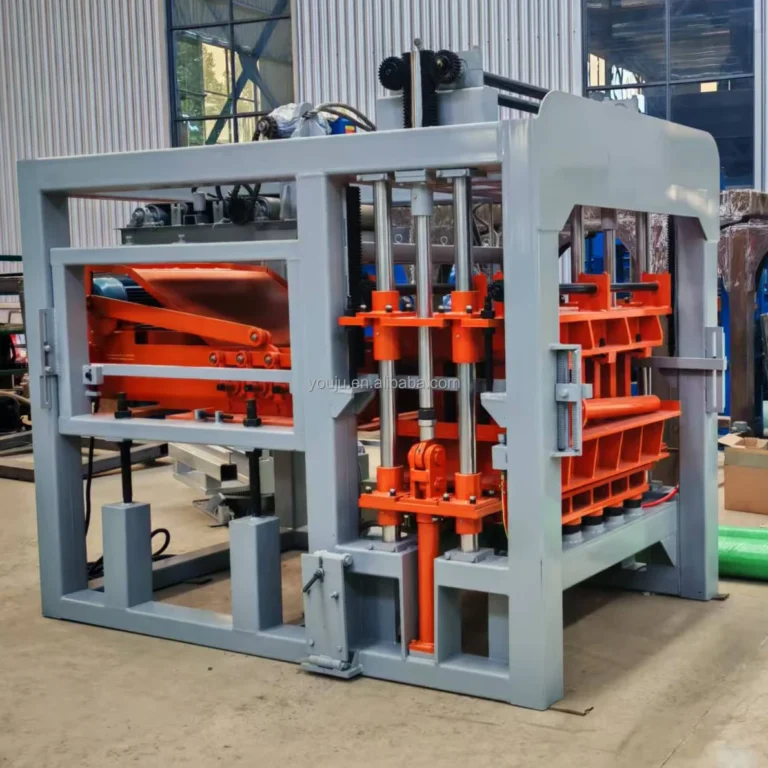
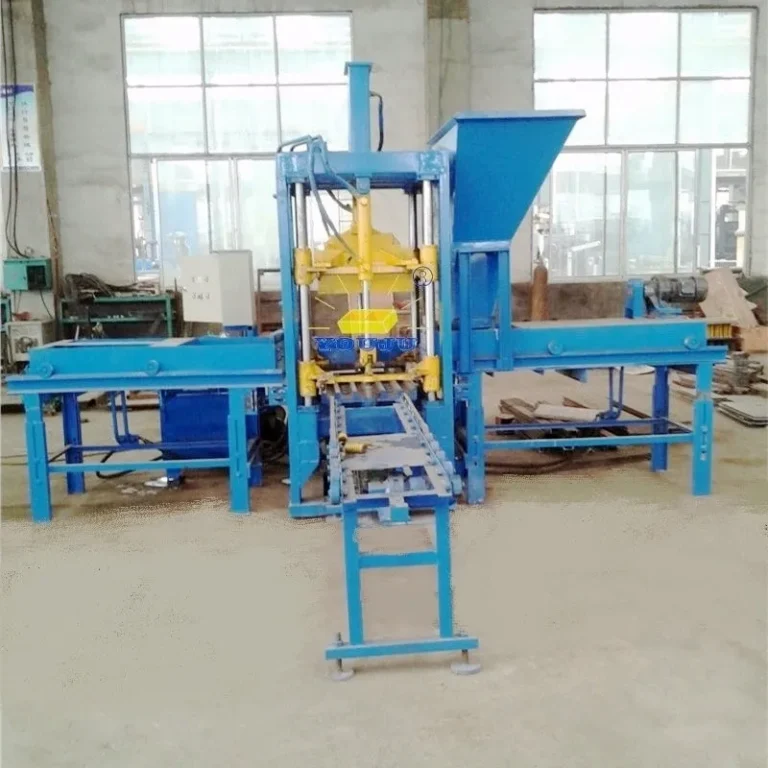
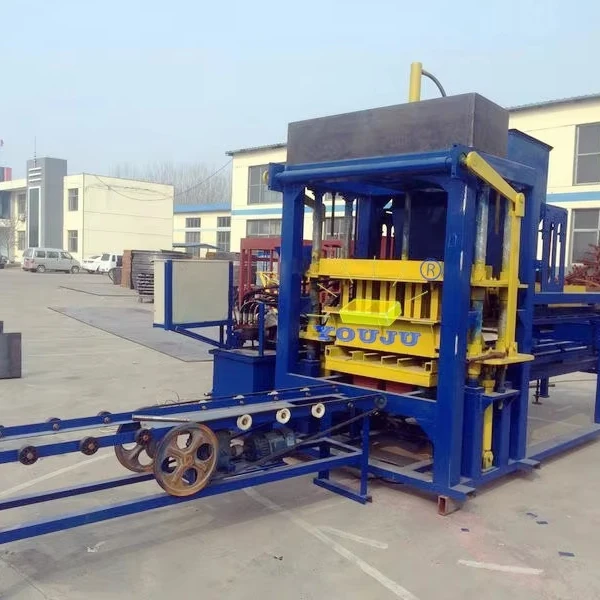
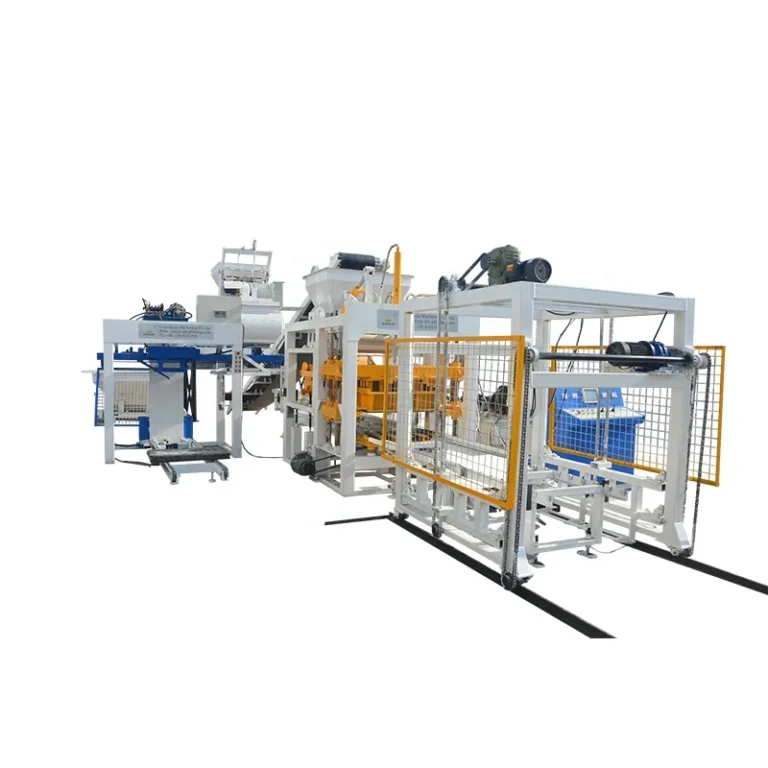
Machine and mould matched as one system — the QT8-15 is specified against the buyer’s actual block format, mix design, and local aggregate, not pulled from a generic catalogue default.
Technical Specifications
| Parameter |
Value |
| Model |
QT8-15 |
| Product Type |
Fully Automatic Hydraulic Block Making Machine |
| Overall Dimensions (L×W×H) |
8300×1860×3000 mm |
| Rated Pressure |
21 MPa |
| Main Vibration Form |
Platform vibration |
| Vibration Frequency |
2800~4500 r/min |
| Vibration Force |
45 kN |
| Pallet Size |
950×900 mm |
| Molding Cycle |
15-25 s |
| Overall Power |
55.5 kW |
| Total Mass |
9 T |
| Demolding Method |
Hydraulic |
| Recommended Factory Area |
500 m² |
| Control System |
Computer controlled, fully automatic |
| Output Capacity |
(basis to be confirmed — depends on block format, material, and thickness) |
| Raw Materials |
Crushed stone, sand, cement, dust, fly ash, gravel, slag |
| Applied Products |
Concrete blocks, hollow/solid blocks, pavers, interlocking blocks, curbstone, colored pavers |
| Standards |
CE, ISO 9001 |
Application Suitability
| Application |
Material or Output |
| Hollow block production for residential and commercial walls |
Crushed stone, sand, cement, fly ash |
| Solid block manufacturing for load-bearing structures |
Gravel, cement, sand blends |
| Paving block and colored paver runs for municipal and landscape projects |
Fine aggregate, cement, pigment |
| Interlocking brick production for retaining walls and slopes |
Crushed stone, slag, cement |
| Curbstone forming for road and infrastructure works |
Coarse aggregate, cement, sand |
| Porous and permeable block runs for drainage applications |
Graded aggregate, cement, minimal fines |
What "15-25 Seconds per Cycle" Actually Means for Your Daily Output
A molding cycle range only translates to real daily output once the block format, mix design, and material feeding rhythm are all defined.
Sellers often quote the shortest cycle a machine can achieve, but that number usually assumes a small, thin paver with an ideal mix. When you switch to a tall hollow block with a stiffer concrete blend, the vibration time extends and the cycle stretches toward the upper end of the range. Buyers who plan their entire business case around the optimistic figure end up disappointed when daily production falls noticeably short of projections [NEED_CITE: typical cycle variation across block formats in stationary hydraulic presses]. The fully automatic hydraulic block making machine manufacturer should always provide a capacity table that states the assumed format beside every output figure.

Where the QT8-15 Sits in the Stationary Range
The QT8-15 occupies the mid-to-high tier among stationary block presses, positioned above small workshop semi-automatic models and below the larger QT10-15 and QT12-15 lines. For an entrepreneur setting up a first block plant, this tier offers a meaningful step up in pallet area and vibration force without demanding the footprint and capital of the highest-output machines. The 950×900 mm pallet size allows multiple block cavities per cycle, which is where the output advantage over smaller models comes from. Buyers comparing tiers should look at pallet area, total vibration force, and recommended factory space rather than cycle time alone.
Matching the Press to Your Plant Footprint
A 500 m² recommended factory area covers the press, material feeding, pallet circulation, and initial stacking, but does not include curing yard space. When planning the layout, the pallet return conveyor and the stacking station must be timed so the press never waits for an empty pallet. If the curing racks or forklifts you already own are sized for a different pallet dimension, the mismatch will surface during commissioning, not during quotation review. The fully automatic hydraulic block making machine manufacturer should confirm pallet size, curing rack compatibility, and stacking method before production begins [NEED_CITE: pallet handling bottlenecks in block plant layout].
Reading the Pressure and Vibration Numbers Together
The 21 MPa rated hydraulic pressure and the 45 kN vibration force at 2800~4500 r/min must be evaluated as a pair. Hydraulic pressure determines how firmly the upper mold compresses the concrete, while platform vibration settles the mix into the mold cavity. If vibration force is high but pressure is low, blocks may look dense on the surface but crumble at the core. The QT8-15 uses a multiaxis synchronizer vibration mode that directs force vertically downward, keeping compaction even across the full pallet area. The long-period over-length guide bearing on the upper mold reduces lateral drift, which protects mold edges and maintains dimensional accuracy over thousands of cycles.
When the Wrong Configuration Costs More Than the Machine
A press configured for a mix the buyer cannot source locally forces a material change that was never budgeted. Pallet handling, stacking, and curing left out of the quotation means blocks are stacked by hand at the end of each shift, erasing the labor advantage of a fully automatic line. Voltage, frequency, and PLC display language left unconfirmed can delay commissioning by weeks while transformers or control panels are replaced on site [NEED_CITE: common commissioning delays caused by electrical mismatches]. Every one of these issues is avoidable when the specification conversation happens before the order is placed.
Why Buyers Choose This Range
Block machinery is the single focus here, so the QT8-15 press, mold, pallet, and handling equipment are specified as one matched system rather than assembled from unrelated suppliers. Configuration is set against the buyer’s actual mix design and target block format, which prevents the common gap between quoted and real output. Molds are designed for the formats the buyer’s market sells, including custom drawings when standard catalogs do not cover a needed shape. Automation level is selectable, meaning a buyer can start with semi-automatic pallet handling and add automatic stacking later. Installation support includes operator training so the team is running independently before the service engineer leaves the site.
Documentation & Verification
- Line layout and capacity calculation stating the block format assumed for each output figure
- Machine specification sheet with voltage, frequency, and PLC language confirmed before production
- Mold drawing and format list covering every block type your market requires
- Factory test record and packing photographs provided before container loading
- CE declaration and ISO 9001 compliance documents included with shipment
- Hydraulic and electrical schematic for local maintenance teams
Installation, Commissioning & Support
- Foundation must support 9 T static mass plus dynamic vibration loads across the 8300 mm machine length
- Dedicated power circuit rated for 55.5 kW total draw with voltage and frequency confirmed pre-production
- Machine ships dismantled for container loading; reassembly and alignment completed on site
- First-run molding cycle and vibration frequency tuned to buyer’s actual mix and target block format
- Operator training covers PLC interface, mold change procedure, and daily maintenance checkpoints
- Wear parts list and mold inventory provided so first replacements are on hand before they are needed
What to Send With Your Inquiry
To size the QT8-15 accurately, share the block formats your market sells, the daily output you need per format, and the local raw materials available including aggregate type and gradation. Provide your site dimensions and the voltage and frequency standard in your region so the electrical package is built correctly from the start.
Frequently Asked Questions
Q: How is the QT8-15 capacity calculated, and which block format is assumed?
A: Output depends on block dimensions, wall thickness, mix density, and the resulting molding cycle within the 15-25 second range. A capacity table should state the exact format behind every figure. Without that, the quoted number is meaningless. Always request format-specific calculations from the fully automatic hydraulic block making machine manufacturer before comparing machines.
Q: Where does the QT8-15 sit between smaller and larger stationary models?
A: It bridges the gap between small semi-automatic presses and high-capacity QT10-15 or QT12-15 lines. The 950×900 mm pallet and 45 kN vibration force suit medium-to-high daily volumes. Buyers needing lower investment or a smaller footprint should look at semi-automatic tiers, while those targeting maximum output should evaluate larger models.
Q: Can I start semi-automatic and upgrade later?
A: Yes. The QT8-15 platform supports selectable automation levels. A buyer can begin with manual pallet handling and add automatic stacking or cubing stations later. The press itself remains the same; the supporting equipment around it is what changes.
Q: What voltage and PLC language options are available?
A: Voltage and frequency are configurable to match the buyer’s local grid standard. PLC display language is confirmed during the specification stage so operators can read the interface on day one. Both must be locked before production starts to avoid on-site delays.
Q: What supporting equipment is included versus optional?
A: The quotation can cover raw material feeding, mixing, pallet feeding, stacking, and curing rack handling, or these can be sourced locally. Clarify which stations are in scope before the quote is finalized so the press is never left waiting between cycles.

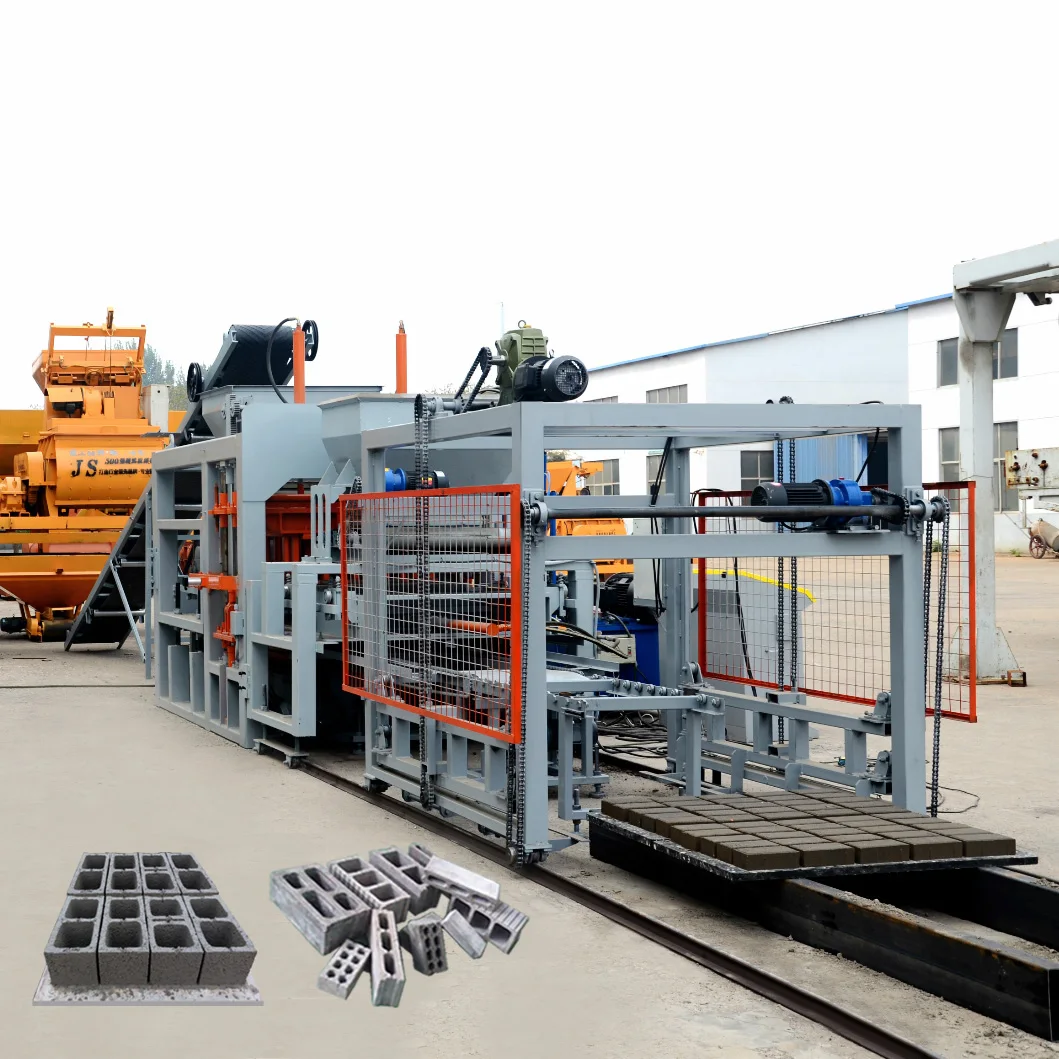
 Stationary block machine