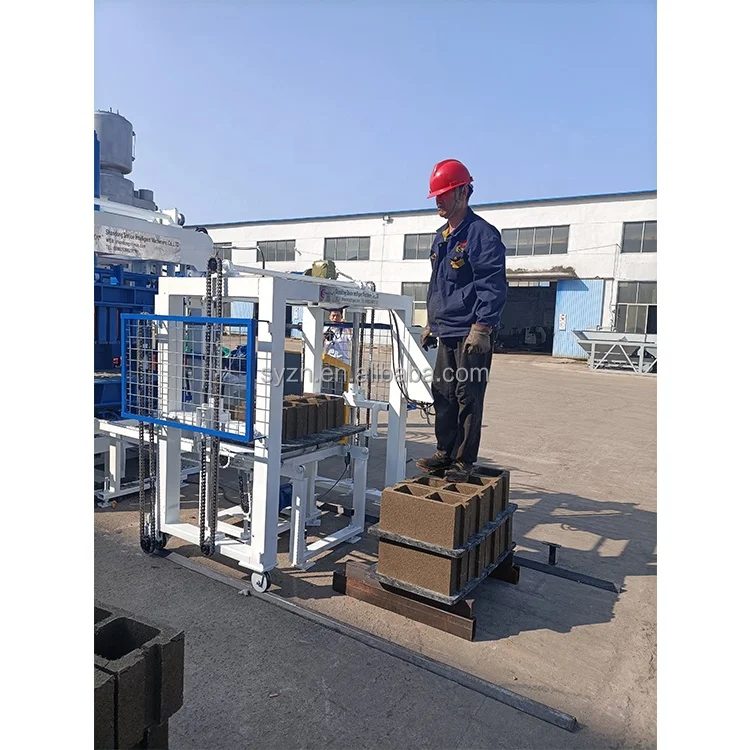
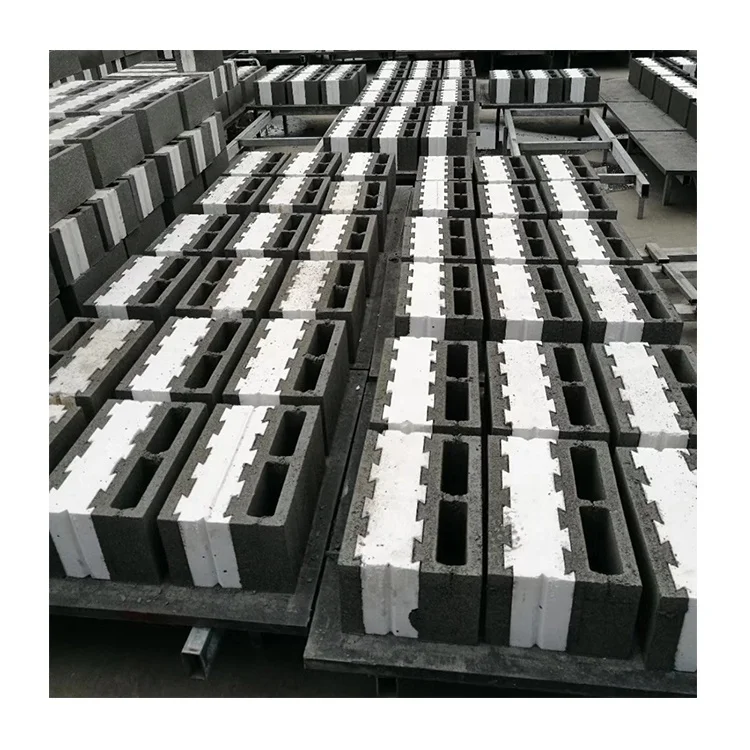
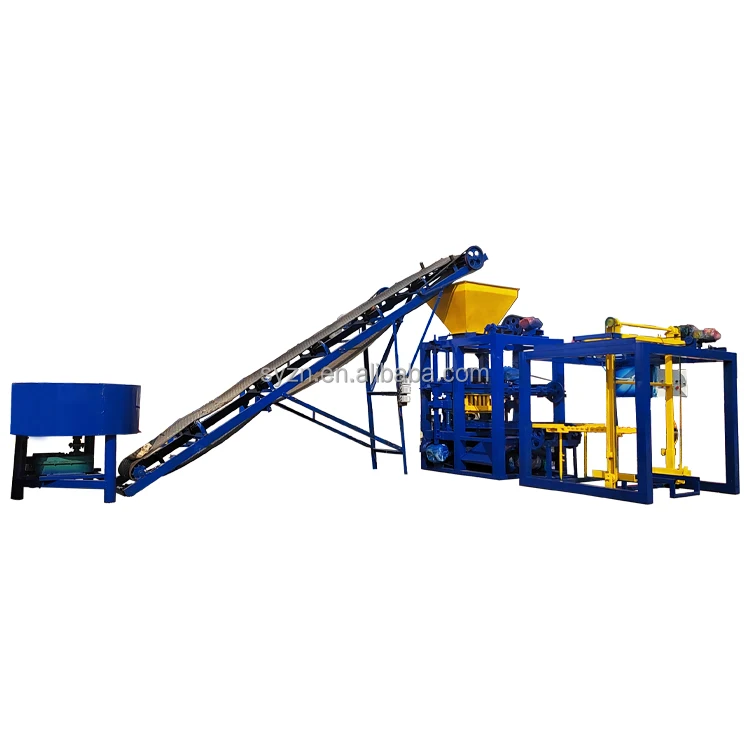
Matched System Configuration — the QT6-15 block machine, mould, pallet and handling equipment are specified together against your local aggregate and target block format, not pulled from a catalogue default.
Technical Specifications
| Parameter |
Value |
| Model |
QT6-15 |
| Product Type |
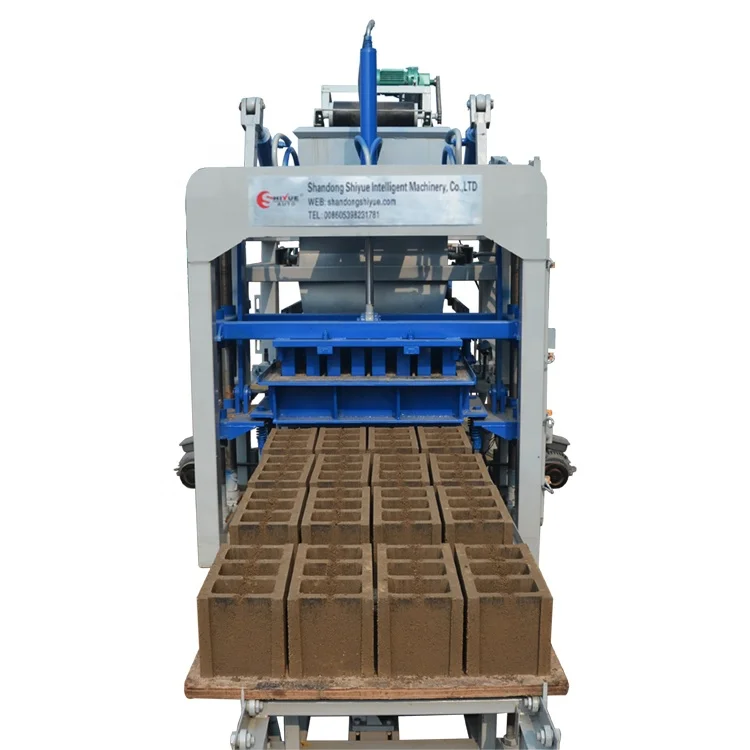
Concrete Hollow Block Making Machine |
| Overall Dimensions |
8200 × 1700 × 2950 mm |
| Total Mass |
7 T |
| Overall Power |
37 kW |
| Vibration Frequency |
0–60 Hz (adjustable) |
| Vibration Form |
Platform Vibration |
| Vibration Force |
45 kN |
| Moulding Mode |
Automatic loading, vibration moulding |
| Demolding Method |
Hydraulic |
| Pallet Size |
880 × 850 mm |
| Molding Cycle |
15–20 s (basis: hollow block); 20–25 s (basis: paving brick) |
| Control System |
PLC with touch screen, fault diagnosis, safe logic interlock |
| Hydraulic System |
Independent integrated hydraulic station |
| Factory Area Required |
1200 m² |
| Block Compressive Strength |
More than 15 MPa |
| Raw Material Adaptability |
Waste ash, slag, cement, various aggregates |
| Warranty |
1 year for whole machine (excluding spare parts) |
| Output (400×200×200 mm Hollow Block) |
6 pcs/mould, 8640–11520 pcs/8 hr (basis: 15–20 s cycle) |
| Output (400×150×200 mm Hollow Block) |
8 pcs/mould, 11520–15360 pcs/8 hr (basis: 15–20 s cycle) |
| Output (240×115×53 mm Solid Brick) |
32 pcs/mould, 46080–61440 pcs/8 hr (basis: 15–20 s cycle) |
| Output (200×100×60 mm Rectangular Paver) |
21 pcs/mould, 17280–23040 pcs/8 hr (basis: 20–25 s cycle) |
| Output (225×112.5×60 mm Zigzag Paver) |
15 pcs/mould, 17280–23040 pcs/8 hr (basis: 20–25 s cycle) |
Application Suitability
| Application |
Material or Output |
| Hollow block production for building walls |
Crushed stone, cement, sand, and slag aggregates |
| Solid brick manufacturing |
Fly ash, cement, and fine aggregate blends |
| Rectangular paving brick for walkways and yards |
Coarse aggregate and cement with pigments |
| Zigzag interlocking paver for driveways |
High-strength aggregate mix with colour oxide |
| On-site production for housing projects |
Locally sourced waste ash and available sand |
| Format expansion for existing concrete product plants |
Same raw material base, mould change on 880×850 mm pallet |
What the "Pieces per Hour" Figure Actually Means for the QT6-15 Block Machine for Sale
Capacity is meaningless without naming the block format it was measured on.
I once saw a Middle East buyer order a mid-tier automatic machine based on a sample capacity figure, only to find his local oversized aggregate cut actual output roughly in half because the cycle time had to be extended to fill the mould properly. He was ready to ship the machine back. The QT6-15 concrete block making machine range lists each output tier with its specific block size and cycle time attached — 15–20 seconds for standard hollow blocks, 20–25 seconds for denser paving formats. [NEED_CITE: block machine capacity calculation methods and industry standards] When you compare the QT6-15 block machine for sale against other options, make sure the comparison uses the same block dimensions and the same cycle assumptions, otherwise the numbers simply do not describe the same machine.

Positioning the QT6-15 Within the Automatic Range
The QT6-15 sits in the mid-tier of the Shiyue automatic lineup, above semi-automatic and mobile egg-laying models and below the high-capacity lines designed for continuous three-shift operation. It targets buyers who have outgrown workshop-scale machines but do not yet need a fully continuous plant with automatic cubing. The 880×850 mm pallet and 37 kW total power place it in a bracket where a standard industrial electrical supply and a mid-size curing yard are sufficient to support daily production.
How the Automation Level Shapes Your Daily Operation
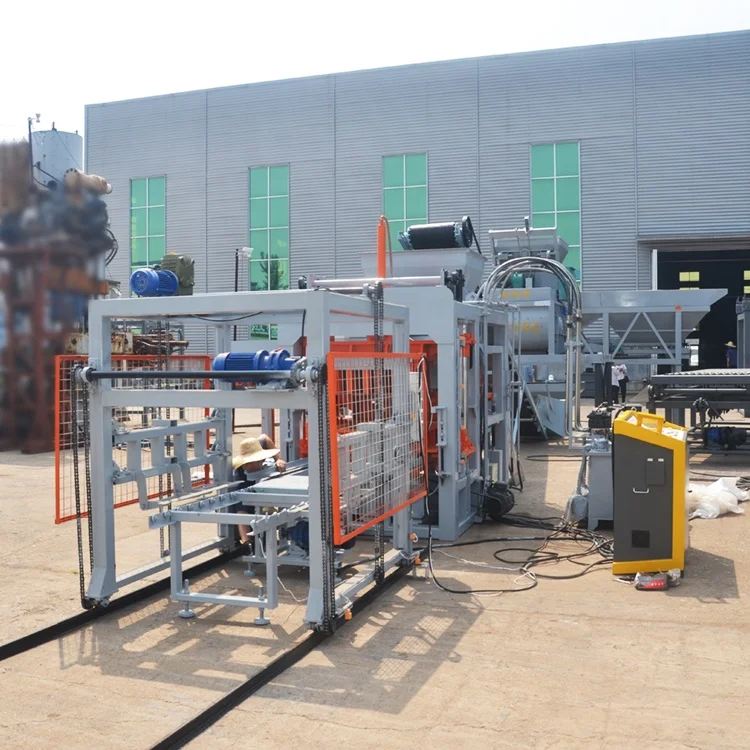
The PLC touch screen with fault diagnosis and safe logic interlock circuit handles the moulding sequence — material feed, vibration timing, hydraulic demould — without requiring the operator to manually time each step. This removes the biggest source of inconsistency in semi-automatic operation: human timing variation across a long shift. The QT6-15 block machine for sale still requires manual pallet handling and stacking at this configuration level, meaning you control where to invest first and where to add automation later as production volume grows. [NEED_CITE: PLC control standards for concrete block making equipment]
Reading the Specs That Determine Your Block Quality
The independent integrated hydraulic station sits physically separated from the main vibration and dust zone of the press, which matters because hydraulic valve contamination is a primary cause of pressure drift over long production runs. The 45 kN vibration force combined with hydraulic demoulding produces the compaction density that gives blocks their compressive strength — rated above 15 MPa for the QT6-15. The 0–60 Hz adjustable vibration frequency lets the operator tune the setting to the specific aggregate grading being used; coarser material typically needs a lower frequency with longer dwell, while fine sand blends respond to higher frequency. The pallet size of 880×850 mm must match the curing racks and forklift capacity you already have on site, because every pallet in circulation has to be physically handled through the curing area and back.
The Hidden Cost of Skipping the Configuration Step
A buyer who selects a machine purely on price and quoted cycle speed, without confirming whether the vibration force and hydraulic pressure match their local mix design, will end up with blocks that crack during demoulding or fail compressive strength testing at the construction site. A pallet size chosen without checking the curing yard dimensions means pallets stack unevenly or cannot be moved by the existing forklift, turning a production bottleneck into a handling crisis. [NEED_CITE: common causes of block breakage in concrete block manufacturing] Voltage and PLC display language left unconfirmed before production can delay commissioning by weeks after the machine arrives, because rewiring a control panel and reprogramming a display on site is far more expensive than specifying it correctly at the factory.
Why Buyers Source the QT6-15 Block Machine for Sale Here
Block machinery is our single focus — machine, mould, pallet and handling equipment are specified as one matched system rather than assembled from separate suppliers. Every configuration is set against the buyer’s actual mix design and local aggregate, not a catalogue default. Mould design covers the formats the buyer’s market actually sells, including custom drawings when standard options do not fit. The automation level is selectable so a buyer can start with the QT6-15 at its base configuration and add automatic stacking or cubing as production volume justifies the investment. Installation, commissioning, and operator training are included in the process so the machine is running correctly before the team leaves site.
Documentation & Verification
- Line layout and capacity calculation stating the block format assumed for each output figure
- Machine specification sheet with voltage, frequency, and PLC display language confirmed
- Mould drawing and format list covering your exact block dimensions
- Pallet specification matched to your curing area and forklift capacity
- Factory test record before dispatch
Installation, Commissioning & Support
- 1200 m² factory area with level concrete floor to support 7 T machine mass and vibration loads
- 37 kW total power requiring dedicated three-phase supply with confirmed voltage and frequency
- Machine shipped condition and on-site assembly scope confirmed before dispatch
- PLC touch screen commissioning with fault diagnosis system calibrated to your production parameters
- Operator training covering mould change procedure and cycle time adjustment by block format
- Wear parts and mould list provided for first replacement planning
Before You Request a Quote
Send us the specific block formats your market demands — dimensions, wall thickness, and whether solid or hollow. Tell us your local raw materials and aggregate grading so the mix design can be matched to the vibration settings. Confirm your site’s voltage, frequency, and the PLC display language your operators need.
Frequently Asked Questions
Q: How is the QT6-15 capacity calculated, and how does it compare to other models?
A: Each output figure in the specification is tied to a specific block dimension and cycle time — for example, 8640–11520 hollow blocks per 8-hour shift based on a 400×200×200 mm block at a 15–20 second cycle. This lets you compare the QT6-15 against other models in the range using the same block format rather than a generic pieces-per-hour number that may assume a different product.
Q: Where does the QT6-15 sit between semi-automatic and higher-tier machines?
A: It occupies the mid-tier automatic position — PLC-controlled moulding with hydraulic demoulding, but without the fully automatic stacking and cubing of higher-tier lines. This suits buyers stepping up from semi-automatic operation who want to control investment level and add handling automation later as production volume grows.
Q: What voltage and PLC language options are available?
A: Voltage and frequency must be confirmed against your local industrial supply before production begins. The PLC display language is also confirmed at the order stage so operators can read diagnostics and settings in their working language from the first day of operation.
Q: Can the automation level be upgraded after installation?
A: The QT6-15 platform supports adding automatic pallet feeding, stacking, and cubing equipment as separate stations connected to the existing PLC. This allows a buyer to start with manual pallet handling and invest in automation stages as daily output volume and labour costs justify the upgrade.
Q: What factory area and supporting equipment are required?
A: The QT6-15 requires approximately 1200 m² including raw material storage, press area, pallet circulation, and curing zone. Supporting equipment — mixer, pallet feeder, and curing rack handling — must be specified so cycle times across stations are matched and the press is not left waiting between cycles.

 High quality block machine