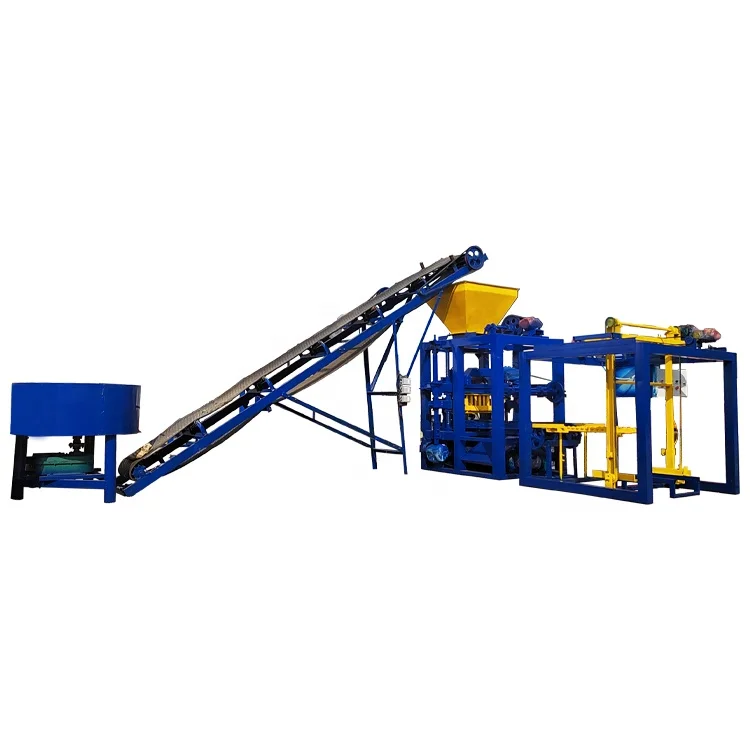
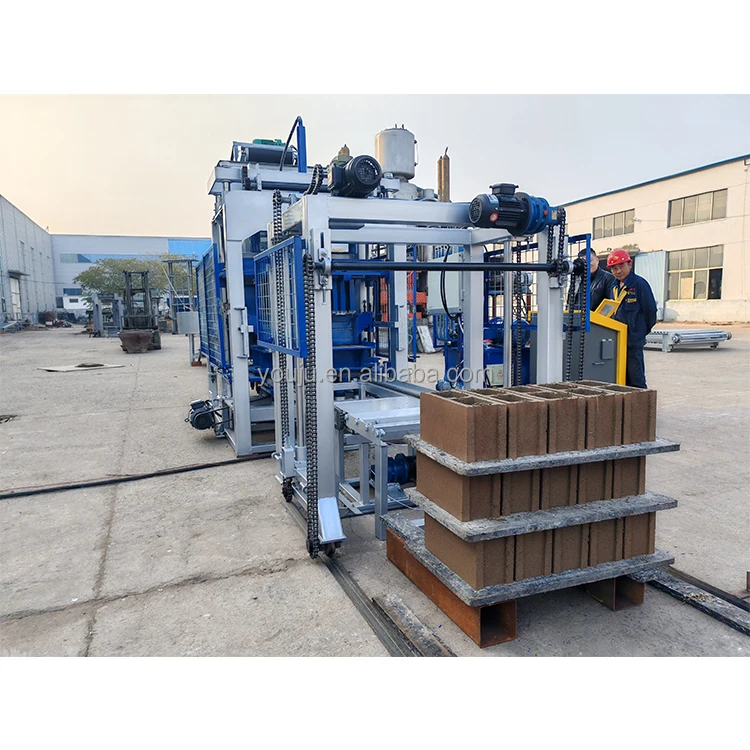
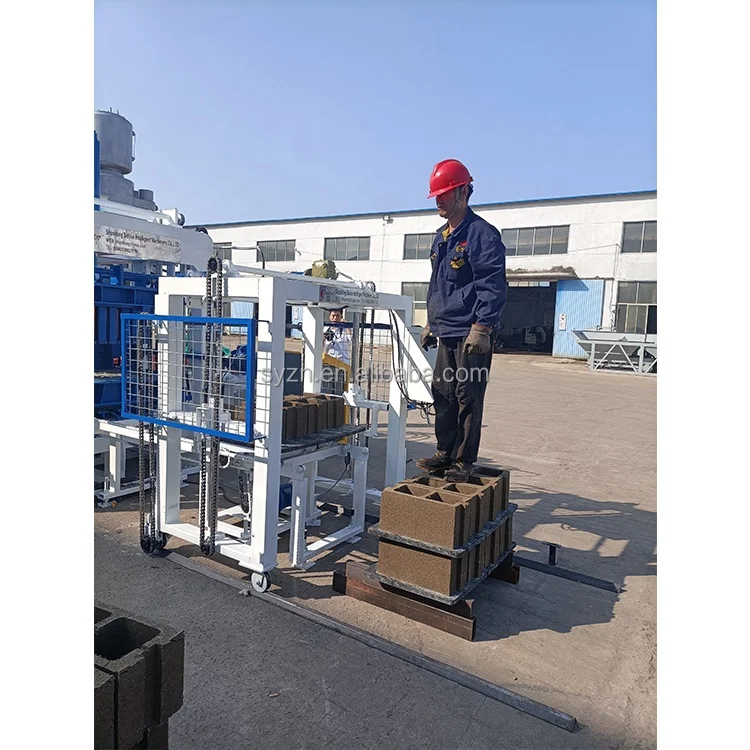
Matched system configuration — The QT5-15 is specified as a complete press, mould, pallet and handling package rather than a standalone unit, so cycle times and output align with your actual block format and local aggregate.
Technical Specifications
| Parameter |
Value |
| Model |
QT5-15 |
| Product Type |
Stationary Automatic Concrete Block Making Machine |
| Overall Dimensions (L×W×H) |
7400×1950×2800mm |
| Rated Pressure |
21MPa |
| Main Vibration Form |
Platform Vibration |
| Vibration Frequency |
2800~4500 r/min |
| Pallet Size |
1100×550mm |
| Molding Cycle |
15-25s |
| Overall Power |
26.5KW |
| Demolding Method |
Hydraulic |
| Automation Level |
Full Automatic |
| Output — Hollow brick 400×200×200mm |
5 pcs/mold, 16-20s cycle, 1800 pcs/h |
| Output — Hollow block 400×150×200mm |
6 pcs/mold, 15-20s cycle, 1300 pcs/h |
| Output — S paver 225×112.5×60mm |
16 pcs/mold, 15-17s cycle, 3700 pcs/h |
| Voltage & Frequency |
Basis to be confirmed with buyer |
| Control System |
Basis to be confirmed with buyer |
Application Suitability
| Application |
Material or Output |
| Hollow block production for building walls |
Crushed stone, sand, cement, fly ash blends |
| Solid block manufacturing for load-bearing structures |
Gravel, slag, cement mixes |
| Paver and interlocking brick for roads and landscaping |
Colored concrete with fine aggregate |
| Kerbstone and curb production for municipal projects |
High-strength concrete with coarse aggregate |
| On-site block production for housing developments |
Locally sourced sand, dust and cement |
Why "Pieces per Hour" Means Nothing Without the Block Format
Every capacity figure we quote names the exact block size, cycle time and mould cavity count behind it.
I once watched a buyer in West Africa sign for an automatic block making machine manufacturer quotation that promised impressive hourly output. The number assumed standard hollow blocks, but his market ran mostly interlocking pavers with a longer press cycle. His actual daily production fell to roughly half the quoted figure within the first week. That mismatch is the single most common complaint I hear from buyers who sourced elsewhere [NEED_CITE: common buyer complaints in block machinery procurement].

Where the QT5-15 Sits on the Range
The QT5-15 occupies the mid-tier of the full automatic lineup. Buyers moving up from semi-automatic plants find it covers daily volumes that justify the automation investment without demanding the footprint of a high-capacity line. For entrepreneurs setting up a first block plant, it offers a configuration that can start with basic pallet handling and add stacking or cubing modules later.
Choosing Between Tiers Based on Your Actual Output Need
The decision between this tier and a higher-capacity model comes down to the block formats your market actually buys. A plant producing primarily hollow blocks at 1800 pcs/h based on a 400×200×200mm format may never need a larger press. A plant adding paver lines alongside hollow blocks needs to verify that the automatic block making machine manufacturer has sized the pallet return and stacking stations to match the faster paver cycle [NEED_CITE: block plant throughput balancing across formats].
Reading the Specs That Actually Matter
The platform vibration system runs between 2800 and 4500 r/min, a range wide enough to handle both coarse aggregate hollow blocks and finer-mix pavers. Vibration frequency must match the mix design; too high a frequency on a stiff mix leaves voids, while too low a frequency on a wet mix causes slumping. The 21MPa rated hydraulic pressure works with that vibration to compact the concrete into the mould cavity. Pressure alone does not determine block density — it is the combination of pressure, vibration amplitude and cycle duration that produces consistent strength across every pallet.
The 1100×550mm pallet size is not arbitrary. It must align with the curing rack spacing and the forklift tine width already in your yard. A pallet that is too wide for your existing racks forces a complete curing area rebuild, and a pallet material that warps under local humidity will jam the return conveyor within weeks.
The Hidden Cost of a Mismatched Configuration
When the pallet size is chosen without checking your curing area, you end up stacking wet blocks by hand on the floor — the exact bottleneck the automation was supposed to eliminate. When voltage and PLC language are not confirmed before the machine leaves the factory, commissioning stalls while you source a step-down transformer or wait for a technician who reads the original display language. These delays are entirely preventable and cost more in lost production days than the confirmation conversation ever would [NEED_CITE: commissioning delays from unconfirmed electrical specifications].
Why Source This Machine Here
Block machinery is the single product focus, so the QT5-15 press, its moulds, pallets and handling equipment are specified as one matched system. Configuration starts from your actual mix design and local aggregate, not a catalogue default. Mould formats are selected for the blocks your market sells, with custom drawings available when your buyers request a non-standard shape. Automation level is selectable — you can begin with semi-automatic pallet handling and add automatic stacking when volume justifies it. Installation support includes operator training so your crew understands mould change procedure and daily maintenance from the first production run.
Documentation & Verification
- Line layout drawing with capacity calculated per your specific block format
- Machine specification sheet confirming pallet size and material for your curing setup
- Mould drawing and format list covering the products your market demands
- Voltage, frequency and PLC display language written confirmation before shipment
- Factory test record run on your aggregate blend and target block dimensions
Installation, Commissioning & Support
- Foundation plan matched to the 7400×1950mm footprint and dynamic vibration loads
- Electrical hookup guide for the 26.5KW total power draw with dedicated circuit requirements
- Machine arrives partially dismantled for container loading with reassembly supervision on site
- First-run commissioning includes cycle time adjustment to your specific mix and block format
- Operator training covers mould change sequence, hydraulic checks and pallet return troubleshooting
- Wear parts list identifies mould liners and hydraulic seals with recommended replacement intervals
What We Need From You to Quote Accurately
Send us the block formats your market actually buys, the daily volume you need for each format and a sample of your local aggregate or mix proportions. Tell us the voltage and frequency at your site, the language your operators read, and the dimensions of your existing curing area and forklifts. If you have upstream mixers or downstream stacking equipment already in place, share those details so the automatic block making machine manufacturer proposal connects to your line without gaps.
Frequently Asked Questions
Q: How do I verify that the quoted capacity matches my block format?
A: Every proposal from this automatic block making machine manufacturer states the exact block dimensions, mould cavity count and cycle time behind each output number. We run a factory test using your mix proportions and record the actual cycle time before shipment, so the figure on paper matches what happens on your floor.
Q: Should I choose semi-automatic or full automatic for my first plant?
A: For a first plant with limited capital, semi-automatic reduces initial investment while still producing quality blocks. The QT5-15 range allows you to start with manual pallet handling and upgrade to full automatic stacking and cubing later, once production volume and market demand justify the additional modules.
Q: What plant footprint does the QT5-15 require?
A: The press itself measures 7400×1950×2800mm, but the complete line including mixer, pallet return and curing rack area needs a larger space. We provide a line layout drawing showing every station so you can confirm your building dimensions before the machine ships.
Q: Can the control system be configured for my local voltage and language?
A: Voltage, frequency and PLC display language are confirmed with you before production begins. This ensures the machine powers up correctly on arrival and your operators can read all prompts and alarm messages without translation delays.
Q: What mould formats are available and can I request custom designs?
A: Standard moulds cover hollow blocks, solid blocks, pavers, interlocking bricks and kerbstones in common market sizes. Custom mould design to your drawings is available when your buyers need a non-standard format or surface texture.

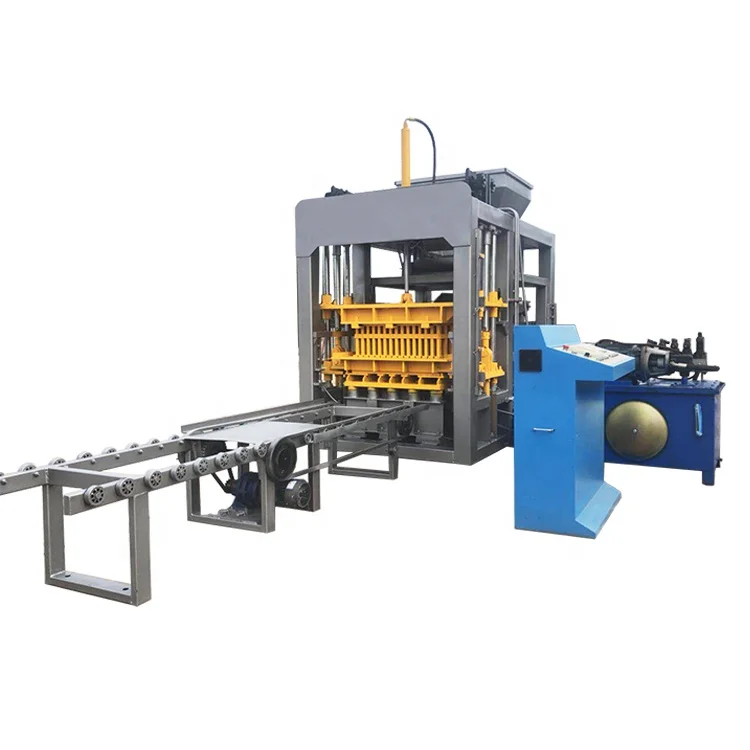
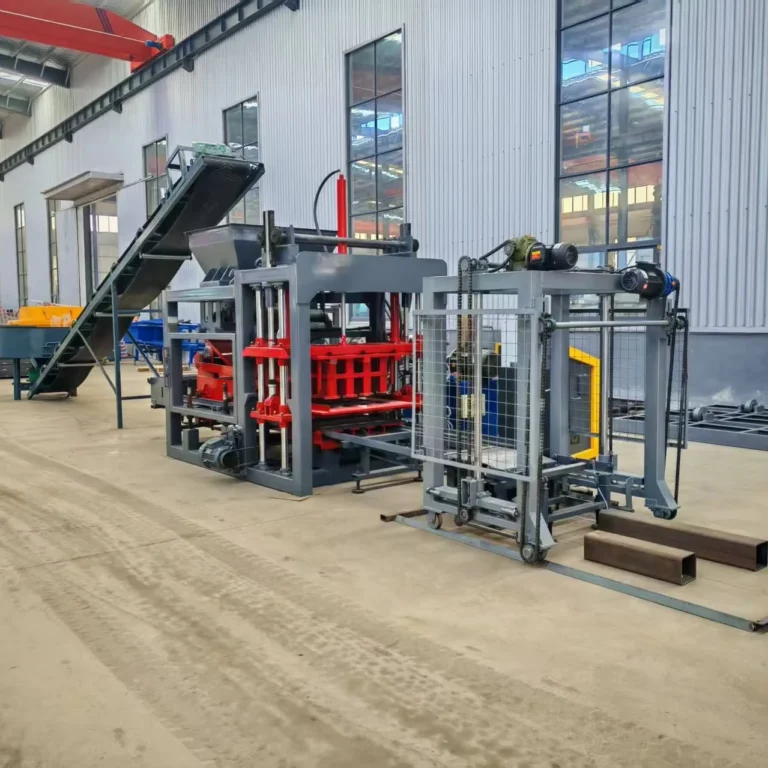 Stationary block machine