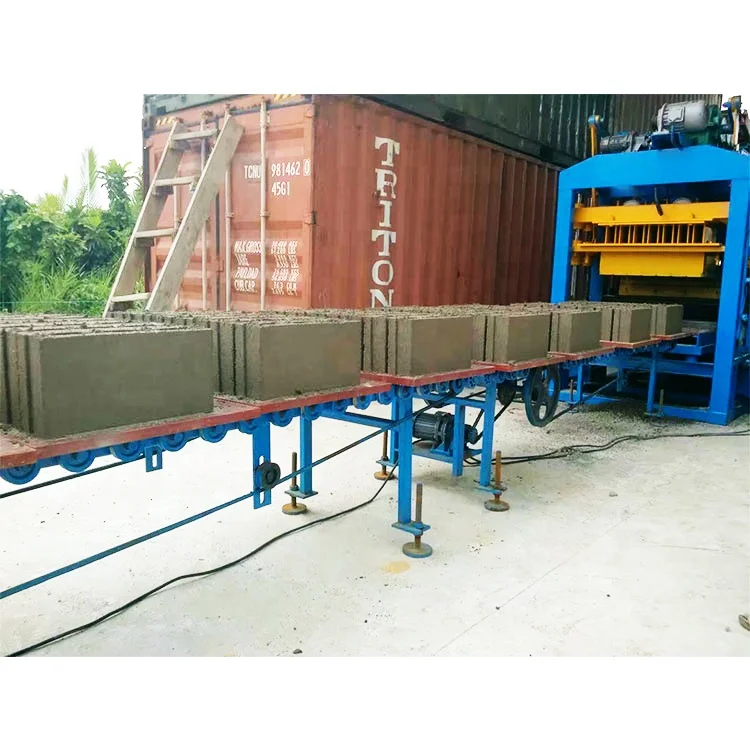
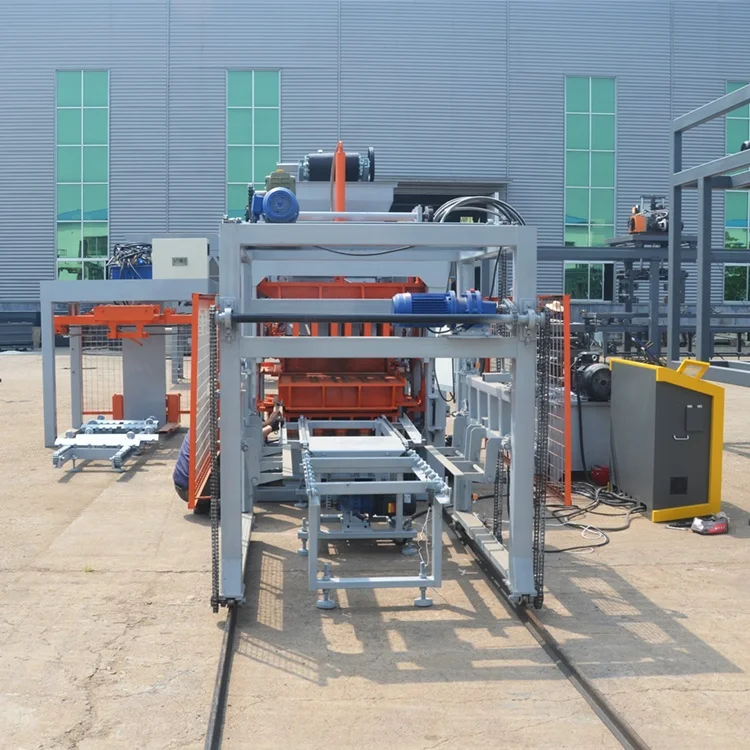
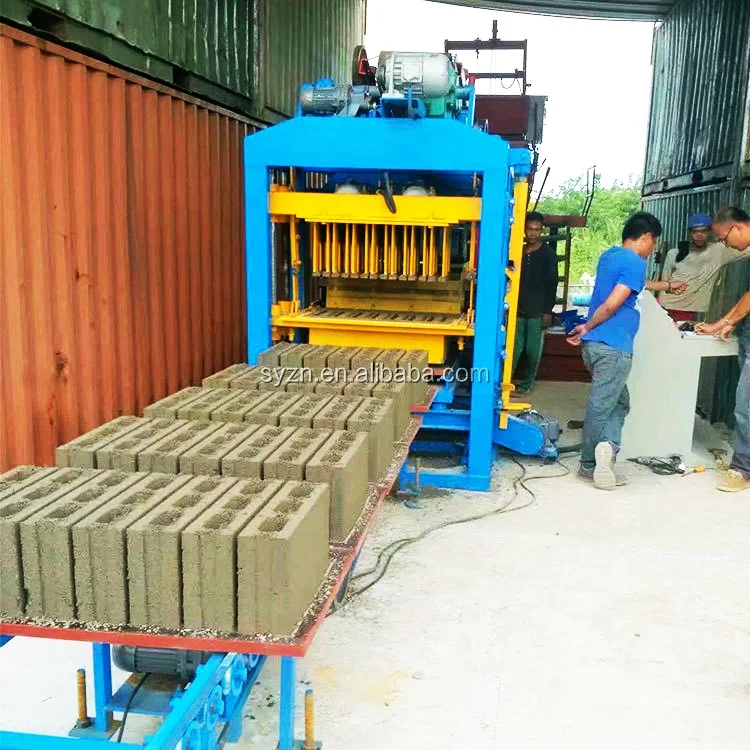
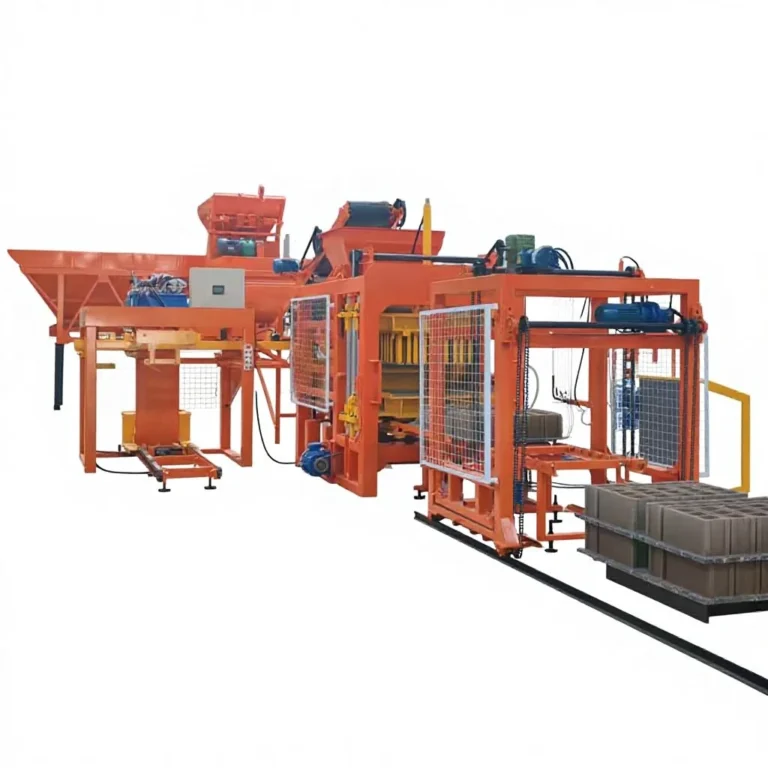
Matched System Sizing — Every Qt4-25a configuration is set against your actual block format, local aggregate, and pallet handling setup rather than shipped as a catalogue default.
Technical Specifications
| Parameter |
Value |
| Model |
Qt4-25a |
| Product Type |
Automatic Block Making Machine |
| Overall Dimensions (L×W×H) |
7100 × 1600 × 2610 mm |
| Net Weight |
5800 kg |
| Rated Power |
27.5 kW |
| Voltage |
380V or configurable to buyer requirements |
| Vibration Force |
60 KN |
| Pallet Size |
1020 × 850 × 40 mm |
| Cycle Time |
25 seconds per cycle |
| Output — Hollow Block 400×200×200 mm |
4 pcs/mould, 960 pcs/hour, 7680 pcs/day (basis: 25s cycle, 8-hour shift) |
| Output — Hollow Block 400×150×200 mm |
6 pcs/mould, 1440 pcs/hour, 11520 pcs/day (basis: 25s cycle, 8-hour shift) |
| Output — Solid Brick 225×112.5×53 mm |
16 pcs/mould, 3840 pcs/hour, 30720 pcs/day (basis: 25s cycle, 8-hour shift) |
| Hydraulic System |
Adopted (pressure rating to be confirmed) |
| Automation Level |
Semi-automatic |
| Mould Format |
Standard hollow block, solid brick |
| Color Options |
According to buyer request |
| Warranty |
1 year |
| Standards |
ISO 9001:2008, CE |
Application Suitability
| Application |
Material or Output |
| Small-to-medium block plant production |
Hollow blocks and solid bricks from crushed stone, sand, cement, and fly ash |
| On-site construction block manufacturing |
Standard walling blocks produced directly at the building project location |
| First block plant setup |
Entry-level hollow block and solid brick output for entrepreneurs with limited initial investment |
| Existing plant format expansion |
Adding solid brick production alongside existing hollow block runs |
What "960 Pieces per Hour" Actually Means for the Qt4-25a Block Making Machine for Sale
The capacity number only holds true when tied to a specific block format and a confirmed cycle time.
I have seen buyers compare two machines purely on a headline output figure, only to find after delivery that the quoted number assumed a smaller block format than what their market actually demands. With this Qt4-25a block making machine for sale, the 960 pieces per hour figure is based on the 400×200×200 mm hollow block at a 25-second cycle. Switch to the larger 400×150×200 mm format and the per-cycle count rises to six, but the daily calculation must still factor in pallet return time, operator loading rhythm, and mix delivery pauses. [NEED_CITE: capacity calculation methods for concrete block machines]

Where This Tier Sits in the Block Machine Range
The Qt4-25a occupies the entry-to-mid tier, aimed at buyers who need consistent hollow block and solid brick output without the capital outlay and plant footprint of a fully automatic line. Its semi-automatic configuration keeps the press cycle reliable while leaving pallet handling and stacking to manual or forklift-assisted operations. For a first-time plant entrepreneur, this tier provides a practical starting point that can later be supplemented with automatic stacking as volume grows.
Comparing Footprint and Investment Across Output Tiers
A fully automatic line requires a larger curing yard, dedicated pallet return conveyors, and a cubing station — all of which expand the total floor area and capital requirement considerably. The Qt4-25a block making machine for sale fits within a more compact workshop layout, with the 7100 × 1600 mm machine footprint leaving room for raw material storage and a modest curing zone. Buyers evaluating whether to start semi-automatic or go straight to full automation should weigh their daily volume target against the available site area and the curing rack capacity they can support. [NEED_CITE: block plant layout planning for semi-automatic versus automatic lines]
Reading the Specification Sheet Beyond the Headline Numbers
The 60 KN vibration force works together with the hydraulic system to compact the concrete mix into the mould cavity. If your local aggregate has a high clay content or irregular grading, the effective density may fall short of what a clean-graded mix achieves — which is why matching vibration force and hydraulic pressure to your specific material is essential before finalizing configuration. The 1020 × 850 × 40 mm pallet size defines how many blocks sit on each board and, critically, whether that loaded pallet weight stays within the lifting capacity of your existing forklift. The 27.5 kW rated power determines the electrical supply requirement; a dedicated circuit with appropriate breaker sizing prevents voltage drop during the vibration peak of each cycle.
The Hidden Cost of Ordering on Headline Capacity Alone
When a buyer orders based on a single output number without confirming which block format it assumes, the machine arrives and the actual daily production falls noticeably short of the business plan. Pallets sized without checking the curing area dimensions lead to double-handling, and a voltage mismatch discovered at commissioning delays the entire startup. [NEED_CITE: common block machine commissioning delays from unconfirmed electrical specifications] Mould changes that were never timed during the factory test eat into shift hours, reducing the format flexibility the buyer expected.
Why Source This Qt4-25a Block Making Machine for Sale Here
Block machinery is our single focus, which means the machine, mould, pallet, and handling equipment are specified as one matched system rather than assembled from separate suppliers. Configuration is set against your actual mix design and target block format — not a catalogue default. Mould design covers the formats your local market sells, with custom drawings available when standard formats do not match. Automation level is selectable, so you can begin with the semi-automatic Qt4-25a and plan an upgrade path as production volume increases. Every machine ships with a factory test record documenting actual cycle time per format before it leaves the workshop.
Documentation & Verification
- Line layout showing Qt4-25a footprint with pallet return and curing zone marked
- Capacity calculation sheet stating the block format behind each output figure
- Pallet specification matched to your forklift load rating and curing rack dimensions
- Voltage and control language confirmation signed off before production begins
- Factory test record with measured cycle times for your ordered mould formats
Installation, Commissioning & Support
- Foundation pad sized to the 7100 × 1600 mm footprint with vibration isolation allowance
- Dedicated 27.5 kW supply circuit with breaker rating matched to starting current
- Machine shipped in dismantled state with reassembly guidance for on-site teams
- First-run parameter setting calibrated to your local aggregate and mix proportions
- Operator training covering mould change procedure and daily maintenance checkpoints
- Wear parts list identifying hydraulic and vibration components with replacement intervals
What to Prepare Before Requesting a Quotation
To size the Qt4-25a accurately to your project, share the specific block formats your market requires along with your target daily output and available workshop dimensions. Confirm your local voltage and frequency so the electrical system is built to match from the start. If you have existing pallets or forklifts on site, provide their specifications so the pallet and handling setup integrates without modification.
Frequently Asked Questions
Q: How does Qt4-25a output compare across different block formats?
A: Output varies by format because the mould cavity count changes while the cycle time stays at 25 seconds. The 400×200×200 mm hollow block yields 960 pieces per hour, the 400×150×200 mm yields 1440, and the solid brick yields 3840. Real daily output also depends on pallet return speed and mix supply continuity.
Q: Where does this semi-automatic tier sit against fully automatic models?
A: The Qt4-25a requires a smaller plant footprint and lower capital outlay than a fully automatic line. Pallet handling and stacking are managed manually or by forklift rather than through conveyors and cubing stations, making it suitable for sites with limited space or lower initial volume targets.
Q: Is the 380V configuration adjustable for different markets?
A: Voltage is configurable to buyer requirements. Confirm your site voltage and frequency before production so the motor, control panel, and heating elements — if fitted — are matched correctly, avoiding commissioning delays after the machine arrives.
Q: Can the automation level be upgraded later?
A: The semi-automatic configuration can be supplemented with automatic pallet feeding and stacking equipment as your production volume grows. Planning the upgrade path at the ordering stage ensures the machine frame and control system accommodate future additions.
Q: What mould formats are included and how long does a change take?
A: Standard hollow block and solid brick moulds are available. Mould change time depends on the format and the operator’s familiarity with the procedure. Request a timed mould change demonstration during the factory test so you know the realistic downtime between format switches.

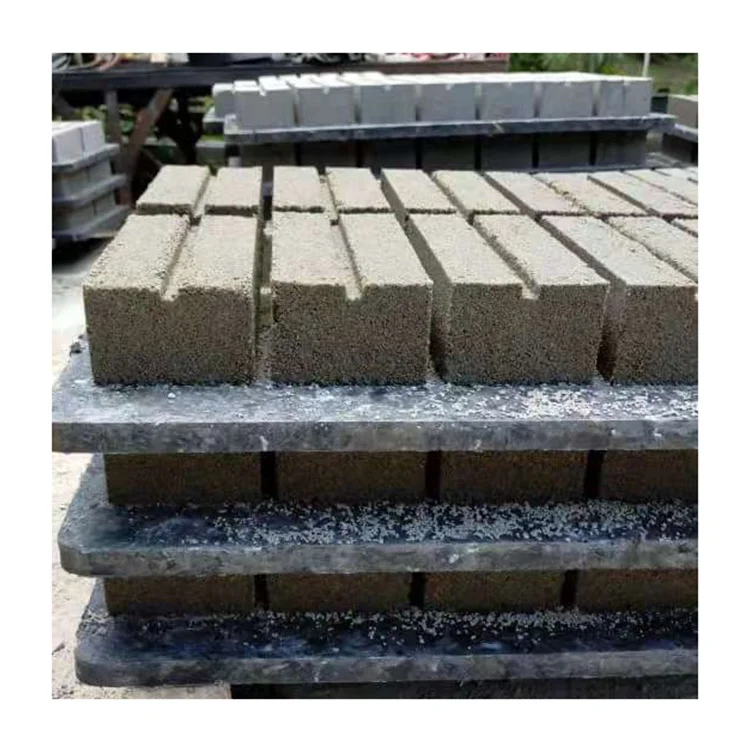
 High quality block machine