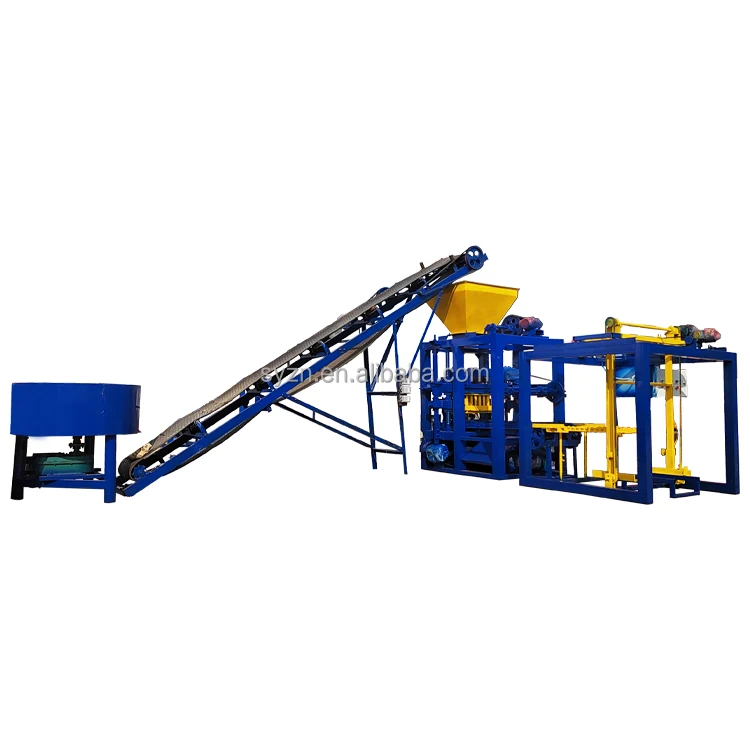
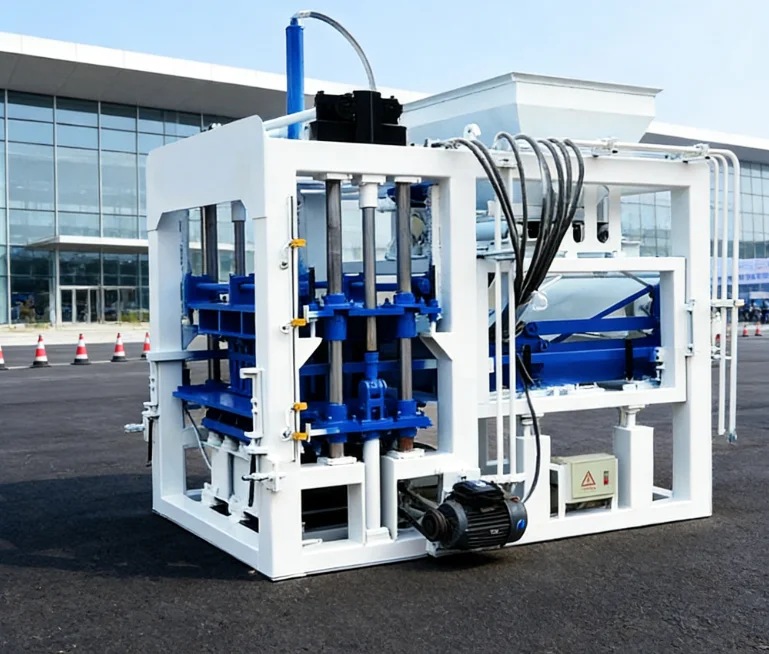
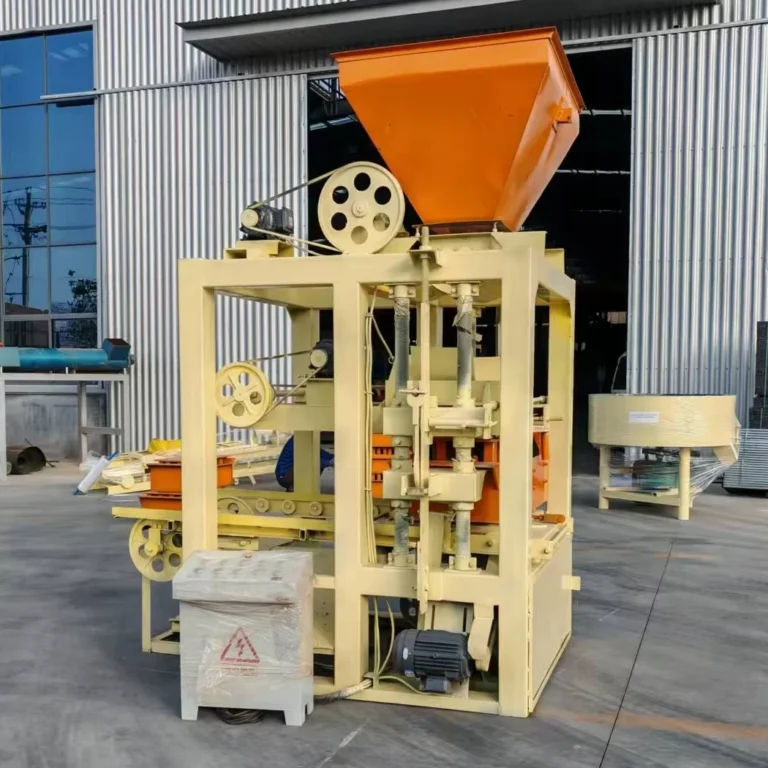
Mid-Tier Positioning — the QT4-15 bridges small workshop output and high-capacity automatic lines, configured against your actual block format and local aggregate rather than a catalogue default.
Technical Specifications
| Parameter |
Value |
| Model |
QT4-15 |
| Product Type |
Stationary Automatic Concrete Block Making Machine |
| Host Machine Power |
27.5 kW |
| Moulding Cycle |
15 s |
| Dimension Of Host Machine |
7100 × 1600 × 2610 mm |
| Pallet Size |
1020 × 570 mm |
| Weight Of The Host Machine |
5 T |
| Vibration Force |
40 kN |
| Mixer Model |
JS500 |
| Voltage |
380 V (frequency and phase to be confirmed for destination market) |
| General Water Consumption |
4 T per day |
| Workers Required |
3–4 |
| Workshop Area |
150 m² |
| Control System |
Computer controlled directional vibration, photoelectric material control |
| Motor Brand |
Siemens Motor |
| Vibration Method |
Low-frequency feeding, high-frequency vibrating; table and mould vibrating together |
| Feeding System |
Hopper with swing-type cutting device for uniform material distribution |
| Automation Level |
Automatic (scope including stacking and pallet handling to be confirmed) |
| Theoretical Productivity |
Stated per block format on request (basis to be confirmed) |
Application Suitability
| Application |
Material or Output |
| Hollow block production |
Crushed stone, sand, cement, and fly ash blends |
| Multicellular brick production |
Lightweight aggregate and cementitious mixes |
| Paving brick production |
High-strength concrete with fine aggregate gradation |
| Standard solid brick production |
Dense aggregate and cement mixes for load-bearing walls |
What "Cycles per Hour" Leaves Out When Sizing a Stationary Block Machine Manufacturer
Real daily output depends entirely on which block format you run, not the headline cycle time.
I have watched buyers sign contracts based on a cycle figure that assumed a thin paver, only to find their actual hollow block format doubled the cycle and halved the daily count. A stationary block machine manufacturer that quotes capacity without naming the assumed format is asking you to gamble your production schedule. The QT4-15 moulding cycle is listed at 15 s, but that number shifts depending on block height, cavity count, and the aggregate grading you feed into the JS500 mixer [NEED_CITE: capacity calculation methodology per block format].

Where the QT4-15 Sits in the Output Tier Ladder
The QT4-15 occupies the middle ground of the stationary block machine range. Below it, semi-automatic models suit first-time entrepreneurs running a single format in a limited workshop. Above it, high-capacity automatic lines serve plants that run multiple formats across two or three shifts. This model targets buyers who have outgrown manual pallet handling and need consistent throughput without committing to the footprint and capital of a fully automatic cubing system. Understanding where you land on this ladder prevents over-investing in capacity your market cannot absorb or under-investing and bottlenecking your own distribution network.
Matching Plant Footprint to the Tier You Choose
A 150 m² workshop area requirement places the QT4-15 in a manageable footprint for most block yards. Larger automatic tiers demand considerably more floor space for curing racks, automatic stackers, and pallet return conveyors. Smaller semi-automatic tiers can operate in tighter spaces but rely on manual pallet movement, which caps the realistic daily volume. Before you compare output figures, measure the space you can allocate and the curing area your existing forklift can service. The pallet size of 1020 × 570 mm defines the envelope; if your curing yard is laid out for a different pallet dimension, the entire handling flow needs to be re-thought [NEED_CITE: plant layout planning for block production facilities].
Reading the Specs That Actually Shape Your Output
The 40 kN vibration force combined with the hydraulic pressure determines whether your local aggregate compacts into a block that meets the strength grade your market demands. Vibration alone does not guarantee density; the computer controlled directional vibration system on the QT4-15 adjusts frequency and cancels residual vibration at the end of each cycle to prevent micro-cracking in the green block. The Siemens motor specification supports extended service life under continuous high-frequency vibrating duty, a point that matters when replacement motor lead times in your region run into several weeks. The hopper with swing-type cutting device feeds material uniformly across the mould cavity, reducing weight variation between blocks in the same batch. Photoelectric material control monitors feed level so the press does not cycle on a short charge.
The Hidden Cost of Skipping Configuration Questions
I once saw a Central American plant receive a block machine configured for a standard sand-cement mix, only to discover their local volcanic aggregate was far more cohesive than the supplier had assumed. The vibration force was insufficient to compact the sticky material, and daily output dropped sharply within the first week. When a buyer does not confirm aggregate source, moisture content, and target block strength before production begins, the machine arrives optimized for a material that does not exist at the job site. The result is costly retrofitting or, worse, a machine that never reaches its intended capacity [NEED_CITE: aggregate compatibility in concrete block production].
Why Source the QT4-15 Through This Range
Block machinery is our single focus, so the machine, mould, pallet, and handling equipment are specified as one matched system rather than assembled from separate suppliers. We configure each QT4-15 against the buyer’s actual mix design, local aggregate, and target block format instead of shipping a catalogue default. Mould design covers the formats your market sells, and custom drawings are available when standard options do not fit. Automation level is selectable, meaning a buyer can start at a lower automation tier and add stacking or pallet handling modules later. Installation support includes on-site commissioning and operator training so the first production run does not become a costly learning exercise.
Documentation & Verification
- Line layout and capacity calculation stating the block format assumed for the QT4-15 tier
- Machine specification sheet confirming voltage, frequency, and PLC display language for your market
- Mould drawing and format list showing achievable blocks on the 1020 × 570 mm pallet
- Factory test record demonstrating cycle time and output per format before dispatch
- Hydraulic and electrical schematic for local maintenance teams
- Operation and maintenance manual with wear parts and mould replacement schedule
Installation, Commissioning & Support
- 150 m² workshop floor with level concrete base to absorb the 5 T host machine weight and vibration loads
- 380 V supply with dedicated circuit rated for the 27.5 kW host power draw, frequency to be confirmed before wiring
- Machine dismantled for container shipment and reassembled on-site with alignment of the 7100 mm frame
- First-run commissioning covering the 15 s moulding cycle, vibration frequency tuning, and photoelectric sensor calibration
- Operator training on the computer controlled directional vibration interface and JS500 mixer feed routine
- Wear parts list covering mould liners, vibration table springs, and hydraulic seals with recommended replacement intervals
What We Need From Your Inquiry
To position the QT4-15 correctly within the range and confirm the right configuration, we need to know the block formats your market currently sells and the daily volume you expect per format. Share your local aggregate type and source, workshop dimensions, and the voltage and frequency standard at your site. If you already have pallets, forklifts, or a curing yard in place, include those details so the line layout matches what you have on the ground.
Frequently Asked Questions
Q: How does the QT4-15 output tier compare to smaller semi-automatic and larger fully automatic models?
A: The QT4-15 sits between small workshop machines that rely on manual pallet handling and high-capacity lines with automatic stacking and cubing. It targets buyers who need consistent daily volume without the capital and floor space of a fully automatic plant. Exact output comparison depends on the block format you plan to run, which we state per format in our capacity calculation.
Q: What plant footprint does this tier require versus adjacent tiers?
A: The QT4-15 requires approximately 150 m² of workshop area, which is larger than a semi-automatic setup but considerably smaller than a fully automatic line with curing rack handling and cubing stations. Your curing yard and forklift reach must also accommodate the 1020 × 570 mm pallet size used in this tier.
Q: Can I start at a lower automation level and upgrade later?
A: Yes. The automation scope is selectable, so you can begin with basic automatic pressing and add pallet feeding, stacking, or cubing modules as your production volume grows. The machine frame and control system are designed to accept these additions without replacing the host press.
Q: Which block formats fit the 1020 × 570 mm pallet, and how does format choice affect output?
A: This pallet supports hollow blocks, multicellular bricks, paving bricks, and standard solid bricks within its dimensional envelope. Larger or taller formats increase cycle time and reduce daily output, while smaller formats yield more pieces per cycle. We provide a format-by-format capacity breakdown before you commit to an order.
Q: What investment separates this tier from the next step up?
A: The step up to a high-capacity automatic line adds automatic stacking, cubing, and extended pallet return systems, which increase both capital cost and workshop footprint. The QT4-15 tier avoids those additions while still delivering automatic pressing and vibration control, keeping investment moderate for buyers whose market volume does not yet justify a full automatic line.

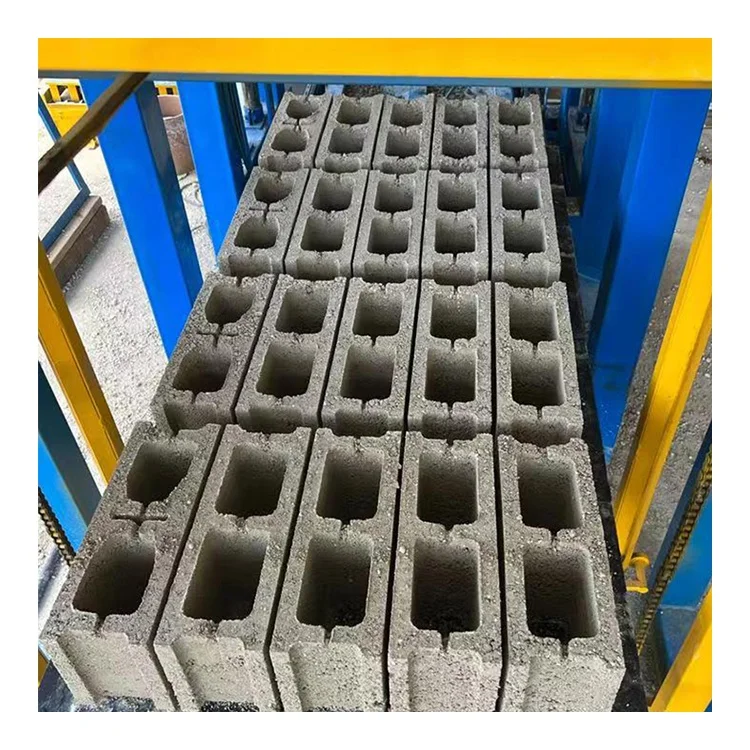
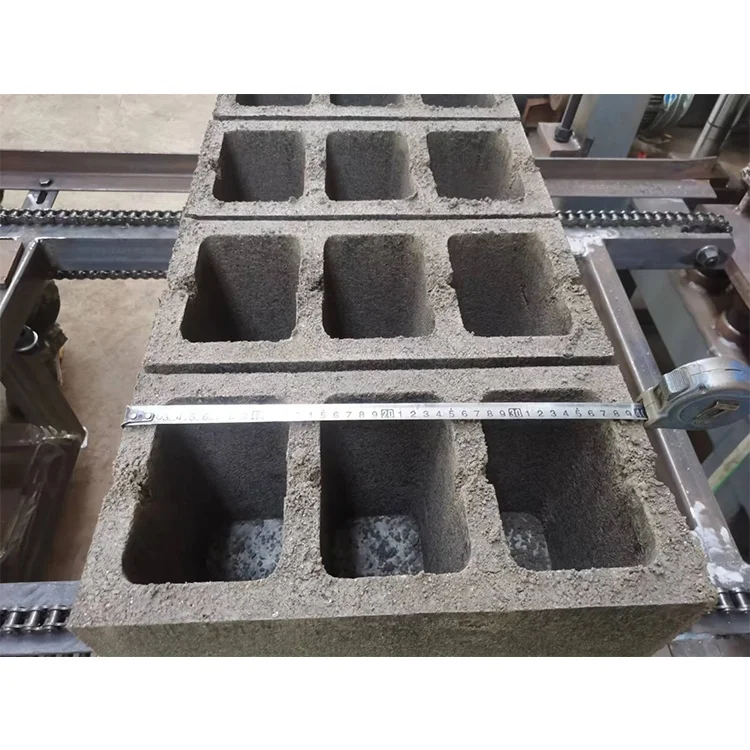 Stationary block machine