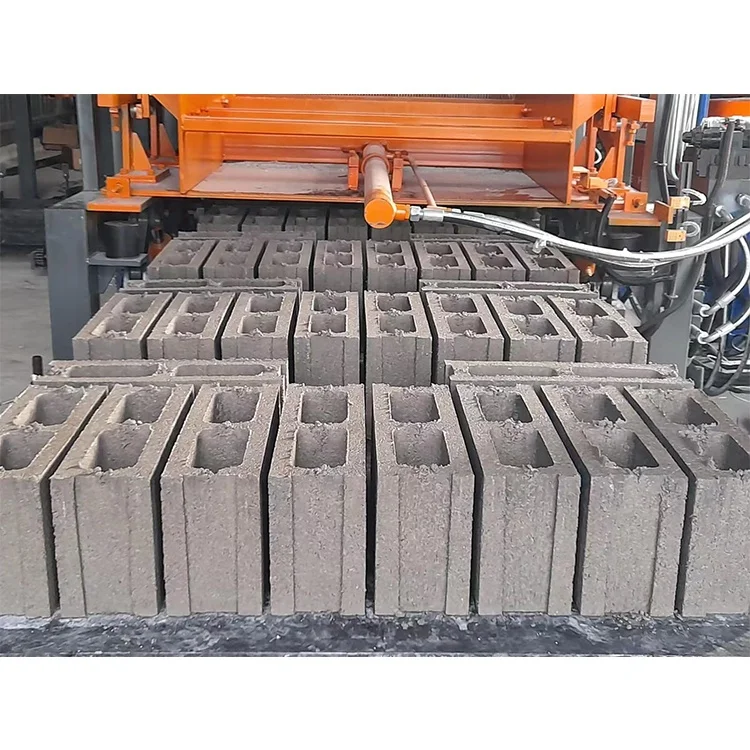
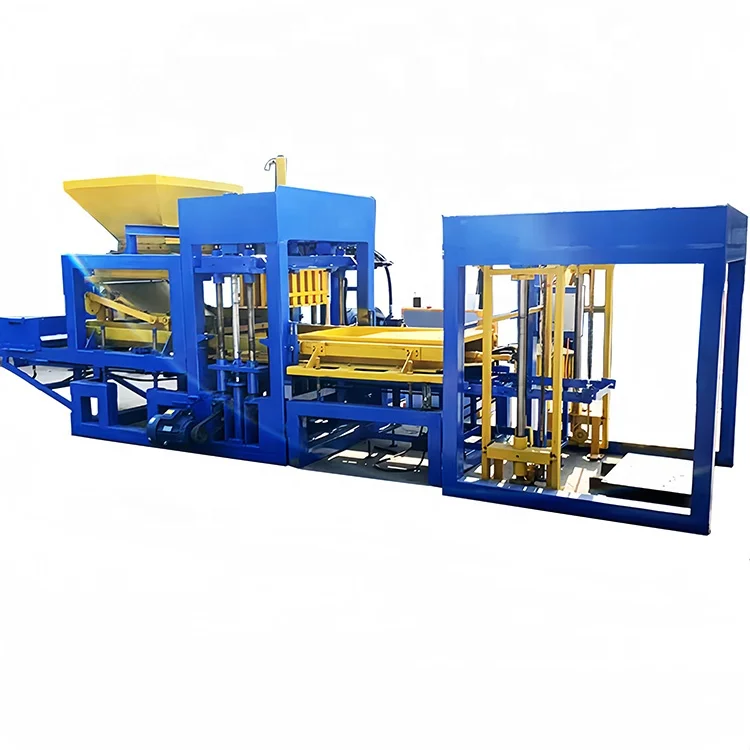
Configuration matched to local aggregate and mix design — the QT4-15 block machine manufacturer calibrates vibration and hydraulic pressure against your specific raw material, not a catalogue default.
Technical Specifications
| Parameter |
Value |
| Model |
QT4-15 |
| Product Type |
Automatic Hydraulic Concrete Block Making Machine |
| Control System |
Computer controlled, fully automatic (PLC) |
| Vibration Mode |
Multiaxis synchronizer vibration, vertically downward |
| Hydraulic System |
High thermal efficiency, low heat productivity |
| Guide Bearing |
Long-period over length guide bearing for upper mould and mould box alignment |
| Mixer System |
Multiaxis forced mixer system |
| Rack Construction |
High strength with special welding technique, resists vibrating shock |
| Automation Level |
Fully automatic |
| Output Capacity (400×200×200mm hollow block) |
900–1200 pcs/h, 7200–9600 pcs/8hr |
| Output Capacity (400×150×200mm block) |
1080–1440 pcs/h, 8640–11520 pcs/8hr |
| Output Capacity (400×100×200mm block) |
1440–1920 pcs/h, 11520–15360 pcs/8hr |
| Output Capacity (200×100×60mm paving block) |
2880–3840 pcs/h, 23040–30720 pcs/8hr |
| Output Capacity (240×115×53mm solid brick) |
5930–6720 pcs/h, 47400–53700 pcs/8hr |
| Molding Cycle |
15–20s |
| Mould Format |
400×200×200 / 400×150×200 / 400×100×200 / 200×100×60 / 240×115×53 |
| Warranty |
1 year for the whole machine (excluding spare parts) |
Application Suitability
| Application |
Material or Output |
| Hollow block production |
Crushed stone, sand, cement, fly ash aggregates |
| Multicellular brick production |
Lightweight aggregate and cement blends |
| Paving brick production |
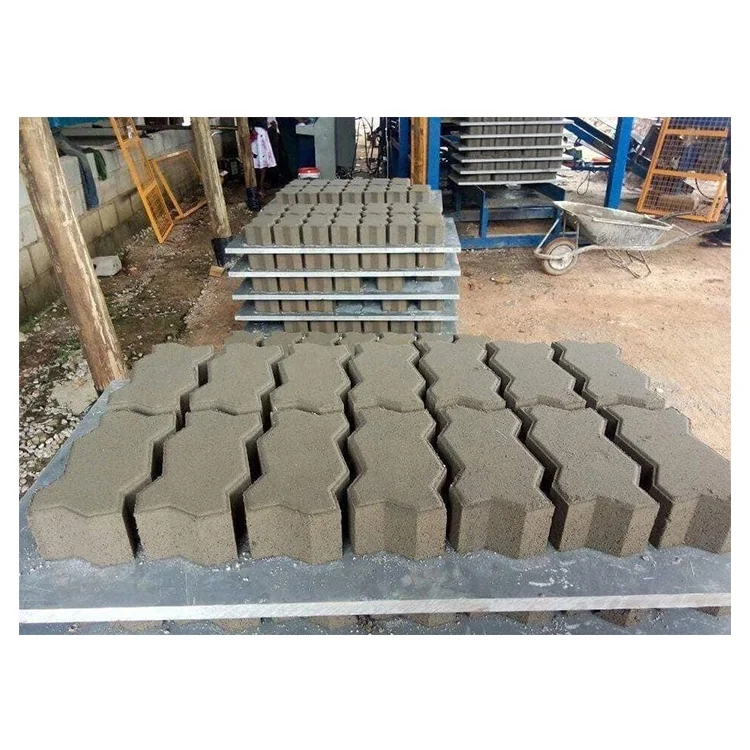
Dense aggregate mixes for high compressive strength |
| Standard solid brick production |
Sand-cement or fly ash-cement formulations |
| Block and paver production plants |
Multiple format output across shifts |
| Construction contractor yards |
On-site or yard-based medium volume production |
| Building material distributors |
Format diversification for regional markets |
| First block plant entrepreneurs |
Mid-tier automatic entry with upgrade potential |
What "9600 Hollow Blocks per Day" Actually Assumes About Your Format
Every output figure on this page ties to one specific block dimension, and mixing them up is how buyers end up with half the production they budgeted for.
When an automatic block making machine for sale lists a single headline capacity, buyers often assume that number applies across every mould they plan to run. In practice, a hollow block takes a longer cycle and occupies more pallet area than a solid brick, so the same QT4-15 block machine manufacturer produces vastly different daily totals depending on which format sits on the press. I have watched contractors order based on the highest number in the brochure, then discover their primary product — usually a 200mm hollow block — yields less than half that volume. The mismatch shows up on day one of commissioning, when the target block format is loaded and the actual cycle time begins to dictate real throughput. [NEED_CITE:]

Where the QT4-15 Sits in the Full Machine Range
The Shiyue range spans from semi-automatic workshop models up through high-capacity fully automatic lines with integrated cubing. The QT4-15 occupies the mid-tier automatic position — computer-controlled operation with PLC management, multiaxis vibration, and hydraulic pressing, but without the full automatic stacking and cubing systems found on higher-tier models. This makes it a common choice for buyers who have outgrown semi-automatic equipment but are not yet ready for a complete high-volume line. Understanding where this automatic block making machine for sale lands helps buyers gauge the investment step and the plant footprint they should plan for.
Semi-Automatic Versus Full Automatic — What Changes on the Floor
Moving from a semi-automatic machine to the QT4-15 means the operator no longer controls each cycle manually — the PLC governs feed timing, vibration duration, hydraulic pressure application, and mould release sequence. What stays the same is the need for manual pallet handling at the discharge end unless the buyer specifies additional handling equipment. In a typical mid-tier setup, one or two workers move cured pallets to the yard while the press continues cycling. Higher-tier automatic lines add pallet return conveyors, stacking stations, and cubing systems that remove this manual link entirely. The QT4-15 block machine manufacturer designs the machine so that a buyer can start here and add handling automation later without replacing the press itself. [NEED_CITE:]
Reading the Specs That Matter Beyond the Brochure
The multiaxis synchronizer vibration with vertical downward force directly determines how densely the concrete mix compacts inside the mould cavity — insufficient vibration leaves voids in hollow block walls, while excessive force can cause segregation in lean mixes. The long-period over length guide bearing controls the alignment between upper mould and mould box, which is what keeps block dimensions consistent across thousands of cycles and prevents uneven wear on mould edges. The high thermal efficiency hydraulic system matters in tropical or Middle Eastern installations where ambient temperature pushes oil temperature up, potentially softening the hydraulic response and lengthening cycle times. The multiaxis forced mixer system handles raw materials with varying particle sizes and moisture contents, which is where many buyers discover their local aggregate does not behave like the reference sand used during factory testing.
The Hidden Cost of Skipping the Configuration Conversation
When a buyer orders a mid-tier automatic machine without confirming pallet size against their existing curing racks and forklifts, the pallets arrive incompatible with the yard layout — blocks end up stacked by hand on whatever flat surface is available. Skipping voltage and frequency confirmation means the motor winding specification may not match the local grid, and correcting that after the machine has been shipped and installed sets a project back by weeks. Choosing an automation level without planning for pallet handling labour means the press output piles up faster than two workers can clear it, creating a bottleneck the machine itself was never designed to solve. These are not engineering failures — they are specification gaps that surface only after the machine is bolted to the floor. [NEED_CITE:]
Why This QT4-15 Block Machine Manufacturer Approaches It Differently
Every machine is configured against the buyer’s actual mix design and local aggregate, so the vibration force and hydraulic pressure are set for your material, not a reference standard. Block machinery is the single focus, meaning the press, mould, pallet, and handling equipment are specified as one matched system rather than assembled from separate suppliers. Mould design covers the formats your market actually sells, with custom drawings available for non-standard block shapes. The automation level is selectable and upgradable, so you can start with the QT4-15 as a fully automatic press and add pallet return and stacking modules as volume grows. Installation support includes on-site commissioning and operator training so the crew running the machine on day one understands cycle parameters and mould change procedure. [NEED_CITE:]
Documentation & Verification
- Line layout with capacity calculation stating block format assumed for each output figure
- Machine specification sheet confirming pallet size, voltage, and frequency for your site
- Mould drawing and format list covering every block shape in your quotation
- Factory test record showing cycle times run against your specified block format
- Hydraulic and electrical schematic matching your confirmed voltage and control language
- Operation and maintenance manual with wear parts list and replacement intervals
Installation, Commissioning & Support
- Foundation must accommodate the QT4-15 rack footprint with level concrete pad rated for vibration loads
- Dedicated electrical circuit matching confirmed voltage and frequency specification before machine arrival
- PLC display language set to operator preference during factory configuration, verified before shipment
- Multiaxis forced mixer system commissioned with your local aggregate to establish baseline mix proportions
- Mould change procedure trained on-site so format changeover does not consume the first production shift
- Wear parts list provided with recommended replacement intervals for guide bearings and hydraulic seals
What to Include in Your First Enquiry
To position the QT4-15 correctly within the range and build an accurate line layout, share the block formats your market demands, your target daily volume per format, and the raw materials available locally including aggregate type and source. Confirm the voltage and frequency at your site, the PLC display language your operators need, and whether you have existing curing racks or forklifts that dictate pallet dimensions. If you are comparing this model against a semi-automatic or higher-tier automatic line, stating your current or planned labour arrangement helps determine which automation level fits.
Frequently Asked Questions
Q: How is the QT4-15’s capacity calculated, and which block format does each figure assume?
A: Every output figure on the specification table is calculated against one specific block dimension — for example, the 900–1200 pieces per hour figure applies to the 400×200×200mm hollow block. Smaller formats like solid bricks cycle faster and yield higher hourly numbers, while larger hollow blocks take longer. The line layout document provided with your quotation states the format assumed for each output figure so there is no ambiguity about real daily production.
Q: Where does the QT4-15 sit compared to semi-automatic and higher-tier automatic models?
A: The QT4-15 is a mid-tier fully automatic press with PLC-controlled cycling, multiaxis vibration, and hydraulic pressing. Below it sit semi-automatic machines where the operator triggers each cycle manually. Above it are higher-capacity automatic lines that integrate pallet return conveyors, automatic stacking, and cubing systems. The QT4-15 block machine manufacturer designs the platform so buyers can add handling automation later without replacing the press.
Q: What voltage, frequency, and PLC language options are confirmed before shipment?
A: Voltage and frequency must match your local grid specification — this is confirmed during the quotation stage and verified again before factory testing. The PLC display language is set to your operator preference, whether English, Spanish, or another supported language. Both parameters are documented in the specification sheet and tested during the pre-shipment factory run so there are no surprises at commissioning.
Q: Can the automation level be upgraded from the QT4-15’s current setup at a later stage?
A: Yes. The QT4-15 platform supports the addition of automatic pallet feeding, pallet return conveyors, stacking stations, and cubing systems as production volume grows. The press itself does not need to be replaced — the handling modules connect to the existing PLC and mechanical interfaces. This upgrade path lets buyers start with the automatic block making machine for sale at a manageable investment level and expand as market demand increases.
Q: What plant footprint and installation conditions does the QT4-15 line require?
A: The footprint depends on which supporting equipment you include — the press alone requires a level concrete foundation rated for vibration loads, while a full line with mixer, pallet feeder, and curing rack handling needs a larger covered area. Power supply must match the confirmed voltage and frequency with a dedicated circuit. Site conditions including ambient temperature affect hydraulic system performance, and this is factored into the configuration during the proposal stage.

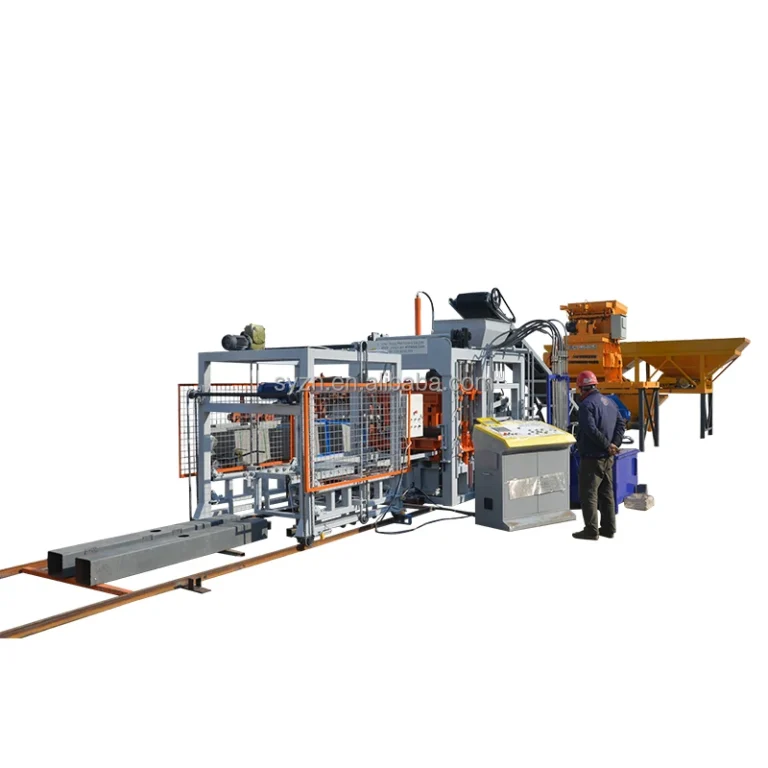 High quality block machine