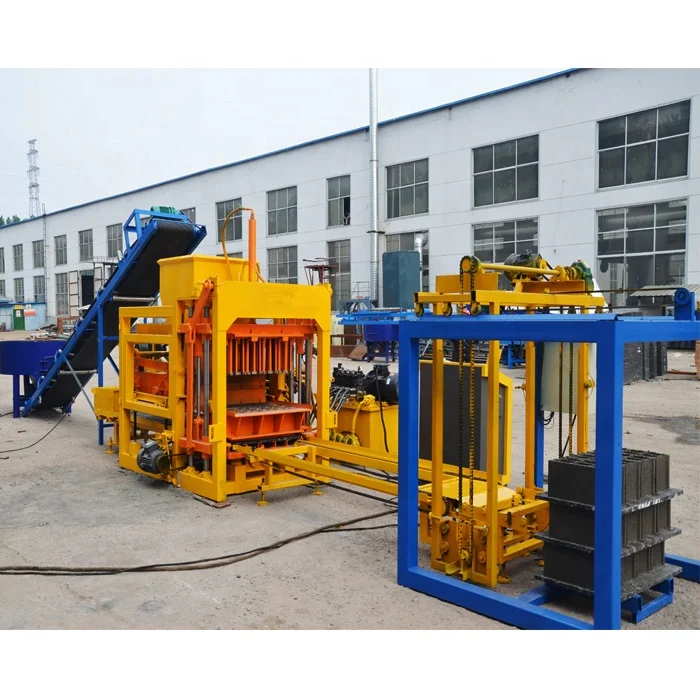
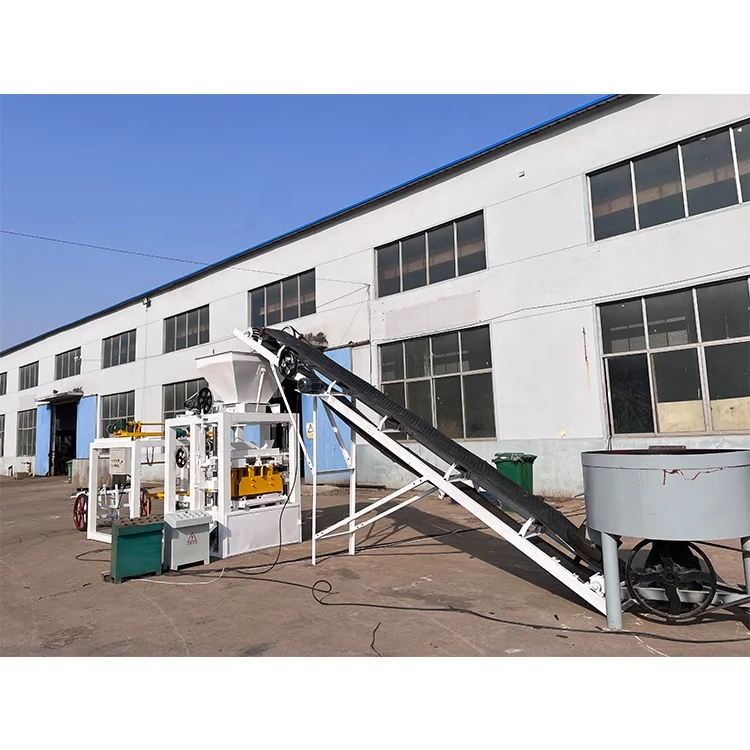
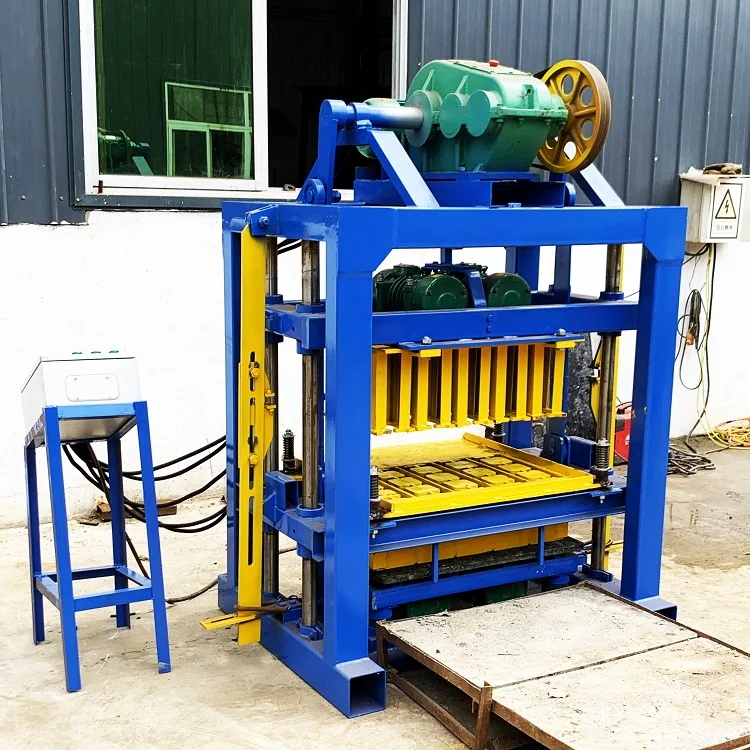
Matched System Specification — The QT15-15 stationary block machine manufacturer configures press, mould, pallet, and handling as one verified line rather than separate catalog items.
Technical Specifications
| Parameter |
Value |
| Model |
QT15-15 |
| Product Type |
Stationary Concrete Block Making Machine |
| Overall Dimensions (L×W×H) |
9350×2520×2950 mm |
| Net Weight |
15 T |
| Rated Power |
45.7 kW |
| Voltage & Frequency |
380V (frequency to confirm with buyer market) |
| Hydraulic Pressure |
21 MPa |
| Pallet Size |
1350×850×40 mm |
| Control System |
PLC (brand and display language configurable) |
| Automation Level |
Automatic (upgradable from semi-automatic baseline) |
| Output Capacity |
3600 pcs/h (based on 400×200×200 mm hollow block, 15 pcs/mould) |
| Output Capacity |
4320 pcs/h (based on 400×150×200 mm block, 16 pcs/mould) |
| Output Capacity |
14000 pcs/h (based on 240×115×53 mm solid brick, 62 pcs/mould) |
| Daily Output |
28800 pcs/day (based on 400×200×200 mm hollow block) |
| Daily Output |
34560 pcs/day (based on 400×150×200 mm block) |
| Daily Output |
112000 pcs/day (based on 240×115×53 mm solid brick) |
| Vibration System |
Four external vibration motors |
| Feeder Design |
European-design material feeder with turning arm cylinder |
| Upper Mould Stability |
Synchronous gear on two sides, wide distance, four-point support |
| Vibration Adjustment |
Airbag system for amplitude and pressure tuning by brick type |
| Color Options |
According to buyer request |
| Warranty |
1 year |
| Standards |
ISO 9001:2008, CE |
Application Suitability
| Application |
Material or Output |
| Hollow block production |
400×200×200 mm format from crushed stone, sand, and cement |
| Solid block production |
400×150×200 mm format from local aggregate and cement blend |
| Standard brick production |
240×115×53 mm solid brick from fine aggregate mix |
| Interlocking brick |
Mould-dependent, using graded aggregate with cement binder |
| Paving block production |
Mould-dependent, high-density mix with fine and coarse aggregate |
| On-site contractor production |
Large-format blocks for housing and infrastructure projects |
What "Cycles per Hour" Hides From the Buyer
Capacity only means something when the block format, mould cavity count, and cycle assumptions are stated alongside it.
I once watched a plant owner in the Middle East stare at a stationary block machine manufacturer’s catalog figure and place an order without ever asking which block that number assumed. When his local aggregate turned out coarser than the default mix, the cycle stretched, daily output dropped sharply, and the gap between brochure promise and actual production became a costly dispute [NEED_CITE: common disputes over unqualified block machine capacity claims]. A single cycles-per-hour figure tells you nothing about what you will actually produce.

Placing the QT15-15 Within the Output Tier Range
The QT15-15 sits at the high-capacity end of our stationary block machine range. Buyers evaluating their first plant typically start by comparing the footprint, investment level, and daily output of each tier against their market volume. This model suits operations that have already confirmed demand for multiple block formats and need sustained throughput across shifts.
The range spans from small workshop machines through semi-automatic mid-tier presses up to this fully automatic tier. Each step up adds pallet handling automation, larger mould platforms, and higher hydraulic and vibration capacity. Understanding where your target output falls on this scale prevents both over-investment in unused capacity and under-investment that forces a second machine purchase within a year.
How the Matched Line Eliminates Station-to-Station Mismatch
A block line is only as fast as its slowest station. The material feeder, press cycle, pallet return, and stacking system must all operate within compatible timings or the press sits idle waiting for the next pallet. When these components come from separate suppliers, timing mismatches are common and usually discovered only after installation [NEED_CITE: block production line integration challenges].
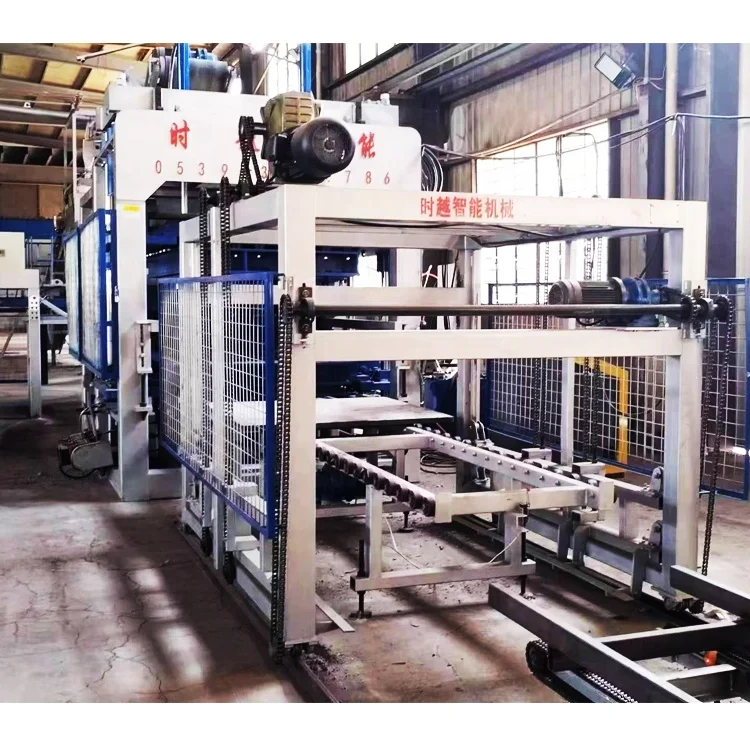
With the QT15-15, the European-design turning arm feeder is specified to fill the mould within the press cycle window. The pallet size of 1350×850 mm is chosen alongside the curing rack dimensions and the forklift the buyer already operates. The automatic stacking and cubing system is rated to keep pace with the press at its stated output per format, so green blocks move off the line as fast as they are produced.
Reading the Specs That Actually Determine Block Quality
Hydraulic pressure at 21 MPa and the four-motor external vibration system work together to compact the mix. Pressure alone does not guarantee density; the vibration must fluidize the material so it settles uniformly under compression. The airbag system lets the operator adjust vibration amplitude and pressure independently for each brick type, which matters when switching between a dry hollow block mix and a wetter paving block formulation.
The upper mould uses synchronous gearing on two sides with a wide span for four-point stability. This geometry distributes pressing force evenly across the mould cavity, reducing thickness variation from corner to corner. Uneven force distribution shows up as blocks that pass a visual check but fail compressive strength testing on one side.
Pallet size at 1350×850×40 mm determines how many blocks cure per rack position. Choosing a pallet without considering existing curing area dimensions or forklift tine spacing creates handling bottlenecks that no press speed can overcome.
The Hidden Cost of Skipping Configuration Verification
When a stationary block machine manufacturer ships a press configured for a standard catalogue mix and the buyer’s local aggregate differs in grading or moisture absorption, the result is inconsistent block strength across batches. The machine is not defective; it was simply set up for conditions that do not exist at the buyer’s site [NEED_CITE: aggregate variability impact on concrete block compressive strength]. Voltage and frequency left unconfirmed can delay commissioning by weeks if the local supply does not match the motor winding. PLC display language assumed rather than specified means operators cannot read fault codes during production.
Why Buyers Source This Tier Here
Block machinery is our single focus, so the QT15-15 is specified as part of a complete matched system — press, moulds, pallets, and handling — rather than assembled from unrelated component suppliers.
Configuration is set against your actual mix design, local aggregate grading, and target block formats rather than defaulted from a catalogue.
Mould design covers the formats your market sells, including custom mould engineering from buyer drawings when standard options do not match.
Automation level is selectable, so a buyer can commission the QT15-15 on a semi-automatic pallet handling basis and add full stacking and cubing automation later as production volume grows.
Installation and commissioning include operator training on the PLC interface, mould change procedures, and daily maintenance routines specific to this press.
Documentation & Verification
- Line layout with capacity calculation stating the block format assumed for each output figure
- Machine specification sheet confirming hydraulic pressure, vibration force, and pallet size against your mix
- Mould drawing and format list including any custom mould designed to your product drawings
- Voltage, frequency, and PLC display language written confirmation before production release
- Factory test record run on your specified block format before container loading
- Operation and maintenance manual covering mould change, hydraulic service, and daily checks
Installation, Commissioning & Support
- Foundation plan sized to the QT15-15 footprint of 9350×2520 mm with vibration isolation requirements
- Electrical supply confirmed at 380V or buyer-specified voltage with dedicated circuit for the 45.7 kW rated load
- Machine shipped in dismantled state with reassembly sequence and lifting point diagram provided
- Commissioning includes first-run cycle tuning on your local aggregate mix and target block format
- PLC interface configured in buyer’s chosen display language before operator training begins
- Wear parts list with hydraulic seal and vibration motor specifications for local sourcing or direct supply
What We Need to Quote Accurately
To configure the QT15-15 for your plant, provide the target block formats with dimensions, required daily output per format, and the local aggregate type and grading available. Confirm your site voltage, frequency, and preferred PLC display language. If you have existing pallets, curing racks, or forklifts, share their dimensions so the handling system is specified to match.
Frequently Asked Questions
Q: How is the QT15-15 capacity verified, and which block format does each figure assume?
A: Every output figure we quote states the block format, mould cavity count, and cycle assumption behind it. The QT15-15 is rated at 3600 pcs/h based on 400×200×200 mm hollow blocks with 15 cavities per mould, and at 14000 pcs/h based on 240×115×53 mm solid bricks with 62 cavities. We provide a written capacity calculation per format before order confirmation.
Q: Can I start the QT15-15 semi-automatic and add automation later?
A: Yes. The automation level is selectable at order stage. A buyer can commission with manual or semi-automatic pallet handling and stacking, then retrofit automatic pallet feeding, stacking, and cubing as production volume justifies the investment. The press platform and PLC remain the same across automation tiers.
Q: How is the machine configured to match my local raw materials?
A: Before final configuration, we review your local aggregate grading, cement type, and available mix proportions. The vibration amplitude and hydraulic pressure are then set to produce consistent density with your specific materials. The airbag system allows further on-site tuning when you switch between block formats.
Q: What electrical and control details are confirmed before shipment?
A: Voltage, frequency, and PLC display language are confirmed in writing before production begins. This prevents the common situation where a machine arrives with motor windings or control panel labels that do not match the buyer’s local power supply or operator language, which would otherwise delay commissioning.
Q: How does the QT15-15 compare to smaller tiers in footprint and investment?
A: The QT15-15 occupies a larger plant footprint and requires higher investment than mid-tier models, justified by its output capacity across formats. Buyers comparing tiers should weigh their confirmed daily volume requirement against the floor space and capital available. We provide a side-by-side tier comparison showing footprint, output per format, and automation options for each.

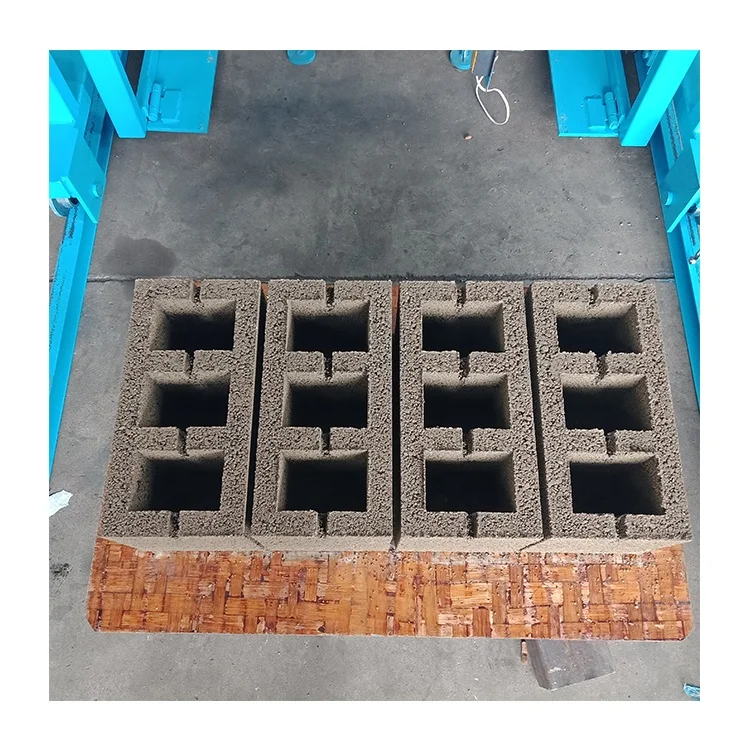 Stationary block machine