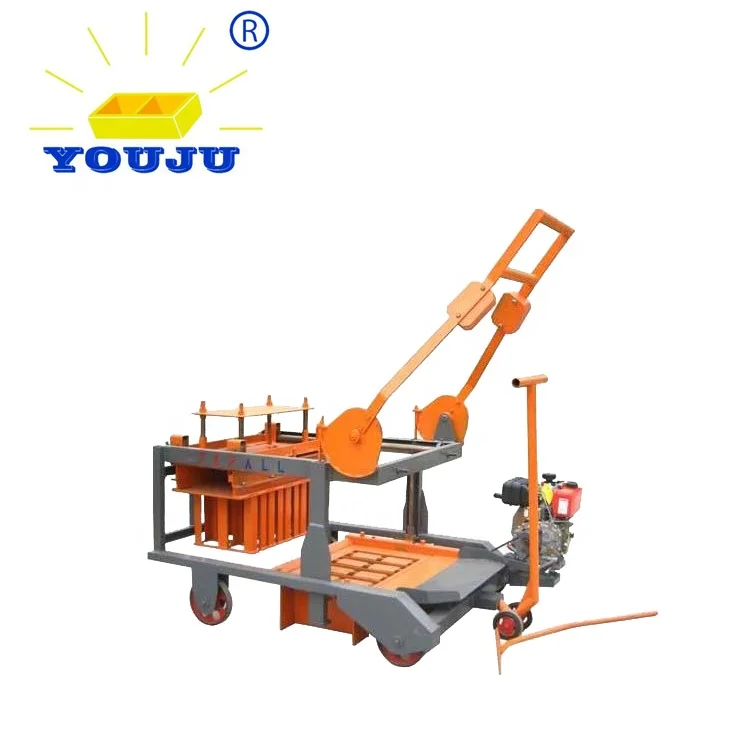
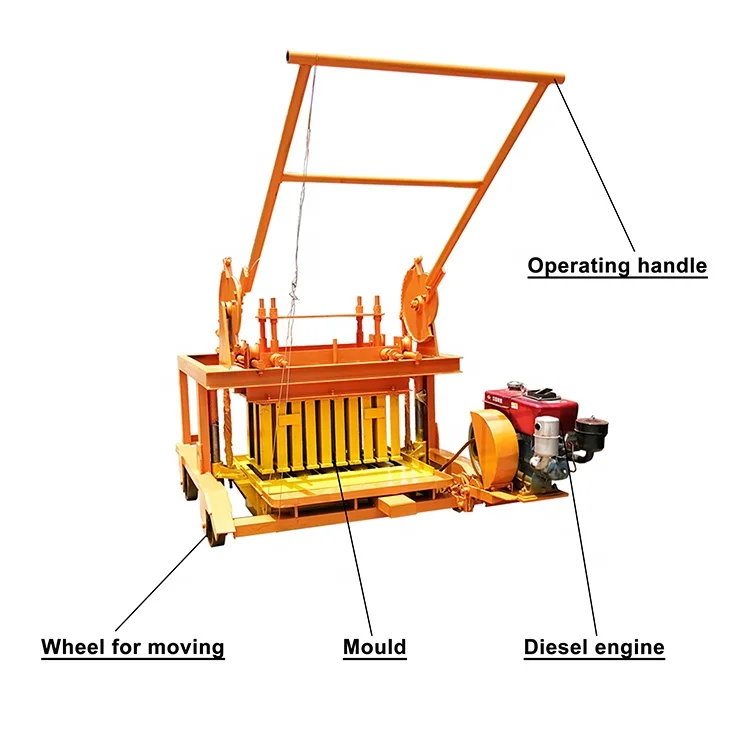
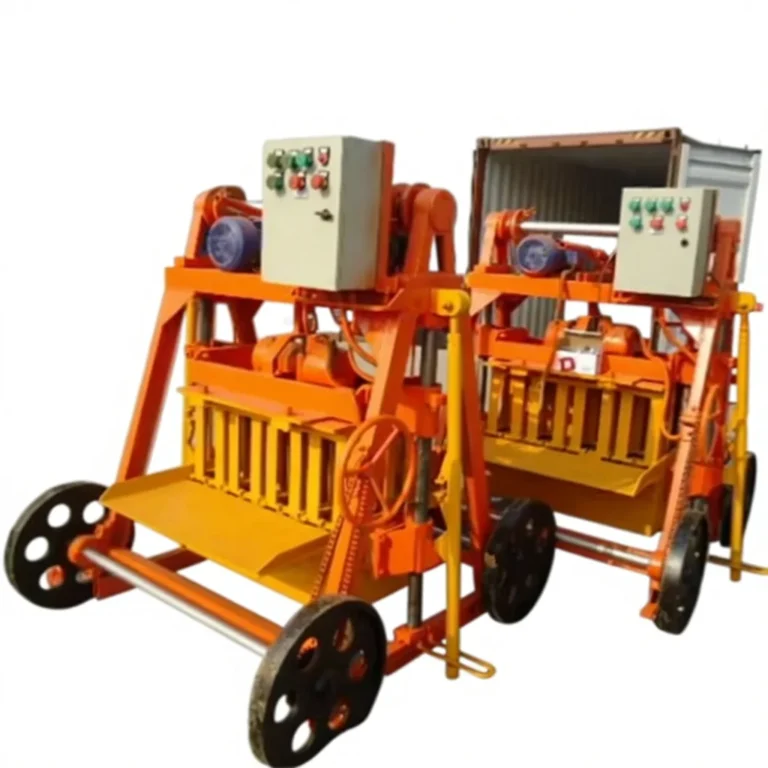
Single-Focus Engineering — the QMY4-30 is specified as one matched mobile unit, not assembled from separate catalogue items, so mould, power and movement are sized together for your site.
Technical Specifications
| Parameter |
Value |
| Product Type |
Mobile Hydraulic Block Making Machine |
| Model |
QMY4-30 |
| Overall Dimensions (L×W×H) |
1300 × 1500 × 1000 mm |
| Net Weight |
950 – 1000 kg |
| Total Installed Power |
5.95 kW |
| Hydraulic Method |
Mold Vibration |
| Exciting Power |
28.6 kN |
| Excitation Frequency |
4500 r/min |
| Molding Cycle |
30 s |
| Output Capacity |
3000 pcs/day (basis not stated in source — confirm block format) |
| Raw Material |
Concrete, sand, cement, fly ash, lime, gypsum |
| Automation Level |
Manual Transmission / Hydraulic-assisted |
| Movement |
Forward, reverse, corner (egg-laying type) |
Application Suitability
| Application |
Material or Output |
| On-site hollow block production at remote building sites |
Crushed stone, sand and cement mixes |
| Small-scale paver and solid block runs for local sale |
Fly ash, sand and cement blends |
| Contractor-led housing projects on difficult terrain |
Concrete with local aggregate |
| Suburban or coastal construction without fixed plant access |
Standard masonry-grade concrete |
Why Voltage Must Be Confirmed Before You Ship a Mobile Block Machine
Every export-bound QMY4-30 leaves the factory only after its motor, control box and vibration drive are matched to the buyer’s stated site voltage and frequency.
A mobile block machine manufacturer often quotes a unit without asking what the power supply looks like on the actual job site. I once watched a contractor in East Africa plug a 380 V motor into a 415 V grid that spiked higher during off-peak hours; the winding failed inside a week and the whole crew sat idle while a replacement motor was air-freighted. Matching electricals is not paperwork — it is the difference between producing blocks on day one and losing a fortnight [NEED_CITE: voltage and frequency standards by export market].

Where the QMY4-30 Sits in the Full Range
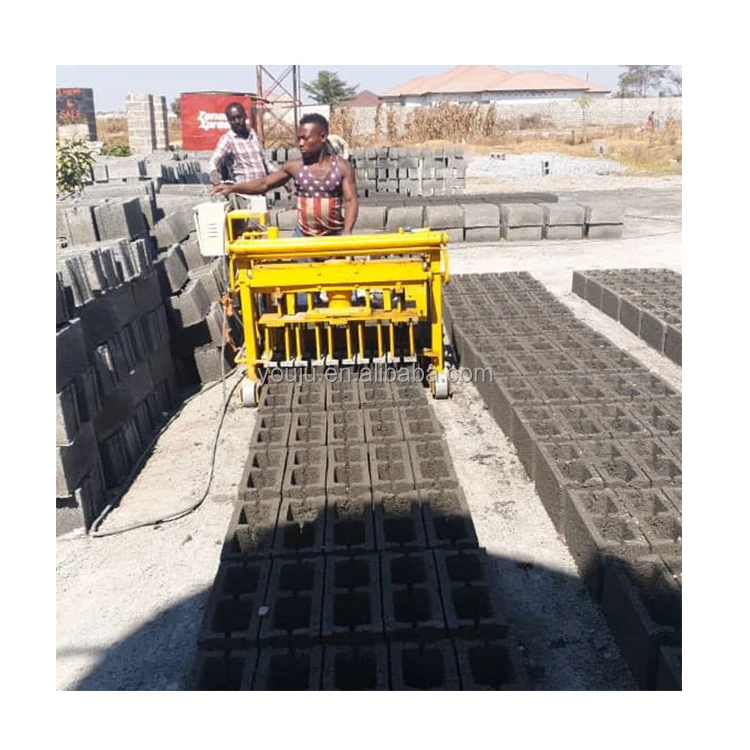
The QMY4-30 occupies the entry-mobile tier, designed for buyers who want to produce on-site without investing in a fixed plant, pallet circulation or conveyor lines. Because the unit lays blocks directly onto the ground and then moves forward, it removes the cost of pallets entirely. That makes it the natural first machine for contractors or entrepreneurs who plan to add a semi-automatic line later once daily volumes justify the footprint. A mobile block machine manufacturer that also supplies the higher tiers can plan that upgrade path with you now, so the mould formats and block sizes remain compatible as you grow.
How the Egg-Laying Movement Works in Practice
During each cycle the mould fills, vibrates at 28.6 kN, compacts the mix and then the operator walks the unit forward while the freshly formed block stays behind to cure in place. The forward-reverse-corner movement pattern lets a single operator cover a long straight run or a turning production row, which is essential on uneven or confined sites where a fixed press and conveyor cannot be installed. On hilly terrain or inside a partially completed structure the compact 1300 × 1500 mm footprint lets the QMY4-30 work where larger machines simply cannot reach [NEED_CITE: site preparation guidance for egg-laying block machines].
Reading the Numbers That Actually Matter
The 30-second molding cycle, combined with 28.6 kN of exciting power, determines how densely the concrete is compacted and therefore how quickly the block reaches handling strength. A lower excitation force leaves a softer block that cracks when moved, while a higher frequency without matching force creates surface cracks. The 5.95 kW total power draw tells you whether a small diesel generator on site can sustain production or whether a dedicated supply circuit is needed. Because this is a mobile block machine manufacturer specification rather than a third-party claim, each value traces back to the actual motor and vibrator fitted.
The Cost of Skipping Configuration Details
Buyers who order a mobile press without confirming which block format the quoted output assumes often discover the daily figure drops sharply when they switch to a thicker or taller mould. Others find the vibration motor overheats because the local ambient temperature was never discussed. Each of these gaps turns into idle days, emergency parts orders and frustrated masons standing around a silent machine [NEED_CITE: common commissioning failures on mobile block machines in tropical climates].
Why Buyers Source This Tier Here
Block machinery is the only product line, so the QMY4-30 is not repackaged from a general construction catalogue. The mould, power and movement are configured against your target block format and local aggregate before production starts. Mould drawings and format lists are supplied so you can see exactly which sizes are possible. Voltage and control language are confirmed in writing before dispatch, which is something I personally re-check on every unit bound for sites with unstable grids. Factory test records document the machine running under load, giving you a baseline to match on arrival.
Documentation & Verification
- Line layout stating the block format assumed for daily output
- Machine specification sheet with confirmed voltage and frequency
- Mould drawing and format list for every available size
- Factory test record on your target mix before dispatch
- Packing photographs for customs and insurance records
Installation, Commissioning & Support
- Confirm 5.95 kW supply circuit with correct breaker rating
- Level production area to within tolerance for consistent block height
- Verify motor rotation direction before first molding cycle
- Operator training on mold vibration timing and forward movement
- Spare vibration springs and seal kit supplied at dispatch
- Daily inspection checklist covering hydraulic and electrical points
What to Share When You Request a Proposal
Tell us the block formats your market actually sells, the daily volume you need and the raw materials available within hauling distance. Share your site voltage, frequency and the language your operator reads on a control display. If the ground is sloped, soft or confined, a quick sketch or photo helps us confirm whether the QMY4-30 footprint fits without additional site work.
Frequently Asked Questions
Q: What block format is the 3000 pcs/day figure based on?
A: That figure appears in the source without a stated format. We calculate realistic output per mould — hollow, solid, paver or interlocking — using your chosen block dimensions and the 30-second cycle, so you see the number that applies to your product, not a catalogue headline.
Q: Where does the QMY4-30 sit compared to semi-automatic and automatic tiers?
A: It is the entry-mobile tier, producing on the ground without pallets. Semi-automatic lines add fixed presses and pallet circulation; automatic tiers add stacking and cubing. Starting mobile lets you confirm market demand before committing to a larger footprint.
Q: What voltage and control options are available?
A: Motors and control boxes are configured to your site voltage and frequency before build. Display language is confirmed in writing so operators can read fault codes and cycle prompts in the language they use daily.
Q: Can I upgrade to a fixed line later?
A: Yes. Mould formats and block dimensions can be carried forward so your existing market range continues on a larger press. We plan the upgrade path at the initial inquiry stage to keep transition costs predictable.
Q: Which mould formats fit the QMY4-30?
A: Standard hollow, solid, paving and interlocking moulds are available, and custom moulds can be designed to your drawings. We supply a format list showing every compatible size and the corresponding cycle output before you commit.

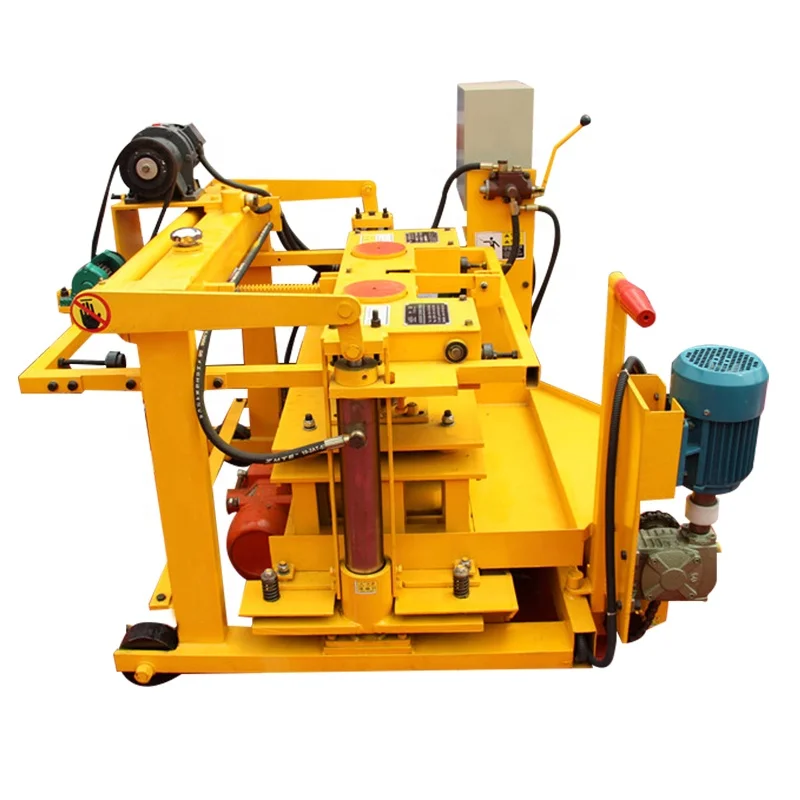
 Mobile block machine