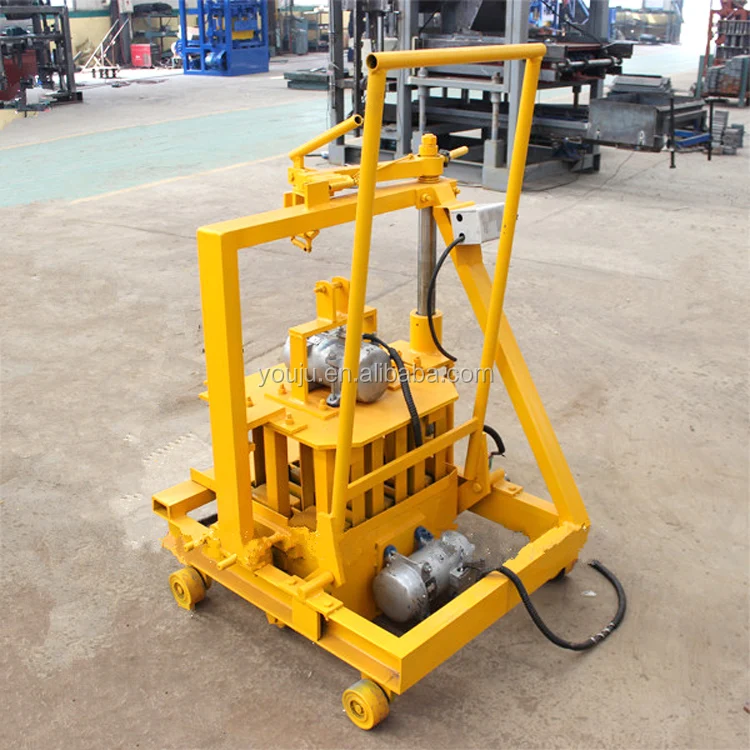
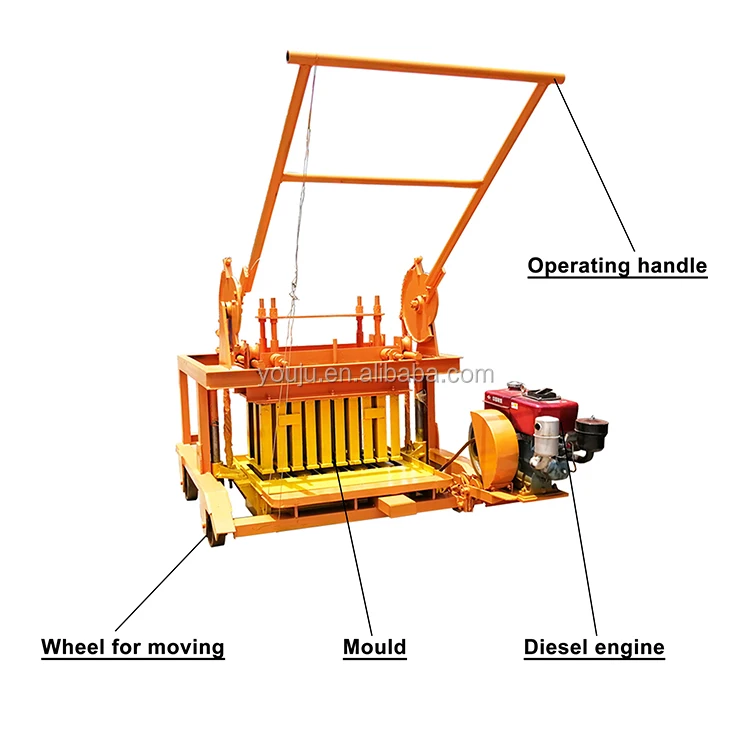
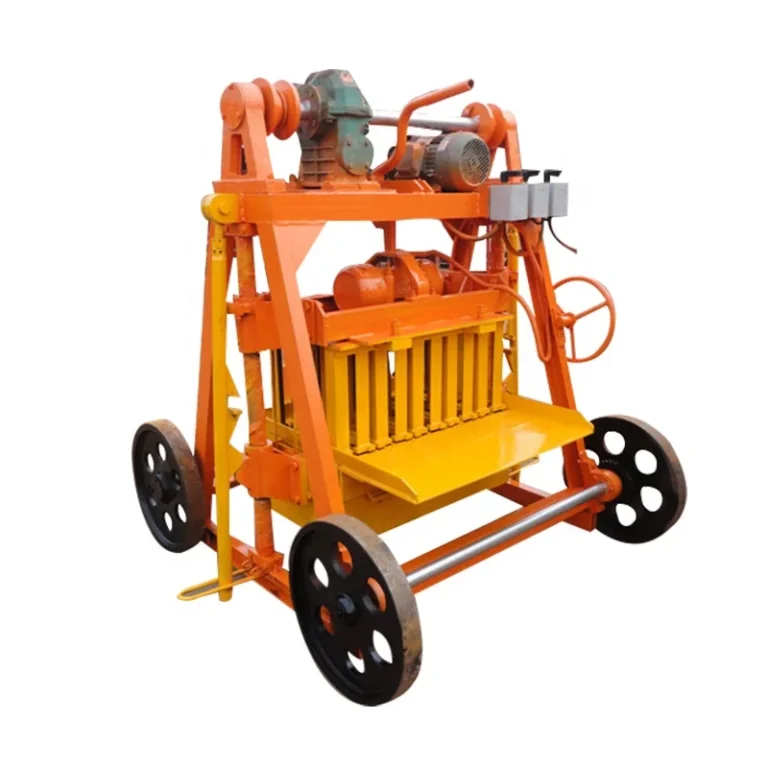
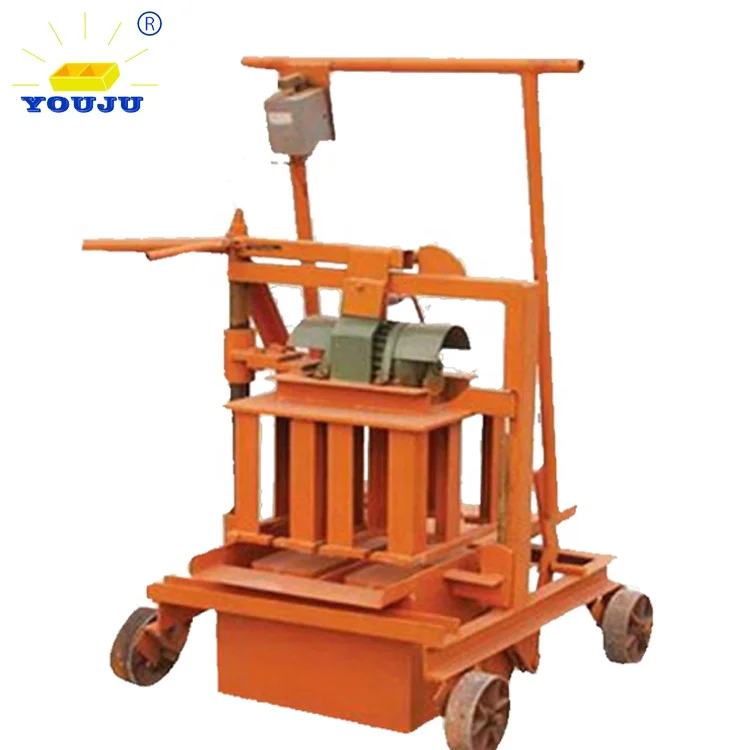
Single-focus block machinery — the QMR4-45 diesel mobile egg laying block machine is specified as a matched system of press, mould, and power source rather than assembled from separate component suppliers.
Technical Specifications
| Parameter |
Value |
| Model |
QMR4-45 |
| Product Type |
Mobile Egg Laying Block Making Machine |
| Overall Dimensions (L×W×H) |
2420×1320×1650 mm |
| Moulding Cycle |
40–45 s |
| Pallet Requirement |
None (egg laying type) |
| Net Weight |
810 kg |
| Rated Power |
6 kW |
| Diesel Engine Option |
6 kW or 6–8 HP |
| Voltage Configuration |
220 V, 380 V, or client local voltage |
| Output Capacity |
3000 pcs/day (basis: 400×200×200 mm hollow block, 8-hour shift) |
| Available Mould Formats |
400×200×200 mm (4 pcs/mould), 400×150×200 mm (5 pcs/mould), 400×120×200 mm (6 pcs/mould) |
| Automation Level |
Manual operation with diesel hydraulic assist |
| Key Features |
No-pallet operation, multiple hollow block formats, compact site footprint |
Application Suitability
| Application |
Material or Output |
| On-site hollow block production |
Crushed stone, river sand, and cement mixes without fixed plant infrastructure |
| Remote construction sites |
Diesel-powered operation where grid electricity is unavailable or unstable |
| Housing project contractors |
Direct production of 400×200×200 mm and 400×150×200 mm hollow blocks on location |
| First-time block plant setup |
Entry-level production for entrepreneurs evaluating market demand before scaling |
| Multiple wall thickness requirements |
Interchangeable moulds for 120 mm, 150 mm, and 200 mm block widths |
What "3000 Pieces Per Day" Actually Means for Your Site
Daily output figures are meaningless unless the block format is stated upfront.
I have watched buyers compare mobile egg laying block machines using only the headline capacity number, then discover on-site that their chosen format runs slower than expected. The QMR4-45 mobile egg laying block machine for sale is rated at 3000 pieces per day based on 400×200×200 mm hollow blocks in an 8-hour shift. If your market demands 400×150×200 mm blocks instead, the per-cycle piece count changes and so does your realistic daily total. [NEED_CITE: block format impact on daily output calculations] Every capacity conversation should start with which format you actually sell, not which format makes the brochure look best.

Placing the QMR4-45 on the Machine Range
The QMR4-45 sits at the entry tier of the mobile egg laying category, designed for buyers who need block production without committing to a fixed plant layout. It occupies a distinct position between hand-operated moulds and semi-automatic stationary lines. The no-pallet design means you eliminate pallet investment and curing rack handling entirely, which simplifies the site setup considerably.
Where Mobile Egg Laying Machines Fit in Your Decision
This mobile egg laying block machine for sale serves contractors who produce blocks directly on housing project sites and entrepreneurs testing local demand before investing in higher-capacity lines. The 2420×1320 mm footprint fits constrained work areas where a stationary plant would not. [NEED_CITE: site footprint requirements for mobile versus stationary block production] When your project moves, the machine moves with it — no dismantling of conveyors or mixer stations required.
Reading the Specifications That Matter
The 6 kW rated power and optional 6–8 HP diesel engine determine whether you run on grid electricity or fuel, which affects your operating cost structure on remote sites. The 40–45 second moulding cycle applies across the listed hollow block formats, but remember that manual mould changes between formats add non-productive time to your shift. The 810 kg net weight keeps the machine transportable while maintaining enough mass to resist vibration walk during operation. Voltage must be confirmed before dispatch — 220 V and 380 V configurations are available, but arriving with the wrong frequency setting delays commissioning. [NEED_CITE: voltage and frequency standards by export market]
The Hidden Cost of Skipping Format Confirmation
Buyers who order based on cycle time alone often find their local aggregate requires longer vibration cycles to achieve target block strength. A machine configured for standard river sand may underperform with weathered or volcanic aggregates common in certain regions. The vibration force and hydraulic pressure must match your specific mix design, not a catalogue default. [NEED_CITE: aggregate variation effects on block density and strength] Skipping material testing before purchase turns a capacity problem into a quality problem that no on-site adjustment can fully correct.
Why Source This Machine Here
Block machinery is our single focus, so the QMR4-45 arrives as a matched system — press, mould, and power source specified together rather than sourced separately. Configuration decisions reference your actual mix design and target block format instead of defaulting to catalogue settings. Mould design covers the hollow block sizes your market sells, with custom drawings available for non-standard formats. The automation level remains selectable, allowing you to start with manual operation and transition to semi-automatic equipment as demand grows. Installation support includes operator training specific to diesel hydraulic systems and no-pallet egg laying technique.
Documentation & Verification
- Factory test record on your specified hollow block format before dispatch
- Machine specification sheet with voltage and frequency confirmed for destination market
- Mould drawing and format list for 400×200, 400×150, and 400×120 mm sizes
- Line layout showing QMR4-45 footprint relative to semi-automatic tiers
- Operation manual covering diesel engine maintenance and hydraulic assist procedures
Installation, Commissioning & Support
- Site requires level ground but no concrete floor preparation for the 2420×1320 mm footprint
- Diesel engine option eliminates need for dedicated electrical circuit installation
- Machine arrives assembled with mould mounted; hydraulic fluid fill required on-site
- First-run parameter adjustment for local aggregate and cement ratio during commissioning
- Operator training covers mould change sequence and egg laying travel technique
- One-year guarantee covers hydraulic components and diesel engine parts
Before You Request a Quote
Provide your target block format and daily output requirement so the capacity calculation reflects your actual production scenario. Specify your local aggregate type and whether samples can be sent for mix design testing. Confirm site voltage and frequency, plus whether diesel or electric power suits your operation. Indicate if you need multiple mould formats included in the initial quotation.
Frequently Asked Questions
Q: How do I verify the real daily output — what block format does the 3000 pcs/day figure assume?
A: The 3000 pieces per day rating assumes 400×200×200 mm hollow blocks produced over an 8-hour shift with 4 pieces per mould. If your market requires different dimensions, the per-mould count changes and daily output must be recalculated for that specific format before you commit to a production target.
Q: Where does the QMR4-45 sit on the range compared to semi-automatic and automatic block machines?
A: This machine occupies the entry tier for mobile production, requiring no pallets or fixed infrastructure. Semi-automatic lines add pallet handling and higher cycle rates but need concrete floors and curing areas. The QMR4-45 suits buyers testing demand or working on project sites where stationary plants are impractical.
Q: What site conditions are needed — do I need a concrete floor or any fixed infrastructure?
A: The QMR4-45 operates on level ground without concrete floor preparation. The egg laying design deposits blocks directly on the surface, so you need adequate space for production travel and block curing. No fixed mixer station or pallet return system is required for basic operation.
Q: Diesel versus electric power — how do I choose based on my site electricity supply?
A: Choose diesel when grid power is unavailable, unstable, or would require expensive transformer installation. The 6–8 HP diesel option provides independent operation. Electric configuration at 220 V or 380 V suits sites with reliable power and lower fuel cost structures.
Q: Can I start with the QMR4-45 and upgrade to a higher-tier machine later?
A: The automation level is selectable across the range, and buyers frequently begin with mobile egg laying production before adding semi-automatic lines as market demand grows. Mould formats and production knowledge transfer to higher-capacity equipment when you expand.

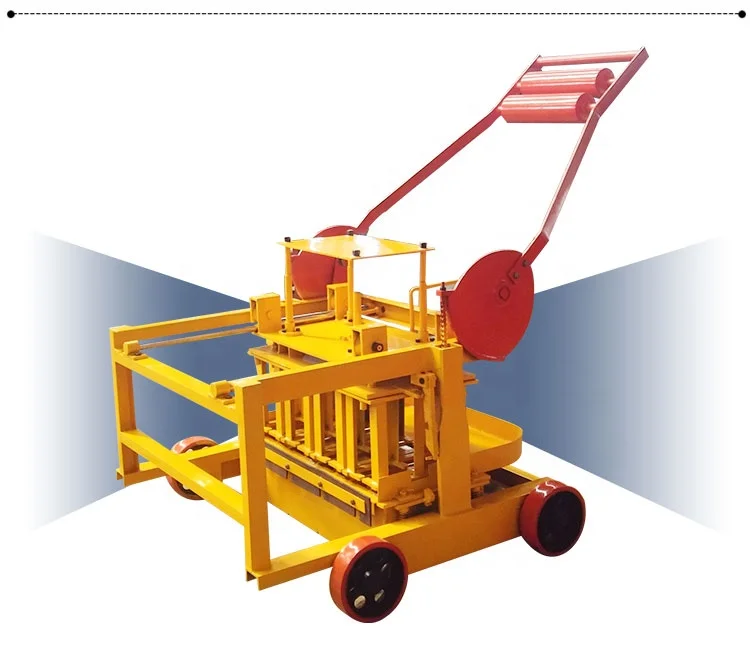
 Mobile block machine