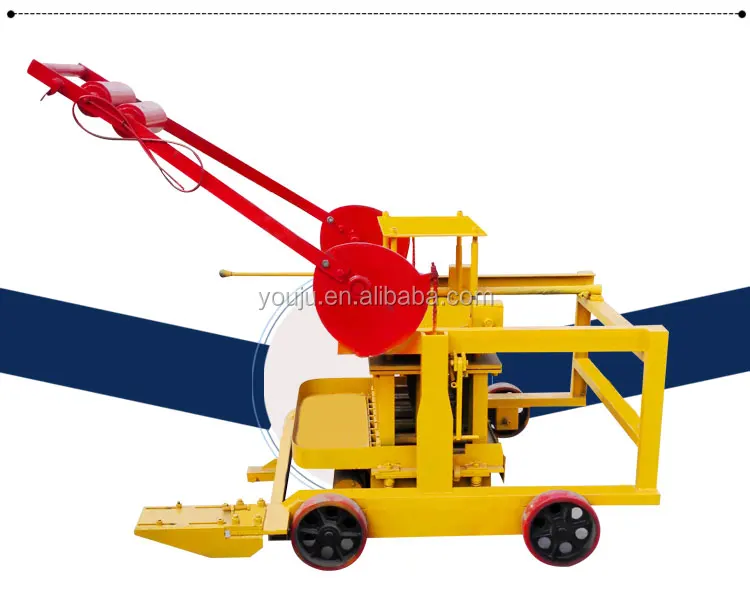
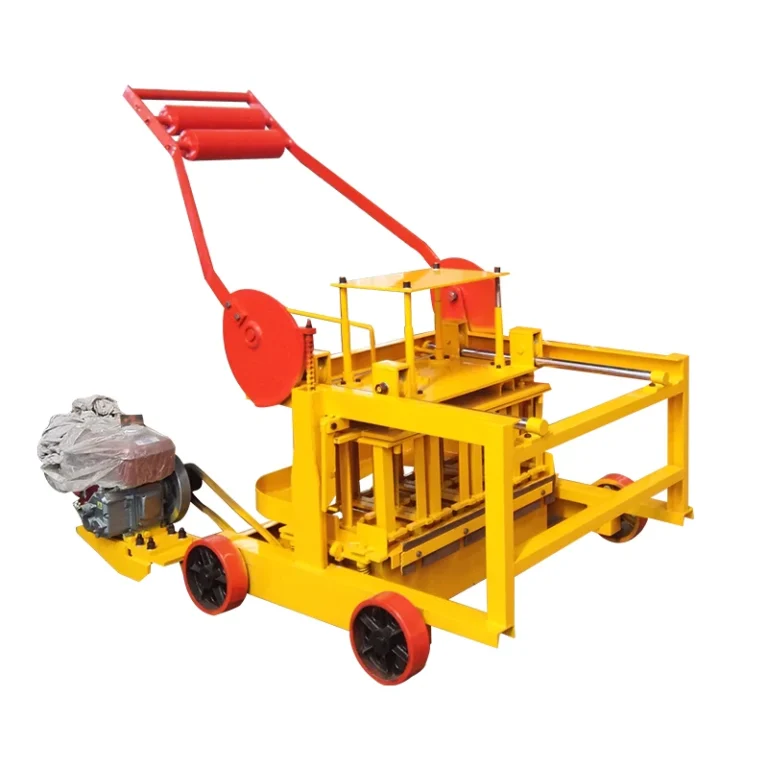
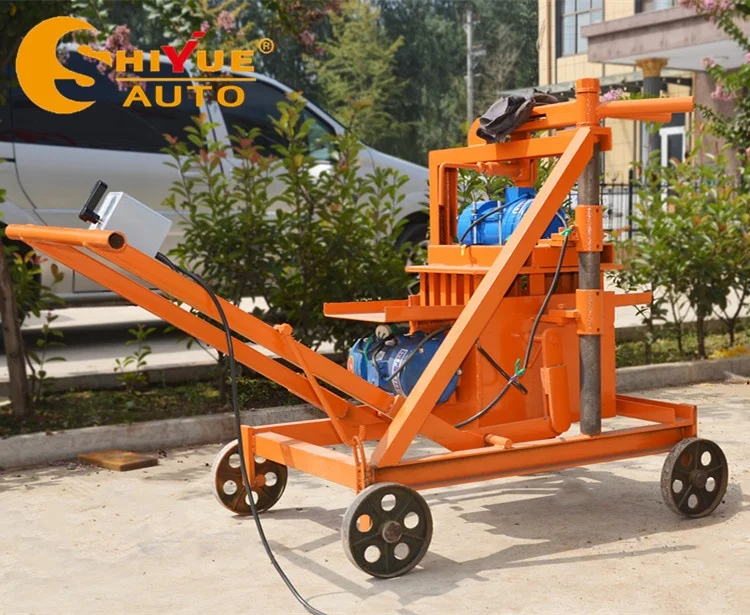
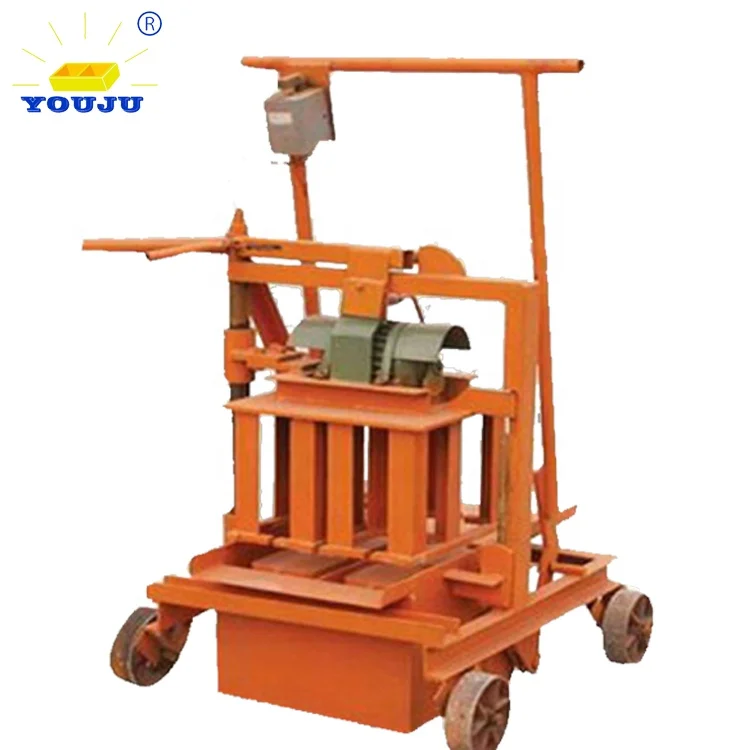
Diesel-Powered Mobility — QMR4-45 produces blocks directly on the ground without pallets or fixed plant, letting contractors start output on-site with minimal infrastructure.
Technical Specifications
| Parameter |
Value |
| Model |
QMR4-45 |
| Product Type |
Mobile Egg Laying Block Making Machine |
| Power Source |
Diesel Engine |
| Machine Type |
Mobile / Egg-laying |
| Automation Level |
Manual / Portable operation |
| Production Format |
Solid blocks, hollow blocks, paving blocks (mould dependent) |
| Output Capacity |
basis to be confirmed (specify block format and cycle) |
| Pallet Size |
Not required (blocks laid directly on ground) |
| Control System |
Basic mechanical / manual control |
| Assembly State |
Fully assembled, portable unit |
| Operating Environment |
Outdoor on-site production |
| Standards |
CE, ISO 9001 |
Application Suitability
| Application |
Material or Output |
| Remote construction sites |
Solid and hollow blocks from local crushed stone and cement |
| Rural housing projects |
Paving blocks and kerbstones using available aggregate |
| Small-scale block entrepreneurship |
Standard hollow blocks from sand, gravel and cement |
| On-site contractor production |
Interlocking bricks from site-sourced soil and cement |
| Development project staging |
Solid blocks for immediate wall construction on the same plot |
Why "Pieces per Hour" Means Nothing Without the Block Format
Capacity figures only hold weight when tied to a specific block size and cycle assumption.
Many mobile block machines are quoted with an hourly output number that assumes an ideal format, often a small solid block with a fast cycle. When the same machine runs a larger hollow block, the mould volume is bigger, the cycle extends, and the actual daily count drops significantly. I have seen buyers order a QMR4-45 based on a brochure number and then discover their target hollow block cuts that figure in half. [NEED_CITE: realistic daily output assumptions for egg laying block machines] The honest approach is to state the format, the cycle basis, and the working hours before any capacity claim is made.

Where the QMR4-45 Sits in the Full Machine Range
The QMR4-45 occupies the entry tier of the Shiyue range, designed for buyers who need to produce blocks without building a fixed plant. Below this, there is no block machine — only manual moulds. Above it, the range steps into semi-automatic stationary lines with pallets, mixers, and stacking systems, and further into fully automatic plants with PLC control and cubing. Understanding where you sit on this ladder determines your capital outlay, your labour requirement, and your daily output ceiling. A Mobile Egg Laying Block Machine manufacturer should help you place yourself on this range before narrowing the configuration.
What Egg-Laying Design Removes from Your Setup
The egg-laying principle eliminates three cost centres that stationary plants require: pallets, a curing rack system, and a covered factory floor. The QMR4-45 moves across a leveled outdoor surface, depositing each block directly on the ground and driving forward to lay the next one. This means your curing area is simply the production area, and blocks cure in place under wet hessian or plastic sheeting. [NEED_CITE: ground surface preparation standards for egg laying block production] The trade-off is that output depends heavily on ground quality — uneven or soft soil causes block deformation before the concrete gains initial set.
Reading the Specifications That Actually Matter
The diesel engine as a power source means the QMR4-45 operates independently of grid electricity, which matters on remote sites where power supply is unreliable or unavailable. The manual control system keeps the operator directly responsible for cycle timing, meaning consistency depends on operator discipline rather than PLC automation. Mould-dependent format flexibility allows solid blocks, hollow blocks, and paving blocks to be produced on the same frame — but the mould change involves physical removal and replacement of the mould box, not a quick-clamp mechanism. The portable assembly state means the unit arrives fully built and can be moved across the site by hand or with a small loader, requiring no foundation work or anchoring.
The Cost of Overlooking Ground Conditions
I watched a contractor in West Africa lose an entire week of production because the site soil was laterite clay that softened under morning moisture. The QMR4-45 laid blocks that slumped before initial set, and the entire batch had to be crushed and re-mixed. Egg-laying machines need a firm, leveled, and well-drained surface — ideally a compacted gravel bed or a thin concrete screed. Buyers who assume any flat ground will work end up with inconsistent block geometry and wasted material. [NEED_CITE: soil bearing requirements for mobile block laying operations]
Why Buyers Source This Tier from Shiyue
Block machinery as a single focus means the QMR4-45 is specified alongside the moulds, mix ratios, and ground preparation advice as one coherent system, not shipped as a standalone press with no context. Configuration is set against the buyer’s actual local aggregate and target block format, so the diesel engine rating and mould selection match the site reality rather than a catalogue default. Mould design covers the formats the buyer’s local market actually purchases, with custom drawings available when standard moulds do not match. The automation level is selectable across the range — a buyer can start with the QMR4-45 and step up to a semi-automatic line as demand grows, keeping the same supplier relationship. [NEED_CITE: CE machinery directive compliance for mobile block making equipment]
Documentation & Verification
- Machine specification sheet stating block format assumptions for any output figure
- Mould drawing and format list confirming available block types for the QMR4-45
- Diesel engine specification sheet matched to site altitude and ambient temperature
- Factory test record on buyer’s target block format before dispatch
- Wear parts and mould list with part numbers for first replacement cycle
- CE declaration and ISO 9001 certificate covering production scope
Installation, Commissioning & Support
- Fully assembled portable unit requiring no foundation — operates on compacted level ground
- Diesel engine commissioning includes fuel system bleed and cold-start verification on site
- Mould alignment check performed during first production run to confirm block geometry
- Operator training covers cycle pacing, mould change procedure, and daily greasing points
- Wear parts list provided with part numbers for mould liners and vibration components
- Ground preparation guidance issued before machine arrival to avoid first-week delays
Before You Request a Quotation
To configure the QMR4-45 correctly, share your target block format and dimensions, the local aggregate type you plan to use, and the ground conditions at your production site. Let us know whether grid electricity is available as a backup or if diesel-only operation is required. If you have an existing mixer or plan to hand-mix, specify that so the output calculation reflects your actual batching speed.
Frequently Asked Questions
Q: How is the daily output of the QMR4-45 calculated and which block format does it assume?
A: Daily output depends entirely on the block format, cycle time per mould, and effective working hours. A small solid block cycles faster than a large hollow block, so any quoted figure must state which format it assumes. We calculate capacity per specific block type and share the basis before quotation so there is no gap between expectation and site reality.
Q: Where does the QMR4-45 sit compared to semi-automatic and automatic tiers?
A: The QMR4-45 is the entry point of the range — no pallets, no fixed plant, no curing racks. Semi-automatic tiers add pallet-based production, a mixer, and basic stacking. Automatic tiers introduce PLC control, automatic stacking, and cubing. Buyers choose the QMR4-45 when capital is limited and site conditions favour portable, ground-laid production.
Q: What block formats and mould options are available for this egg-laying machine?
A: The QMR4-45 supports solid blocks, hollow blocks, and paving blocks through mould changes. Available formats depend on mould inventory and custom design capability. We confirm the exact format list and provide mould drawings before order so the buyer knows which block types the machine can produce on arrival.
Q: What ground conditions are required for egg-laying block production?
A: The surface must be firm, level, and well-drained. Compacted gravel or a thin concrete screed works best. Soft soil, clay that retains moisture, or uneven ground causes blocks to deform before initial set. We issue ground preparation guidance before dispatch so the site is ready when the machine arrives.
Q: When should a buyer consider upgrading from mobile to a semi-automatic line?
A: The shift makes sense when daily volume demand exceeds what a portable unit can sustain, when block consistency requirements tighten, or when labour costs rise enough to justify pallet-based automation. The QMR4-45 remains useful for satellite production even after a stationary line is installed.

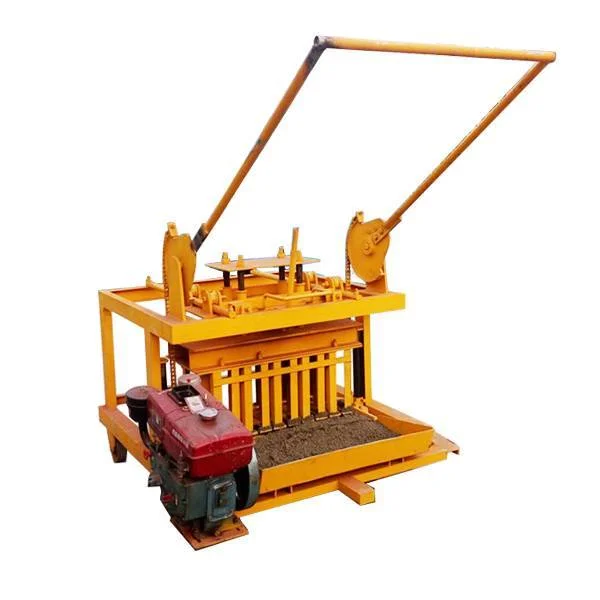
 Mobile block machine