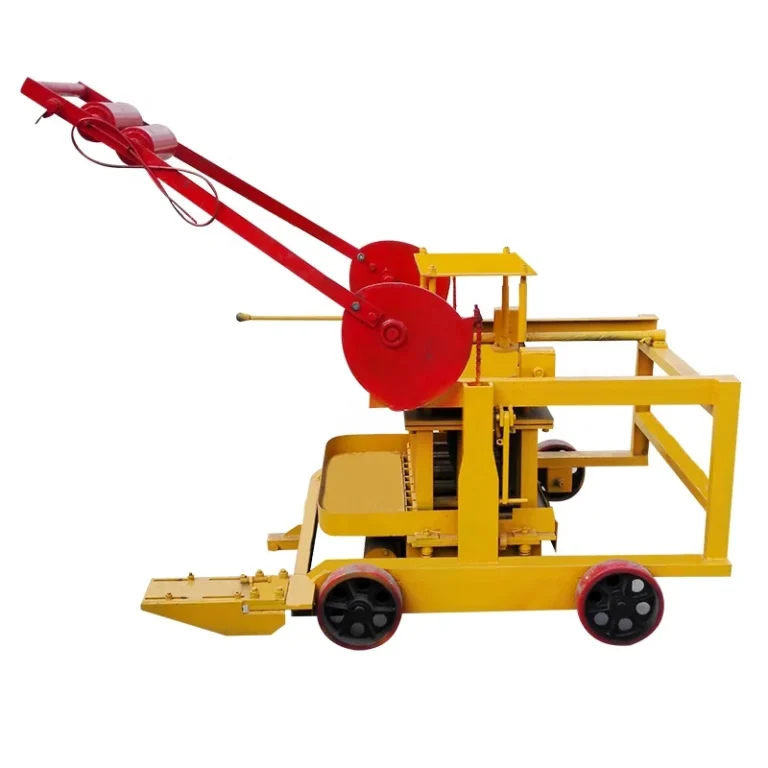
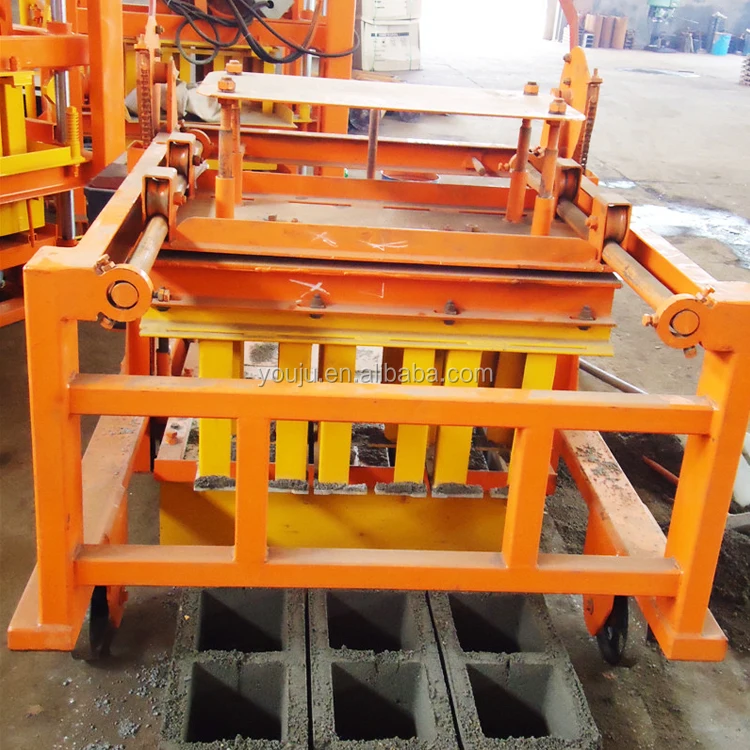
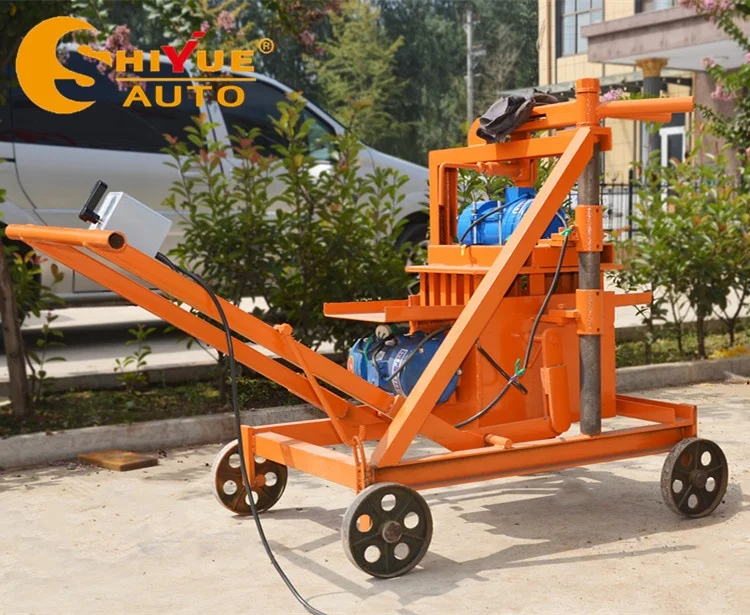
No-pallet egg-laying design — the QMR4-45 mobile block machine forms and leaves blocks directly on the ground, removing pallet purchase, handling labour and curing rack investment from your first-day budget.
Technical Specifications
| Parameter |
Value |
| Model |
QMR4-45 |
| Product Type |
Mobile Concrete Block Making Machine |
| Power Source |
Diesel |
| Rated Power |
8 hp (basis not stated in source — confirm diesel engine model and continuous or peak rating) |
| Molding Cycle |
45 s (basis not stated in source — confirm block format, material and wall thickness) |
| Molding Form |
Vibration and Pressure |
| Vibration Force |
60 kN |
| Total Weight |
800 kg |
| Overall Dimensions (L × W × H) |
2420 × 1320 × 1650 mm |
| Pallet Requirement |
None (egg-laying type) |
| Block Formats |
Hollow block, solid brick, paver brick, fly ash brick, concrete block |
| Basic Equipment Included |
JZC350 or JQ350 diesel concrete mixer with electric generating unit; transport trolley |
| Mobility |
Wheel-mounted, moveable on-site |
| Voltage & Frequency |
(basis not stated in source — confirm target market grid or generator supply) |
| Control System |
(basis not stated in source — confirm manual or semi-automatic operation) |
| Automation Level |
(basis not stated in source — confirm degree of automation) |
| Hydraulic Pressure |
(basis not stated in source — confirm MPa rating) |
| Mould Change Time |
(basis not stated in source — confirm format changeover duration) |
| Daily Output Capacity |
(basis not stated in source — confirm block format, working hours and mix design) |
| Standards |
(basis not stated in source — confirm CE or other applicable certification) |
Application Suitability
| Application |
Material or Output |
| On-site hollow block production for building contractors |
Crushed stone, river sand, cement and water |
| Solid brick and paver production for housing developments |
Fly ash, sand, cement blends |
| Remote or off-grid job sites without electrical infrastructure |
Diesel-powered mixing and forming |
| First block plant for entrepreneurs with minimal fixed investment |
Locally sourced aggregates matching regional market formats |
What "45-Second Cycle" Actually Means for Your Daily Output
A cycle time is only honest when it names the block format and mix design behind it.
Catalogue sheets frequently quote the fastest possible cycle with the lightest, simplest block, while the format your market actually buys requires a longer press and cure window. I have watched a mobile block machine for sale arrive on site promising rapid production, only to discover the 45-second figure assumed a thin solid brick in clean river sand, while the contractor was running high-clay local sand on 200 mm hollow blocks. Daily throughput fell to roughly half, and we had to re-tune vibration and pressure in the field [NEED_CITE: mix design impact on block machine cycle time]. Before comparing machines, always ask which block format and material gradation the quoted cycle assumes.

Where This Tier Sits in the Full Machine Range
The QMR4-45 sits at the entry tier of mobile block machines, aimed at contractors and first-time producers who need blocks on-site without investing in a fixed plant, pallet inventory or curing racks. Above this tier, semi-automatic static machines add pallet-based stacking and higher volume, while fully automatic lines introduce batching accuracy, PLC control and cubing systems. The mobile block machine for sale at this level trades peak throughput for zero fixed infrastructure and immediate relocation between job sites.
Diesel Power and the Off-Grid Advantage
Grid electricity is not available on many rural housing developments, remote road projects and disaster-recovery sites where blocks must be produced locally. The diesel engine removes that dependency entirely, while the included electric generating unit supplies the vibration motor and any auxiliary controls [NEED_CITE: power supply standards for construction equipment in developing regions]. Fuel cost per block produced can be lower than running a diesel generator large enough to feed a full electric line, particularly where the grid connection fee alone would exceed the machine price.
Vibration Force, Pressure and Mix Design
Sixty kilonewtons of vibration force must be matched to hydraulic pressure and the buyer’s specific aggregate gradation to produce consistent block density. Too much vibration with a lean cement mix leaves voids; too little with a rich mix fails to compact the core. The QMR4-45 relies on the operator to set feed volume and cycle duration by hand, which means commissioning time should include running the buyer’s actual sand, stone and cement through several batches while adjusting the balance between vibration and pressure until block strength meets the local standard.
The Hidden Cost of Skipping Pallet and Mixer Verification
Buyers often assume that a no-pallet egg-laying machine needs no further equipment planning. In practice, the ground surface must be level concrete or compacted earth, and the curing area must be large enough to hold several days of production while blocks gain initial strength. If the included diesel mixer is sized too small for the press cycle, the machine waits for batches and actual output drops well below the theoretical figure [NEED_CITE: production line bottleneck in small block plants]. Confirming mixer drum capacity against the block volume per cycle before dispatch prevents this mismatch.
Why Source This Machine Through Shandong Shiyue Intelligent Machinery
Block machinery is our single focus, so the QMR4-45 is specified together with its mixer, moulds and trolley as one matched set rather than assembled from separate suppliers. Moulds are selected against the block formats your local market actually sells, and custom drawings are available when a project calls for non-standard dimensions. Configuration is checked against your mix design and aggregate, not a catalogue default, and voltage or control language is confirmed before production so commissioning is not delayed on arrival. The machine ships after a factory test run, and we provide installation support, operator training and wear part supply once production begins.
Documentation & Verification
- Line layout and capacity calculation stating the exact block format and mix design assumed
- Mould drawing and format list matching the buyer’s local market dimensions
- Factory test record run with an aggregate blend comparable to the buyer’s site material
- Voltage and control language confirmation sheet signed off before dispatch
- Operation and maintenance manual with mould change procedure and wear part list
- Packing photographs and customs documentation support for the destination port
Installation, Commissioning & Support
- Level concrete or compacted ground surface required; the 2420 × 1320 mm footprint moves freely on its wheels
- Diesel engine and generator must match local fuel grade; vibration motor voltage confirmed before wiring
- Machine arrives fully assembled on the transport trolley; no structural dismantling for container loading
- Commissioning includes running the buyer’s sand, stone and cement through trial batches to set vibration and pressure
- Operator training covers manual feed timing, mould changeover and daily lubrication points
- Mould and wear part list provided at dispatch so first replacements can be ordered before stock runs out
Before You Request a Quotation
Send the block format and dimensions your market buys, your daily volume target and the number of working hours per shift. Include a description or sieve analysis of your local sand and stone so we can confirm the mixer and vibration settings match. State whether the site has any grid power for auxiliary lighting or controls, and confirm the control display language your operators require.
Frequently Asked Questions
Q: How is daily output calculated, and which block format is the figure based on?
A: We state daily output per specific block format, wall thickness, shift length and mix design, not a single peak number. The 45-second cycle in the specification sheet must be confirmed against your target block before any capacity commitment is made.
Q: What block formats can the QMR4-45 produce, and how long does a mould change take?
A: The machine handles hollow blocks, solid bricks, pavers and fly ash bricks with interchangeable moulds. Mould changeover time depends on the format pair and operator familiarity; we provide the procedure during commissioning.
Q: The machine is diesel-powered — does any component still require electricity?
A: Yes. The vibration motor and any electric start system draw power from the included generating unit. Voltage and frequency of that generator must match the motor nameplate before first start-up.
Q: What ground surface and curing area are required for egg-laying operation without pallets?
A: Blocks are laid directly on level concrete or well-compacted earth. The curing area must hold several days of output, protected from rain and direct sun during the initial strength gain period.
Q: Are moulds and hydraulic wear parts available when the first replacement is due?
A: A wear parts list is included in the documentation package, and replacement moulds can be ordered to custom drawings. We recommend ordering the first set before initial stock runs low on site.

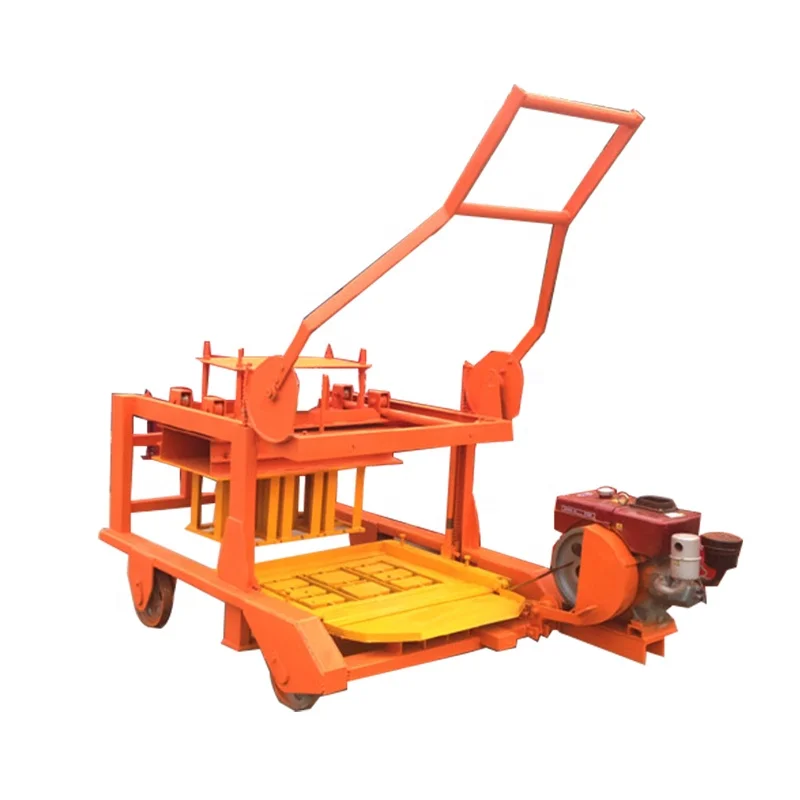
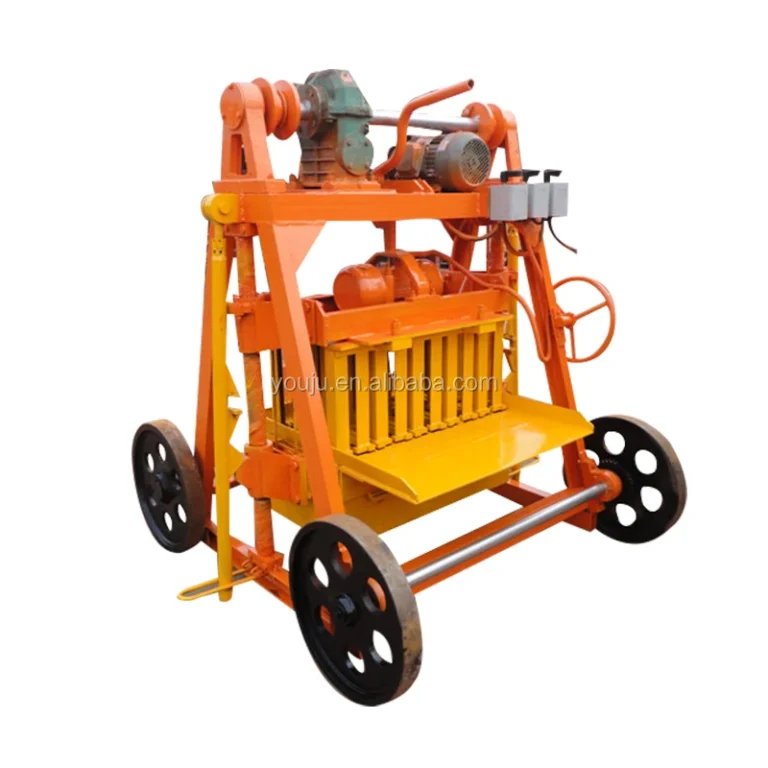 Mobile block machine