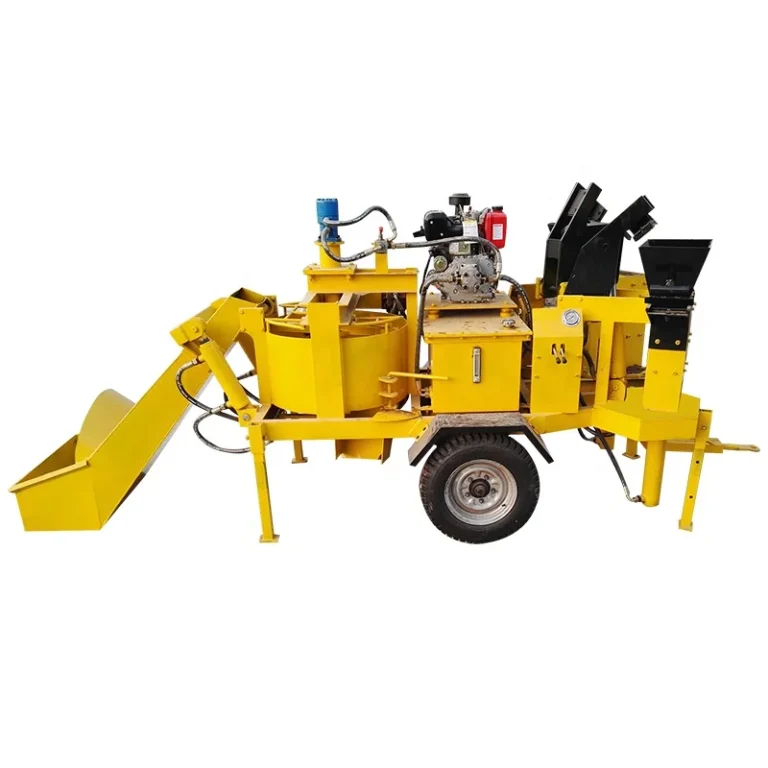
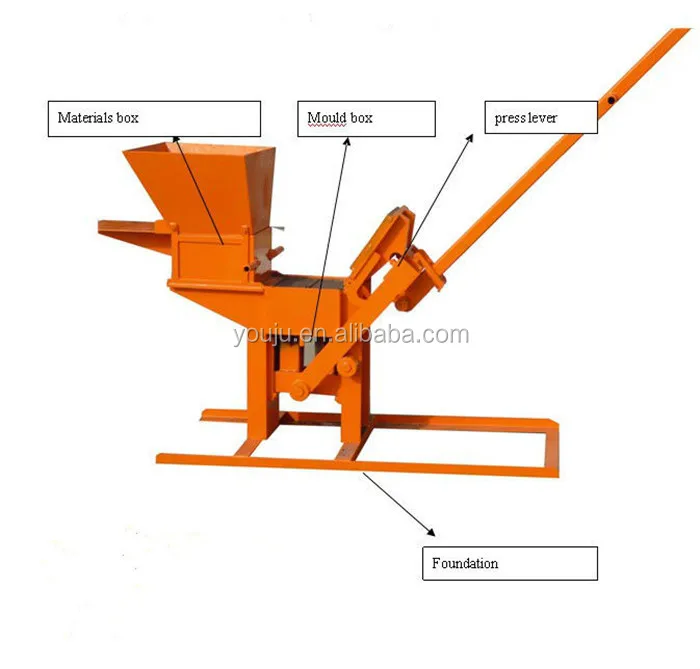
Single-Focus Machinery Alignment — the LY2-40 sits at the entry of a block machine range built as matched systems, so buyers placing themselves on the output tier map can see exactly where manual, mobile production fits before scaling up.
Technical Specifications
| Parameter |
Value |
| Model |
LY2-40 |
| Product Type |
Manual Clay Interlocking Brick Making Machine |
| Power Source |
No Power, Completely Manual |
| Lifting System |
Manually Operated |
| Mobility |
Mobile devices using steel wheels |
| Mould System |
Molds changeable for various blocks |
| Overall Dimensions (L×W×H) |
1600 x 700 x 1200 mm |
| Net Weight |
200-240 kgs |
| Molding Cycle |
30-40s |
| Output Capacity |
400 pcs – 1000 pcs/day (basis to be confirmed) |
| Warranty |
1 Year |
| Basic Equipment (Optional Mixer) |
JFA-1 Mixer or JQ350 Mixer |
| Material Mixing |
Manual mixing or Automatized mix (via line mixer) |
| Control System |
None (Manual Operation) |
| Automation Level |
Manual |
Application Suitability
| Application |
Material or Output |
| No power area block production |
Soil-cement mixtures in off-grid locations |
| Small-scale clay interlocking brick manufacturing |
Local clay blended with cement binder |
| On-site mobile construction block molding |
Variable site soils relocated daily via steel wheels |
| Soil and cement mixture ecological brick production |
Stabilized earth with adjustable cement ratios |
What "1000 Pieces a Day" Actually Means for Manual Presses
Cycle time means nothing without the block format that time was measured against.
When a Manual Clay Interlocking Brick Making Machine manufacturer quotes daily output, the number usually assumes a small, thin interlock profile run by an experienced crew working an eight-hour shift at a steady rhythm. If your interlocking brick is thicker or uses a heavier soil-cement mix, the same LY2-40 will produce noticeably fewer units before sundown. I once watched a project in the Levant stall because the contractor ordered a manual press expecting to match the output figures from a hollow block catalogue, only to discover his interlocking profile required a longer compression stroke and two operators to feed the mould consistently [NEED_CITE: block format impact on manual press throughput]. The capacity range of 400 to 1000 pieces per day is not a promise — it is a window that narrows based on your specific brick geometry, local soil plasticity, and crew fatigue.

Positioning the Manual Tier Within the Full Block Machine Range
The LY2-40 represents the starting point of a broader equipment spectrum. Entrepreneurs and project contractors evaluating their first block investment often need a machine that demands no electrical infrastructure and can be relocated as the build site progresses. This manual tier sits below semi-automatic and fully automatic lines, where hydraulic pressure and vibration force replace human effort and where daily output scales to tens of thousands of units. Understanding this tier structure matters because buyers who outgrow a manual press within twelve months would have been better served by a semi-automatic configuration from the outset.
Where a Mobile Manual Press Earns Its Place on Site
Contractors producing interlocking bricks for a specific housing or development project often cannot justify the footprint and capital of a fixed plant. The LY2-40 rolls on steel wheels between curing bays, allowing operators to press bricks directly where they will be laid or stacked. Because the machine requires no power connection, it functions in remote areas where grid electricity or generators are unavailable, and it can serve as supplementary capacity alongside a larger stationary line when demand spikes. This dual role — primary machine for off-grid sites, backup for established plants — is where the manual tier proves its value within the full range [NEED_CITE: mobile block production advantages in remote construction].
Decoding the Molding Cycle and Physical Footprint
The stated 30 to 40-second molding cycle governs realistic throughput only when paired with the interlocking brick format the operator is actually pressing. Thicker or more complex interlocking profiles require longer compression time and slower mould release to prevent cracking. At 1600 x 700 x 1200 mm and 200 to 240 kgs, the LY2-40 occupies minimal floor space, meaning a single operator can work it in a confined area, but the surrounding workflow — mixing station, curing racks, raw material stockpile — must still be planned so that the press is never waiting for feed material. The optional JFA-1 or JQ350 mixer choice depends on local soil consistency; sandy soils may blend adequately by hand, while heavier clays benefit from mechanical mixing to achieve uniform cement distribution. Changeable molds mean a single LY2-40 can produce multiple interlocking profiles, though each mould swap requires downtime that must be scheduled into the production day rather than treated as instantaneous.
The Hidden Cost of Ignoring Soil Composition
Buyers who specify a manual press without testing their local clay against the intended cement ratio frequently discover that bricks crack during curing or crumble under handling. When soil plasticity is too high, the operator struggles to release the mould cleanly, stretching the cycle time well beyond the 30 to 40-second baseline and cutting daily output in half. Conversely, sandy soil with insufficient binder produces interlocking bricks that fail compression tests, forcing the contractor to increase cement content and absorb the added material cost. Either scenario turns a seemingly low-investment machine into a source of recurring waste and schedule delays [NEED_CITE: soil-cement compatibility testing for manual brick production]. The pain is not the machine itself — it is the mismatch between the press configuration and the ground beneath the project site.
Why Sourcing the Machine Range From One Manufacturer Matters
Block machinery built as a matched system means the LY2-40 is not a standalone catalog item but the entry tier of a range where moulds, pallets, and handling equipment are specified together. When you later move to a semi-automatic or automatic line, the interlocking brick profiles and mould interfaces remain compatible, preserving the format library you have already developed. Configuration is set against the buyer’s actual mix design and local aggregate rather than a default template, so the optional JFA-1 or JQ350 mixer is recommended based on soil testing, not stock availability. Mould design and supply cover the formats the buyer’s market actually sells, with custom profiles available from buyer drawings. Automation level is selectable and upgradeable, so an entrepreneur starting with the LY2-40 can transition to powered equipment without abandoning the mould inventory and operational knowledge already accumulated.
Documentation & Verification
- Machine specification sheet confirming LY2-40 dimensions, net weight, and manual cycle parameters
- Mould drawing and format list detailing available interlocking profiles and custom design options
- Line layout showing LY2-40 placement relative to mixing station and curing area
- Factory test record on the buyer’s specified clay-cement blend before dispatch
- Operation and maintenance manual covering mould swap procedures and steel wheel maintenance
Installation, Commissioning & Support
- No electrical connection required; the LY2-40 operates entirely by manual force upon delivery
- Optional JFA-1 or JQ350 mixer requires local voltage confirmation and a dedicated circuit
- Steel wheels allow immediate relocation without dismantling for on-site positioning
- Mould change training provided so operators can swap interlocking profiles within one shift
- Wear parts list covering manual linkage components and mould liner replacement intervals
- Operator training on soil-cement mixing ratios matched to local clay characteristics
What to Share Before Requesting a Quotation
To size the LY2-40 correctly within the full block machine range, share your target interlocking brick format, daily output expectation, and local soil composition including clay-to-sand ratio. Confirm whether grid power or a generator is available on site for the optional mixer, and describe the curing area dimensions so the mobile layout can be planned around your existing workflow.
Frequently Asked Questions
Q: How does the 400-1000 pcs/day capacity vary based on the specific interlocking brick format and operator speed?
A: The stated range assumes a standard interlocking profile and consistent crew pacing. Thicker or more complex profiles extend the molding cycle beyond 30-40 seconds, reducing daily output. Operator experience and soil-cement workability further influence how many cycles can be completed per hour. A capacity calculation tied to your exact brick format provides a reliable figure.
Q: Where does the LY2-40 manual tier sit in the overall machine range compared to semi-automatic and automatic models?
A: The LY2-40 is the entry tier, requiring no power and offering mobile operation for off-grid or supplementary production. Semi-automatic machines add hydraulic assistance and higher throughput, while automatic lines integrate batching, pallet feeding, and stacking for continuous high-volume output. Each tier shares mould compatibility within the range.
Q: What plant footprint and site conditions are required to operate this manual machine and optional mixer effectively?
A: The LY2-40 at 1600 x 700 x 1200 mm needs a level working surface with clearance for operator movement and mould access. The optional JFA-1 or JQ350 mixer requires additional space for material stockpiling and a power source. Adequate curing area nearby prevents unnecessary brick handling and supports continuous production flow.
Q: Can I start with the LY2-40 manual machine and later upgrade to a semi-automatic or automatic line from the same manufacturer?
A: Yes. The range is structured so that interlocking brick formats, mould profiles, and operational knowledge carry forward. When you upgrade to powered equipment, the mould library you built on the LY2-40 remains usable, and the manual press can be retained as backup capacity for off-grid contingencies.
Q: What specific mold formats for interlocking bricks are available or customizable for this manual press?
A: Standard interlocking profiles suited to regional building codes are available, and custom mould designs can be produced from buyer drawings. Each LY2-40 accepts changeable moulds, allowing multiple formats on a single machine. The format list and mould drawings are provided during configuration to confirm compatibility with your target market.

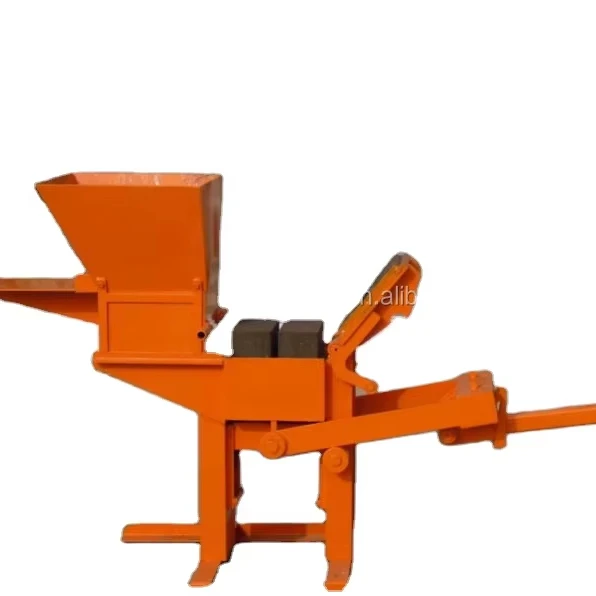
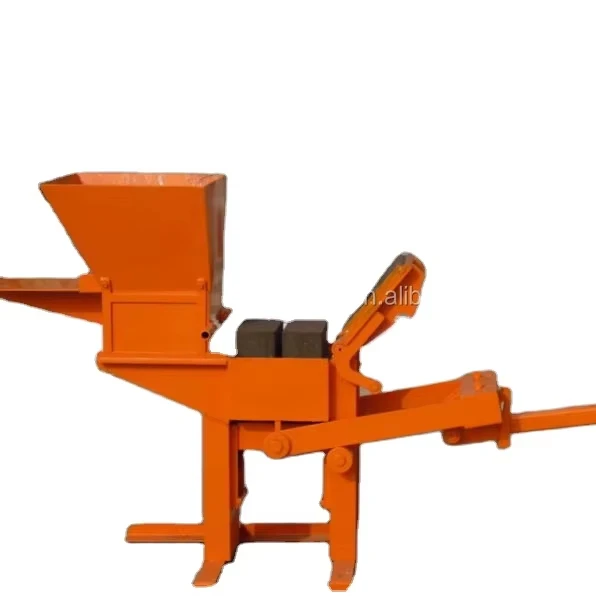 Clay interlocking brick