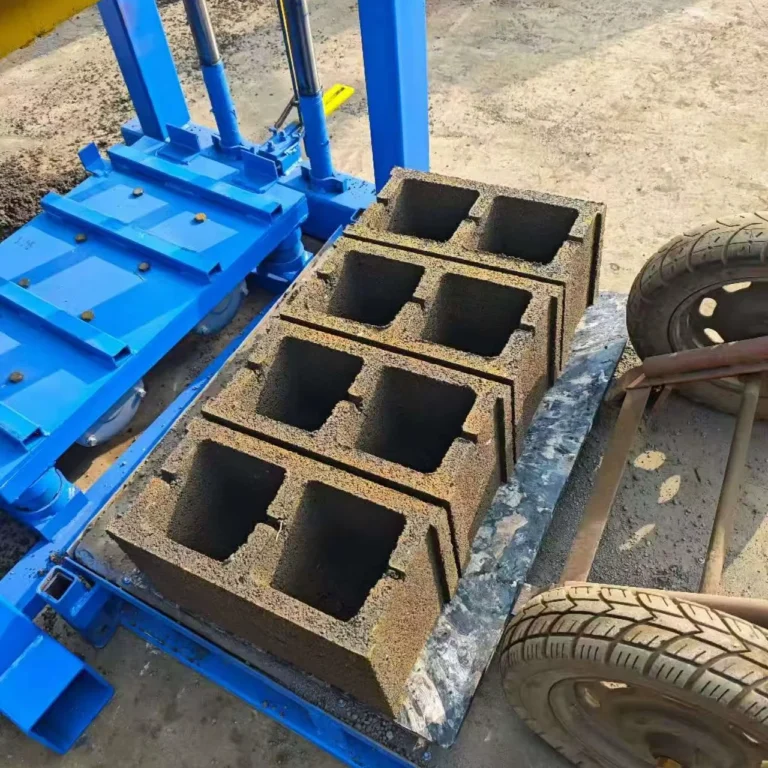
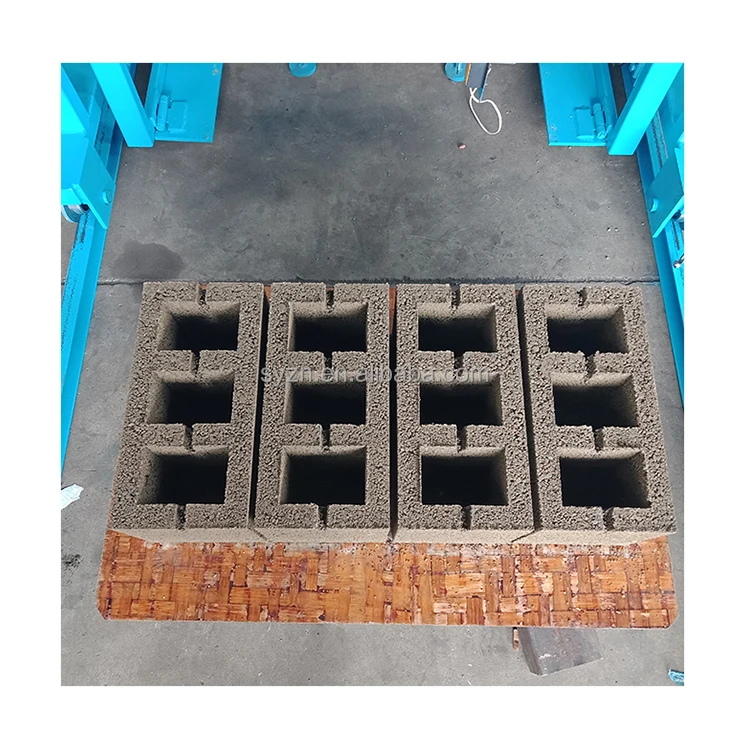
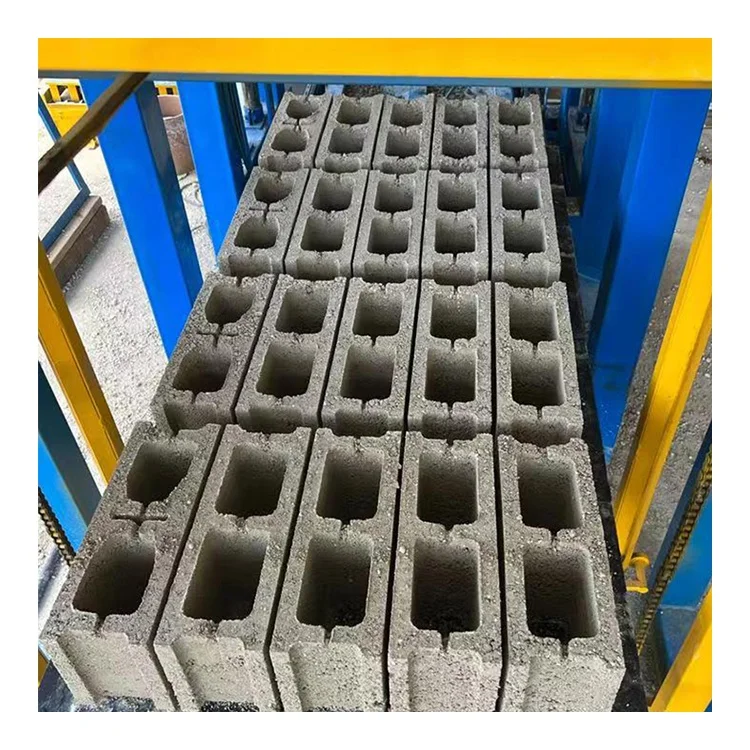
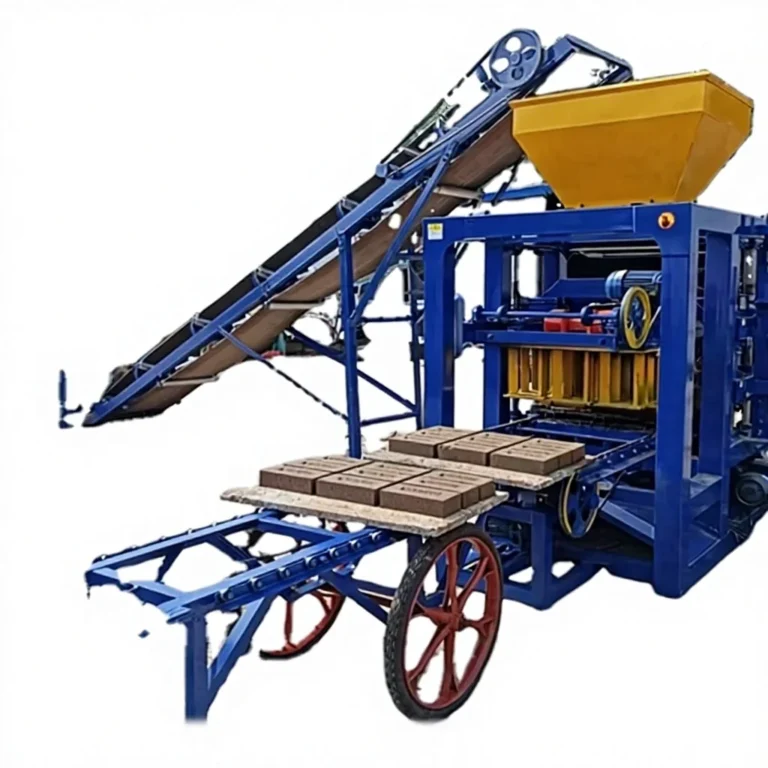
Matched System Configuration — every component from the QTJ4-25 host press to its JQ350 mixer, mould and pallet is sized together so the bottleneck stays where you planned it, not hidden in an unquoted conveyor gap.
Technical Specifications
| Parameter |
Value |
| Model |
QTJ4-25 |
| Product Type |
Semi-Automatic Concrete Block Making Machine |
| Rated Power |
17.9 kW |
| Control System |
Motor-driven with hydraulic station (PLC availability to be confirmed) |
| Overall Dimensions (L×W×H) |
6400 × 1500 × 2700 mm |
| Net Weight |
2500 kg |
| Vibration Force |
60 kN |
| Vibration Frequency |
2800 r/min |
| Moulding Cycle |
25 s |
| Pallet Size |
850 × 550 × 20 mm |
| Output Capacity |
960 pcs/h, 7680 pcs/day (based on 400×200×200 mm hollow block, 4 pcs/mould) |
| Mould Formats |
Hollow, solid, paver, curbstone (8", 6", 5", 4" options) |
| Automation Level |
Semi-automatic |
| Stacking Method |
Manual with trolley |
| Standard Configuration |
Host machine 1 set, block mould 1 set, JQ350 mixer |
| Voltage & Frequency |
Configurable (confirm before order) |
Application Suitability
| Application |
Material or Output |
| Hollow block production for building walls |
Cement, crushed stone, sand, fly ash |
| Solid block production for load-bearing structures |
Cement, fine aggregate, coarse aggregate |
| Paving block production for walkways and yards |
Cement, granite chips, river sand |
| Curbstone production for road edges |
Cement, crushed stone, pigment (optional) |
| On-site contractor block making |
Local aggregate blends confirmed by trial |
What "960 Pieces per Hour" Actually Means on the Floor
Capacity only holds when the block format, mix design and pallet rotation all line up — change one and the number shifts.
I have watched buyers receive a machine rated for impressive hourly output, only to discover the figure assumed a large hollow block format they did not plan to sell. When they switched to a smaller solid block that the local market actually demands, the per-cycle piece count changed, the moulding rhythm changed, and the daily tally fell short of their business plan. That mismatch is not a machine fault — it is a specification gap. A semi-automatic block machine for sale should come with a capacity table that names every format, not a single headline number. [NEED_CITE: standard block format dimensions and cycle time variables]

Where the QTJ4-25 Sits in the Range
Buyers stepping up from a mobile egg-layer often land here. The QTJ4-25 occupies the mid-range semi-automatic tier in Shiyue’s stationary block machine lineup, bridging the gap between single-operator mobile production and a fully automatic line with pallet feeders and stackers. It gives a first-time plant owner a stationary press with a hydraulic station and a fixed pallet size, without the capital and floor space that an automatic system demands. If your daily target stays in the thousands rather than tens of thousands, this tier keeps your investment proportional.
The Tier Above and the Tier Below
Below this machine, mobile egg-laying units produce blocks directly on the ground with no pallet — they are cheap to start but limited in format variety and block density. Above it, fully automatic lines add batching scales, automatic pallet feeders, stacking robots and curing rack systems that reduce labour but require a larger building envelope and a three-phase supply capable of handling peak loads across multiple motors simultaneously. The QTJ4-25 sits between those two worlds, offering the mould flexibility of a stationary press while keeping the operator in the loop for pallet handling and stacking. [NEED_CITE: typical power supply requirements for semi-automatic versus automatic block lines]
Vibration, Pressure and What They Do to Your Block
The 60 kN vibration force combined with a 2800 r/min frequency works the mix from the bed mould upward, while the hydraulic station pushes the upper mould down. Together they compact the concrete into the mould cavity from two directions, which is what gives a hollow block its wall density and a paver its surface finish. If either force is too low for the aggregate you source locally — say, a coarse crushed stone with a large top size — the block comes out friable on the edges. If both forces are high but the mix is too wet, the block slumps when the mould lifts. Matching vibration and pressure to your actual aggregate is not optional; it is the difference between blocks that pass a compressive strength test and blocks that crack on the pallet before they reach the curing area.
What Happens When the Pallet and the Curing Area Disagree
The QTJ4-25 runs on 850 × 550 × 20 mm pallets, and that dimension is not arbitrary — it matches the mould footprint and the spacing of the vibration table. But the pallet also has to travel from the press to the curing area, and that journey depends on the forklift you already own and the rack system you plan to build. Buyers who choose pallet material without thinking about the curing environment find that bamboo pallets warp in high humidity while steel pallets add weight that a small forklift cannot manage. Getting the pallet right before the machine ships avoids a situation where freshly pressed blocks sit on the floor because the handling chain downstream was never part of the conversation. [NEED_CITE: pallet material selection for concrete block curing environments]
Why Shiyue for This Tier
Every QTJ4-25 leaves the factory with its host machine, block mould and JQ350 mixer specified as one set, so the mixer output matches the press cycle rather than leaving the operator waiting for the next batch. Mould options cover hollow, solid, paver and curbstone formats across multiple sizes, meaning one press can serve several product lines as the local market evolves. The 17.9 kW rated power keeps the machine within reach of standard industrial three-phase supplies without requiring a dedicated transformer upgrade. Voltage and frequency are confirmed before production so that the motor windings and the control panel match the buyer’s grid on arrival. Factory testing runs the actual mould that ships with the machine, not a test mould, so the first cycle on the buyer’s floor mirrors the last cycle in Linyi.
Documentation & Verification
- Capacity calculation sheet listing output per block format, not just per cycle
- Machine specification sheet confirming vibration force and hydraulic pressure matched to your mix
- Voltage and frequency confirmation document signed before production begins
- Factory test record using the buyer’s specific mould and pallet set
- Packing photographs showing machine dismantling and container loading arrangement
- Operation and maintenance manual with hydraulic and electrical schematics
Installation, Commissioning & Support
- 6400 × 1500 mm footprint requires a level concrete slab with anchor bolt provisions
- 17.9 kW rated power needs a dedicated three-phase circuit with correct breaker sizing
- Host machine ships with hydraulic station pre-assembled; on-site connection limited to power and mixer
- First-run commissioning includes mould alignment check and vibration frequency verification
- Operator training covers mould change procedure across hollow, solid and paver formats
- Wear parts list provided with recommended reorder intervals for vibration table bearings and hydraulic seals
Before You Send an Inquiry
Tell us the block formats your market actually buys — dimensions, not just names — and the daily output you need for each. Share the aggregate you can source locally, including any fly ash or crusher dust you plan to use, so we can confirm the mix before the machine is built. Confirm your site voltage, frequency and the control language your operators will need, because changing those after the panel is wired adds weeks. If you already have pallets or a forklift, send the dimensions so we can check compatibility with the 850 × 550 mm pallet size.
Frequently Asked Questions
Q: How is the 960 pcs/h capacity calculated, and what happens when I switch to a smaller solid block?
A: The 960 pcs/h figure is based on 400×200×200 mm hollow blocks at 4 pieces per mould with a 25-second cycle. When you switch to a smaller solid block format, the per-mould piece count changes and the cycle time may adjust, so the hourly total shifts. We provide a format-by-format capacity table with every proposal so you know the output for each block you plan to sell.
Q: Where does the QTJ4-25 sit in the full range, and when should I step up?
A: It occupies the mid-range semi-automatic tier, above mobile egg-layers and below fully automatic lines with pallet feeders and stackers. Step up when your daily target exceeds what one operator can manage manually, or when you need the batch-to-batch consistency that automatic batching and stacking deliver across long production runs.
Q: What pallet size does this machine use, and can it work with what I already have?
A: The QTJ4-25 uses 850 × 550 × 20 mm pallets. If you already own pallets or a forklift, share the dimensions before ordering so we can confirm compatibility. Mismatched pallets cause handling delays and can damage freshly pressed blocks during the move to the curing area.
Q: Is the mixer included, or do I source it separately?
A: The standard configuration includes one JQ350 mixer matched to the press cycle. This means the mixer batch size and discharge rate are calculated so the operator is not waiting for material between cycles. Additional mixers or a larger model can be specified for higher-output formats.
Q: What site preparation is needed before the machine arrives?
A: You need a level concrete slab to accommodate the 6400 × 1500 mm footprint, anchor bolt positions, and a dedicated three-phase circuit for the 17.9 kW rated power. The curing area and pallet storage space should be planned around the 850 × 550 mm pallet size so blocks move smoothly from press to rack.

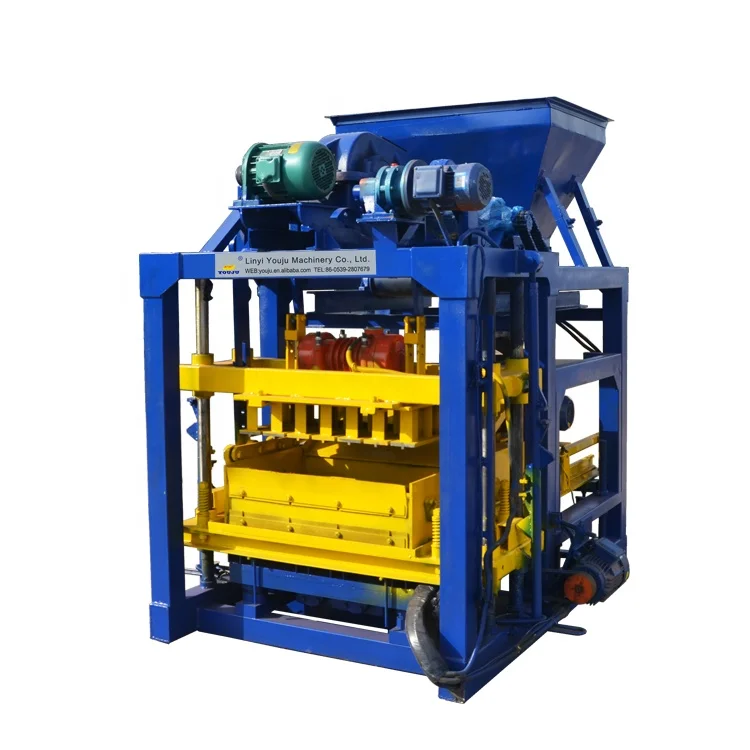
 Stationary block machine