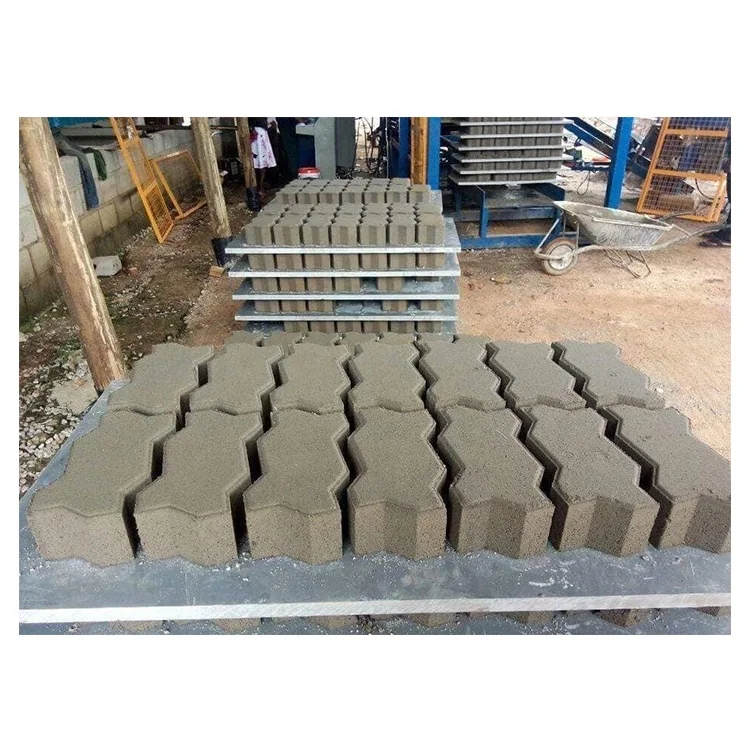
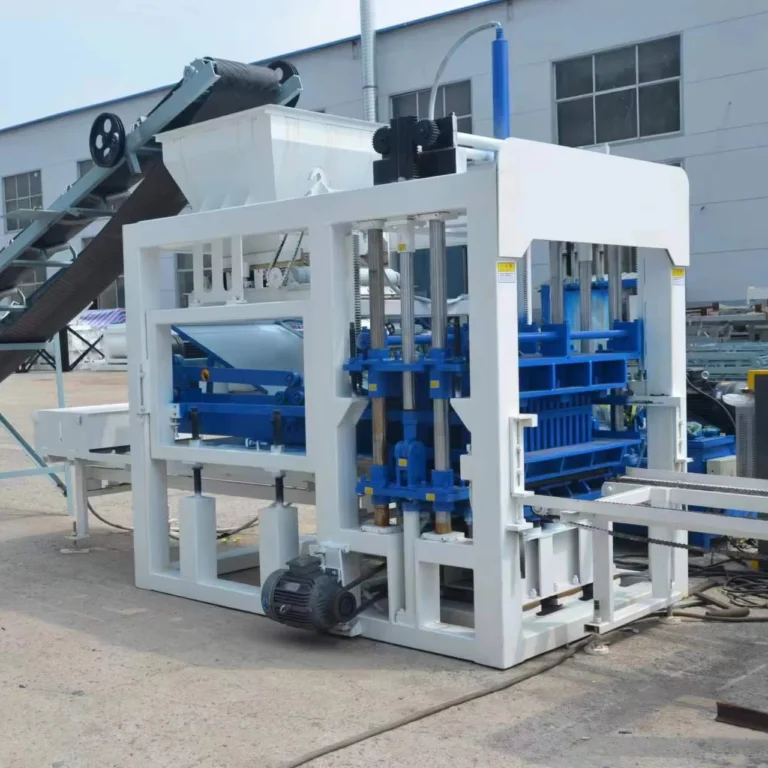
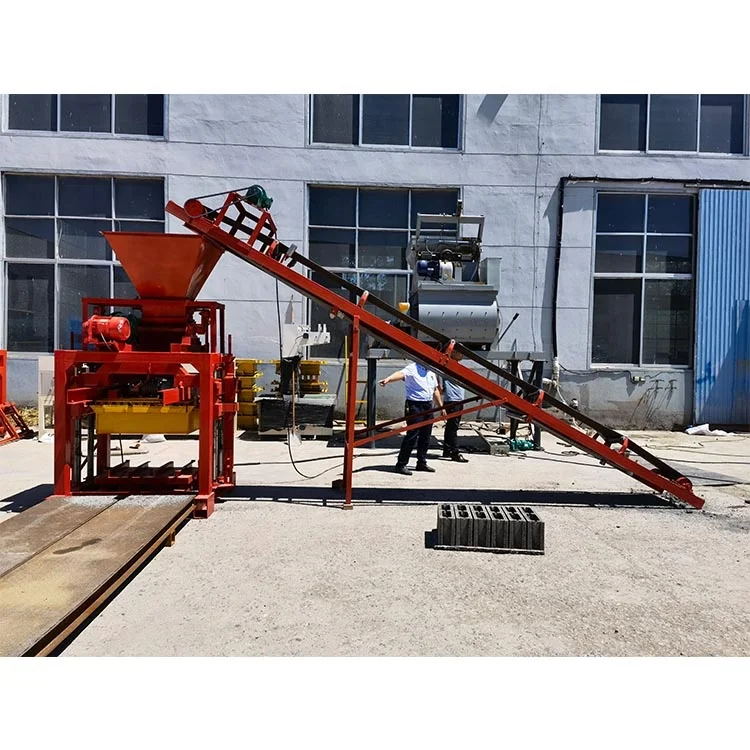
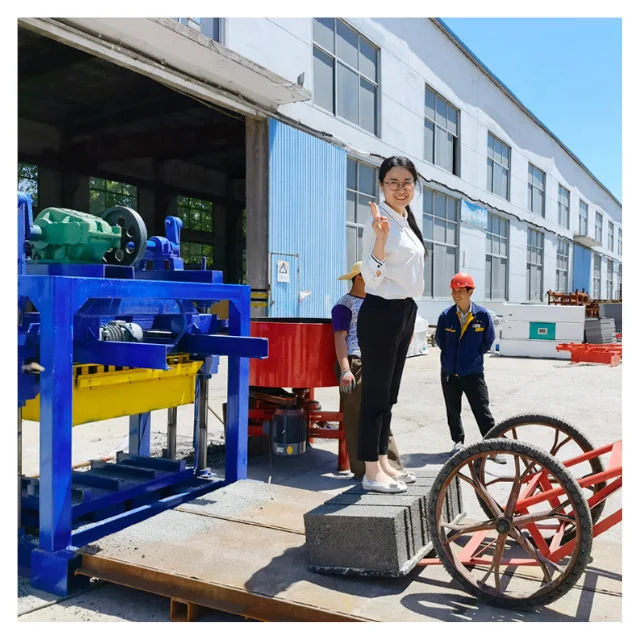
Matched System Design — the QT6-15 block machine, its moulds, pallets and handling equipment are specified together against your actual mix and target format, not sourced from separate catalogues.
Technical Specifications
| Parameter |
Value |
| Model |
QT6-15 |
| Product Type |
Hydraulic Concrete Block Making Machine |
| Overall Dimensions (L×W×H) |
8200×1700×2950 mm |
| Overall Power |
37 kW |
| Vibration Force |
45 kN |
| Vibration Frequency |
0–60 Hz (adjustable) |
| Vibration Form |
Platform Vibration |
| Moulding Mode |
Automatic loading, vibration moulding |
| Pallet Size |
880×850 mm |
| Molding Cycle |
15–20 s (hollow/solid), 20–25 s (pavers) |
| Demolding Method |
Hydraulic |
| Total Mass |
7 T |
| Factory Area Required |
1200 m² |
| Control System |
PLC with touch screen, built-in fault diagnosis, action interlock logic |
| Hydraulic System |
Independent integrated hydraulic station |
| Block Compressive Strength |
More than 15 MPa |
| Output: Hollow Block 400×200×200 mm |
8,640–11,520 pcs / 8 hr (6 pcs/mould, 15–20 s cycle) |
| Output: Hollow Block 400×150×200 mm |
11,520–15,360 pcs / 8 hr (8 pcs/mould, 15–20 s cycle) |
| Output: Solid Brick 240×115×53 mm |
46,080–61,440 pcs / 8 hr (32 pcs/mould, 15–20 s cycle) |
| Output: Rectangular Paver 200×100×60 mm |
17,280–23,040 pcs / 8 hr (21 pcs/mould, 20–25 s cycle) |
| Output: Zigzag Paver 225×112.5×60 mm |
17,280–23,040 pcs / 8 hr (15 pcs/mould, 20–25 s cycle) |
| Raw Material Adaptability |
Waste ash, slag, various aggregates |
| Voltage & Frequency |
Configurable — confirm before order |
| Warranty |
1 year for the whole machine (excluding spare parts) |
Application Suitability
| Application |
Material or Output |
| Load-bearing hollow block production |
Crushed stone, sand, cement mixes targeting >15 MPa |
| Non-load-bearing hollow block production |
Lightweight aggregates, waste ash, slag blends |
| Solid brick manufacturing |
Standard concrete mixes for masonry walls |
| Paving brick production |
High-density mixes for pedestrian and light traffic areas |
| Interlocking / zigzag paver production |
Colour-faced or standard concrete for driveways and walkways |
| On-site contractor block production |
Locally sourced aggregates with variable grading |
| Fixed block plant medium-to-high output |
Multi-format runs with PLC-controlled batch consistency |
What "10,000 Blocks a Day" Actually Means for the QT6-15
Every capacity figure here is tied to a specific block size, mould cavity count, and cycle time — not a single headline number.
I remember a Middle East buyer who ordered a QT6-15 based on a sample-book daily output. The quotation assumed clean, well-graded aggregate. His local sand carried a high clay content, the mix stuck in the mould, cycle times stretched, and real output dropped to roughly six tenths of the stated capacity. The whole line rhythm collapsed because the feeding, curing and stacking stations were sized for a number that never existed on his site. When evaluating a QT6-15 block machine manufacturer, the first question should never be "how many blocks per day" — it should be "how many of my blocks, with my mix, on my pallets" [NEED_CITE: common causes of block plant output shortfalls in export markets].
Where the QT6-15 Sits in the Full Shiyue Range
The Shiyue range spans mobile egg-layers for on-site work, semi-automatic machines for small workshops, and high-capacity fully automatic lines with cubing systems. The QT6-15 occupies the mid-to-high tier of the automatic segment. It delivers PLC-controlled hydraulic pressing with a touch screen interface and built-in fault diagnosis, but it does not include the fully automatic stacking and cubing stations found on larger models. This positioning makes the QT6-15 block machine manufacturer offering suitable for buyers who need consistent automated pressing without the investment and footprint of a top-tier line.
Automation You Can Grow Into
A buyer setting up a first plant can configure the QT6-15 with manual pallet handling at the start, keeping initial capital lower, and add automatic pallet feeding and stacking later as volume grows. The PLC architecture and action interlock logic remain the same across configurations, so the upgrade path does not require a control system replacement [NEED_CITE: PLC upgrade paths in hydraulic block presses]. This flexibility matters when a distributor or importer needs to serve both first-time entrepreneurs and established manufacturers expanding their format range.

Reading the Specs That Matter on Site
The 45 kN vibration force and 0–60 Hz adjustable frequency work together with the independent hydraulic station to compact the mix. Vibration alone does not determine block density — the hydraulic pressure must match the vibration profile and the buyer’s specific mix design, otherwise the block surface may crack or the core may remain under-compacted. The 880×850 mm pallet size must align with the curing racks and forklifts already on site; ordering a pallet dimension that does not match existing infrastructure forces a costly replacement of handling equipment before a single block is produced. Cycle times vary by format: hollow blocks run at 15–20 seconds, while pavers require 20–25 seconds because of the higher compaction needed for surface durability. Understanding these relationships prevents the common mistake of sizing downstream equipment to the fastest cycle time the machine can achieve, rather than the cycle time the buyer’s actual product demands.
The Hidden Cost of Skipping the Configuration Conversation
When a quotation lists a QT6-15 without confirming voltage, frequency, and PLC display language before production, the machine may arrive at site and sit idle for weeks while transformers or control panels are sourced locally. I have seen contractors lose an entire commissioning window because the touch screen displayed in a language the local operators could not read, and the PLC firmware had to be re-flashed after arrival [NEED_CITE: commissioning delays caused by unconfirmed electrical specifications]. Equally, when pallet specifications are chosen without checking the buyer’s curing area dimensions, pallets pile up in aisles, forklifts cannot turn, and the theoretical output of the press becomes irrelevant because finished blocks have nowhere to go.
Why Source This QT6-15 Block Machine Manufacturer
Block machinery is our single focus, so the QT6-15 is never quoted as a standalone press — moulds, pallets, and handling equipment are specified as one matched system against the buyer’s actual production target. Every capacity calculation states the block format, mould cavity count, and cycle time assumed, so there is no ambiguity between the proposal document and the nameplate. Mould design covers the formats the buyer’s local market actually sells, including custom drawings when standard cavity layouts do not fit. The automation level is selectable from semi-automatic through to automatic pallet handling, meaning the initial investment can match the project’s cash-flow reality. Installation, commissioning, and operator training are included in the project scope rather than treated as optional extras [NEED_CITE: matched-system approach to block plant specification].
Documentation & Verification
- Line layout and capacity calculation stating the block format assumed for each QT6-15 output figure
- Machine specification sheet with hydraulic and electrical schematic for local engineer review
- Mould drawing and format list covering every cavity layout included in the quotation
- Voltage, frequency, and PLC display language confirmation document signed before production
- Factory test record with photographs of the QT6-15 running the buyer’s specified block format
- Packing photographs and customs documentation support provided before container loading
Installation, Commissioning & Support
- 1200 m² factory area required including raw material storage and curing zone for the QT6-15 line
- 37 kW total power draw demands a dedicated circuit with confirmed voltage and frequency before dispatch
- Machine dismantled into main frame, hydraulic station, and control cabinet for standard container loading
- On-site commissioning includes PLC parameter tuning against the buyer’s actual mix and aggregate
- Operator training covers mould change procedure, fault diagnosis interface, and daily maintenance schedule
- Wear parts and mould list provided with recommended reorder intervals for hydraulic seals and vibration springs
Before You Request a Quotation
Tell us the specific block formats your market demands — hollow, solid, paver, or interlocking — along with target daily output per format. Share your local aggregate type and any waste materials you plan to incorporate, plus the voltage, frequency, and PLC language your site requires. If you already have pallets, curing racks, or forklifts on site, provide their dimensions so the QT6-15 configuration can be matched to your existing infrastructure from day one.
Frequently Asked Questions
Q: How does the QT6-15 compare with smaller semi-automatic models and larger fully automatic lines in the Shiyue range?
A: The QT6-15 sits in the mid-to-high automatic tier. It offers PLC-controlled hydraulic pressing with a touch screen and fault diagnosis, which semi-automatic models lack. Larger fully automatic lines add integrated stacking and cubing stations. The QT6-15 suits buyers who need automated pressing consistency without the footprint and investment of a top-tier line, and it can be upgraded with automatic pallet handling later.
Q: Which block formats are included in the capacity calculation, and how does output change when switching moulds?
A: Capacity is stated separately for 400×200×200 mm hollow blocks, 400×150×200 mm hollow blocks, 240×115×53 mm solid bricks, and two paver formats. Output changes because cavity count and cycle time differ per format — for example, solid bricks run 32 per mould at 15–20 seconds, while pavers run fewer cavities at 20–25 seconds. Mould change time should be factored into daily planning.
Q: What plant footprint does the QT6-15 require, and where does it sit in overall investment level?
A: The QT6-15 requires approximately 1200 m² including raw material storage, pressing area, and curing zone. It occupies the mid-to-high investment tier of the Shiyue range. Buyers can start with manual pallet handling to reduce initial capital and add automatic feeding and stacking as production volume justifies the upgrade.
Q: Can I start semi-automatic and upgrade the QT6-15 later?
A: Yes. The PLC control architecture and action interlock logic remain identical whether pallet handling is manual or automatic. Upgrading later involves adding pallet feeding and stacking modules without replacing the main control system. This allows first-time plant operators to match their initial investment to project cash flow.
Q: What voltage, frequency, and PLC display language options are available, and when must I confirm them?
A: Voltage and frequency are configurable to match the buyer’s local supply, and the PLC touch screen language can be set before production. These details must be confirmed and documented before the machine enters assembly, because retro-fitting transformers or re-flashing firmware after arrival causes commissioning delays and additional on-site costs.

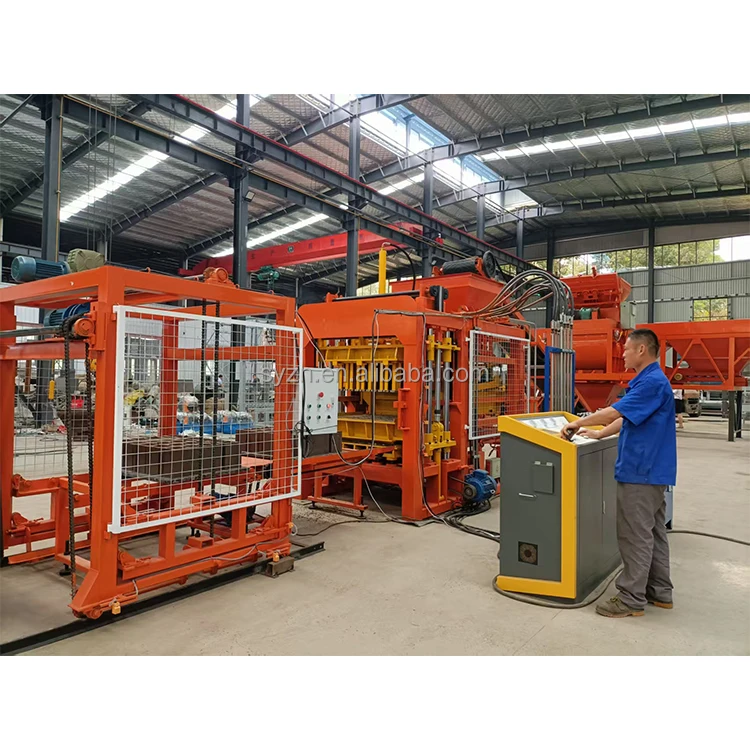
 High quality block machine