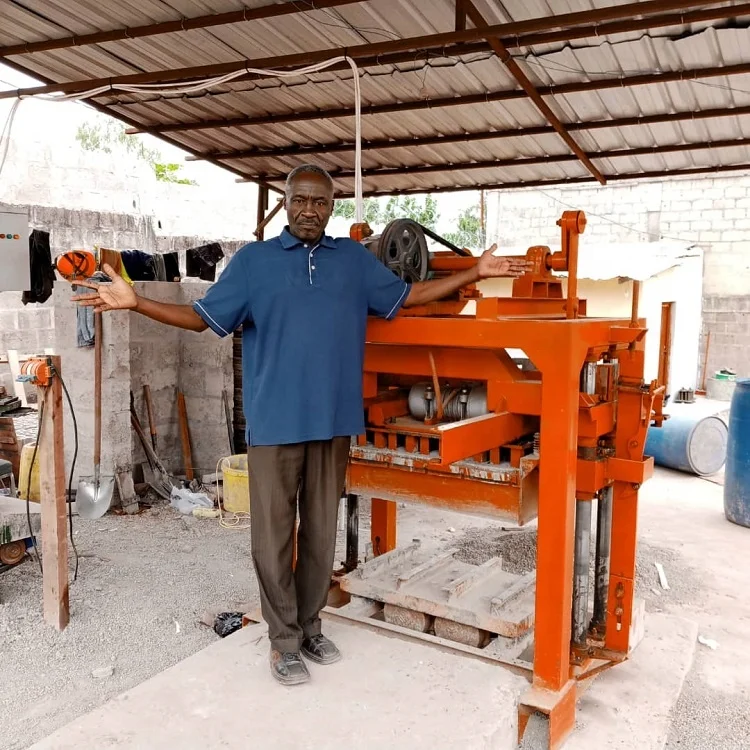
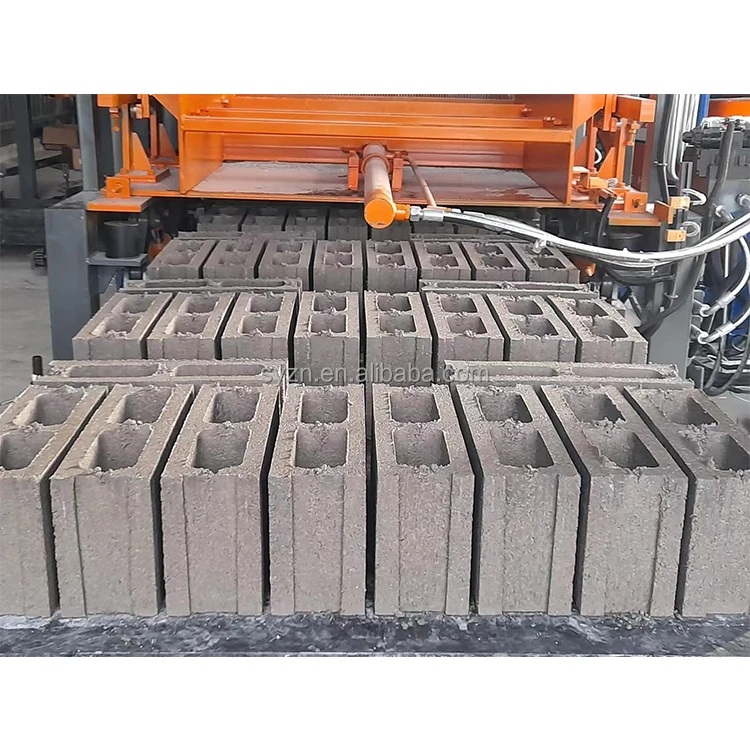
Matched System Configuration — The QT8-15 is specified as a complete unit with press, pallet, and mould rather than a standalone machine, so you know exactly what arrives at your site.
Technical Specifications
| Parameter |
Value |
| Model |
QT8-15 |
| Product Type |
Automatic Concrete Block Making Machine |
| Overall Dimensions (L×W×H) |
8300 × 1860 × 3000 mm |
| Pallet Size |
950 × 900 mm |
| Main Vibration Form |
Platform Vibration |
| Vibration Force |
45 kN |
| Vibration Frequency Range |
2800 – 4500 r/min |
| Rated Hydraulic Pressure |
21 MPa |
| Demolding Method |
Hydraulic |
| Molding Cycle |
15 – 20 s (basis not stated in source — confirm block format, material, and thickness) |
| Overall Power |
55.5 kW (rated or peak not specified) |
| Total Machine Mass |
8 T |
| Automation Level |
Automatic (specific stations not detailed) |
| Warranty |
1 year (excluding spare parts) |
Application Suitability
| Application |
Material or Output |
| Hollow block production |
Crushed stone, sand, cement, fly ash |
| Solid block production |
Gravel, slag, cement blends |
| Paving block and colored paver production |
Fine aggregate with pigment additives |
| Interlocking block and kerbstone production |
Coarse aggregate with high cement content |
What "15–20 Second Cycle" Actually Means on the QT8-15
A cycle range tells you the machine can run — the block format tells you what it produces in that time.
Manufacturers often quote an automatic concrete block making machine complete range by its fastest possible cycle. A 15-second cycle on a thin paver is a very different output from a 20-second cycle on a 200 mm hollow block. I have seen buyers calculate daily capacity from the low end of the range, only to find their actual product — taller, denser, or using a coarser local aggregate — pushes the cycle to the upper limit or beyond. The QT8-15 molding cycle is listed as 15–20 seconds, but the block format, mix design, and target strength behind that figure are not stated in the source data [NEED_CITE: block format assumptions in cycle time declarations]. Without those details locked down before purchase, your daily output projection is a guess.

Where the QT8-15 Sits in the Full Machine Range
The QT8-15 occupies the mid-to-high tier of an automatic concrete block making machine complete range. It is positioned above small workshop semi-automatic presses and below high-capacity lines designed for continuous three-shift operation. Buyers evaluating their first fully automatic plant, or replacing a semi-automatic unit that has reached its output ceiling, typically land on this tier. The 950 × 900 mm pallet size and 8-tonne machine mass indicate a press built for steady production volumes without the footprint and foundation demands of the largest models in the lineup.
How the Range Lets You Start Small and Scale Later
A key advantage of surveying the complete range before committing is the upgrade path. A buyer might begin with a semi-automatic model to validate local market demand, then move to the QT8-15 tier when daily volume justifies the step. Because pallet dimensions, mould mounting systems, and control architectures are designed with range compatibility in mind, the transition does not mean scrapping your existing pallet inventory or retraining operators from scratch. This continuity matters when you are planning capital expenditure across multiple phases [NEED_CITE: phased plant investment strategies for block producers].
Reading the Specs That Actually Shape Your Output
Platform vibration on the QT8-15 operates across a 2800–4500 r/min frequency range with a rated vibration force of 45 kN. Frequency and force together determine how thoroughly the mix is compacted inside the mould cavity. A higher frequency suits finer aggregates and thinner block walls, while a lower frequency with full force drives compaction in coarse, heavy mixes. The 21 MPa hydraulic pressure works in tandem: vibration settles the material, pressure locks it into shape before demolding. If your local crushed stone is harder or more angular than the default test mix, the vibration setting must be adjusted during commissioning to match — otherwise block density drops and strength falls short. The 55.5 kW overall power rating reflects the combined load of the hydraulic pump, vibration motor, and handling drives, which informs your electrical supply planning and transformer sizing.
The Cost of Skipping Configuration Details
I once configured a mid-tier automatic press for a buyer using catalogue defaults. The local aggregate turned out to be significantly coarser than assumed, and the vibration settings could not compact it adequately — an entire batch of blocks was rejected for low compressive strength. When specifications like pallet size, vibration force, and cycle time are taken at face value without confirming the buyer’s actual raw materials, the machine arrives but the blocks do not meet local standards. Pallet handling, stacking, and curing equipment left out of the quotation mean output piles up on the floor waiting for manual labor, negating the automation you paid for [NEED_CITE: consequences of mismatched vibration settings on block compressive strength].
Why This Is Where You Source the QT8-15
Block machinery is the single focus here, so the QT8-15 is quoted as a matched system — press, mould, pallet, and handling — not assembled from separate suppliers. Configuration starts from your actual mix design and target block format rather than a catalogue default. Moulds are designed for the formats your market actually sells, and custom mould drawings are accepted. Automation level is selectable, meaning you can begin at a semi-automatic station and add automatic stacking or cubing later. Installation includes on-site commissioning and operator training, so your crew is running production independently before the technician leaves.
Documentation & Verification
- Line layout and capacity calculation stating the block format assumed for the QT8-15 cycle time
- Machine specification sheet confirming vibration force, hydraulic pressure, and pallet size as matched values
- Mould drawing and format list for every block type the 950 × 900 mm pallet can produce
- Voltage, frequency, and PLC display language confirmed in writing before production begins
- Factory test record on the buyer’s specified block format before the QT8-15 leaves the workshop
Installation, Commissioning & Support
- Foundation designed around the 8300 × 1860 mm footprint and 8-tonne mass of the QT8-15
- Electrical supply verified against the 55.5 kW load and confirmed voltage and frequency
- Platform vibration frequency tuned to the buyer’s local aggregate during on-site commissioning
- Mould change procedure demonstrated and practiced with the buyer’s operators before handover
- Wear parts list and first-replacement schedule provided for hydraulic and vibration components
Before You Request a Quote
Share the block formats your market demands, your target daily output per format, and the raw materials available locally — including aggregate type and gradation. Confirm your site’s voltage, frequency, and preferred PLC display language. State your available plant area so the line layout can account for curing racks and pallet circulation alongside the QT8-15 press footprint.
Frequently Asked Questions
Q: How is QT8-15 daily output calculated, and which block format does the capacity figure assume?
A: The 15–20 second molding cycle is a range. Actual cycle depends on the specific block format, mix design, and target strength. We provide a written capacity calculation that states the exact block format, cycle time, and daily output assumption so you can verify it against your production plan before ordering.
Q: Where does the QT8-15 sit compared to semi-automatic and higher-capacity automatic models?
A: It sits in the mid-to-high automatic tier of the complete block machine range. Semi-automatic models suit lower volumes and smaller sites, while larger automatic lines serve high-capacity plants. The pallet and mould systems are range-compatible, supporting a future upgrade without replacing your entire pallet inventory.
Q: What voltage, frequency, and PLC language options are available, and how are they confirmed?
A: Voltage and frequency are configured to your local supply standard. PLC display language is confirmed in writing before production begins. This is documented in the specification sheet so there are no commissioning delays when the QT8-15 arrives at your site.
Q: What plant footprint does the QT8-15 require, and does the stated area include curing?
A: The press itself measures 8300 × 1860 × 3000 mm. The stated factory area reference needs clarification on whether it covers only the press zone or the full line including curing racks and pallet return. We provide a line layout drawing showing total space requirements before you finalize your building plan.
Q: Which block formats fit the 950 × 900 mm pallet, and can custom moulds be supplied?
A: The QT8-15 produces hollow blocks, solid blocks, pavers, interlocking blocks, and curbstones on this pallet size. Custom moulds can be manufactured to your drawings. A mould drawing and format list are supplied with every quotation so you know exactly which products are achievable.

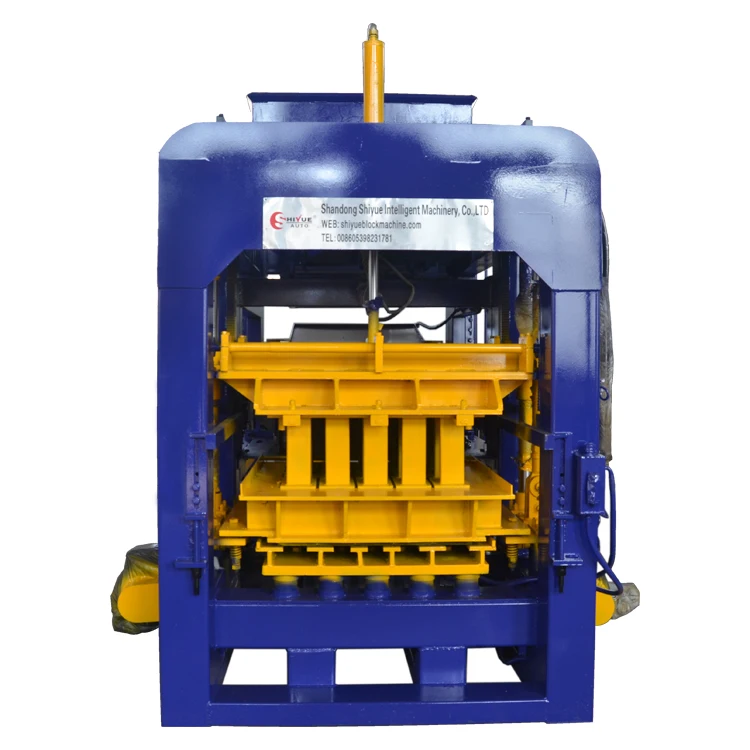
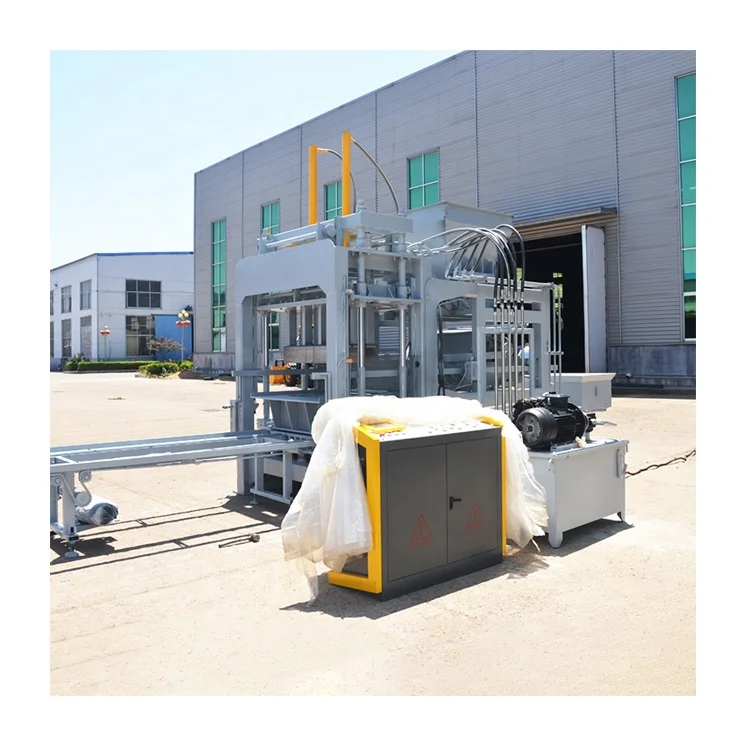 High quality block machine