

Curbstone Machine Warranty & After-Sales Guide by Shiyue Manufacturer
A warranty claim is often rejected not because the machine failed, but because the raw material violated the input standards.
The validity of a Curbstone Machine Warranty depends less on the calendar date and more on adherence to aggregate specifications and operational protocols. Most disputes arise from a mismatch between manufacturer expectations for clean, graded sand and the reality of local site materials, or from confusing normal wear-and-tear with structural defects. Understanding these boundaries before installation prevents costly downtime and ensures that support resources are directed toward genuine manufacturing issues rather than preventable operational errors.
I remember standing in a dusty yard in Lagos, watching a QT6-15 struggle to eject blocks. The vibration parameters were perfect, the hydraulic pressure was stable, yet every curbstone stuck to the mold. The local operator insisted the machine was defective. A quick sieve test revealed the sand contained excessive clay and mud, far beyond the tolerance for dry-cast concrete. This wasn’t a mechanical failure; it was a material compliance issue. That incident reshaped how I view post-sales support. It is not just about fixing broken parts; it is about defining what constitutes a valid claim versus an operational adjustment. [NEED_CITE: impact of aggregate quality on dry-cast concrete production]
To navigate this landscape, buyers must look beyond the duration of coverage and examine the specific exclusions related to consumables and maintenance neglect. This guide breaks down the practical realities of protecting your investment through clear definitions and proactive diagnostic habits.
What Does the Warranty Actually Cover?
Coverage is strictly limited to manufacturing defects in materials and workmanship, excluding damages caused by improper use or external factors.
When reviewing a Curbstone Machine Warranty, the first step is to distinguish between a defect and a degradation. A defect implies the part was flawed when it left the factory, such as a cracked weld on the main frame or a malfunctioning PLC module due to internal wiring errors. Degradation, however, is the natural result of friction, pressure, and chemical exposure during operation.
Manufacturers typically exclude items that interact directly with abrasive concrete mixes. These include molds, vibration springs, and hydraulic seals. These components are subject to high-frequency stress and abrasive wear. Expecting them to last indefinitely without replacement is akin to expecting tires on a truck to last forever without tread loss. The warranty serves as a safety net for unexpected failures, not a maintenance subsidy for routine consumption. [NEED_CITE: standard industry practices for wear parts exclusion in heavy machinery]
Consider the case of a buyer in Kenya who reported a hydraulic hose burst after only three months of operation. Upon review of the maintenance logs, it became clear that daily inspections for abrasion and proper routing had been skipped. The hose had rubbed against a sharp edge of the frame, a condition that regular visual checks would have identified early. This was classified as maintenance neglect rather than a material defect. The cost of replacement fell to the operator, highlighting the importance of adhering to prescribed inspection routines.
Understanding this distinction helps plant managers budget accurately. Instead of viewing every breakdown as a potential warranty claim, they can categorize issues into "covered defects" and "operational costs." This clarity reduces friction during support interactions and speeds up the resolution process for genuine issues.
Why Do "Quality" Machines Fail Early?
Premature failures are frequently linked to deviations in raw material specifications rather than inherent flaws in machine construction.
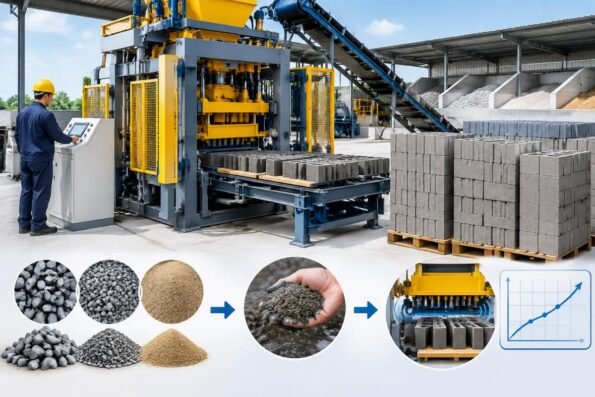
It is a common misconception that a robust machine can process any type of aggregate. In reality, the longevity of a Curbstone Machine Warranty is heavily influenced by the quality of the input material. Concrete block machines are engineered for specific ranges of aggregate size, moisture content, and mud percentage. Deviating from these standards introduces abnormal stresses on the vibration system and mold assembly.
For instance, high clay content in sand acts as a binder that causes sticking and requires higher ejection forces. This extra force transfers stress to the mold guides and vibration motors, accelerating wear beyond design limits. Similarly, oversized aggregates can jam the feed system or damage the mixer blades. These issues are not covered under warranty because they stem from non-compliance with the technical manual’s material requirements. [NEED_CITE: technical specifications for aggregate in concrete block manufacturing]
A project in Peru faced repeated mold misalignment issues. The initial assumption was a structural weakness in the frame. However, remote diagnostics revealed that the local stone dust used as fine aggregate was too fine and lacked the necessary gradation. This caused uneven compaction and lateral stress on the mold box during vibration. Once the mix design was adjusted to include properly graded sand, the alignment issues ceased. The machine itself was sound; the fuel feeding it was inappropriate.
| Material Factor | Standard Requirement | Risk of Non-Compliance |
|---|---|---|
| Sand Mud Content | Low (Clean Washed Sand) | High risk of sticking and mold damage |
| Aggregate Size | Uniform Gradation | Jamming and uneven compaction |
| Moisture Level | Controlled Dry-Cast Range | Poor block formation and excess wear |
This table illustrates how material variables directly impact machine health. Buyers must verify their local raw materials against the manufacturer’s specifications before commissioning. If local materials differ significantly, pre-testing or mix design consultation is essential to avoid voiding the Curbstone Machine Warranty through misuse.
How to Handle Common Faults Remotely?
Structured remote diagnostics can resolve operational errors faster and more cost-effectively than waiting for on-site visits.
In the past, a machine fault meant days of downtime while waiting for an engineer to fly out. Today, the efficiency of a Curbstone Machine Warranty support system relies on remote diagnostic protocols. Most issues reported as "machine failure" are actually operational errors or sensor misalignments that can be corrected via video call and error code analysis.
The process begins with the operator documenting the issue. This includes capturing the specific error code from the PLC screen, recording a short video of the malfunction, and noting the recent operational history. Support teams then use this data to guide the operator through a checklist. This might involve checking sensor connections, verifying hydraulic pressure settings, or recalibrating the mold height.
A notable example involved a buyer in Southeast Asia who reported a complete system shutdown. The panic was palpable, with fears of a major electrical failure. Through a structured video session, the support team guided the operator to check the emergency stop circuits and safety door sensors. It turned out that a minor misalignment in a safety switch was triggering the lockout. The fix took ten minutes and required no spare parts. This approach saves significant time and money, keeping the production line running without the delay of international travel. [NEED_CITE: benefits of remote technical support in industrial equipment maintenance]
For more complex issues, manufacturers like Shiyue integrate multi-language support and express spare parts delivery into their service model. If a part is indeed faulty, identifying it remotely ensures that the correct component is shipped via express courier, minimizing downtime. This hybrid approach of remote diagnosis followed by targeted parts replacement maximizes the value of the after-sales support structure.
Which Parts Are "Consumables"?
Clear identification of wear parts prevents disputes by setting realistic expectations for replacement cycles.
One of the most frequent sources of confusion in after-sales support is the definition of "wear parts." These are components designed to absorb friction and impact, and they have a finite lifespan regardless of the machine’s overall quality. Excluding them from the standard Curbstone Machine Warranty is industry standard, yet it often catches new investors off guard.
Typical consumables include:
- Molds and Liners: Direct contact with abrasive concrete leads to gradual dimensional changes and surface wear.
- Vibration Springs: Constant high-frequency cycling causes metal fatigue over time.
- Hydraulic Seals and Hoses: Subject to pressure cycles and environmental exposure, leading to eventual leakage or bursting.
- Mixing Blades and Liners: Abrasion from aggregate mixing reduces their thickness and efficiency.
Understanding this list allows plant managers to stock critical spares in advance. Instead of treating a worn mold as a defect, it should be viewed as a scheduled maintenance item. Proactive replacement of these parts prevents secondary damage to more expensive components like the vibration motor or frame structure.
By maintaining a inventory of these consumables, operators ensure continuous production. The warranty remains intact for the core mechanical and electrical systems, providing long-term security for the major investment. This separation of concerns clarifies responsibilities: the manufacturer guarantees the integrity of the machine’s design and build, while the operator manages the upkeep of its working surfaces.
Conclusion
Protecting your investment requires strict adherence to material standards and proactive maintenance, not just reliance on warranty terms.
The true value of a Curbstone Machine Warranty lies in its ability to cover genuine manufacturing defects while encouraging best practices in operation. By respecting raw material specifications, distinguishing wear parts from structural components, and utilizing remote diagnostic tools, buyers can minimize downtime and maximize productivity. Clear communication and defined boundaries transform after-sales support from a source of conflict into a strategic asset for long-term business success.

Industry expert sharing insights about concrete machinery, block making technology and turnkey production solutions.
View all posts →
Leave a Reply