

QT10-15 Block Machine for Sale in Peru | Turnkey Plant Supplier
Most buyers think the main block machine is the whole investment. In reality, the real cost trap hides in the batching silo interfaces and cement silo connections that never match the mixer — leaving the entire line idle on arrival.
For investors and contractors searching for a QT10-15 block machine for sale in Peru, the answer is straightforward: a true turnkey plant supplier must deliver the complete line — batching system, cement silo, mixer, curing setup, and stacker — fully matched to Peru’s volcanic sand and river gravel aggregates, with voltage stabilization built in for the grid’s frequent fluctuations, and backed by CE/SGS certification for government tender compliance.
I still remember a job in Lagos, Nigeria, where I spent months on-site commissioning a semi-automatic line. The local grid would drop voltage without warning, and the inverter board would fry every few days. The client kept pushing for output while dust choked the electrical cabinet so badly we dared not open the door. That was years ago, but the lesson carried over when a buyer in Lima once came back to me saying a competing QT10-15 block machine for sale in Peru was priced noticeably lower. I asked what was included. The other quote covered only the main host machine — no batching silos, no cement silo, no proper mixer interface. When the containers arrived at Callao port, the cement silo flange simply did not align with the mixer inlet. The entire line sat idle for weeks while custom adapters were fabricated locally, at a cost that erased whatever was saved upfront [NEED_CITE: common integration failures in imported block plant equipment due to unmatched silo-mixer interfaces].
That kind of mismatch is avoidable — but only if you know exactly what a real turnkey delivery looks like and how to verify the supplier before committing.
Why Peru’s Block Machine Market Is Heating Up in 2026?
Peru’s construction sector is being driven by a structural housing deficit and a wave of public infrastructure spending, pushing both private investors and government contractors toward high-output block production lines.
The demand side is clear. Peru continues to face a significant affordable housing gap, particularly in rapidly urbanizing corridors around Lima, Arequipa, and Trujillo. Government programs targeting social housing have accelerated procurement cycles, while private developers in secondary cities are scaling up block production to meet commercial and residential demand [NEED_CITE: Peru’s housing deficit and public infrastructure investment trends driving construction material demand]. This dual pull — public tenders requiring certified equipment and private investors chasing quick payback — has made the QT10-15 block machine for sale in Peru one of the most searched configurations in Latin America over recent procurement cycles.
I have watched this shift from the field side. A few years back, most inquiries from Peru were for small manual or semi-automatic machines — a single investor with a modest yard, making a few hundred blocks a day. Now the conversations are different. A contractor in Arequipa needed a full line to supply a government housing project, complete with CE documentation and formal bid paperwork. A private investor near Lima wanted to upgrade from a aging semi-auto setup to something that could push daily output into the five-digit range, using local volcanic sand mixed with river gravel. A distributor in Cusco was exploring regional agency arrangements, asking about container loading density and spare parts supply chains.
The pattern is consistent: buyers are moving up the capacity ladder, and they need a QT10-15 block machine for sale in Peru that arrives as a complete, matched system — not a collection of disconnected components.
What Makes QT10-15 the Right Fit for Peru’s Conditions?
The QT10-15 is the configuration that balances high daily output with the ability to handle Peru’s specific aggregate profile — volcanic sand, river gravel, and variable moisture content — while tolerating the voltage instability common in many industrial zones.
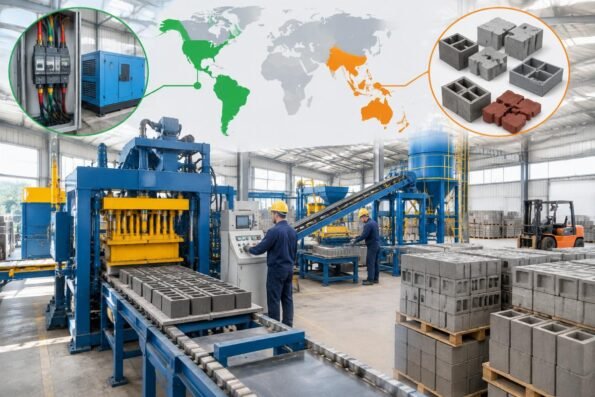
Many buyers assume European or Turkish machines are inherently more reliable. In practice, Peru’s electrical grid in secondary industrial areas experiences frequent voltage dips and phase imbalances. Equipment designed for stable European grids often struggles here. Lines that have been field-proven in markets with similarly unstable power — across multiple regions in Africa and South America — tend to perform more reliably because their electrical systems are built with wider tolerance ranges and more robust surge protection [NEED_CITE: voltage instability impact on block machine electrical systems in emerging market grids].
The aggregate situation is equally important. Peru’s common raw materials — volcanic sand from southern regions, river gravel from Andean deposits — have different absorption rates and particle shapes compared to the limestone-based aggregates common in Europe. A mold and mix design optimized for European conditions will produce blocks with inconsistent density and higher breakage rates when switched to volcanic sand without adjustment. The QT10-15 platform allows mold customization and vibration parameter tuning to compensate for these material differences, which is something a proper turnkey supplier should handle during the commissioning phase rather than leaving to the buyer.
From a cost perspective, a complete QT10-15 block machine for sale in Peru from a qualified Chinese manufacturer typically comes in substantially below comparable European or Turkish packages — often by a margin wide enough to fund the entire curing area and initial raw material inventory. The savings are not just on the host machine; they extend across the batching system, the cement silo, and the control panel, all of which are priced at a fraction of what European integrators charge for the same functional scope.
What Does a Real Turnkey Plant Include Beyond the Main Machine?
A genuine turnkey delivery means every module from raw material storage to finished block stacking arrives as a matched, pre-engineered system — not just the host machine dropped at the port.
This is where the most costly misunderstandings happen. When a buyer compares quotes for a QT10-15 block machine for sale in Peru, the host machine price is the most visible number. But the host machine cannot produce a single block without the supporting modules. A real turnkey package includes:
- Batching silos — multiple compartments for different aggregate sizes, with calibrated gates matched to the mixer’s cycle time
- Cement silo — with proper flange interface to the mixer, dust collection, and level indicators
- Mixing system — pan mixer or twin-shaft, sized to the host machine’s cycle, with wear-resistant liners suited to abrasive volcanic aggregates
- Conveying system — belt conveyors and skip hoists connecting batching to mixing to the host machine hopper
- Pallet circulation — pallet feeder, wet block conveyor, and return system matched to the mold size and block height
- Curing infrastructure guidance — rack or floor curing layout, humidity management recommendations
- Stacking system — finger car or cross conveyor with auto-stacker, calibrated to the block pattern
I once worked with a buyer who purchased a host machine from one vendor and tried to source the batching silos locally to save on freight. The local silo outlet dimensions did not match the mixer inlet. The mixer batch weight was inconsistent. The host machine’s vibration timing was calibrated for a specific feed rate that the mismatched silos could not maintain. The result was a line that technically ran but produced blocks with unacceptable density variation — and the buyer blamed the host machine [NEED_CITE: integration failures when block plant components are sourced from mismatched suppliers].
When evaluating a QT10-15 block machine for sale in Peru, the right question is not "what is the machine price" but "what modules are included, and are they pre-matched at the factory before shipment." A supplier who delivers the full line as one engineered system — batching, mixing, forming, curing, stacking — eliminates the interface risk entirely.
How to Verify a Supplier Before Committing to a Peru Project?
Verification is not about brochures — it is about checking certification validity, confirming installation commitments in writing, and assessing the spare parts supply chain before signing anything.
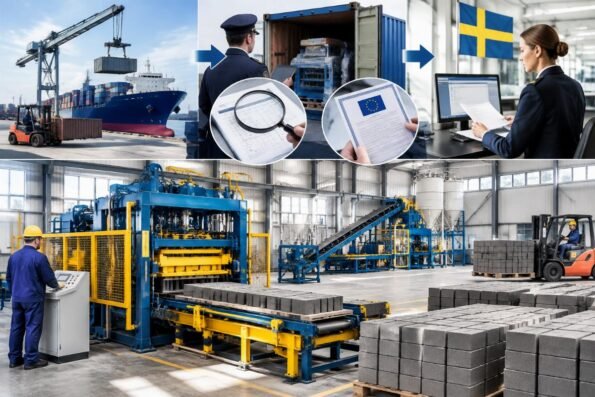
Government contractors in Peru often require CE or SGS certification as a tender prerequisite. But not all certificates are equal. A CE declaration self-issued by a trading company carries no weight; what matters is a certificate from a recognized notified body, with the equipment model number explicitly listed [NEED_CITE: CE certification requirements and notified body verification for construction machinery exports]. Similarly, SGS inspection reports should cover the specific machine configuration being shipped, not a generic product family.
Beyond certification, the installation and training commitment is critical. A supplier who promises "we will send engineers" without specifying duration, scope, and deliverables in the contract is leaving the most vulnerable phase — commissioning — undefined. The commissioning period is when mold settings are tuned to local aggregates, vibration parameters are adjusted, and operators are trained. A proper commitment specifies the number of engineers dispatched, the expected commissioning timeline, and the performance benchmarks that define successful handover.
Spare parts availability is the third verification pillar. Wear parts — mold liners, vibration table rubber mounts, mixer blades — will need replacement within the first year of operation. A supplier who cannot provide a spare parts list with part numbers, or who has no track record of shipping parts to Latin America, is a supplier who will leave you waiting weeks for a component that halts the entire line.
When I evaluate a QT10-15 block machine for sale in Peru on behalf of a buyer, I check three things first: Is the CE/SGS certificate valid and model-specific? Is the installation scope written into the contract with clear milestones? And can the supplier demonstrate a working parts supply chain to the region? If any of these three fails, the price becomes irrelevant.
What Is the Real ROI Timeline for a QT10-15 Line in Peru?
The payback period depends on daily output actually achieved — not the theoretical cycle time printed in a brochure — and on the block price your local market will bear.
A QT10-15 host machine has a theoretical cycle that suggests very high daily output. But theoretical output assumes perfect conditions: consistent aggregate supply, uninterrupted power, trained operators, and zero downtime for mold changes. In real operation, the actual daily figure is determined by the slowest module in the line — usually the curing area turnover or the pallet circulation speed, not the host machine itself.
A private investor near Lima, operating a yard of moderate size, upgraded from a semi-automatic line to a full QT10-15 block machine for sale in Peru setup with matched batching and stacking. The target was to produce enough standard blocks daily to supply multiple construction sites in the surrounding district. With two shifts and proper curing management, the line reached a daily output that allowed the investor to project payback well within the typical range for this equipment class in Latin America — a timeline that compared favorably against the financing cost of the investment [NEED_CITE: ROI calculation methodology for block production lines in Latin American markets].
The key variable is not the machine speed but the system integration. A line where the batching silos feed the mixer at the right rate, where the pallet return keeps up with the host machine cycle, and where the stacker handles the output without bottlenecks will consistently outperform a line where one module is undersized or mismatched. This is why the turnkey approach — where one supplier engineers the entire flow — produces better real-world output than a pieced-together line, even if the host machine is identical.
For government contractors, the ROI calculation shifts slightly. The margin per block may be lower on a public tender, but the volume commitment is higher and more predictable. A QT10-15 line running on a guaranteed government supply contract can achieve payback on a compressed timeline, provided the delivery and certification requirements are met without delay.
Fazit
A QT10-15 block machine for sale in Peru is only as good as the system around it — batching, mixing, curing, and stacking must arrive as one matched package, not a standalone host machine. The Peruvian market’s combination of housing demand, aggregate specificity, and grid instability requires a supplier who understands turnkey integration, holds valid certifications, and commits to on-site commissioning with measurable outcomes. Verify the system, not just the price, and the investment will perform. Industry expert sharing insights about concrete machinery, block making technology and turnkey production solutions.
Leave a Reply