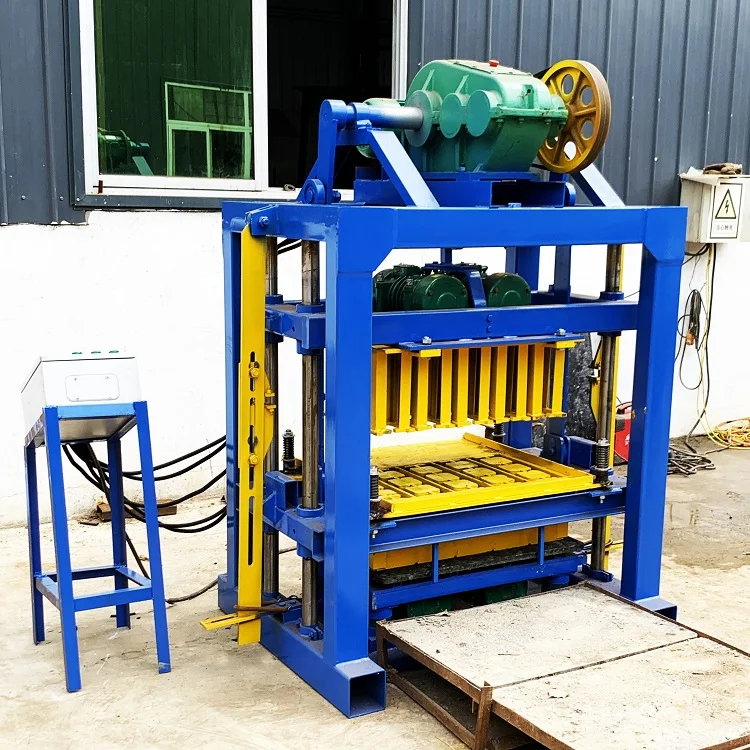
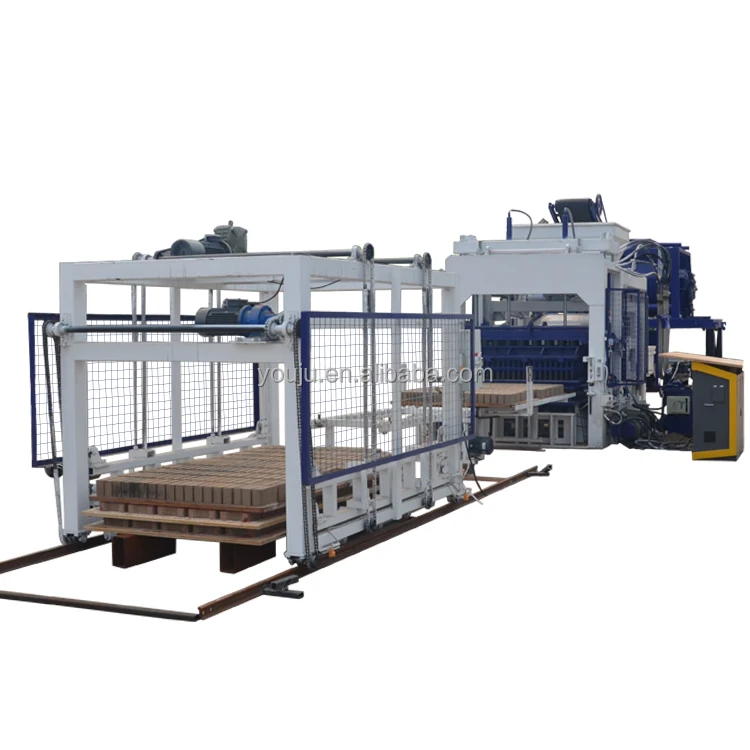
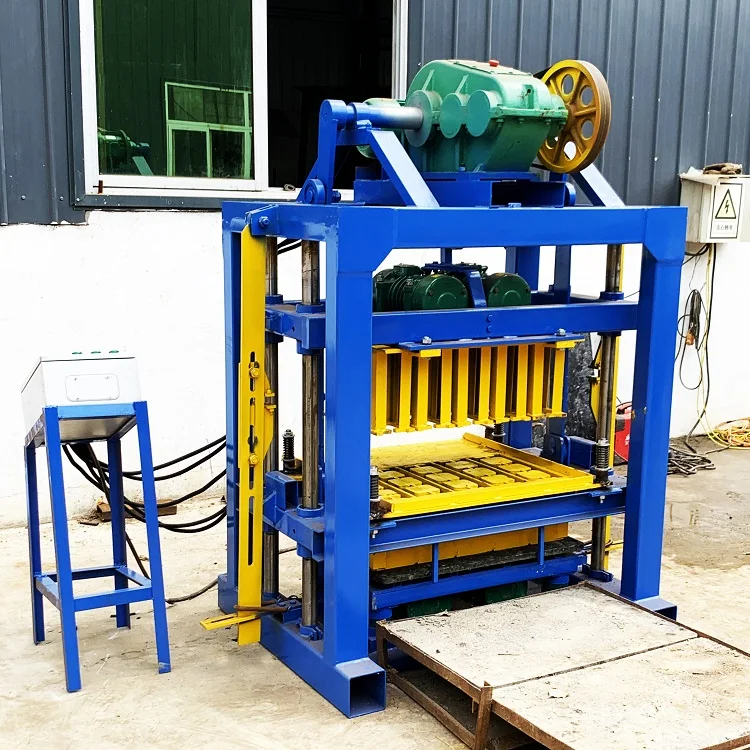
Compact Entry-Tier Fit — the QTJ4-40 anchors our stationary block machine range for first-plant buyers who need honest output figures before committing to a larger footprint.
Technical Specifications
| Parameter |
Value |
| Model |
QTJ4-40 |
| Product Type |
Stationary Concrete Block Making Machine |
| Overall Dimensions (L×W×H) |
1350 × 1460 × 1800 mm |
| Net Weight |
1000 kg |
| Rated Power |
9.5 kW |
| Voltage & Frequency |
Configurable to buyer’s local supply (basis to be confirmed) |
| Control System |
Manual operation (basis not stated in source — verify PLC availability) |
| Vibration Frequency |
2800 r/min |
| Standard Mould Format |
390 × 190 × 190 mm, 4 pcs per cycle |
| Mould Change System |
Interchangeable moulds; custom designs to buyer drawings |
| Workers Required |
3–5 per shift |
| Assembly State |
Stationary |
| Warranty |
1 year |
| Applicable Standard |
China National Patent No. 022692541 |
Application Suitability
| Application |
Material or Output |
| Small hollow block plants |
Crushed stone, sand, cement mix — 390 × 190 × 190 mm hollow blocks |
| Contractor on-site production |
Standard concrete masonry units for housing and wall projects |
| First-time block entrepreneurs |
Entry-level output range with room to add formats via mould swaps |
| Building material distributors |
Compact footprint machine for demonstration or small-volume sales |
Why the Voltage Question Comes Before the Price
Choosing a stationary block machine manufacturer without locking down your local voltage and frequency is the single most common reason machines sit idle on arrival. Confirming power supply before signing the contract prevents weeks of on-site rewiring. A machine built for one grid standard cannot simply be plugged into another — the motor winding, contactor ratings, and control transformer all match the specified supply [NEED_CITE: voltage and frequency standards by export market]. I have watched an entire project stall because a QTJ4-40 arrived wired for a voltage the site did not have, and sourcing a matching transformer locally took the better part of a month.

Where the QTJ4-40 Sits in the Full Range
Our stationary block machine manufacturer lineup spans from this entry-tier manual unit all the way through high-capacity automatic lines with stacking and cubing. The QTJ4-40 occupies the first step — it produces standard hollow blocks using manual pallet handling and a straightforward vibration system. Buyers who need higher daily volumes or multiple block formats running in the same shift move up to semi-automatic or fully automatic tiers, where pallet feeding, block stacking, and curing rack handling are integrated into one continuous cycle.
Understanding the Footprint and Foundation
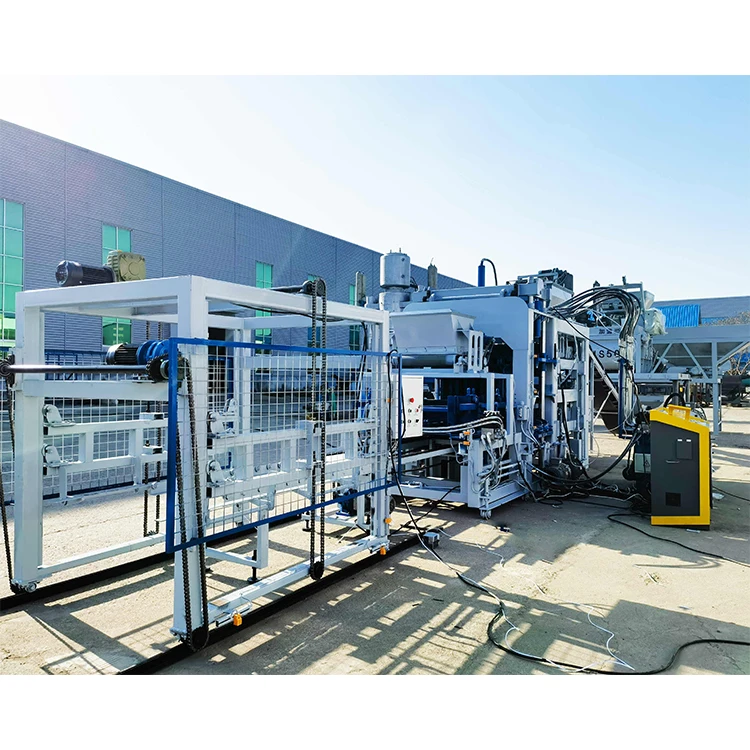
A 1350 × 1460 × 1800 mm frame means the QTJ4-40 fits inside a modest workshop or an open-air curing yard without requiring a dedicated building. The stationary assembly sits on a level concrete pad, and the 9.5 kW total power draw stays within the supply capacity of most small industrial sites. For buyers planning a complete block production setup, the real spatial consideration is the curing area — fresh blocks remain on pallets for hours, and the pallet count plus forklift turning radius determine how much ground you actually need [NEED_CITE: concrete block curing area planning guidelines].
Reading the Vibration and Mould Numbers
The 2800 r/min vibration frequency comes from a dedicated vibration motor mounted directly below the mould box, transmitting force upward through the concrete mix to compact aggregate particles into a dense matrix. At this frequency and the stated cycle rhythm, the machine produces 4 pcs of 390 × 190 × 190 mm hollow blocks per mould — this is the format assumption behind any output figure, and quoting daily capacity without naming the block size is meaningless. Mould interchangeability lets you swap to solid blocks or pavers, but cycle time changes with each format because fill depth and compaction requirements differ. The 1000 kg machine weight provides the mass needed to absorb vibration recoil, keeping the frame stable during each press cycle rather than walking across the floor.
What Happens When Configuration Is Skipped
Buyers who skip the configuration conversation often discover that the pallet size quoted does not match the curing racks or forklifts they already own, forcing a second purchase. A control panel labeled in a language the operators cannot read slows training and invites operating errors. When the vibration force was never matched to the buyer’s actual aggregate — perhaps a locally available lightweight pumice instead of crushed granite — block strength falls below the project specification [NEED_CITE: aggregate selection effect on concrete block compressive strength]. These are not machine defects; they are mismatches that a proper pre-order survey prevents.
Why Source This Range Here
Block machinery is our single focus, so the QTJ4-40 arrives as part of a matched system — machine, mould, pallet, and handling — rather than assembled from unrelated suppliers. Every quotation includes a capacity calculation that names the exact block format and cycle time assumed, removing guesswork from your business plan. We configure voltage, frequency, and control panel language to your destination market before production starts, based on the confirmed site conditions you provide. Custom mould design is available to your drawings, so you can produce the formats your local market actually sells instead of settling for catalogue defaults. The documentation package travels with the machine, covering layout, specifications, and test records for a transparent handover.
Documentation & Verification
- Line layout and capacity calculation stating 390 × 190 × 190 mm format assumption
- Machine specification sheet with confirmed voltage, frequency, and control language
- Mould drawing and compatible format list with cycle times per block type
- Factory test record verifying vibration performance and block output before dispatch
- Packing photographs and customs documentation support for smooth clearance
Installation, Commissioning & Support
- Level concrete pad required matching 1350 × 1460 mm base footprint
- Dedicated electrical circuit sized for 9.5 kW total draw at confirmed voltage
- Machine ships assembled; pallet station and mixing area configured on arrival
- Commissioning includes first-run vibration tuning against your local aggregate
- Operator training covers mould change procedure and daily lubrication points
- Wear parts list identifies vibration motor, mould liners, and hydraulic seals
What to Share With Your Inquiry
Tell us the block formats your market sells, the daily volume you need, and the local aggregate you plan to use. We also need your site voltage, frequency, and preferred control panel language so the QTJ4-40 arrives ready to run. If you already own pallets, forklifts, or a curing yard, share those dimensions — we will match the machine output to your existing handling setup.
Frequently Asked Questions
Q: How is the daily output of the QTJ4-40 calculated, and which block format does it assume?
A: Output is calculated from the mould format of 390 × 190 × 190 mm producing 4 pcs per cycle at a 2800 r/min vibration frequency. Any daily figure must state this exact block size and the number of working hours assumed, because switching to a different mould changes cycle time and piece count per press.
Q: Where does the QTJ4-40 sit compared to semi-automatic and automatic tiers?
A: It is the entry tier in our stationary block machine manufacturer range, using manual pallet handling and a simple vibration system. Semi-automatic and automatic models add pallet feeding, stacking, and cubing to raise daily volume and reduce manual labour, suited for buyers who have outgrown entry-level output.
Q: What voltage options are available, and can the control display be set to my local language?
A: Voltage and frequency are configured to your confirmed site supply before production. The control panel language is specified at order — sharing this detail early prevents the commissioning delays I have seen when a machine arrives with an unreadable display.
Q: What plant footprint does the QTJ4-40 need compared to higher-output models?
A: The machine itself occupies 1350 × 1460 × 1800 mm, fitting a small workshop. The total site footprint depends on pallet count and curing area, which grow with daily output. Higher-tier automatic machines require more linear space for stacking and cubing conveyors.
Q: Can I start with the QTJ4-40 and add automation later?
A: The range is designed so buyers can begin at entry tier and move up. Custom moulds ordered now remain compatible with larger machines in the lineup, protecting your initial tooling investment when you expand capacity.

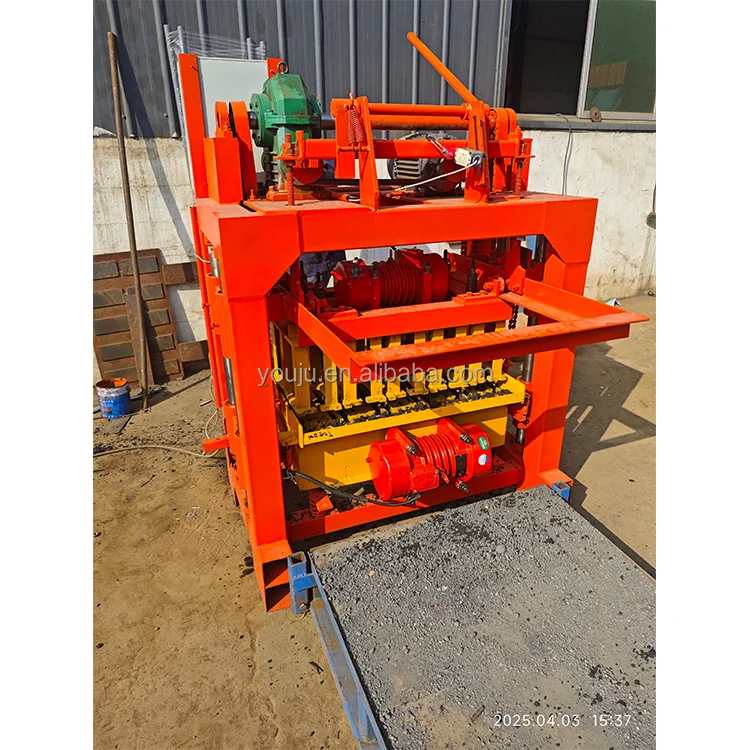
 Stationary block machine