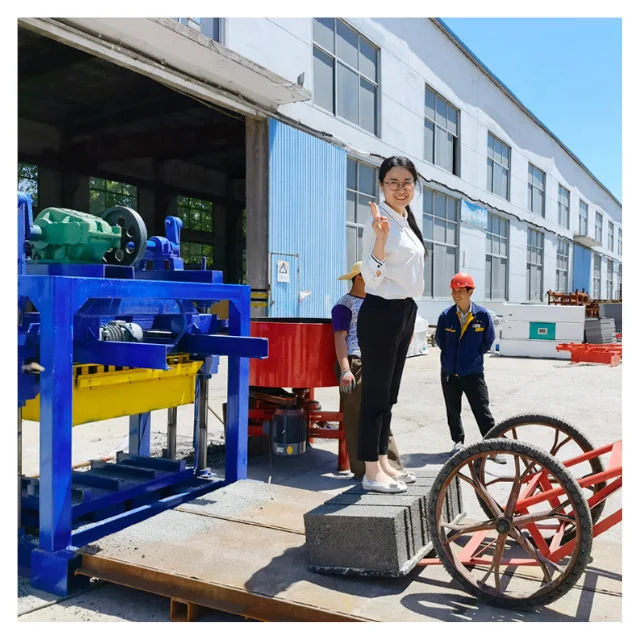
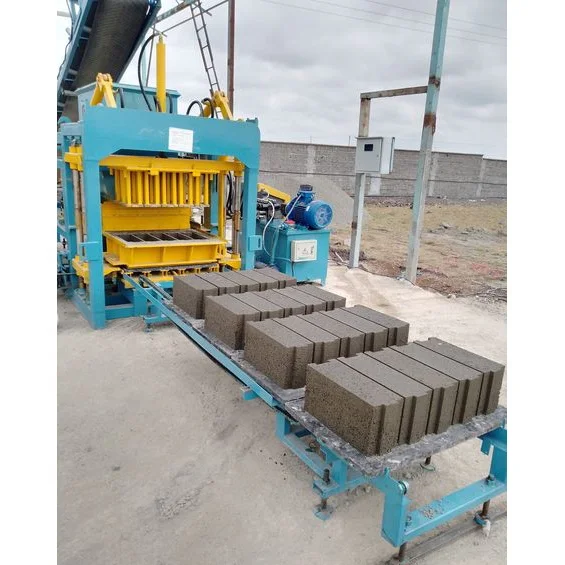
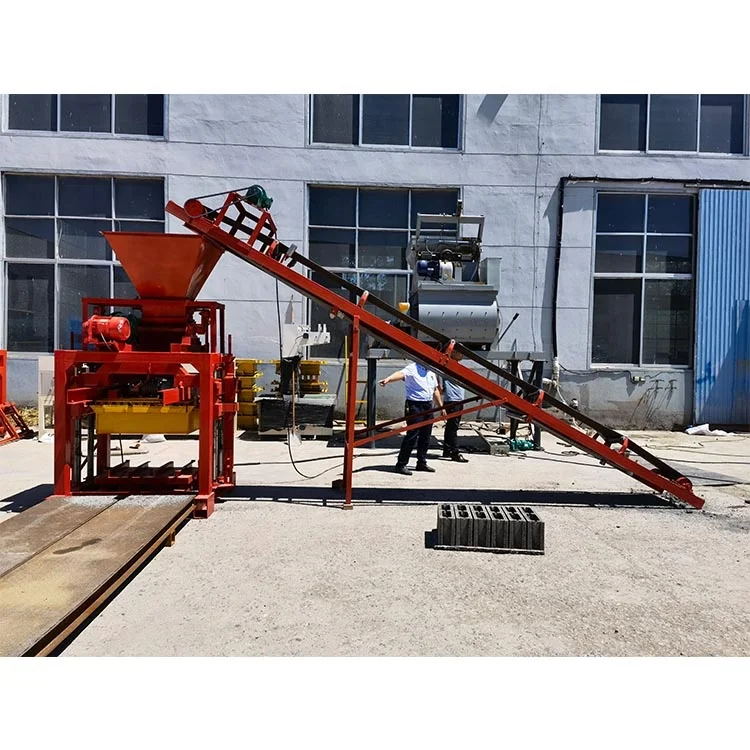
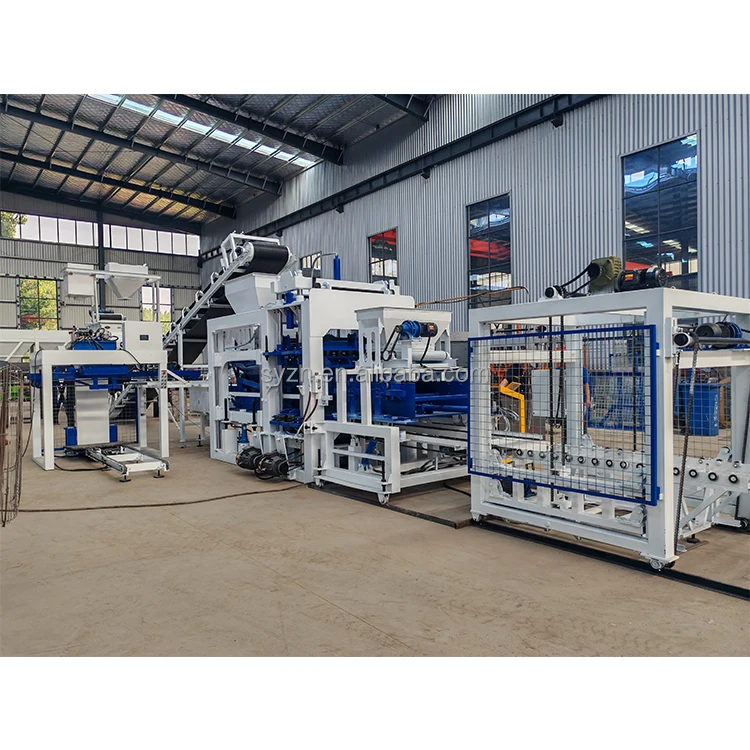
Matched System Configuration — the QTJ4-24 semi-automatic block machine is specified with its mixer, conveyor, and pallets as one coordinated line rather than sourced from separate vendors, so cycle times align from raw feeding through curing.
Technical Specifications
| Parameter |
Value |
| Model |
QTJ4-24 |
| Product Type |
Semi-Automatic Concrete Block Making Machine |
| Rated Power |
11.95 kW (main machine) |
| Overall Dimensions (L×W×H) |
3600 mm × 1700 mm × 2560 mm |
| Net Weight |
3.5 T |
| Pallet Size |
900 mm × 450 mm |
| Moulding Cycle |
24–26 s |
| Vibration Method |
Table vibration with upper and lower vibrators |
| Feeding Method |
Manual feeding, two feed ways |
| Control System |
Electrical control cabinet with mechanical interlocking |
| Automation Level |
Semi-automatic (mechanical + manual operation) |
| Assembly State |
Main machine + 6 m belt conveyor + JQ350/JQ500 mixer |
| Wiring Specification |
Main power 3×16 mm²; main machine 3×6 mm² |
| Lubrication |
JQ350 reducer 10 kg (35–40# machine oil); JQ500 reducer 15 kg (35–40# machine oil) |
| Warranty |
1 year (excluding spare parts) |
Application Suitability
| Application |
Material or Output |
| Hollow block production for low-rise residential walls |
Crushed stone, river sand, and cement blends |
| Solid block manufacturing for load-bearing structures |
Dense aggregate mixes with standard cement ratios |
| Standard brick output for paving and partition walls |
Fine sand and cement with controlled moisture content |
| On-site block production for construction contractors |
Locally available aggregates without extensive processing |
| Small workshop block plants with limited floor space |
Variable raw materials depending on regional supply chains |
What "24 Seconds per Cycle" Actually Means for Your Daily Tally
A cycle time only matters when tied to the specific block format being pressed, because a hollow block and a solid brick demand entirely different compaction sequences.
Many quotations quote cycles per hour without naming the block format behind that figure, leaving buyers to discover the real daily output on their first production run. I once watched a contractor in Southeast Asia lose half a shift because the capacity sheet assumed lightweight hollow blocks while his market demanded dense solid pavers. The vibration table, the hydraulic pressure, and the feeding method all behave differently when the mix and the mould change. The semi-automatic block machine manufacturer must state the format up front so the buyer can plan labour and curing space honestly. [NEED_CITE: typical discrepancies between quoted and actual block machine output]
Placing the QTJ4-24 on the Semi-Automatic Block Machine Range
This model occupies the entry tier of the Shiyue semi-automatic block machine lineup, designed for buyers who are commissioning their first plant or adding a compact secondary line. The table-vibration press pairs with a JQ350 or JQ500 mixer and a 6 m belt conveyor to form a simple circuit that does not require a concrete pit. Floor space remains minimal, which suits urban workshops or temporary project sites where a full automatic line would be impractical. The mechanical interlocking control keeps the operator in the loop at every station, making troubleshooting straightforward for crews with limited automation experience.
Mould Flexibility and the Formats the Market Actually Sells
The QTJ4-24 supports multiple mould formats from a single press frame: 400×200×200 mm hollow blocks at four pieces per mould, 390×120×190 mm hollow blocks at six pieces per mould, and 240×115×53 mm solid bricks at twenty-one pieces per mould. Cycle time holds at 24–26 seconds across these formats, though actual daily output scales with the number of pieces each mould produces. Buyers switching between hollow blocks and solid bricks within the same shift must account for the mould change procedure, which involves unbolting the mould box and recalibrating the upper press head [NEED_CITE: mould change time impact on daily block production]. Confirming the exact mould dimensions against local building codes before ordering prevents the common situation where the machine arrives but the blocks do not match what the market stocks.
How Vibration Force and Mix Design Shape Block Strength
The upper and lower vibrator arrangement on the QTJ4-24 works by transmitting vibration energy from the table through the mould cavity while the upper head applies static pressure. When the local aggregate contains high clay or silt content, this energy transfer weakens, and blocks emerge with lower compressive strength even though the cycle time remains unchanged. Adjusting the vibration duration or modifying the sand-to-cement ratio compensates for poor aggregate quality, but the adjustment window has limits. Pallet size at 900×450 mm determines how many blocks travel into the curing area per cycle; if the buyer’s existing forklift or curing racks were sized for a different pallet, the entire downstream handling flow stalls. Matching the mixer output — whether JQ350 or JQ500 — to the press appetite ensures the conveyor never runs empty and the press never idles waiting for fresh material.

The Cost of Skipping the Raw Material Conversation
Ordering a semi-automatic block machine without disclosing the local sand source and aggregate gradation often surfaces as inconsistent block density during the first week of production. The vibration table was calibrated at the factory for a reference mix, and when the buyer’s actual material contains more fines or moisture than that reference, the compaction energy dissipates before reaching the mould cavity. Correcting this on site means experimenting with vibration time, feeder speed, and cement dosage — a process that consumes raw material, labour hours, and buyer confidence. In regions where river sand carries high silt loads, the daily yield can fall far below the figure quoted on the capacity sheet because the operator must extend the vibration phase to achieve acceptable strength [NEED_CITE: effect of aggregate quality on block machine throughput]. Wiring specifications, including the main power cable at 3×16 mm², must also match the local voltage and frequency; arriving with a motor wound for 380 V 50 Hz in a 440 V 60 Hz market delays commissioning until a transformer or replacement motor is sourced.
Why Source This Semi-Automatic Block Machine From Shiyue
Block machinery remains the single focus, so the press, mould, pallet, and conveyor are specified as one matched system rather than assembled from separate suppliers who shift blame when cycle times do not align. The configuration is set against the buyer’s actual mix design and target block format, not pulled from a catalogue default that assumes a reference material the buyer cannot source. Mould design covers the formats the buyer’s local market demands, including custom drawings when standard dimensions do not match regional building codes. The automation level is selectable, meaning a buyer can start with the manual pallet handling of the QTJ4-24 and move to a higher tier later without replacing the entire line. Installation support includes operator training on the mechanical interlocking control, and mould and wear part supply continues after the first replacement falls due.
Documentation & Verification
- Line layout and capacity calculation stating the block format assumed for each output figure
- Machine specification sheet covering rated power, dimensions, and pallet size
- Mould drawing and format list so the buyer can verify dimensions against local codes
- Voltage and control language confirmation form signed before production begins
- Factory test record on the buyer’s target block format before dispatch
- Operation and maintenance manual with wiring diagrams and lubrication schedules
Installation, Commissioning & Support
- Flat concrete floor required; no pit digging thanks to the 2560 mm overall height
- Main power supply 3×16 mm² cable with dedicated circuit breaker matching the 11.95 kW rated load
- Machine arrives as one main unit plus conveyor and mixer, bolted down on site
- First-run commissioning covers vibration time adjustment for the buyer’s specific aggregate
- Operator training on the electrical control cabinet and mechanical interlocking sequence
- Wear parts list with mould and vibrator replacement intervals included in the manual
- Daily lubrication check on JQ350 or JQ500 reducer using 35–40# machine oil
What to Prepare Before Requesting a Quotation
Provide the target block format dimensions and the daily volume your market absorbs so the capacity calculation reflects reality. Confirm the local voltage and frequency, along with any preference for control panel language, to avoid wiring changes after arrival. Share the raw material source — whether river sand, crushed stone, or recycled aggregate — and its typical moisture content so the mixer and vibration settings can be matched before the machine leaves the factory.
Frequently Asked Questions
Q: How is daily output calculated per block format on the QTJ4-24?
A: The moulding cycle is 24–26 seconds, and the pieces per mould vary by format — four pieces for 400×200×200 mm hollow blocks, six pieces for 390×120×190 mm hollow blocks, and twenty-one pieces for 240×115×53 mm solid bricks. Daily output is derived by multiplying the cycle rate by pieces per mould, then factoring in shift length, mould changes, and mixer feeding continuity. The quotation states the assumed format so the buyer can verify the figure against actual working hours.
Q: What voltage and frequency configurations are available for different target markets?
A: The motor and control cabinet can be wound and wired to match the buyer’s local grid, but the exact voltage and frequency must be confirmed before production starts. Supplying this detail during the inquiry phase prevents the common situation where a 380 V 50 Hz machine arrives in a 440 V 60 Hz market and sits idle until a transformer or replacement motor is sourced locally.
Q: Which mixer model — JQ350 or JQ500 — should I pair with this press?
A: The choice depends on target output and the raw material’s mixing characteristics. The JQ350 handles lighter batches and suits buyers producing primarily hollow blocks at moderate volume. The JQ500 offers a larger drum capacity for denser mixes or higher daily volumes, keeping the conveyor continuously fed so the press does not idle. The semi-automatic block machine manufacturer will recommend based on the stated block format and shift plan.
Q: What is the upgrade path from this semi-automatic model to higher automation?
A: The QTJ4-24 is built on a press frame that can accept automatic pallet feeding, stacking, and cubing stations in later phases. Buyers who begin with manual pallet handling can add these stations as volume grows, retaining the original press and moulds. This incremental approach spreads capital expenditure across production milestones rather than requiring a full automatic line investment on day one.
Q: How are moulds and wear parts supplied when the first replacement is due?
A: A complete wear parts and mould list ships with the machine, identifying every component with its part number and material specification. Replacement moulds can be ordered to the original drawing or to a new custom design if the buyer’s market shifts to a different block format. Standard wear parts for the vibrator and hydraulic interfaces are stocked for dispatch alongside regular spare part orders.

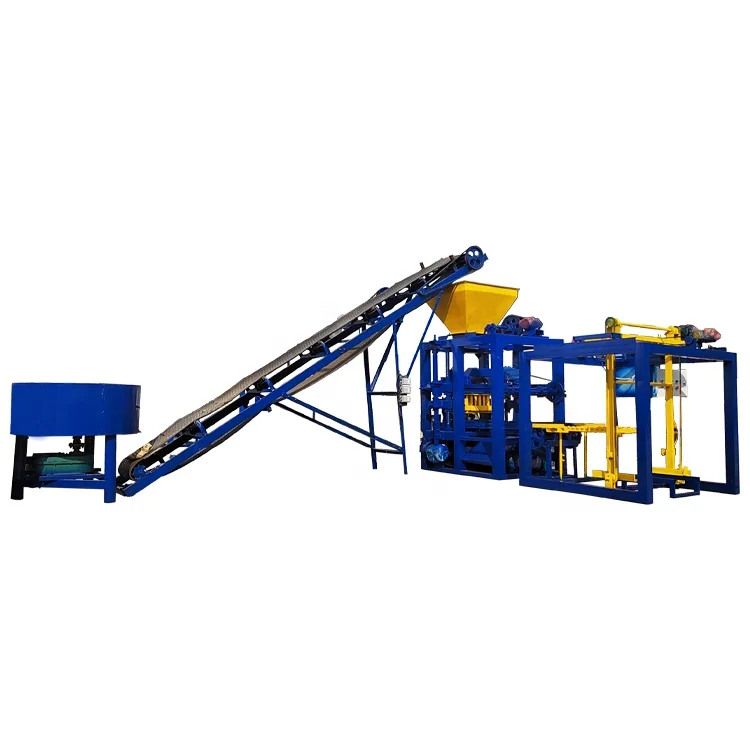
 High quality block machine