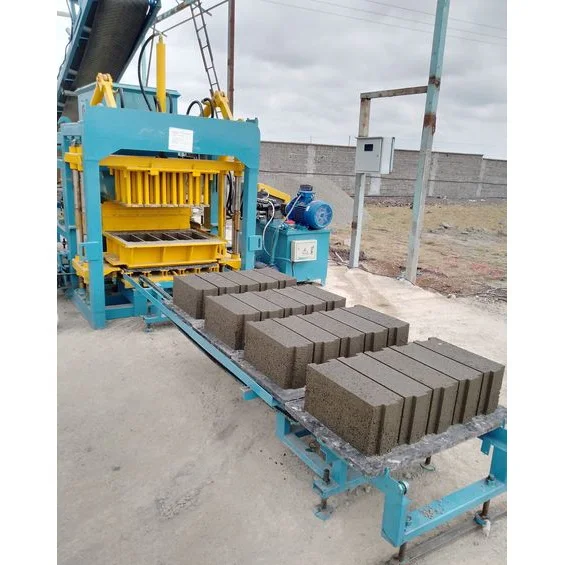
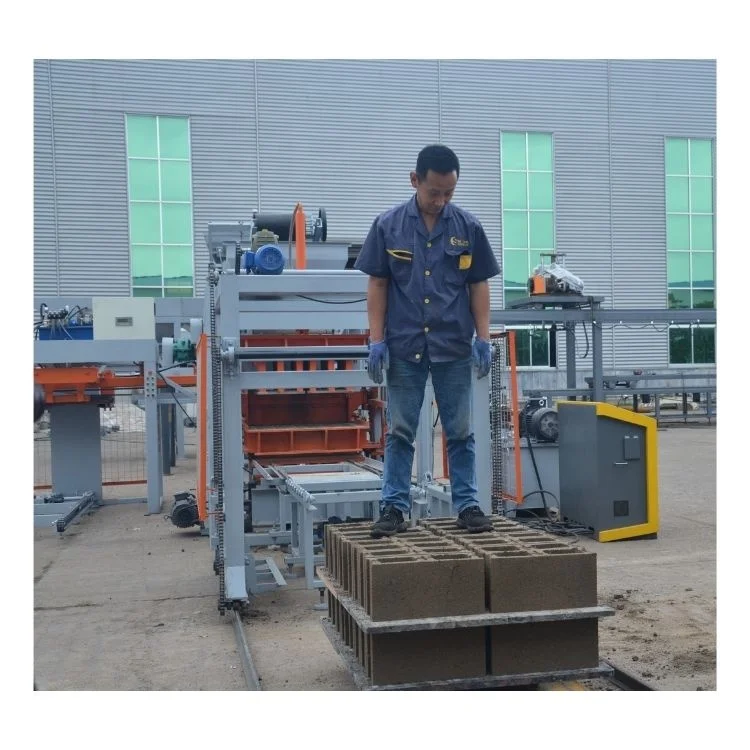
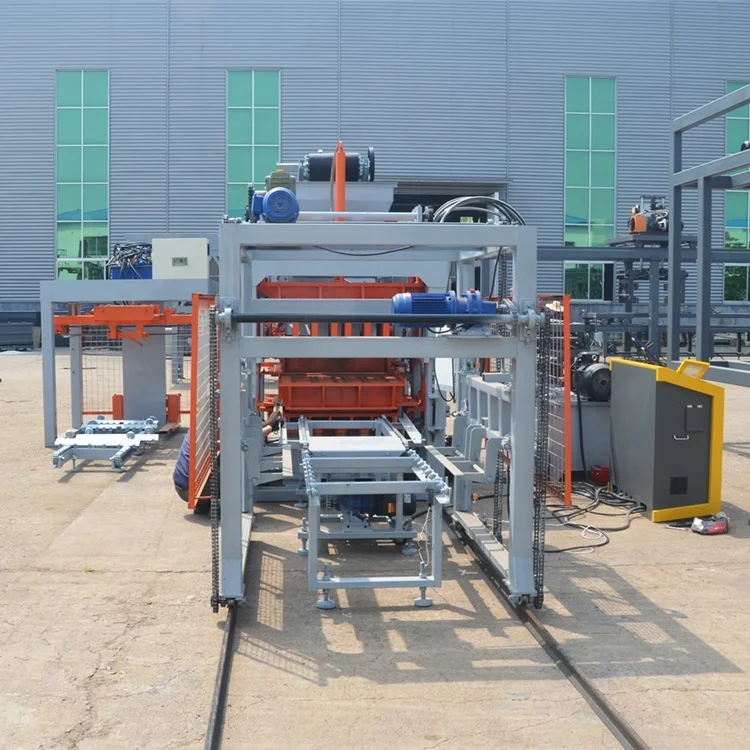
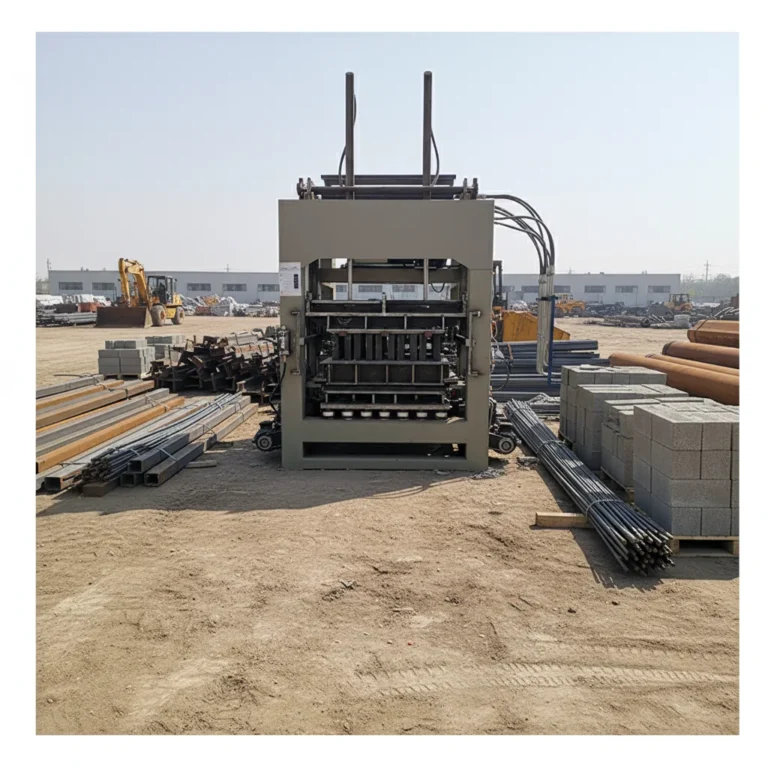
Mid-Range Automated Pressing — The QT6-15 occupies the mid-tier of the Shiyue block machine range, covering hollow blocks, solid bricks, and pavers within a single plant footprint rather than requiring separate dedicated lines.
Technical Specifications
| Parameter |
Value |
| Model |
QT6-15 |
| Product Type |
Automatic Hydraulic Block Making Machine |
| Overall Dimensions (L×W×H) |
8200 × 1700 × 2950 mm |
| Total Mass |
7 T |
| Overall Power |
37 kW |
| Vibration Form |
Platform Vibration |
| Vibration Frequency |
0–60 Hz |
| Vibration Force |
45 kN |
| Moulding Mode |
Automatic loading, vibration moulding |
| Demolding Method |
Hydraulic |
| Molding Cycle |
15–20 s (basis to be confirmed per block format) |
| Pallet Size |
880 × 850 mm |
| Control System |
PLC with touch screen and built-in fault diagnosis |
| Compressive Strength of Blocks |
>15 MPa |
| Factory Area Required |
1200 m² |
| Hydraulic System |
Independent integrated station, isolated from dust and main vibration |
| Output Capacity (400×200×200 mm hollow block) |
6 pcs/mould, 8,640–11,520 pcs / 8 hr shift |
| Output Capacity (400×150×200 mm hollow block) |
8 pcs/mould, 11,520–15,360 pcs / 8 hr shift |
| Output Capacity (240×115×53 mm solid brick) |
32 pcs/mould, 46,080–61,440 pcs / 8 hr shift |
| Output Capacity (200×100×60 mm rectangular paver) |
21 pcs/mould, 17,280–23,040 pcs / 8 hr shift (cycle 20–25 s) |
| Output Capacity (225×112.5×60 mm zigzag paver) |
15 pcs/mould, 17,280–23,040 pcs / 8 hr shift (cycle 20–25 s) |
| Raw Material Adaptability |
Waste ash, slag, cement-reduced mixes, bearing and non-bearing blocks |
| Voltage & Frequency |
Configurable to site requirement (basis to be confirmed at order) |
| PLC Display Language |
Configurable at order |
Application Suitability
| Application |
Material or Output |
| Hollow block production for load-bearing and partition walls |
Crushed stone, sand, cement, waste ash mixes at compressive strength >15 MPa |
| Solid brick manufacturing for masonry and infill |
Local aggregate and cement blends, 240×115×53 mm format |
| Rectangular paving blocks for driveways and walkways |
High-density aggregate and cement, 200×100×60 mm |
| Interlocking and zigzag pavers for commercial landscaping |
Cement-reduced mix designs, 225×112.5×60 mm |
| On-site production for housing development contractors |
Mixed-format output from a single 1200 m² plant footprint |
Why Catalogue Output Figures Mislead Block Plant Buyers
Every capacity number published for the QT6-15 automatic block making machine is tied to a specific block format and cycle time, so daily shift planning starts from a verified baseline instead of a brochure peak.
Capacity without a format assumption is a number without meaning.
Many quotations list a single hourly figure derived from the fastest possible cycle on a lightweight hollow block. When the buyer’s actual market demands solid bricks or dense interlocking pavers, the vibration and pressing stages must run longer, and the moulding cycle stretches from 15 seconds toward 25 seconds or beyond. Daily output then falls well short of the quoted number, and the buyer is left reconciling a shortfall that was never disclosed before shipment. [NEED_CITE: block machine output calculation standards by format]

Positioning the QT6-15 Across the Shiyue Output Tiers
The QT6-15 sits between the entry-level semi-automatic machines and the high-capacity fully automatic lines in the Shiyue range. Buyers moving from manual pallet handling or egg-laying mobile units find this tier covers the jump to PLC-controlled vibration pressing without requiring the infrastructure of a large-scale plant. The 1200 m² factory area requirement keeps the initial site investment contained while still allowing room for curing racks and pallet circulation.
Matching the Automation Level to Your Plant Trajectory
Automation on this tier covers automatic raw material feeding, PLC-controlled moulding cycles, and hydraulic demolding, leaving pallet return and stacking as configurable additions. A buyer planning to start with manual pallet handling can later add automatic stacking and cubing as demand grows. This selectable automation path means the QT6-15 block machine manufacturer specification does not lock a first-time plant owner into infrastructure they are not yet ready to staff or maintain. [NEED_CITE: automation upgrade paths in block production]
How Hydraulic Pressure and Vibration Determine Block Density
The 45 kN vibration force and independent hydraulic station work together during the moulding cycle: platform vibration at up to 60 Hz settles the aggregate into the mould cavity, while hydraulic pressure compresses the mix from above to drive out air and lock particle-to-particle contact. This combination produces compressive strength above 15 MPa, which is the threshold most building codes require for load-bearing hollow blocks. Because the hydraulic station is isolated from dust and main machine vibration, pressure consistency holds across long shifts without the seal wear that degrades density over time. The 880 × 850 mm pallet size must match the curing rack dimensions and forklift capacity already on site, otherwise cured blocks cannot move to the yard without manual re-stacking.
The Cost of Specifying Without Local Aggregate Data
When a machine is configured for a standard sand-and-cement mix but the buyer’s local source is laterite or high-clay river gravel, vibration time must increase to achieve target density, and the quoted cycle no longer applies. In West African projects where red soil clay content runs high, moulding cycles have doubled on machines that were sized to catalogue figures, cutting realistic daily output in half before the buyer understood why. Voltage mismatches compound the problem: a PLC and hydraulic pump specified for 380 V / 50 Hz will not commission correctly on a 415 V / 60 Hz site, and the resulting motor damage may not surface until weeks into production. [NEED_CITE: voltage and frequency standards by export market]
What the Shiyue Single-Focus Approach Means for This Machine
Block machinery is the sole product line, so the QT6-15 press, mould, pallet, and handling equipment are specified as one matched system rather than assembled from unrelated suppliers. Mould design covers the formats the buyer’s local market actually sells, including custom drawings when a project requires non-standard dimensions. Configuration starts from the buyer’s actual mix design and target block format, not a default catalogue page, which is why every capacity figure in the specification table carries its format assumption. Installation and commissioning include operator training on mould change procedures and PLC fault diagnosis, so the local crew can handle first-line troubleshooting without waiting for remote support.
Documentation & Verification
- Line layout and capacity calculation stating the block format assumed for each output tier
- Machine specification sheet covering pallet size, vibration ratings, and hydraulic pressure
- Mould drawing and format list matching the buyer’s target market products
- Voltage, frequency, and PLC display language confirmation recorded before production begins
- Factory test record on the buyer’s specified block format before dispatch
Installation, Commissioning & Support
- 1200 m² factory area with level concrete slab to support the 7 T machine mass and pallet circulation
- Dedicated power circuit sized for the 37 kW overall load at the confirmed local voltage and frequency
- Machine ships in dismantled sections for container loading; reassembly sequence provided in the operation manual
- PLC touch screen commissioning includes language setting, fault diagnosis calibration, and action interlock verification
- Operator training covers mould change, hydraulic pressure adjustment, and vibration frequency tuning per format
- Wear parts and mould spares list provided so first replacements are identified before the machine leaves the factory
Preparing Your Inquiry
A complete specification for the QT6-15 automatic block making machine starts with the block formats your local market sells, the daily output target per format, and the raw materials available within hauling distance of your plant. Include your site voltage and frequency, preferred PLC display language, and the pallet size that fits your existing curing racks and forklift. With these details confirmed, the configuration proposal can carry verified capacity figures instead of generic estimates.
Frequently Asked Questions
Q: How is the output capacity of the QT6-15 verified for each block format?
A: Every output figure in the specification table is calculated from the mould cavity count and the moulding cycle range for that specific format. Hollow blocks at 400×200×200 mm run a shorter cycle than dense pavers, so the 8-hour shift total differs accordingly. Buyers receive a line layout document that states the assumed format alongside each capacity number.
Q: What voltage and PLC language options are available before shipment?
A: Voltage and frequency are configured to match the buyer’s site power supply, and the PLC touch screen language is set during factory testing. Both parameters must be confirmed at the order stage so the electrical system and control documentation are correct when the machine arrives, avoiding commissioning delays.
Q: Where does the QT6-15 sit compared to other machines in the Shiyue range?
A: It occupies the mid-tier, above semi-automatic and mobile egg-laying models and below the highest-capacity automatic lines. This positions it for buyers stepping up from manual operations who need PLC-controlled pressing and multiple format capability without the site infrastructure a high-capacity line demands.
Q: What plant preparations are needed before the QT6-15 arrives?
A: The buyer should prepare a level foundation within a 1200 m² area, a dedicated power circuit for the 37 kW load at the confirmed voltage, and curing rack space matched to the 880×850 mm pallet size. Forklift capacity should be checked against loaded pallet weight to ensure smooth transfer from press to curing zone.
Q: How long does a mould change take, and what formats can the QT6-15 produce?
A: The press handles hollow blocks, solid bricks, rectangular pavers, and interlocking zigzag pavers through mould swaps. Mould change procedure and estimated time are covered in the operation manual and during on-site operator training, so the crew can switch formats without extended downtime.

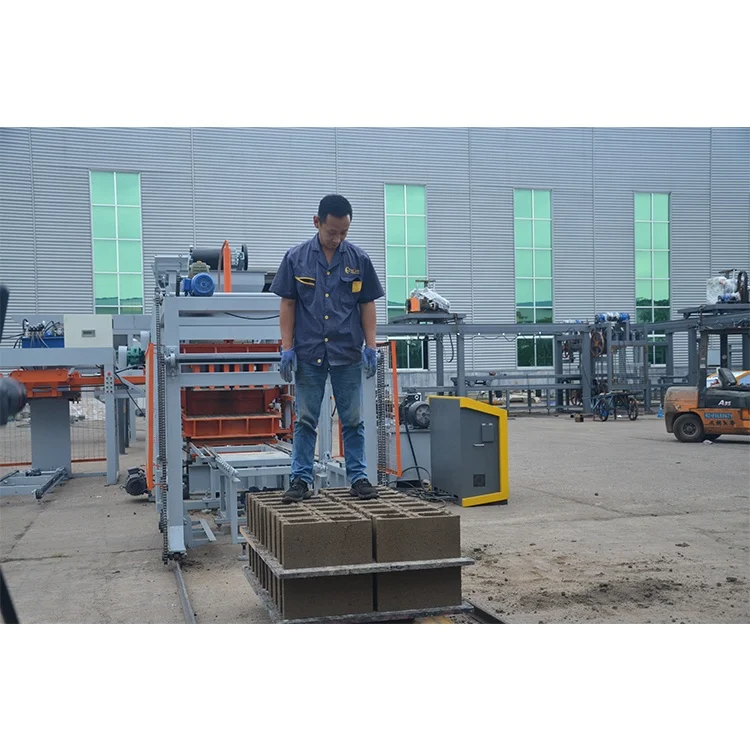
 High quality block machine