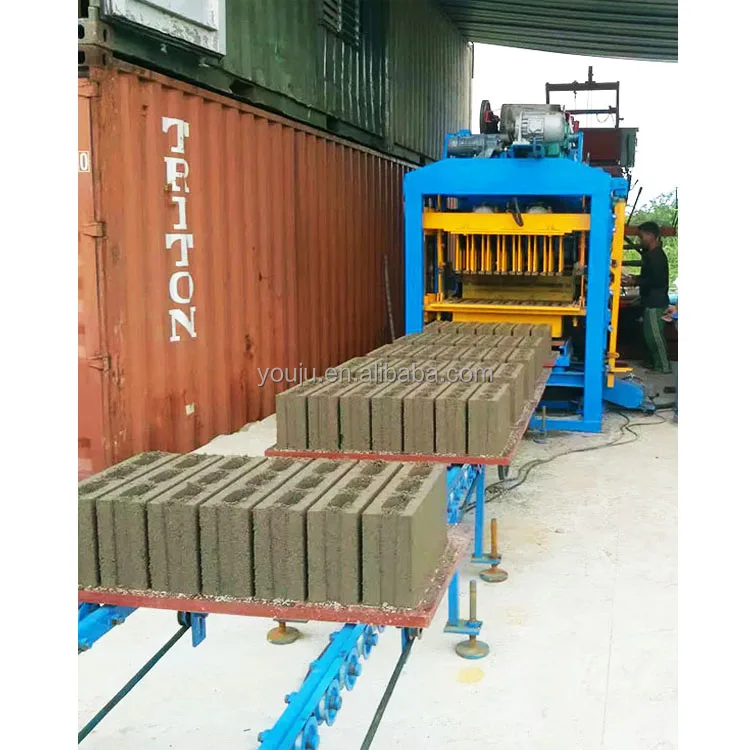
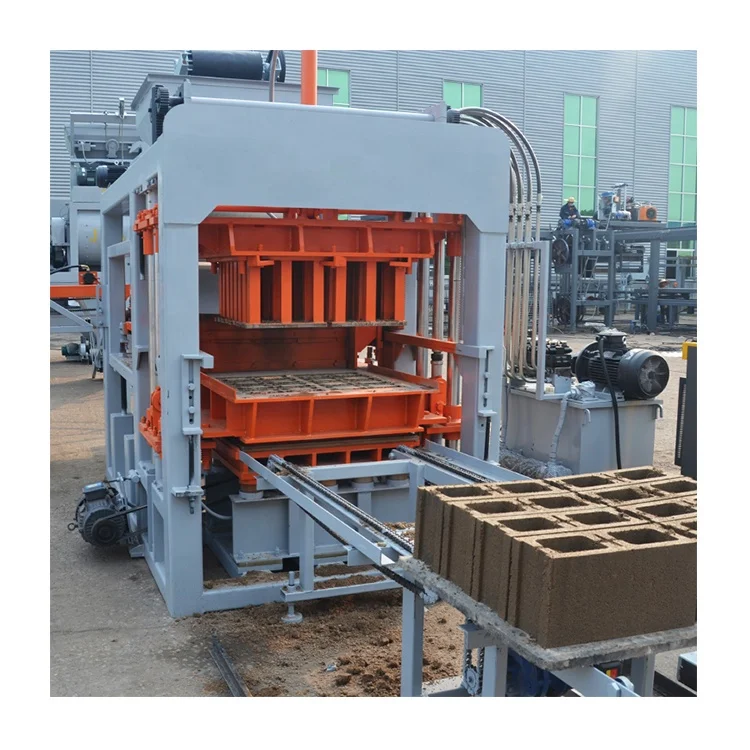
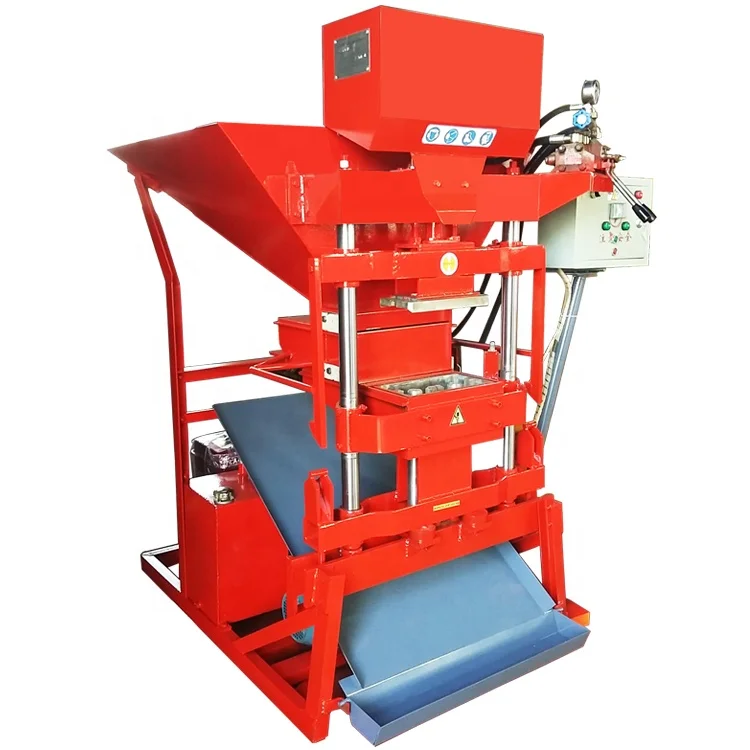
Matched System Design — Every QT4-16 configuration ships with mould, pallet, and handling equipment specified together, so the press never waits on upstream or downstream stations.
Technical Specifications
| Parameter |
Value |
| Model |
QT4-16 |
| Product Type |
Hydraulic Concrete Block Making Machine |
| Overall Dimensions (L×W×H) |
7400×1950×2800 mm |
| Total Mass |
5 T |
| Rated Pressure |
21 MPa |
| Main Vibration Form |
Platform Vibration |
| Vibration Frequency |
2800-4500 r/min |
| Vibration Force |
40 kN |
| Pallet Size |
900×550 mm |
| Molding Cycle |
15-20 s (basis not stated in source — confirm block format / material / thickness) |
| Demolding Method |
Hydraulic |
| Machine Frame Material |
Manganese steel (China national standard) |
| Control System |
PLC intelligent control with man-machine interface, fault diagnosis system, remote control function |
| Automation Level |
Configurable from semi-automatic to full automatic |
| Applied Products |
Hollow blocks, solid blocks, pavers, interlocking blocks, kerbstone, colored pavers |
| Raw Materials |
Crushed stone, sand, cement, fly ash, gravel, slag |
Application Suitability
| Application |
Material or Output |
| Hollow block production for residential and commercial wall systems |
Crushed stone, sand, cement, fly ash blends |
| Solid dense block manufacturing for load-bearing structures |
Gravel, sand, cement with high aggregate content |
| Interlocking paver and colored paver runs for walkways and driveways |
Fine sand, cement, pigment additives |
| Kerbstone and boundary wall block production for site contractors |
Coarse aggregate, slag, cement mixes |
| On-site block production for housing and development projects |
Locally sourced sand, gravel, and cement |
Why "Cycles per Hour" Does Not Tell You Daily Output
Real capacity is measured in finished blocks per format, not raw press cycles.
When buyers compare machines on cycle time alone, they assume every second produces a saleable unit. In practice, the QT4-16 block making machine manufacturer quoting 15–20 seconds per cycle may be referencing a specific block height and mix that does not match your local aggregate. A taller hollow block requires longer vibration, a fly-ash-heavy mix demands different pressure hold times, and pallet transfer adds seconds that catalogue figures omit [NEED_CITE: capacity calculation methods in concrete block production]. Without a format-by-format breakdown, daily output estimates become unreliable.

Placing the QT4-16 Within the Complete Machine Range
The QT4-16 occupies the mid-tier of our block machine lineup. Below it, smaller workshop machines serve entrepreneurs producing a single block format at lower daily volumes. Above it, high-capacity automatic lines run continuous shifts with full cubing and stacking. The QT4-16 block making machine manufacturer configuration bridges these tiers — it handles multiple mould formats on a 900×550 mm pallet and can be specified from semi-automatic pallet handling through to fully automatic stacking, letting buyers scale investment to their current market demand.
Automation Tiers and What Each Removes from the Operator
A semi-automatic QT4-16 requires manual pallet insertion and block removal, keeping initial capital low while demanding more floor labor. Moving to automatic pallet feeding eliminates the heaviest manual task and reduces cycle variation between operators. Full automation adds stacking and cubing, so finished blocks leave the press area in transport-ready packs [NEED_CITE: labor allocation across automation levels in block plants]. The QT4-16 control system supports remote diagnostics, meaning automation faults can be addressed without waiting for an on-site visit — a practical advantage when the plant is in a remote project location.
How Pressure, Vibration, and Frame Mass Interact at the Press
The 21 MPa rated hydraulic pressure and 40 kN platform vibration work together to compact the mix into the mould cavity. Pressure alone cannot consolidate a stiff, low-slump mix; vibration alone cannot hold the block shape during demolding. The adjustable vibration frequency range of 2800–4500 r/min allows the operator to tune compaction to the block format — finer pavers benefit from higher frequency, while tall hollow blocks need sustained lower-frequency vibration to fill deep cavities. The manganese steel frame, built to China national standard, provides the mass required to absorb these forces without transmitting resonance into the foundation, which preserves mould alignment over years of production cycles. The 5 T total mass is a deliberate design choice — lighter frames of comparable footprint tend to develop fatigue cracks at the vibration mounting points within the first year of heavy use.
The Hidden Cost of Mismatched Pallet and Curing Layout
Selecting a pallet size without checking your existing curing racks and forklift capacity creates a bottleneck that no press upgrade can solve. The QT4-16 runs on 900×550 mm pallets, which must match the shelf spacing in your curing area and the fork width of your handling equipment. Buyers who overlook this end up stacking cured blocks by hand or purchasing an entirely new rack system after the machine arrives. Pallet material also matters — bamboo pallets flex under heavy hollow blocks and produce uneven base surfaces, while steel pallets last longer but add weight that manual handlers struggle with across a full shift [NEED_CITE: pallet material selection for concrete block curing].
Why Buyers Source This Machine Tier Here
Block machinery is our single focus, so the QT4-16 is never sold as a standalone press — it arrives as a matched system with mould, pallet, and handling specified to your product range. We set the vibration force and hydraulic pressure against your actual mix design and local aggregate, not a catalogue default. Moulds are designed for the formats your market sells, including custom drawings when standard options do not cover your requirements. The automation level is selectable, so a buyer can start with semi-automatic pallet handling and upgrade to full stacking later without replacing the press. Installation includes operator training on the PLC interface and fault diagnosis system, reducing the learning curve at first startup.
Documentation & Verification
- Line layout with capacity calculation stated per block format, not as a single cycle figure
- Machine specification sheet confirming pallet size, vibration force, and hydraulic pressure against your mix
- Mould drawing and format list covering every block type in your product range
- Voltage, frequency, and PLC display language confirmation document signed before production
- Factory test record on your specified block format before dispatch
- Wear parts and mould replacement list with part numbers for reordering
Installation, Commissioning & Support
- Foundation plan accounts for the 7400×1950 mm footprint and 5 T operating mass with vibration isolation
- Electrical supply matched to confirmed voltage and frequency with dedicated circuit for the 21 MPa hydraulic pump
- Machine shipped in dismantled state with reassembly sequence documented for site crew
- First-run commissioning includes PLC parameter tuning for your block format and molding cycle
- Operator training covers man-machine interface navigation and fault diagnosis response
- Wear parts inventory established for hydraulic seals and vibration motor bearings at startup
What We Need to Size Your Configuration
To move from general inquiry to a firm proposal, we need your target block formats with dimensions, the daily output you expect per format, and the raw materials available at your site including aggregate type and any fly ash or slag content. Confirm your local voltage and frequency, preferred PLC display language, and whether your curing area uses racks or floor curing. If you have existing forklifts or pallet racks, share their specifications so the 900×550 mm pallet system integrates without modification.
Frequently Asked Questions
Q: What output tiers does the QT4-16 cover, and where does it sit compared to smaller or larger models?
A: The QT4-16 sits in the mid-range of our block machine lineup. Below it, smaller machines handle single-format, low-volume workshop production. Above it, high-capacity lines run multi-shift automatic operations. The QT4-16 bridges these tiers by supporting multiple mould formats on a single pallet size and offering selectable automation from semi-automatic to full automatic configuration.
Q: How is realistic daily capacity calculated per block format rather than quoted as a single cycle figure?
A: We calculate capacity by taking the molding cycle for each specific block format — accounting for height, mix density, and vibration time — then multiplying by the number of cavities per mould and effective working hours. This gives a format-by-format daily output that reflects what your plant will actually produce, not a theoretical maximum based on the shortest possible cycle.
Q: Can I start with semi-automatic configuration and upgrade to full automation later?
A: Yes. The QT4-16 platform supports a phased automation path. You can begin with semi-automatic pallet handling and manual stacking to reduce initial investment, then add automatic pallet feeding, stacking, and cubing modules as production volume grows. The PLC control system and machine frame remain the same throughout the upgrade.
Q: What plant footprint and curing area does the QT4-16 require at each automation level?
A: The press itself occupies a 7400×1950 mm footprint, with additional space needed for raw material feeding, pallet return, and block stacking. Semi-automatic configurations require roughly 600 m² of total factory area including curing space. Full automatic lines with stacking and cubing need additional floor area for the cubing station and transport lanes, which we detail in the line layout document.
Q: Which block formats and mould options are available for this machine tier?
A: The QT4-16 supports hollow blocks, solid blocks, paving blocks, interlocking blocks, kerbstones, and colored pavers. Moulds are designed to fit the 900×550 mm pallet and can be customized to buyer drawings when standard format options do not match local market requirements. Mould change uses the hydraulic demolding system for alignment.

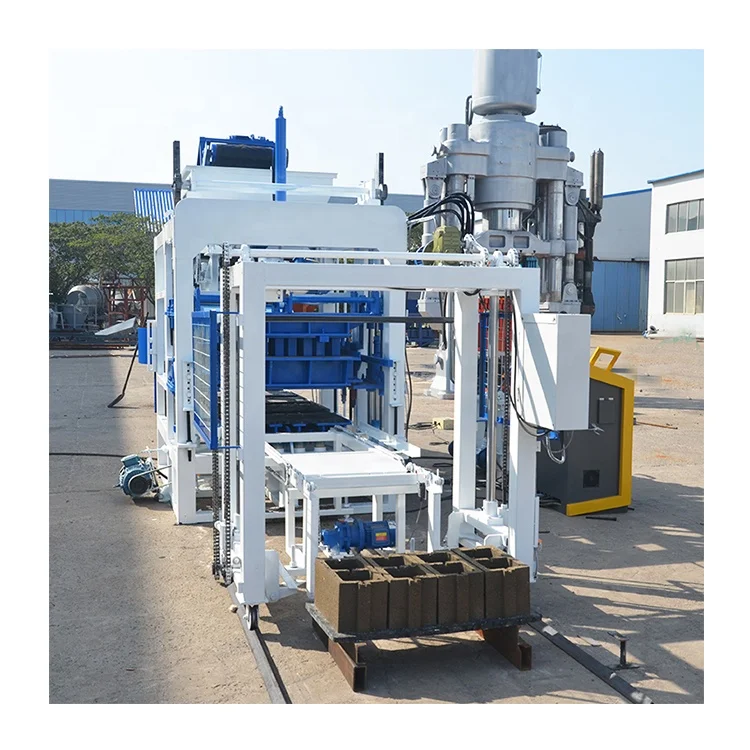
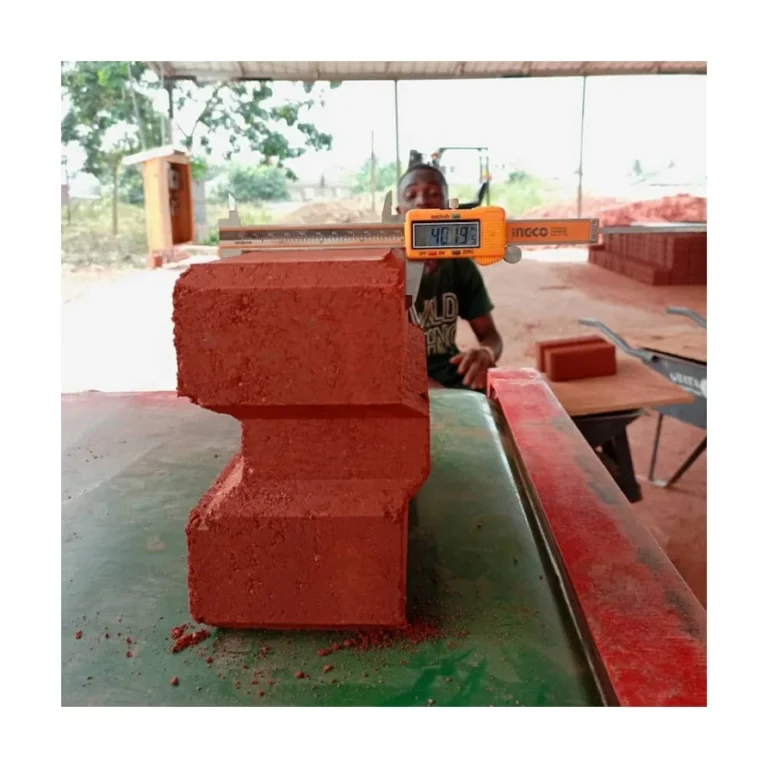 Semi automatic block