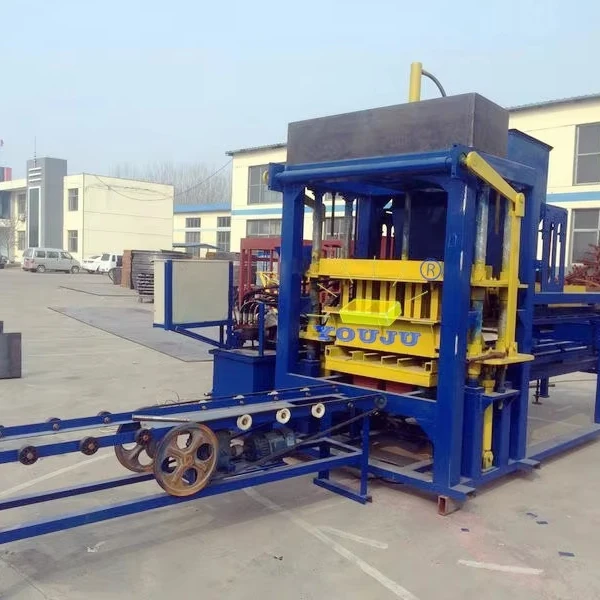
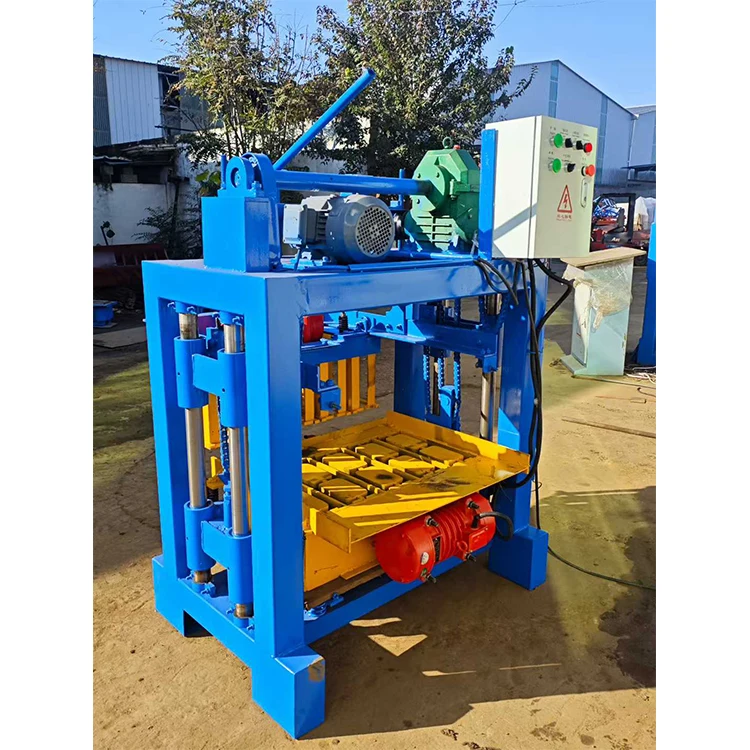
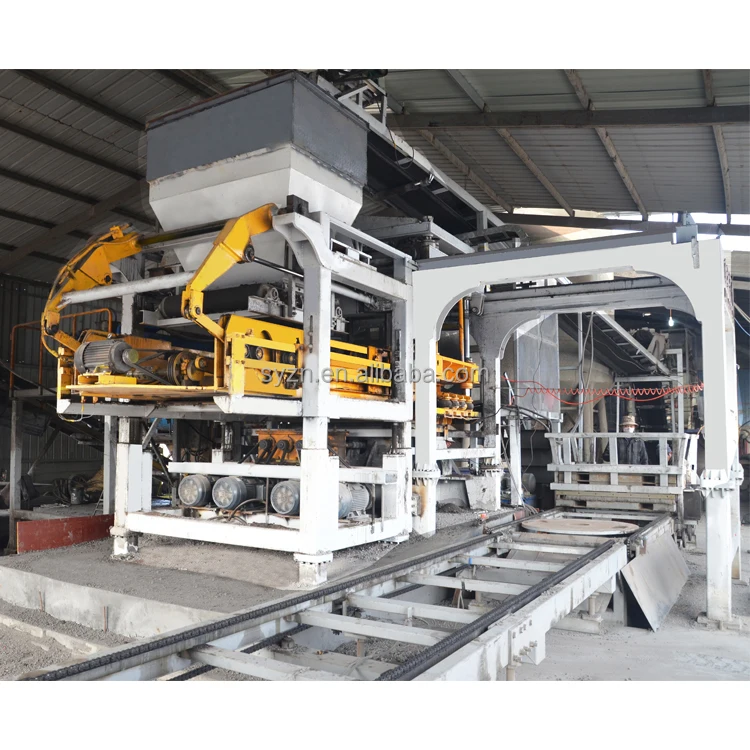
Specified to Your Mix Design — Every QT4-15 configuration is validated against the buyer’s actual aggregate, cement ratio, and target block format before the vibration table is tuned, preventing the capacity shortfall that occurs when a catalogue default meets local material.
Technical Specifications
| Parameter |
Value |
| Model |
QT4-15 |
| Product Type |
Automatic Concrete Block Making Machine |
| Rated Power |
27.5 kW |
| Voltage |
380V (frequency configurable to target market) |
| Control System |
PLC with computer-controlled directional vibration |
| Overall Dimensions (L×W×H) |
7100 × 1600 × 2610 mm |
| Net Weight |
5 T |
| Vibration Force |
40 kN |
| Pallet Size |
1020 × 570 mm |
| Moulding Cycle |
15 s (basis not stated in source — confirm block format and material) |
| Mixer Model |
JS500 |
| Water Consumption |
4 T per day |
| Workers Required |
3–4 |
| Workshop Area |
150 m² |
| Motor Brand |
Siemens |
| Vibration Method |
Table and mould vibrating together; low-frequency feeding, high-frequency vibrating |
| Feeding System |
Hopper with swing-type cutting device |
| Material Level Control |
Photoelectric sensor |
| Automation Level |
Automatic |
Application Suitability
| Application |
Material or Output |
| Hollow block production |
Crushed stone, cement, and sand aggregate mixes |
| Solid block manufacturing |
Dense concrete mixes requiring high compaction |
| Paving block production |
High-strength surface mixes with pigment additives |
| Interlocking brick forming |
Dry-consistency concrete with interlocking profile moulds |
| On-site contractor production |
Locally sourced aggregate at remote construction locations |
Why "15 Seconds per Cycle" Does Not Tell You the Daily Output
A cycle time only becomes a reliable output figure when the block format, mix consistency, and pallet return speed are all defined.
I have watched buyers sign for an automatic concrete block making machine for sale based on a cycles-per-hour number, then discover on commissioning day that their chosen hollow block format needs a longer vibration hold, or that their pallet return conveyor cannot keep pace with the press. The QT4-15 is rated at a 15-second moulding cycle, but that figure must be validated against the specific block you intend to produce [NEED_CITE: cycle time versus block format and mix design]. Without that validation, the real daily throughput can fall noticeably below expectation, and the buyer is left adjusting parameters on the shop floor instead of running production.

Placing the QT4-15 on the Stationary Machine Range
The QT4-15 occupies the mid-tier of our stationary automatic block machine lineup. Below it sit semi-automatic models that require manual pallet handling and lower capital outlay; above it, higher-capacity lines with fully automatic stacking and cubing systems that serve large-scale plants. For a buyer moving up from a mobile egg-layer or a workshop-scale press, this automatic concrete block making machine for sale provides a fully automated moulding cycle without the footprint and infrastructure demands of a high-output line.
How the Range Connects to Your Plant Layout
A stationary machine does not operate in isolation. The JS500 mixer, raw material feed hopper, pallet feeding system, and downstream curing rack handling must all match the press cycle so the machine is never left waiting for material or an empty pallet. When specifying the QT4-15, we map each supporting station to the press timing, confirming that the 150 m² workshop area accommodates the full line layout [NEED_CITE: block plant line layout and station synchronization]. This is where buyers surveying the range for the first time often need the most guidance — matching investment tier to realistic daily workflow.
Vibration, Pressure, and Pallet Size Decoded
The 40 kN vibration force works in combination with hydraulic pressure to compact concrete into the mould cavity. The low-frequency feeding phase distributes material evenly, then the high-frequency vibrating phase liquefies the mix within seconds, producing consistent block density across the pallet. The 1020 × 570 mm pallet size directly determines how many blocks are formed per cycle and must align with the curing racks and forklifts already in the buyer’s yard. The Siemens motor driving the vibration table is selected for continuous-duty thermal capacity, reducing the risk of overheating during extended production runs compared to generic motors of equivalent power rating.
The Cost of Configuring Without Your Local Aggregate
When a block machine is configured for a standard quartz-sand mix but the buyer’s local supply is volcanic aggregate or recycled crushed concrete, the vibration parameters will not transfer directly. The result is inconsistent block strength, extended cycle times, and a higher rejection rate on the curing rack [NEED_CITE: effect of aggregate type on block vibration parameters]. I saw this firsthand in Honduras, where a machine tuned for standard aggregate lost nearly half its expected daily output when switched to local volcanic stone — it took days of parameter adjustment on site to recover. Specifying the QT4-15 against the buyer’s actual mix design before factory testing eliminates this risk entirely.
Why Buyers Source This Range Through Us
Block machinery is our single focus, so the QT4-15 is specified as one matched system — press, mould, pallet, and handling — rather than assembled from separate suppliers. We set every configuration against the buyer’s target block format and local aggregate, not a catalogue default. Mould design covers the formats the buyer’s market actually sells, including custom drawings when a standard mould does not fit. The automation level is selectable within the range, so a buyer can begin with the QT4-15 and move to higher-tier automatic stacking as demand grows. Installation support includes on-site commissioning and operator training so the crew understands parameter adjustment from day one.
Documentation & Verification
- Line layout drawing with capacity calculation stating the assumed block format for the QT4-15 cycle time
- Machine specification sheet confirming pallet size, vibration force, and motor rating matched to your target block
- Voltage, frequency, and PLC display language confirmation document signed off before production begins
- Factory test record with photographs showing the QT4-15 running your specified mould and mix
- Hydraulic and electrical schematic package for local maintenance team reference
- Packing photographs and customs documentation support for export clearance
Installation, Commissioning & Support
- Foundation must support the 5 T net weight and dynamic vibration loads across the 7100 × 1600 mm footprint
- Dedicated 380V circuit with confirmed frequency and correct phase rotation for the 27.5 kW rated power
- Machine arrives with vibration table, hopper, and PLC cabinet as separate assemblies requiring on-site alignment
- First-run commissioning includes vibration parameter tuning against your local aggregate and mix design
- Operator training covers PLC navigation, mould change procedure, and photoelectric sensor calibration
- Wear parts list and mould maintenance schedule provided with recommended replacement intervals
Before You Request a Quote
Tell us the block formats your market sells, the daily output you need, and the local aggregate you will use. We also need your workshop dimensions, available voltage and frequency, and whether you plan to handle pallets manually or add automatic stacking later. With that information, we can position the QT4-15 accurately within the range and provide a capacity calculation tied to your actual product.
Frequently Asked Questions
Q: What block format does the quoted moulding cycle assume, and how do I verify real daily output?
A: The 15-second cycle must be confirmed against your specific block format, wall thickness, and mix design. We provide a capacity calculation that states the assumed format and shows realistic daily output based on your working hours and pallet return speed, so you can compare the QT4-15 against other tiers in the range with a clear, format-specific figure.
Q: Where does the QT4-15 sit compared to semi-automatic and higher-tier automatic models?
A: It is a mid-tier stationary automatic machine. Semi-automatic models below it require manual pallet handling and suit lower investment levels. Higher-tier models above it add automatic stacking, cubing, and larger pallet sizes for high-capacity plants. The QT4-15 bridges the gap for buyers who want a full automatic cycle without a large-line footprint.
Q: What voltage and frequency configurations are available for my target market?
A: The standard configuration is 380V, but frequency and voltage must be confirmed for your local grid before production starts. We document the agreed electrical specification and PLC display language in writing so the QT4-15 arrives ready for connection and commissioning without electrical modification on site.
Q: How much workshop area and how many workers does the QT4-15 require?
A: The QT4-15 requires approximately 150 m² of workshop area including mixer placement and pallet circulation space. A crew of three to four workers covers material feeding supervision, PLC operation, and pallet handling at the output end, depending on the level of downstream automation you choose from the range.
Q: Can I start with the QT4-15 and upgrade automation or capacity later within the same machine family?
A: The stationary range is structured so buyers can begin at the QT4-15 tier and add automatic stacking, cubing, or a higher-capacity press later. Mould formats and pallet sizes within the family are designed to carry forward, protecting your initial tooling investment as production volume grows.

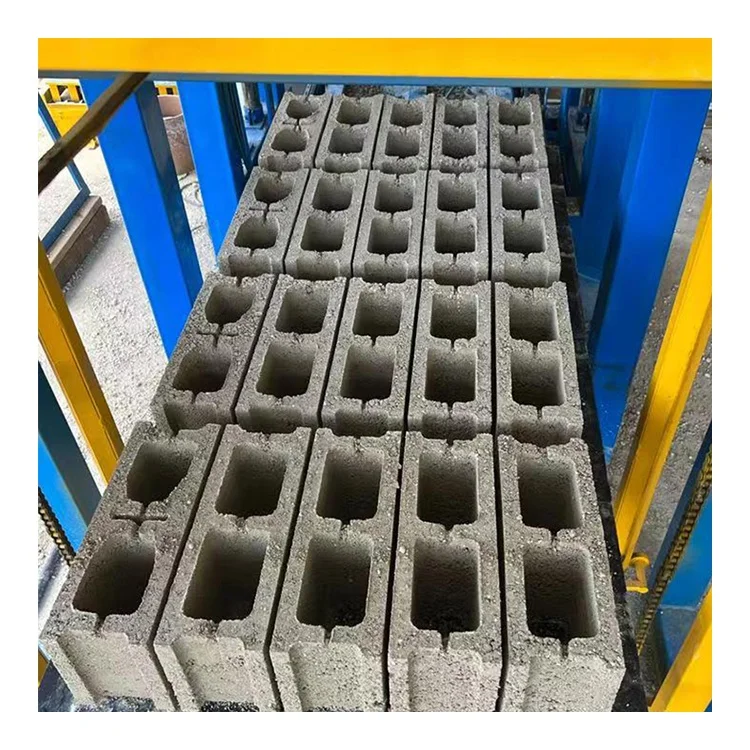
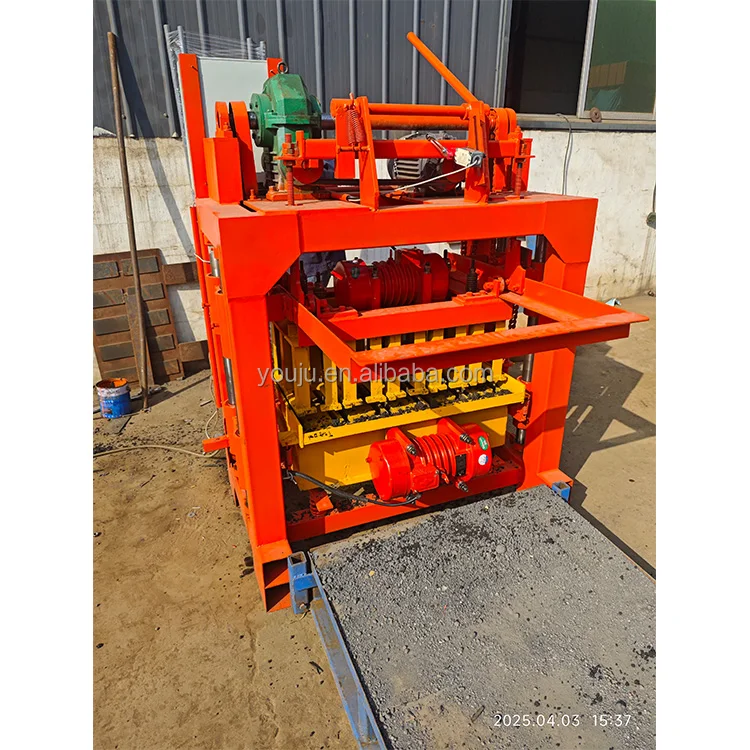 Stationary block machine