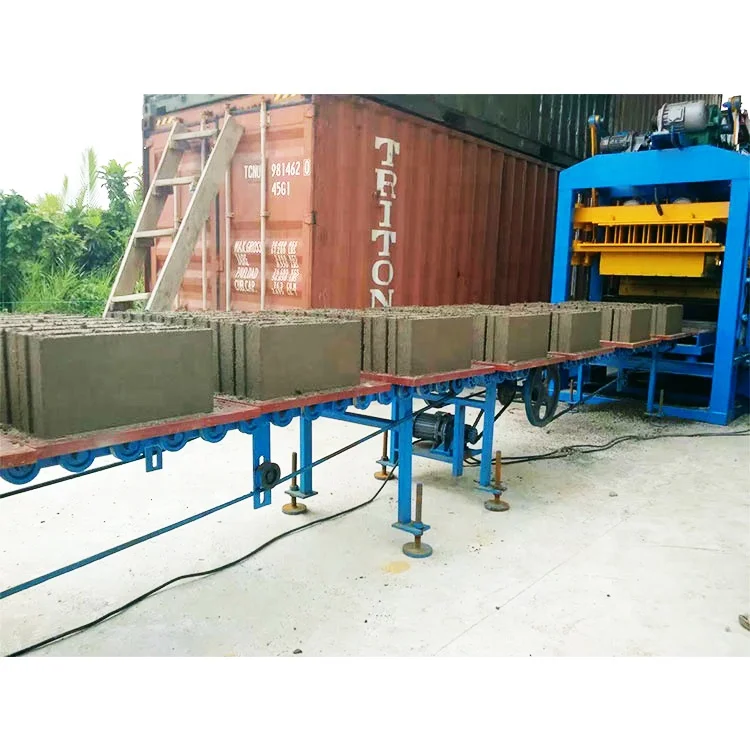
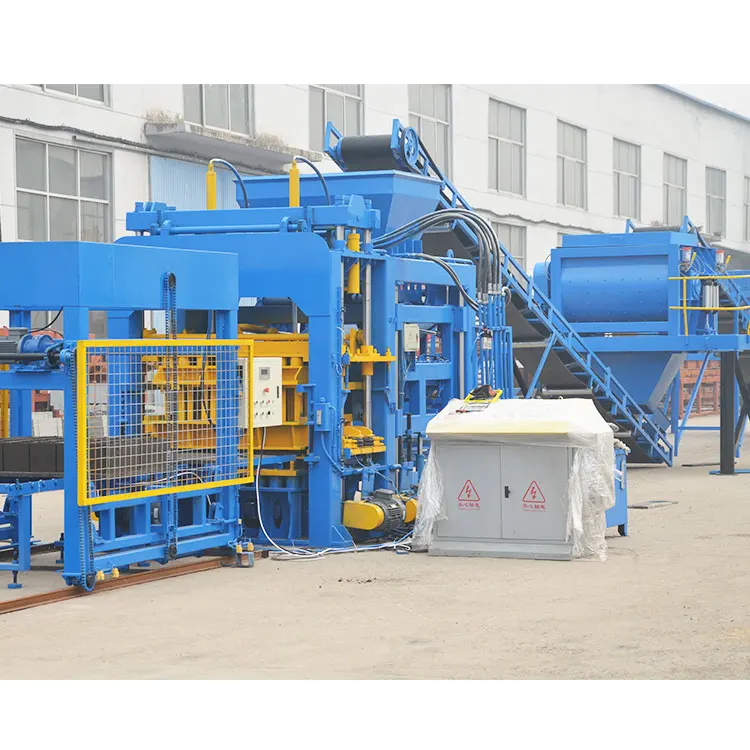
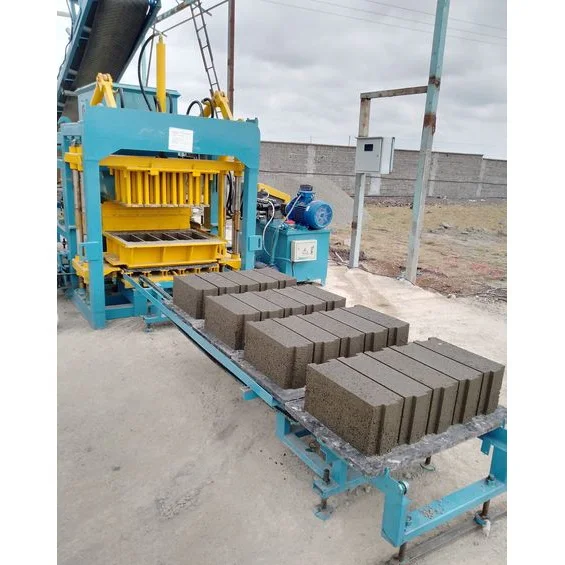
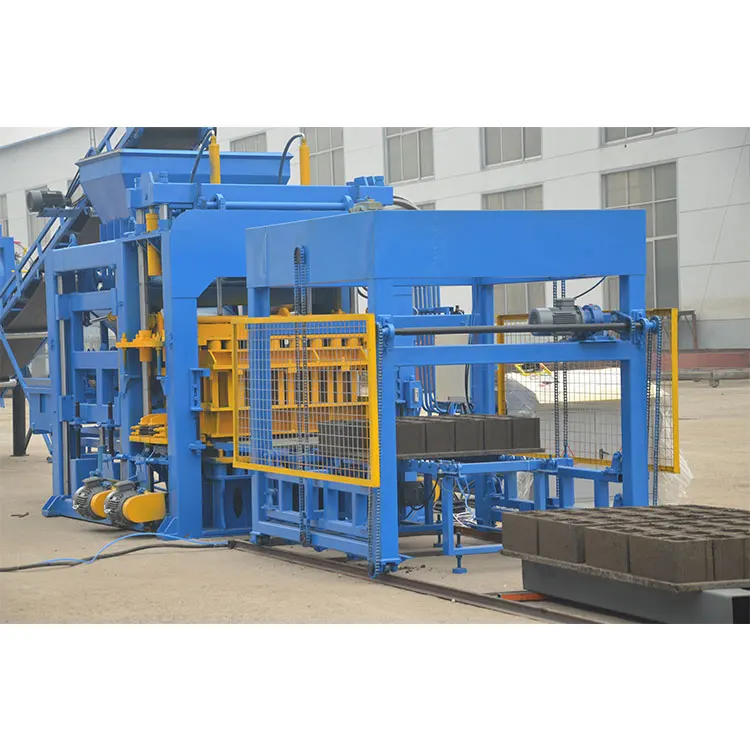
Complete Range Alignment — the QT12-15 anchors the top tier of a fully automatic stationary lineup, specified as one matched system from press through pallet handling rather than pieced together from separate suppliers.
Technical Specifications
| Parameter |
Value |
| Model |
QT12-15 |
| Product Type |
Stationary Automatic Concrete Block Making Machine |
| Control System |
PLC aptitude control with human-machine interface dialogue system |
| Vibration System |
Vertically synchronous vibration, frequency conversion and braking, double vibration sources |
| Hydraulic System |
Computer-controlled flow and pressure |
| Feeding System |
Semi-closed screen reticular rotational forced feeding unit |
| Structure |
Super-strong steel frame with imported original components |
| Hydraulic Loading Unit |
Fitted for continuous automatic mass production |
| Automation Level |
Fully automatic with hydraulic loading unit |
| Molding Cycle (Hollow block & Solid brick) |
15–20 seconds |
| Molding Cycle (Rectangular & Zigzag brick) |
20–25 seconds |
| Output — Hollow block 400×200×200 mm |
12 pcs/mould; 2,160–2,880 pcs/hour; 17,280–23,040 pcs/8 hr |
| Output — Hollow block 400×150×200 mm |
14 pcs/mould; 2,520–3,360 pcs/hour; 20,160–26,880 pcs/8 hr |
| Output — Solid brick 240×115×53 mm |
52 pcs/mould; 9,360–12,480 pcs/hour; 74,880–99,840 pcs/8 hr |
| Output — Rectangular brick 200×100×60 mm |
35 pcs/mould; 5,040–6,300 pcs/hour; 40,320–50,400 pcs/8 hr |
| Output — Zigzag brick 225×112.5×60 mm |
27 pcs/mould; 3,888–4,860 pcs/hour; 31,104–38,880 pcs/8 hr |
| Rated Power |
(basis to be confirmed) |
| Voltage & Frequency |
(basis to be confirmed) |
| Overall Dimensions |
(basis to be confirmed) |
| Net Weight |
(basis to be confirmed) |
| Pallet Size |
(basis to be confirmed) |
| Hydraulic Pressure |
(basis to be confirmed) |
| Vibration Force |
(basis to be confirmed) |
| Certification |
CE declaration where applicable |
Application Suitability
| Application |
Material or Output |
| High-volume hollow block production for structural masonry |
Crushed stone, sand, cement, and water mix; formats 400×200×200 mm and 400×150×200 mm |
| Interlocking and rectangular paving brick manufacturing |
Fine aggregate with pigment additive for colour layers; formats 200×100×60 mm and 225×112.5×60 mm |
| Solid brick output for traditional masonry markets |
Dense aggregate-cement blend; format 240×115×53 mm |
| Large-scale stationary block plants |
Continuous automatic production with hydraulic loading and pallet circulation |
What "Automatic" Means When the Line Is Not Fully Specified
When a buyer invests in a high-output automatic block machine manufacturer solution, the press is only one station. If pallet feeding, stacking, and curing rack handling are not included in the quotation, the rated output never leaves the machine table.
The QT12-15 reaches its stated cycle times only when upstream mixing and downstream pallet handling are matched to the same throughput.
I have walked onto sites where a large-capacity press sat idle half the shift because the curing rack system could not keep up. Blocks piled on pallets beside the conveyor, operators moved them by hand, and the real daily output fell well below the figure on the contract. Before committing to any tier in the range, the entire material flow — from raw material batching to finished cube — needs to be calculated against the slowest station, not the fastest [NEED_CITE: line balancing principles for concrete block production].

Positioning the QT12-15 Within the Full Machine Range
The automatic block machine manufacturer lineup spans semi-automatic machines for smaller workshops, mobile egg-laying units for on-site production without a fixed plant, and fully automatic stationary presses like the QT12-15. This model occupies the highest output tier, intended for large-scale plants where daily volume justifies the investment in a complete pallet circulation and stacking system. Understanding where each tier sits — in terms of capital outlay, floor space, and labour requirement — helps a buyer place themselves on the range before narrowing the specification.
How Output Tiers Shape Plant Footprint and Investment
A semi-automatic machine needs less floor space and allows manual pallet handling, keeping initial investment lower for entrepreneurs setting up a first block plant. Moving to the QT12-15 tier means a longer production line: raw material feeding, forced mixing, the press itself, pallet return conveyors, automatic stacking, and curing rack handling all require dedicated zones. The advantage is continuous production with reduced labour per block, but the plant footprint must be planned accordingly. Buyers working within an existing building should confirm ceiling height and column spacing against the line layout before the order is placed [NEED_CITE: stationary block plant layout planning standards].
Reading the Specification Sheet Against Your Local Conditions
The QT12-15 uses vertically synchronous vibration with double vibration sources and frequency conversion braking, a combination that increases product compactness and extends mould box service life. However, vibration force must be matched to the buyer’s specific mix design and local aggregate. If the aggregate available on-site has higher clay content than the default calibration assumes, the resulting blocks may lack target strength even at full cycle speed. The computer-controlled hydraulic system adjusts flow and pressure to complement the vibration, but both systems need to be set against real material samples before production begins. The semi-closed screen reticular rotational feeding unit forces material evenly into the mould cavity, reducing density variation between the top and bottom faces of each block — a detail that matters especially for paving bricks where surface uniformity is visible.
The Cost of Skipping Line-Level Specification
Choosing a press without specifying pallet size, material, and curing rack configuration leads to problems that surface weeks after commissioning. Pallets chosen without regard to the curing area dimensions force the plant to restack blocks an extra time before curing, adding labour and breakage. If the PLC display language is not confirmed before production, operators spend days navigating menus they cannot read, delaying ramp-up. Voltage and frequency mismatches discovered after arrival can stall commissioning entirely until a transformer or variable-frequency drive is sourced locally [NEED_CITE: voltage and frequency standards by export market]. These are not machine defects — they are specification gaps that a complete range approach is designed to eliminate.
Why Buyers Source the Full Range Here
Block machinery is the single focus, so the QT12-15 is specified alongside its moulds, pallets, and handling equipment as one matched system rather than assembled from unrelated suppliers. Configuration is set against the buyer’s actual mix design, local aggregate, and target block format — not pulled from a catalogue default. Mould design covers the formats the buyer’s market sells, including custom drawings when standard formats do not match local building codes. The automation level is selectable across the range, so a buyer can start with a semi-automatic tier and move to the QT12-15 later as volume grows. Installation and commissioning support includes operator training so the crew can run every format from day one.
Documentation & Verification
- Line layout and capacity calculation stating the block format assumed for every output figure
- Machine specification sheet confirming voltage, frequency, and PLC display language before production
- Mould drawing and format list covering each block size required by the buyer’s market
- Hydraulic and electrical schematic for local maintenance teams
- Factory test record documenting actual cycle times per format before shipment
- Packing photographs and customs documentation support for container loading
Installation, Commissioning & Support
- Foundation design based on the QT12-15 footprint and vibration isolation requirements
- Dedicated power circuit sized for the confirmed rated power and starting current
- Machine dismantled into container-load sections with reassembly sequence documented
- First-run commissioning includes cycle time verification against every mould format ordered
- Operator training covers PLC menu navigation in the confirmed display language
- Wear parts and mould list provided so first replacements can be ordered before stock runs out
- Maintenance schedule aligned with hydraulic oil change intervals and vibration motor inspection
Request a Line-Level Quotation
To receive a configuration that reflects your actual production targets, share the block formats your market demands along with the daily volume you need per format. Include your local raw material type and any aggregate test results available, plus the voltage and frequency at your site. If you already operate pallet handling or curing rack systems, provide the pallet dimensions and forklift specifications so the line can be matched to existing equipment.
Frequently Asked Questions
Q: How does the full machine range help me choose between semi-automatic and the QT12-15?
A: Each tier in the range is defined by output capacity, automation level, and plant footprint. Semi-automatic machines suit smaller workshops with manual pallet handling, while the QT12-15 targets large-scale plants with continuous automatic production. Comparing tiers side by side — including required floor space and labour per shift — lets buyers match the machine to their actual investment level and daily volume before placing an order.
Q: How is capacity verified per block format before shipment?
A: The factory test record documents actual cycle times and output for every mould format included in the order. Figures are recorded with the specific block size, mould cavity count, and material mix used during testing. This record travels with the machine so the buyer can compare arrival performance against the documented baseline during commissioning.
Q: What voltage and PLC language options need confirming before production?
A: Voltage, frequency, and PLC display language must be confirmed in writing before the machine enters the build stage. The human-machine interface dialogue system is configured to the operator’s language so that menu navigation, fault messages, and parameter adjustments are readable from day one, avoiding delays that occur when language settings are discovered only after arrival on site.
Q: What supporting equipment must be specified alongside the QT12-15?
A: To reach the stated output, the line requires matched raw material feeding, forced mixing, pallet feeding, automatic stacking, and curing rack handling. Each station’s cycle time must align with the press so it is never left waiting. Pallet size and material are chosen to fit the buyer’s curing area and existing forklift, not selected from a default list.

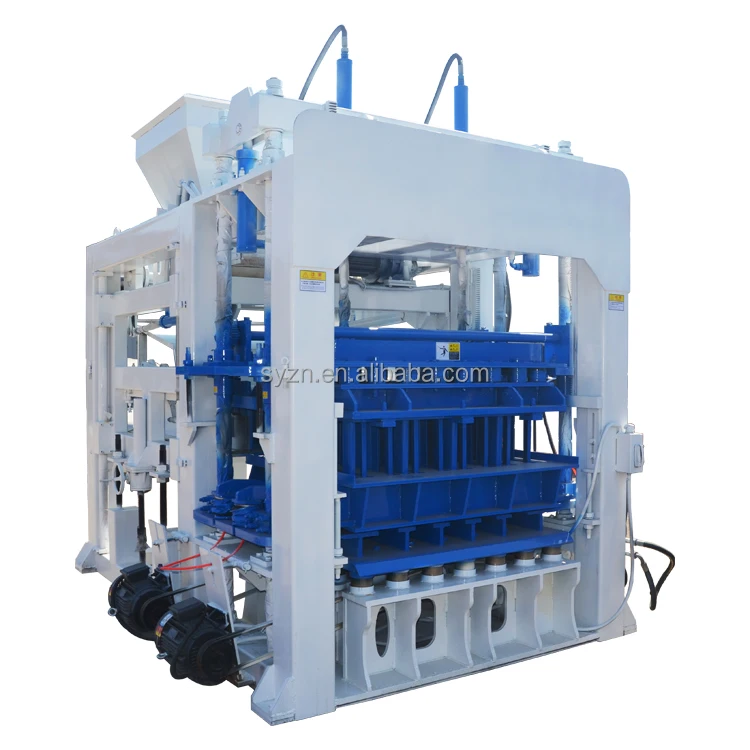
 Automatic block machine