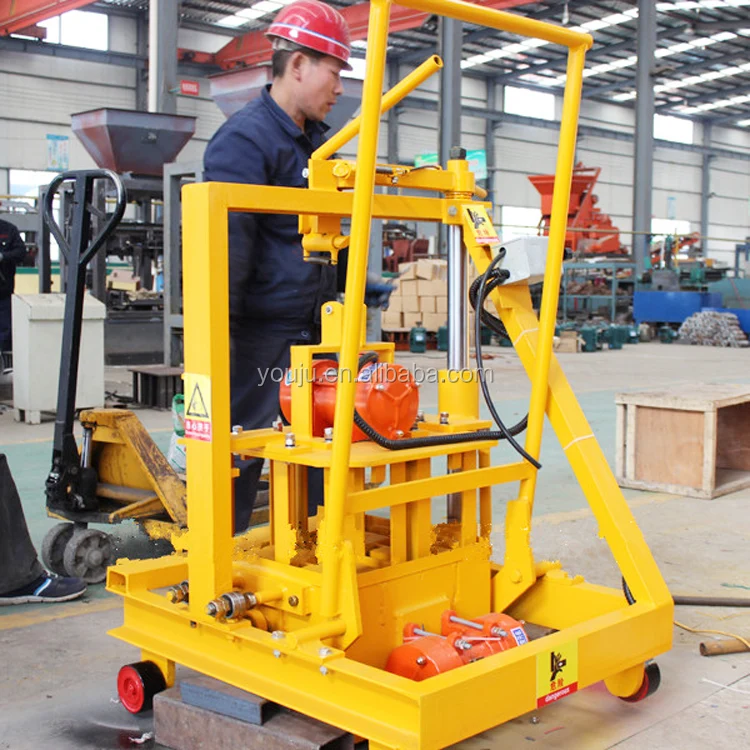
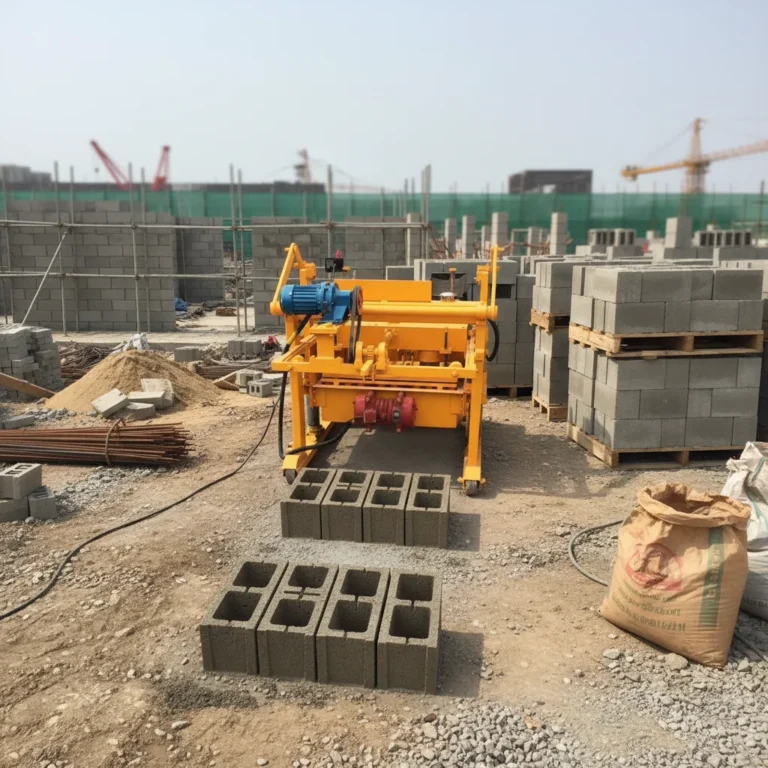
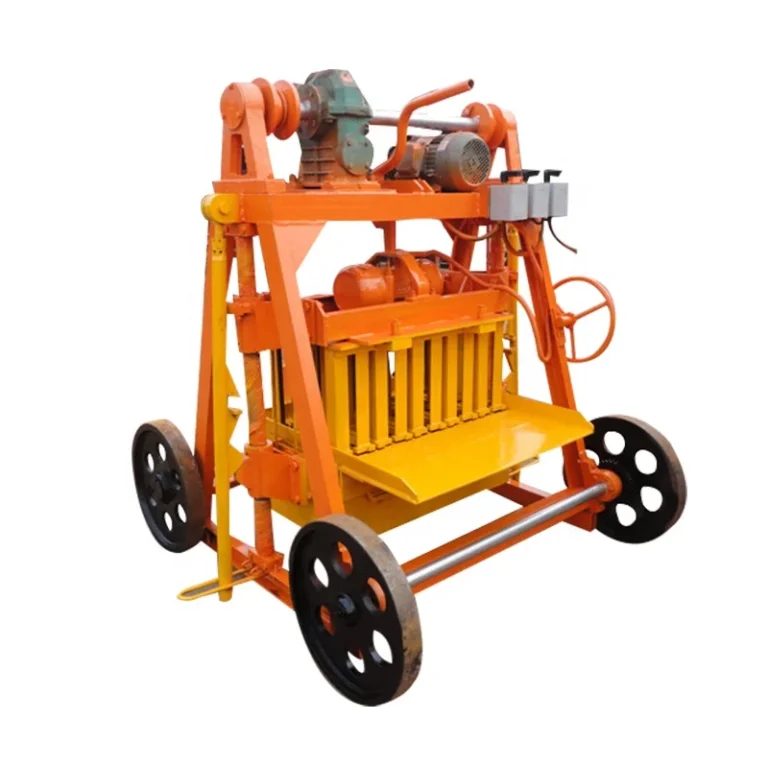
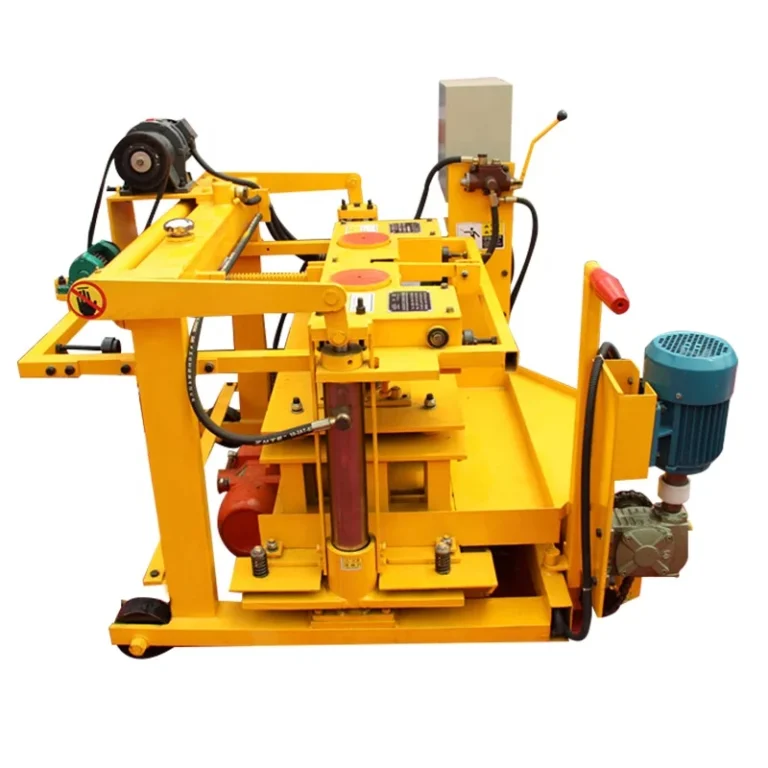
Egg-laying design without pallets — eliminates curing-area logistics so the machine produces directly on the ground, cutting both pallet investment and handling labor for entry-level block plants.
Technical Specifications
| Parameter |
Value |
| Model |
QMR4-45 |
| Product Type |
Mobile Concrete Block Making Machine |
| Overall Dimensions (L×W×H) |
2420×1320×1650 mm |
| Moulding Cycle |
40–45 s |
| Pallet Size |
No pallet required (egg-laying type) |
| Net Weight |
810 kg |
| Rated Power |
6 kW |
| Power Source Option |
Electric motor 6 kW or diesel engine 6–8 HP |
| Voltage |
220 V / 380 V or according to client local voltage |
| Output Capacity |
3000 pcs/day based on 400×200×200 mm hollow block, 4 pcs/mould, 8-hour shift |
| Output Capacity |
3500 pcs/day based on 400×150×200 mm hollow block, 5 pcs/mould, 8-hour shift |
| Output Capacity |
4500 pcs/day based on 400×120×200 mm hollow block, 6 pcs/mould, 8-hour shift |
| Automation Level |
Manual / small-scale mobile |
| Mould Change |
Interchangeable moulds for different block specifications |
| Operating Environment |
Suitable for sites without stable electricity supply (diesel engine option) |
| Warranty |
One year for the whole machine |
| Standards |
CE (referenced in company documentation) |
Application Suitability
| Application |
Material or Output |
| On-site hollow block production at construction projects |
Crushed stone, river sand, cement, water — mixed on-site |
| Remote-area block plants with unreliable grid power |
Diesel-powered operation producing hollow blocks without fixed plant infrastructure |
| First-time block plant startups with minimal capital |
Small-footprint egg-laying production of 400×200×200 mm, 400×150×200 mm, and 400×120×200 mm hollow blocks |
What Capacity Figures Leave Out When the Block Format Is Not Stated
Every daily output number must name the exact block size, mould cavity count, and shift length behind it — otherwise it is just marketing arithmetic.
I have seen buyers sign purchase orders based on a headline daily capacity, then arrive at the site and discover the machine only reaches that number on the smallest format in the catalogue. With the QMR4-45, the spread is real: the same machine produces fewer than half as many large hollow blocks as it does narrow ones over an identical shift. A mobile block machine manufacturer should always publish the format behind every output claim so the buyer can plan against the block the local market actually buys, not the one that inflates the brochure. [NEED_CITE: common block format preferences by regional construction market]

Where the QMR4-45 Sits in the Full Range
The QMR4-45 occupies the entry tier of our mobile block machine range. It produces blocks directly on the ground without pallets, which removes an entire layer of logistics — no pallet purchase, no pallet storage, no forklift cycling pallets to a curing rack. Buyers who have never run a block line often underestimate how much capital and floor area a pallet system absorbs. This machine lets them start producing and selling blocks with nothing more than a flat concrete slab and raw material.
Once a buyer outgrows egg-laying output and moves to semi-automatic or fully automatic tiers, pallets become necessary because the presses run faster than blocks can cure in place. Understanding that transition before committing to a first machine is the reason we publish the full range side by side — so a buyer can place themselves on the spectrum and choose the tier that matches current demand and available capital.
Diesel Power and the Sites the Grid Cannot Reach
Many construction sites in developing regions have either no grid connection or a supply that drops voltage below the motor’s operating window several times a day. The QMR4-45 is available with a 6–8 HP diesel engine that drives both the vibration system and the hydraulic circuit, so the machine can work independently of electrical infrastructure. For a contractor producing blocks on a remote housing project, this removes the cost and delay of running temporary power lines. [NEED_CITE: typical voltage fluctuation tolerance of industrial electric motors]
Where grid power is stable, the electric motor option at 6 kW draws less fuel cost over a long production run. The voltage is configurable — 220 V or 380 V, or matched to the buyer’s local standard — and we confirm the exact voltage and frequency before production starts so the motor arrives ready to connect.
Reading the Specification Sheet Against Real Site Conditions
The 40–45 second moulding cycle governs how many blocks the press completes in a shift, but cycle time alone does not tell the full story. What matters equally is the time the operator spends moving the machine to the next position, feeding the hopper, and waiting for the mix to arrive. On a well-organized site with a dedicated mixer and two operators, the effective cycle approaches the lower end of the range. On a site where one person handles mixing, feeding, and machine movement, the real throughput shifts toward the upper end.
The net weight of 810 kg keeps the machine mobile enough to push across a slab by hand, yet heavy enough that vibration force transfers into the block rather than dissipating through frame movement. Vibration and hydraulic pressure together determine block density and compressive strength; if the local aggregate is high in fines or clay, the vibration frequency may need adjustment to avoid segregation — an issue I have diagnosed on site after a buyer’s first day of production fell short of expectations.
The pallet-free design means the curing area is the slab itself. The buyer must ensure the slab is level and long enough to hold a full shift’s output before blocks are moved.
What Happens When the Machine Is Specified Without the Buyer’s Mix Design
A machine configured for clean, graded aggregate will struggle when fed sand with high clay content. The vibration that compacts a clean mix can cause segregation in a dirty mix, leaving weak layers inside the block. I have traveled to project sites where output dropped sharply and block strength failed testing, not because the machine was faulty but because the vibration frequency and amplitude had never been matched to the material the buyer could actually source. [NEED_CITE: effect of fine aggregate clay content on concrete block compressive strength]
When the specification process skips the buyer’s local raw material, the first week of production becomes an expensive experiment. Getting the mix design, vibration setting, and cycle time aligned before the machine leaves the factory is the difference between a smooth commissioning and a week of rework.
Why Sourcing This Tier From a Single-Focus Manufacturer Matters
Block machinery is our only product line, so the QMR4-45 is specified alongside the moulds, the raw material proportions, and the site conditions it will face — not pulled from a general machinery catalogue. Configuration is set against the buyer’s actual target block format and local aggregate, not a default brochure setting. Mould design covers the formats the buyer’s market sells, and custom mould drawings are available when a non-standard dimension is required.
Automation level is selectable within the range, so a buyer who starts with this mobile tier can later move to semi-automatic lines without changing suppliers or re-learning a different control philosophy. Installation support and operator training are included, which matters especially on first-time plants where no one on site has run a block machine before.
Documentation & Verification
- Line layout showing slab dimensions needed for a full shift of egg-laying output
- Capacity calculation document stating the exact block format behind every output figure
- Machine specification sheet confirming voltage, frequency, and diesel engine rating for the buyer’s site
- Mould drawing and format list for each hollow block dimension the buyer plans to produce
- Factory test record confirming cycle time and block density before dispatch
- Operation and maintenance manual with wear parts list and replacement intervals
Installation, Commissioning & Support
- Requires a level concrete slab at least 100 mm thick to support 810 kg machine weight plus wet block load during curing
- Electric version needs a dedicated 220 V or 380 V circuit matched to confirmed frequency before motor is wired at factory
- Diesel version arrives with engine pre-fitted; buyer supplies fuel and confirms engine service access clearance
- First-day commissioning includes vibration frequency tuning against the buyer’s actual aggregate and mix proportions
- Operator training covers mould change procedure, hopper feeding rhythm, and machine repositioning technique
- Wear parts list identifies high-contact components with expected replacement intervals under normal operation
What to Tell Us Before We Quote
To configure the QMR4-45 correctly, we need to know which hollow block dimensions sell in your local market and the daily quantity you plan to produce on each format. Share your local aggregate type — whether river sand, crushed stone, or a blend — and any lab test data you have on particle grading and clay content. Confirm the voltage and frequency available on site, or whether you intend to run the diesel engine full-time.
Frequently Asked Questions
Q: How is daily output calculated, and which block format does each figure assume?
A: Every output figure we publish names the block dimension, the number of cavities in the mould, and the shift length. For the QMR4-45, 3000 pieces per day assumes 400×200×200 mm blocks from a 4-cavity mould over eight hours, 3500 pieces assumes 400×150×200 mm from a 5-cavity mould, and 4500 pieces assumes 400×120×200 mm from a 6-cavity mould.
Q: Can the QMR4-45 run entirely on diesel without any grid electricity?
A: Yes. The diesel engine option at 6–8 HP drives the vibration motor and the full production cycle. No electrical connection is needed. This configuration is intended for remote construction sites or regions where grid power is unreliable or unavailable during the construction phase.
Q: What block formats can this machine produce, and how long does a mould change take?
A: The QMR4-45 uses interchangeable moulds and can produce multiple hollow block dimensions from one machine frame. Standard moulds cover the listed formats. Mould change is a manual process completed with basic hand tools. Custom moulds are available to buyer drawings for non-standard dimensions.
Q: Where does this mobile machine sit compared to semi-automatic and automatic tiers?
A: The QMR4-45 is the entry tier — pallet-free, egg-laying, suited for small-scale or on-site production. Semi-automatic lines add pallet feeding and higher output. Fully automatic lines add stacking, cubing, and PLC control. Buyers choose based on current daily demand and capital available.
Q: What voltage options are available, and how is this confirmed before production?
A: The electric motor version supports 220 V or 380 V, or can be wound to match the buyer’s local voltage standard. We confirm the exact voltage and frequency during the order process before the motor is sourced, so the machine arrives ready to connect without rewiring on site.

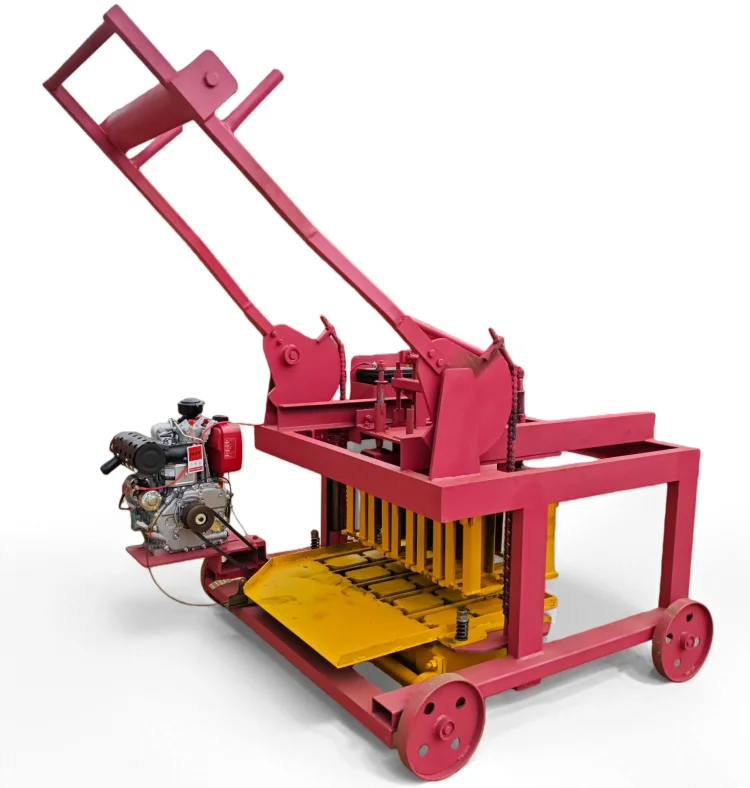
 Mobile block machine