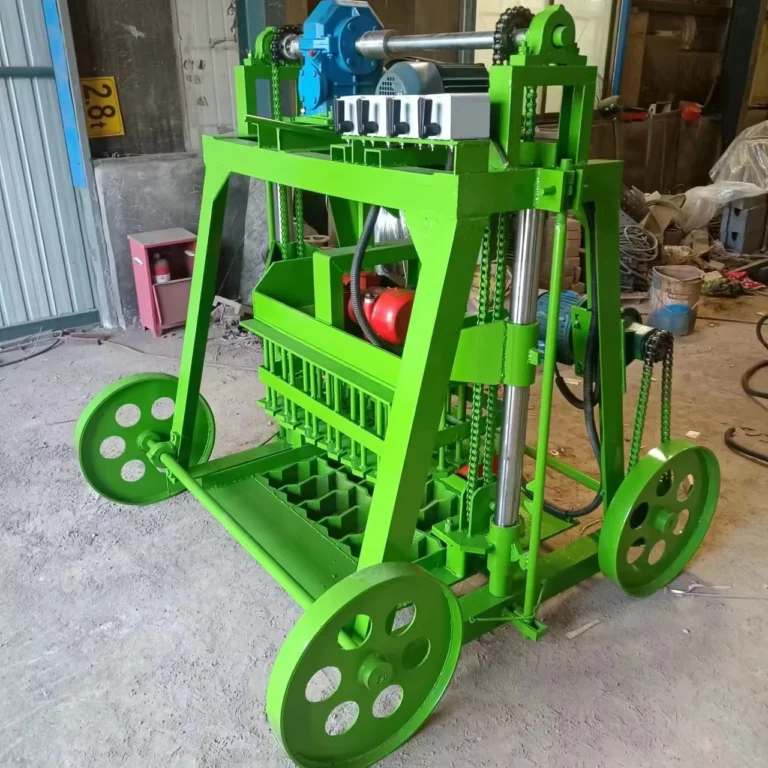
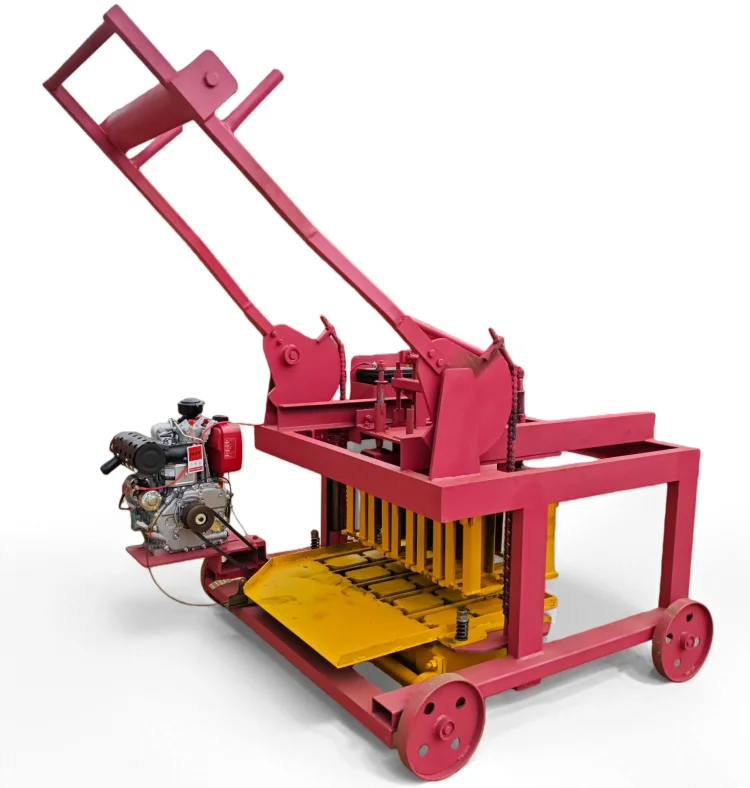
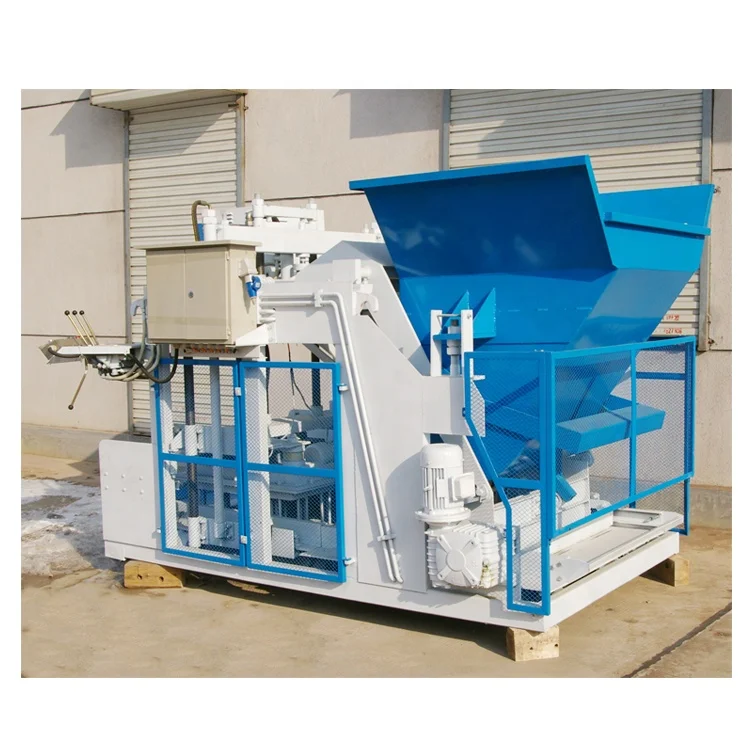
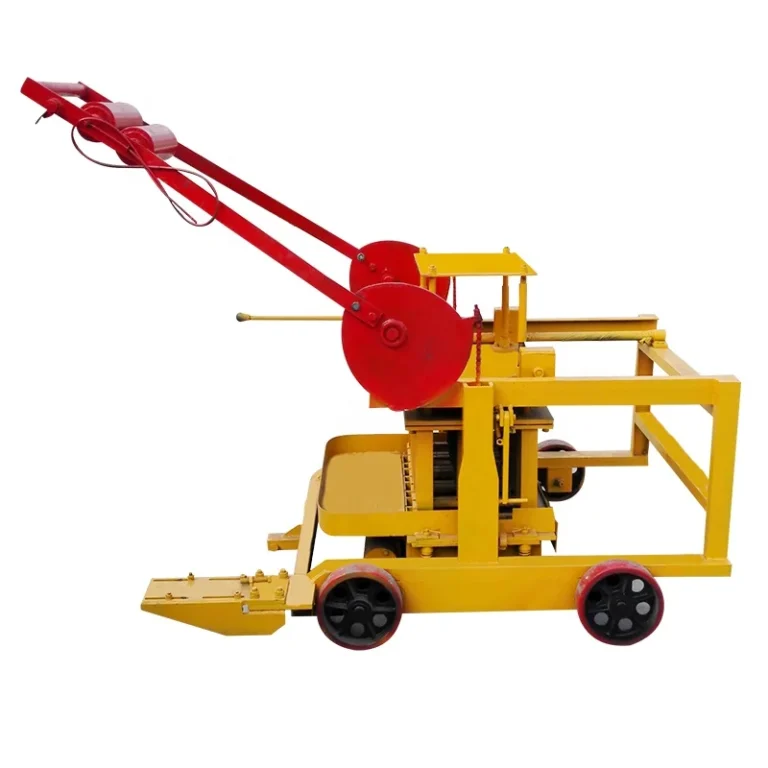
Matched System Approach — the QMR4-45 mobile block machine ships as a complete unit with mixer and trolley, eliminating the need to source separate components that may not integrate properly on remote sites.
Technical Specifications
| Parameter |
Value |
| Model |
QMR4-45 |
| Product Type |
Mobile Block Machine |
| Molding Cycle |
45s |
| Power Source |
Diesel |
| Rated Power |
8hp |
| Molding Form |
Vibration and Pressure |
| Vibration Force |
60KN |
| Total Weight |
800kg |
| Overall Size |
2420×1320×1650mm |
| Pallet Requirement |
No pallet required |
| Compatible Formats |
Paver brick, hollow block, concrete block, solid brick, fly ash brick |
| Basic Equipment Supplied |
JZC350 Diesel Concrete Mixer or JQ350 Diesel Concrete Mixer (Electric Generating Unit); Trolley |
| Automation Level |
Manual operation |
Application Suitability
| Application |
Material or Output |
| On-site hollow block production |
Crushed stone, sand, and cement mixes |
| Remote housing project sites |
Locally sourced aggregates with cement binder |
| Small-scale solid brick operations |
Fly ash blended with sand or stone dust |
| Paver brick production for walkways |
Fine aggregate and cement combinations |
| Contractor yard block making |
Variable aggregate grades depending on local supply |
Why Capacity Claims Fail When the Block Format Changes
A 45-second cycle only means something when you know which block is being molded.
Many mobile block machine manufacturers quote cycles per hour without revealing the format behind that number. A hollow block and a solid paver require different compression times, fill depths, and vibration durations. When a buyer arrives on site and switches molds, the actual daily output often drops noticeably compared to the original quotation. I have watched contractors plan their entire pour schedule around a capacity figure that dissolved the moment they changed from hollow to solid format [NEED_CITE: block format impact on cycle time variance].

Placing the QMR4-45 Within the Mobile Tier
The QMR4-45 represents the entry point of our mobile block machine range, built for buyers who cannot rely on grid power or a prepared factory floor. Diesel operation at 8hp means the machine runs wherever fuel arrives, removing the voltage mismatch problem that delays so many equipment deployments. This tier suits contractors moving between project sites rather than establishing a permanent production facility.
Where the Mobile Tier Ends and Semi-Automatic Begins
Stepping above this mobile tier means committing to a fixed location, pallet circulation, and electrical infrastructure. The QMR4-45 avoids all of that by depositing blocks directly onto the ground — no pallets to purchase, store, or replace. Buyers who need higher volume or consistent curing conditions should evaluate semi-automatic lines, but those require capital and site preparation that this machine deliberately avoids.
What Vibration Force and Cycle Time Actually Mean on a Job Site
The 60KN vibration force works together with the pressure system to compact the concrete mix during each 45-second cycle. For hollow blocks, this force must be sufficient to consolidate the mix around the mold core without collapsing the cavity walls. The 45-second figure applies to the standard molding sequence, but actual throughput depends entirely on the block format selected, the mix consistency, and how quickly operators can reposition the machine between cycles [NEED_CITE: vibration force requirements for different block densities]. An 800kg total weight allows manual relocation across a yard, yet provides enough mass to resist excessive movement during vibration. The no-pallet design simplifies logistics but demands a relatively flat, firm surface for acceptable block geometry.
The Cost of Underspecifying Your Site Conditions
Buyers who select a mobile machine without confirming their ground conditions often discover that freshly laid blocks settle unevenly on soft soil, creating dimensional inconsistency across a production run. Similarly, specifying a diesel-powered unit in an area where diesel supply is unreliable converts the supposed advantage into a daily operational problem [NEED_CITE: site preparation standards for mobile block production]. Voltage and frequency assumptions also surface when electric mixer variants are chosen without matching local grid standards, leaving equipment idle until transformers or generators arrive.
Why Procurement Decisions Land Here
Block machinery as a single focus means the QMR4-45 arrives with a matched diesel mixer and trolley rather than a collection of separately sourced items. Configuration is set against the buyer’s actual mix design and local aggregate availability, not a generic catalog default. Molds are designed for the formats the buyer’s market actually sells, including custom drawings when standard options do not fit. The automation level remains selectable, so a buyer can begin with manual mobile production and move to semi-automatic later without replacing the entire system. Installation support includes operator training specific to the manual molding sequence and mold change procedure.
Documentation & Verification
- Line layout showing the operating radius and material flow for the QMR4-45 with its mixer
- Machine specification sheet listing vibration force, cycle time, and diesel power rating
- Mold drawing and format list confirming which block types fit the QMR4-45 platform
- Factory test record on the buyer’s specified block format before dispatch
- Operation manual covering mold change procedure and daily maintenance checkpoints
Installation, Commissioning & Support
- Flat, compacted ground surface required within the 2420×1320mm machine footprint for level block deposition
- Diesel fuel supply arranged locally to match the 8hp engine consumption rate
- Machine arrives fully assembled; mixer and trolley connect on site without heavy lifting equipment
- First production run supervised to confirm 45-second cycle timing against the selected block format
- Operator training covers manual mold change sequence and vibration duration adjustment per format
- Wear parts list identifies high-contact components for local stocking before the first replacement is due
What to Prepare Before Requesting a Quotation
Confirm the block format your market demands, the daily volume you need to sustain, and whether your site has reliable diesel access or requires the electric generating unit variant. Identify your local aggregate type and maximum particle size so the mix design can be matched to the machine’s vibration characteristics. If you already own curing space or handling equipment, note those dimensions so the output flow can be planned realistically.
Frequently Asked Questions
Q: How is output capacity verified, and what block format is the cycle time based on?
A: The 45-second molding cycle applies to the standard sequence, but actual output must be calculated per block format because fill depth, compression time, and mold complexity all affect the real daily figure. We provide a capacity calculation stating the exact block format assumed, so buyers can compare quoted output against their actual product mix.
Q: What are the voltage options and how do they match my target market’s grid standard?
A: The QMR4-45 runs on diesel power, bypassing grid voltage concerns entirely. However, if the electric generating unit variant is selected for the mixer, voltage and frequency must be confirmed before production to match your local grid standard and avoid commissioning delays upon arrival.
Q: How do I choose between the QMR4-45 mobile tier and a semi-automatic or automatic model?
A: The mobile tier suits contractors who relocate between sites and cannot invest in fixed plant infrastructure. Semi-automatic and automatic models deliver higher volume and consistency but require prepared floors, pallet circulation, electrical connections, and greater initial capital — considerations that favor established production facilities over project-based operations.
Q: What site conditions and space footprint does this mobile machine require for operation?
A: The machine occupies 2420×1320mm but needs additional clearance for the mixer, trolley movement, and block curing area. Ground must be flat and firm enough to support 800kg plus fresh block weight without settling. Diesel access, aggregate storage, and water supply all factor into the total working area required.
Q: Which mold formats are available, and can custom molds be designed to my drawings?
A: Standard molds cover hollow block, solid brick, paver brick, and fly ash brick formats compatible with the QMR4-45 platform. Custom mold design is available from buyer drawings, allowing production of formats specific to your local market demand that may not appear in standard catalogs.

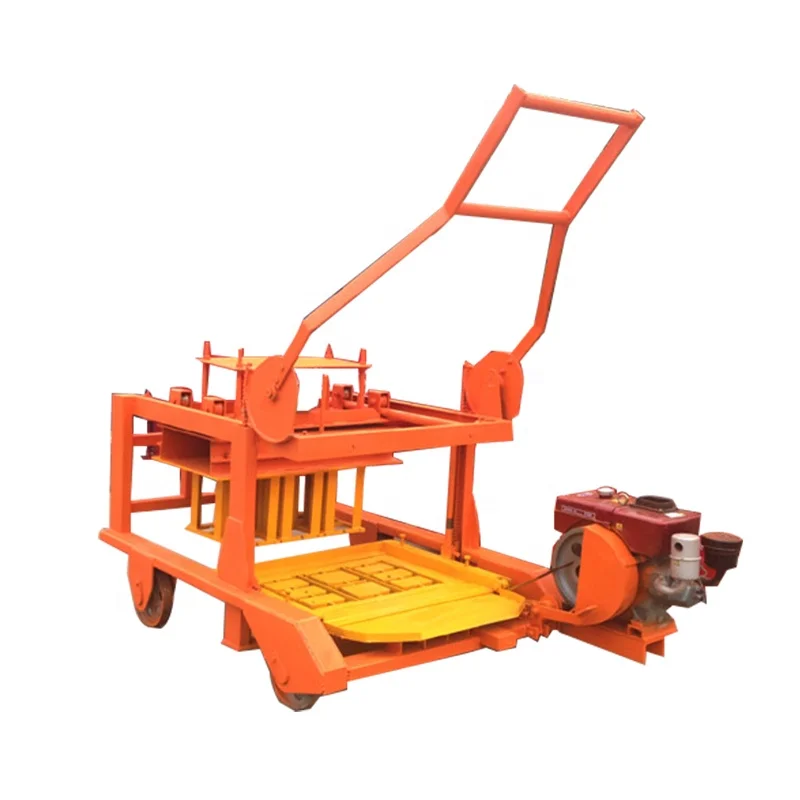
 Mobile block machine