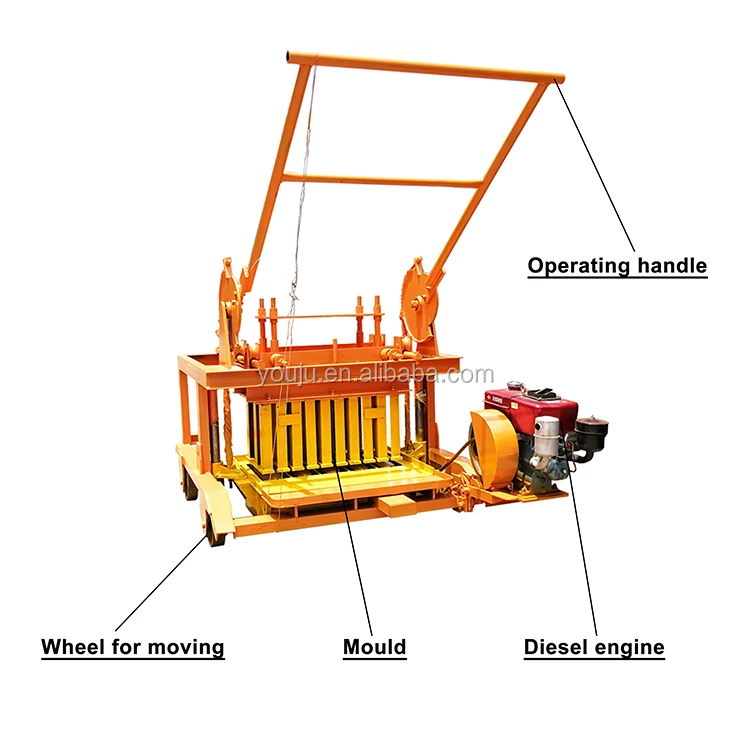
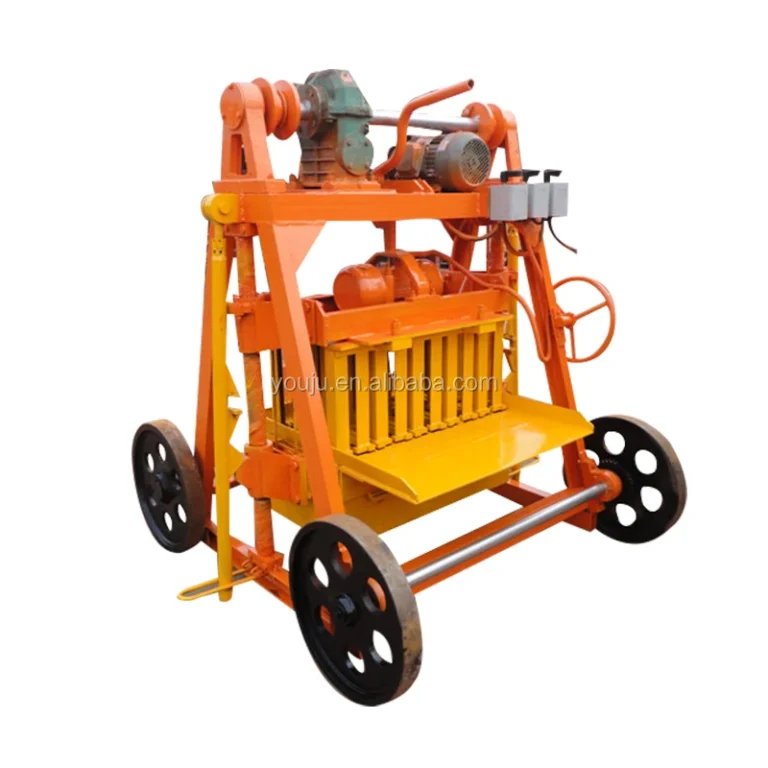
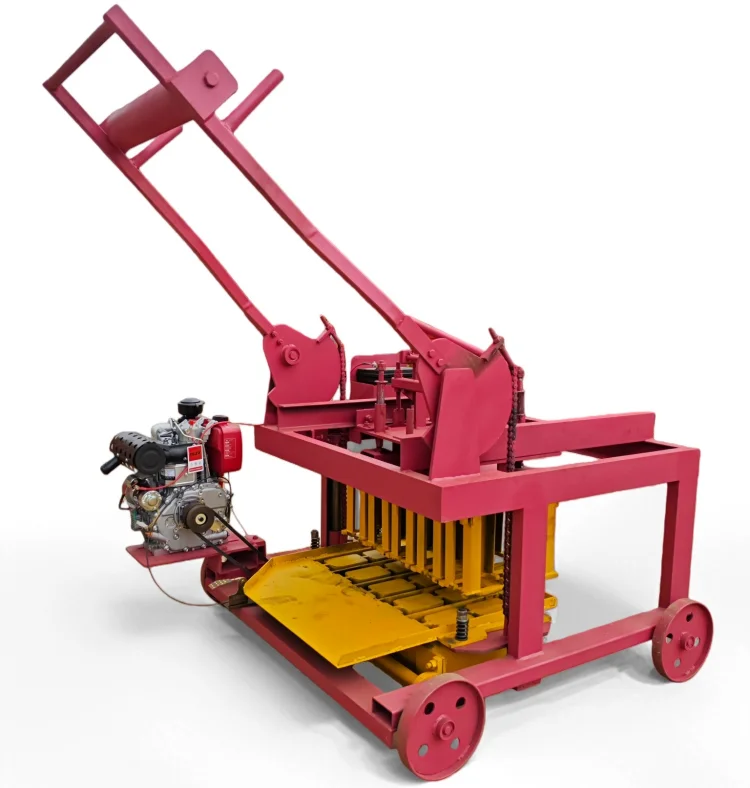
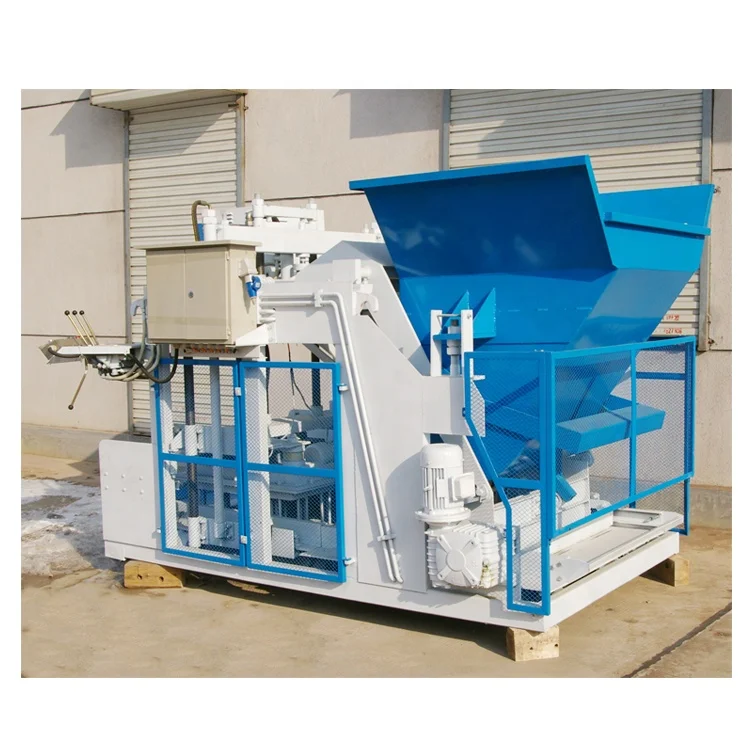
Diesel Independence — The QMR4-45 operates entirely off-grid, eliminating electrical dependency for remote site block production.
Technical Specifications
| Parameter |
Value |
| Model |
QMR4-45 |
| Product Type |
Mobile Manual Egg-laying Brick Making Machine |
| Power Source |
Diesel engine |
| Operation Mode |
Manual |
| Machine Type |
Mobile / Egg-laying |
| Output Capacity |
(basis to be confirmed) |
| Cycle Time |
(basis to be confirmed) |
| Mould Format |
Interchangeable (solid, hollow, paving formats available) |
| Pallet Size |
Not applicable (blocks laid directly on ground) |
| Hydraulic Pressure |
(basis to be confirmed) |
| Vibration Force |
(basis to be confirmed) |
| Automation Level |
Manual |
| Stacking Method |
Manual (egg-laying, blocks cured on ground) |
| Voltage & Frequency |
Not applicable (diesel powered) |
| Control System |
Manual operation |
Application Suitability
| Application |
Material or Output |
| On-site construction block production |
Solid and hollow blocks from local aggregate and cement |
| Off-grid housing development projects |
Standard walling blocks without grid electricity |
| Small-scale entrepreneurial block plants |
Entry-level production with minimal capital outlay |
| Remote infrastructure contracting |
Kerbstones and paving blocks laid directly on prepared ground |
What "Cycles Per Hour" Leaves Out About Mobile Egg-laying Block Machine Capacity
Capacity figures mean nothing without the block format attached to them.
Many suppliers quote a mobile egg-laying block machine manufacturer rating based on a single cycle time, but that cycle varies depending on whether you are pressing a small solid paver or a large hollow block. I have reviewed quotations where the stated output assumed a format the buyer never intended to produce, leaving actual daily volume far below expectation. The QMR4-45 produces different formats at different rates, and each must be calculated against your target market [NEED_CITE: block format demand by regional construction standard].

Where the QMR4-45 Sits in the Full Range
This model anchors the entry point of our mobile block machine lineup. It is designed for buyers who need production capability without the capital commitment of a fixed plant, mixer station, or pallet circulation system. For a first-time block producer or a contractor who needs blocks directly on a building site, the QMR4-45 removes the infrastructure barrier entirely.
Diesel Power and the Off-Grid Advantage
The diesel engine configuration means this machine operates anywhere, independent of local grid reliability or voltage standards. This matters for development projects in regions where electrical infrastructure is still being built out. The mobile egg-laying block machine manufacturer specification here prioritizes fuel availability and mechanical simplicity over electronic control complexity, which keeps maintenance within the capability of a small site crew [NEED_CITE: diesel engine maintenance intervals for industrial equipment].
Mould Change and Format Flexibility on a Manual Platform
The QMR4-45 accepts interchangeable moulds for solid blocks, hollow blocks, and basic paving formats. Mould change is manual, which means it takes longer than a hydraulic clamp system on an automatic press. The trade-off is mechanical simplicity and lower initial investment. Buyers who need to switch formats frequently within a single shift should consider whether a semi-automatic model with faster changeover better suits their production schedule.
The Ground Preparation Requirement That Buyers Overlook
Egg-laying machines deposit blocks directly onto the ground, which means ground flatness and surface preparation directly affect block quality and breakage rates. A site with uneven or soft ground will produce blocks that crack during curing or fail to meet dimensional tolerance. This is not a machine limitation but a site preparation requirement that must be budgeted before production begins [NEED_CITE: ground preparation standards for mobile block production].
Why Source This Configuration Here
Block machinery is our single focus, which means the QMR4-45 is specified as a complete system — machine, mould options, and diesel engine matched to the buyer’s target format and local aggregate. We do not assemble from separate suppliers. Configuration is set against the buyer’s actual mix design, not a catalogue default. Automation level is selectable across our range, so a buyer starting with the QMR4-45 can transition to semi-automatic or fully automatic lines as volume grows. Installation support includes operator training specific to manual egg-laying operation and diesel engine maintenance.
Documentation & Verification
- Line layout showing egg-laying production flow and curing area requirements
- Machine specification sheet confirming diesel engine rating and vibration force
- Mould drawing and format list for available block types
- Diesel engine specification and fuel consumption data
- Operation and maintenance manual covering manual mould change procedures
- Factory test record on buyer’s specified block format before dispatch
Installation, Commissioning & Support
- Site assessment for ground flatness and curing area sizing before machine arrival
- Diesel engine commissioning with fuel system bleed and cold-start verification
- Manual mould change training with cycle time measurement per block format
- Operator training on mix consistency recognition for egg-laying production
- Wear parts list with mould liner and vibration component replacement intervals
- Daily maintenance checklist covering engine oil, vibration mounts, and mould alignment
Before You Send an Inquiry
To configure the QMR4-45 accurately, we need to know your target block format and the daily output you expect from that specific format. Share your local aggregate type and cement availability, as these determine the vibration force and cycle time the machine must deliver. Confirm whether your site has ground preparation capacity or if that needs to be included in project planning.
Frequently Asked Questions
Q: How is the output capacity of the QMR4-45 verified and what block format does it assume?
A: Output capacity is stated per block format, not as a single machine-wide figure. A solid paver and a hollow block have different cycle times and different daily outputs from the same machine. We provide a capacity calculation that names the specific format, dimensions, and assumed mix design so your production planning starts from a verified baseline rather than a catalogue maximum.
Q: What block formats can the QMR4-45 produce and how long does a mould change take?
A: The machine accepts interchangeable moulds for standard solid blocks, hollow blocks, and basic paving formats. Mould change is a manual process requiring the operator to unbolt, lift, and align the replacement mould. Changeover time depends on operator familiarity and is factored into shift planning for buyers who need multiple formats within a single production day.
Q: What site conditions are required for egg-laying operation with the QMR4-45?
A: The production area must have level, compacted ground to prevent block cracking during the curing period. The curing area must be sized to hold multiple days of production without disturbance. Site preparation is a prerequisite that must be completed before the machine arrives, as uneven ground directly increases breakage and reduces usable output.
Q: Where does the QMR4-45 sit compared to semi-automatic and automatic models in the range?
A: The QMR4-45 is the entry point for buyers who need block production without fixed plant infrastructure, pallet systems, or grid electricity. Semi-automatic models add pallet handling and higher output for buyers with established demand. Fully automatic lines serve high-volume plants with dedicated curing and stacking systems. The range allows buyers to start here and transition upward as volume justifies the investment.

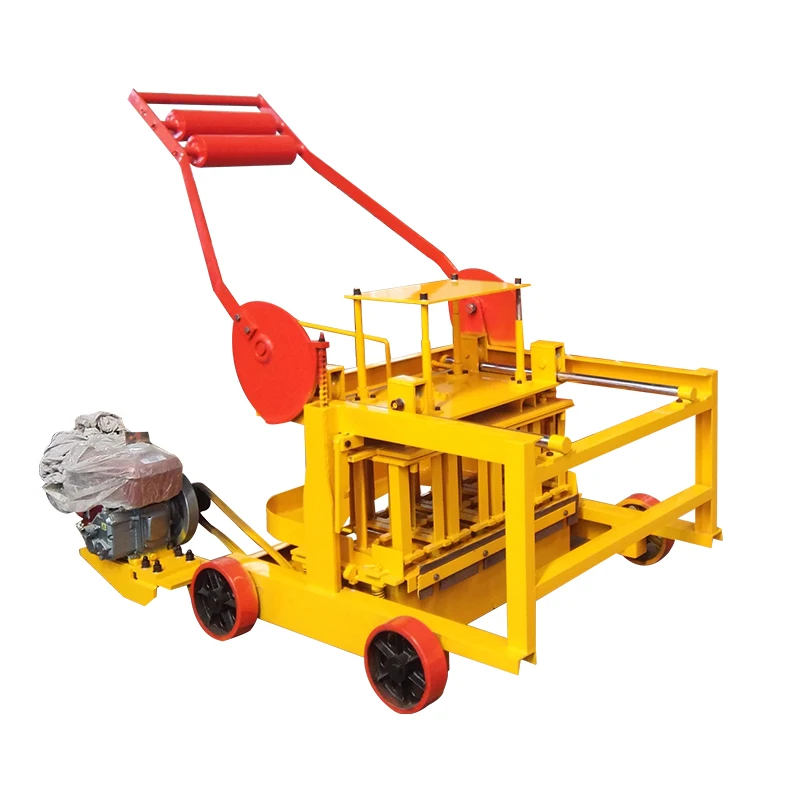
 Mobile block machine