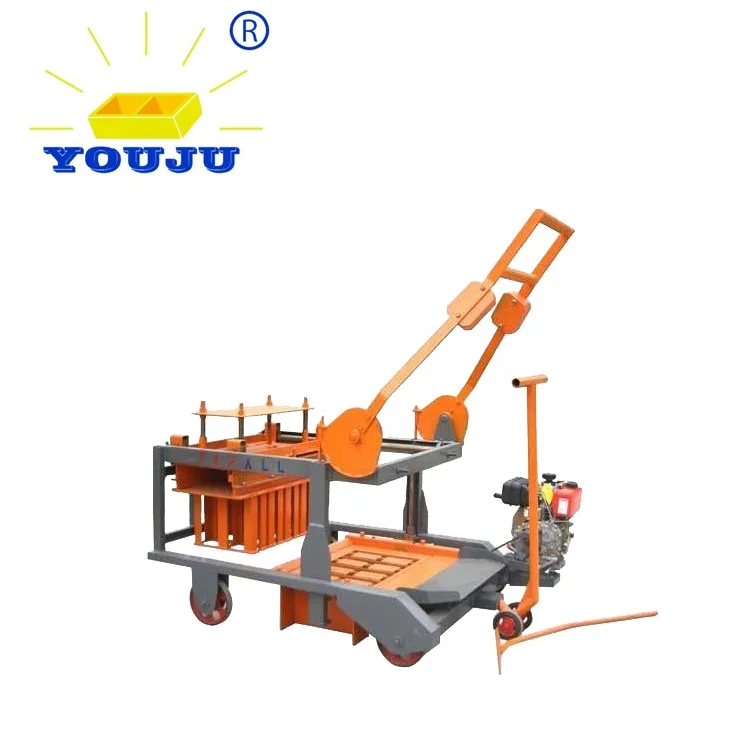
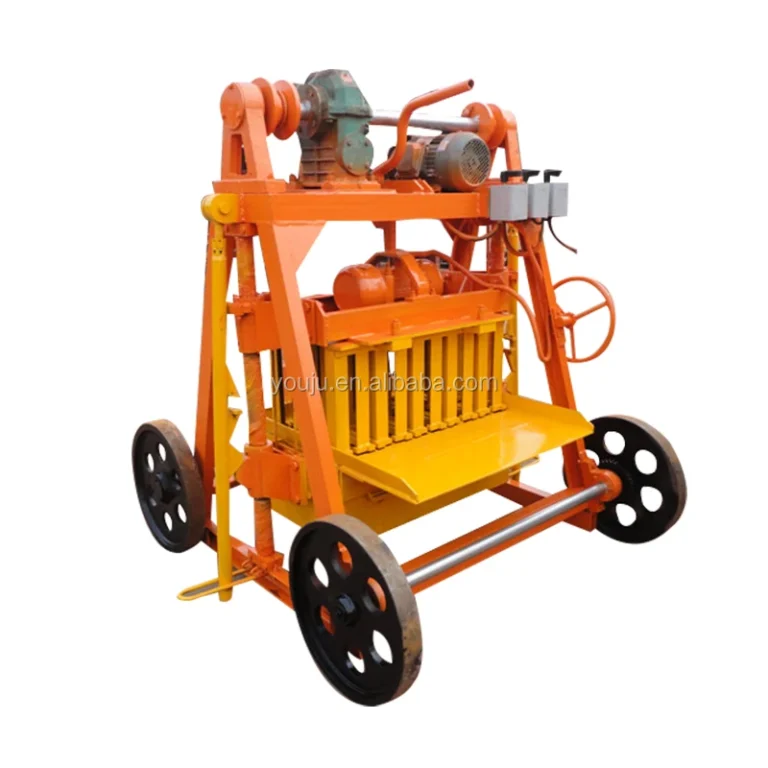
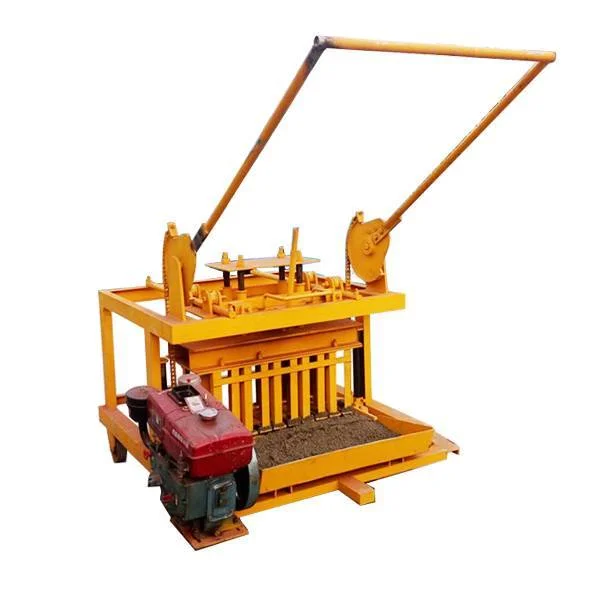
Pallet-Free Entry Tier — the QMJ2-45 mobile egg-laying block machine sits at the investment floor of our range, letting a first-time buyer produce hollow bricks on-site without a fixed plant or pallet inventory.
Technical Specifications
| Parameter |
Value |
| Model |
QMJ2-45 |
| Product Type |
Mobile Egg-Laying Block Making Machine |
| Automation Level |
Manual operation, no PLC |
| Mould Format |
Interchangeable moulds for hollow brick |
| Qty per Mould |
2 pcs (400×200×200 mm); 3 pcs (400×150×200 mm); 4 pcs (400×100×200 mm) |
| Cycle Time |
25–30 s (basis not stated in source — confirm block format and material) |
| Output Capacity |
160 pcs/h at 400×200×200 mm; 240 pcs/h at 400×150×200 mm; 320 pcs/h at 400×100×200 mm hollow brick |
| Daily Output (8 h) |
1,280 pcs at 400×200×200 mm; 1,920 pcs at 400×150×200 mm; 2,560 pcs at 400×100×200 mm |
| Power Source |
Electric engine (kW rating to be confirmed) |
| Voltage & Frequency |
Configurable to target market (confirm before production) |
| Pallet Requirement |
None — pallet-free egg-laying design |
| Labor Requirement |
1 to 3 workers |
| Footprint |
Compact, suitable for constrained sites (exact dimensions to be confirmed) |
| Certification |
ISO 9001:2000, CE |
Application Suitability
| Application |
Material or Output |
| On-site hollow block production |
Crushed stone, sand, cement and water mix laid directly on the ground |
| Remote housing project supply |
Hollow bricks produced where fixed plant infrastructure is unavailable |
| Startup block yard |
Low-volume hollow brick runs with minimal capital and no pallet stock |
| Contractor self-supply |
Project-specific hollow brick formats produced beside the build site |
What "320 Pieces per Hour" Actually Means for Your Hollow Brick
Every mobile block machine manufacturer quotes a headline capacity — the real question is which block format that number assumes.
A buyer comparing two mobile egg-laying machines on a single output figure will miss the fact that capacity shifts dramatically between a 200 mm wide hollow brick and a 100 mm wide one. The QMJ2-45 produces 160 pieces per hour on the 400×200×200 mm format but reaches 320 pieces per hour on the 400×100×200 mm format, simply because the mould holds four blocks instead of two. If your market primarily buys the larger format, planning around the higher number will leave you short every shift. I have watched contractors arrive on site expecting one daily total and discover by lunch that their actual format cuts that figure nearly in half [NEED_CITE: capacity calculation methods for mobile block machines].

Where the QMJ2-45 Sits Across the Full Range
The QMJ2-45 occupies the entry tier of our mobile block machine manufacturer range. It is a manual, pallet-free unit designed for buyers who need to start producing hollow bricks before committing capital to a semi-automatic or fully automatic line. The investment is modest, the footprint is small, and the machine can be relocated as a project moves.
For a buyer surveying options, the next step up would be a semi-automatic stationary machine that adds pallet-based handling and higher vibration force, followed by fully automatic lines with batching, stacking and cubing. The QMJ2-45 exists so that a first-time buyer or a site contractor can validate block demand in their market without financing a complete plant.
Choosing Between Mobile, Semi-Automatic and Automatic Tiers
Each tier in the range trades capital against automation. The QMJ2-45 requires one to three workers, no pallets and no curing rack system — output is laid directly on the ground and cured in place. A semi-automatic machine introduces pallets, a mixer feed system and higher cycle consistency but also demands a dedicated curing area and forklift handling. A fully automatic line adds batching accuracy, automatic stacking and cubing, and significantly reduces labor, but requires a fixed plant building, three-phase power and a larger site footprint [NEED_CITE: block plant investment tiers and site requirements].
The right tier depends on daily volume, available site space and whether the buyer intends to stay mobile or settle into a permanent yard. The QMJ2-45 answers the buyer who is not yet ready to make that permanent commitment.
Reading the Specs That Matter on a Mobile Machine
Cycle time on the QMJ2-45 is listed at 25–30 seconds, but that figure must be read alongside the block format. A 400×200×200 mm hollow brick takes two cavities per cycle, while a 400×100×200 mm brick takes four — so the same cycle time produces very different hourly totals depending on which mould is mounted. Mould interchangeability across these hollow brick formats is what gives the machine its range.
The pallet-free egg-laying design means there is no pallet investment, no pallet return conveyor and no curing rack system to maintain. The trade-off is that block curing happens on the ground where the machine lays them, so the site surface must be level and prepared. Power is supplied by an electric engine, and the voltage and frequency must be confirmed against the local grid before the machine leaves the factory — running a 380 V motor on a 220 V supply will stall the unit on day one.
What Happens When Voltage and Language Are Skipped
Confirming electrical specifications sounds basic, yet it remains one of the most common reasons a block machine sits idle after arrival. A mobile block machine manufacturer may ship a unit wired for a frequency that does not match the buyer’s grid, causing the motor to run hot and trip its thermal overload within the first hour. Control panels defaulted to a language the crew cannot read mean every adjustment becomes guesswork [NEED_CITE: electrical commissioning failures in exported machinery].
On a manual machine like the QMJ2-45 the risk is lower than on a PLC-controlled line, but the motor winding, vibration motor and any auxiliary components still carry a voltage and frequency rating. Getting this wrong does not just delay production — it can void the motor warranty before the first block is laid.
Why Source This Mobile Machine Here
Block machinery is our single focus, so the QMJ2-45 is specified as part of a matched system — moulds, power unit and ground preparation requirements are confirmed together rather than sourced separately.
Configuration is set against the buyer’s actual hollow brick format and local aggregate, not a catalogue default. Every voltage, frequency and control language setting is confirmed in writing before production begins. Mould design covers the hollow brick sizes the buyer’s market actually sells, with custom drawings available. Installation guidance includes ground preparation for the egg-laying method, and operator training covers cycle rhythm, mix consistency and mould change procedure.
Documentation & Verification
- Capacity calculation sheet stating output per hollow brick format assumed
- Machine specification sheet with confirmed voltage and frequency
- Mould drawing and format list for each hollow brick size quoted
- Factory test record run on the buyer’s specified block format
- CE declaration and ISO 9001:2000 documentation where applicable
Installation, Commissioning & Support
- Level ground preparation required; the QMJ2-45 lays blocks directly on the surface without pallets
- Voltage and frequency confirmed before wiring; electric motor matched to local grid supply
- Mould fitted and aligned on site; first cycle observed for block dimension and release quality
- Operator training covers manual cycle rhythm, mix water ratio and mould change procedure
- Spare mould surfaces and wear components listed with recommended replacement intervals
Before You Send an Inquiry
Tell us which hollow brick format your market buys most — the 400×200×200 mm, the 150 mm variant or the 100 mm — so we can calculate realistic daily output on your actual product. Confirm your site voltage and frequency, and whether your ground surface is prepared concrete or compacted earth. If you already have a mixer or plan to hand-mix, let us know so we can match the feed method to the machine cycle.
Frequently Asked Questions
Q: How do I verify the QMJ2-45 capacity against the hollow brick format I actually sell?
A: Request a capacity calculation sheet that states output per specific hollow brick size. The QMJ2-45 produces different totals depending on whether the mould holds two, three or four blocks per cycle. Compare the figure for your primary format, not the highest headline number, against your daily target.
Q: Where does the QMJ2-45 sit compared to semi-automatic and automatic tiers in investment and footprint?
A: It is the entry tier — manual, pallet-free and relocatable, with the smallest site footprint and lowest capital outlay. Semi-automatic machines add pallets and higher output but need a fixed curing area. Automatic lines require a plant building, three-phase power and a larger investment.
Q: What voltage and frequency must I confirm before the QMJ2-45 ships?
A: The electric motor and any vibration components are wound for a specific voltage and frequency. Confirm your site supply — for example 380 V at 50 Hz or 440 V at 60 Hz — before production begins. A mismatch will cause motor overheating and may void the warranty.
Q: Can I upgrade from this mobile machine to a semi-automatic line later?
A: Yes. The QMJ2-45 lets you validate block demand and learn your market before committing to a pallet-based semi-automatic line. When volume justifies it, the semi-automatic tier adds higher vibration force, pallet handling and greater cycle consistency while building on the format knowledge you gained.
Q: What hollow brick mould formats are available and how long does a mould change take?
A: Standard moulds cover 400×200×200 mm, 400×150×200 mm and 400×100×200 mm hollow bricks. Custom mould drawings are available on request. Mould change time depends on bolt configuration and operator familiarity — confirm the procedure during on-site training.

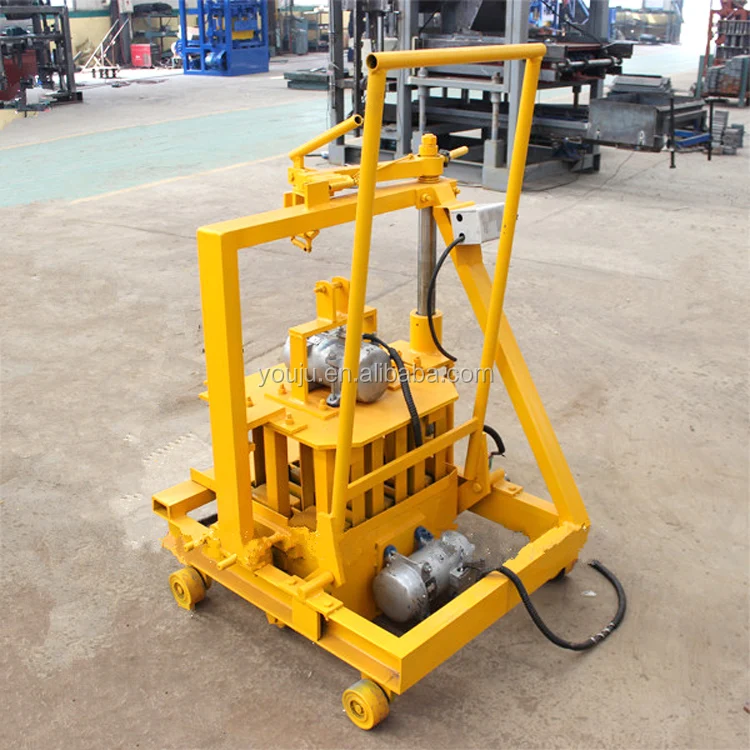
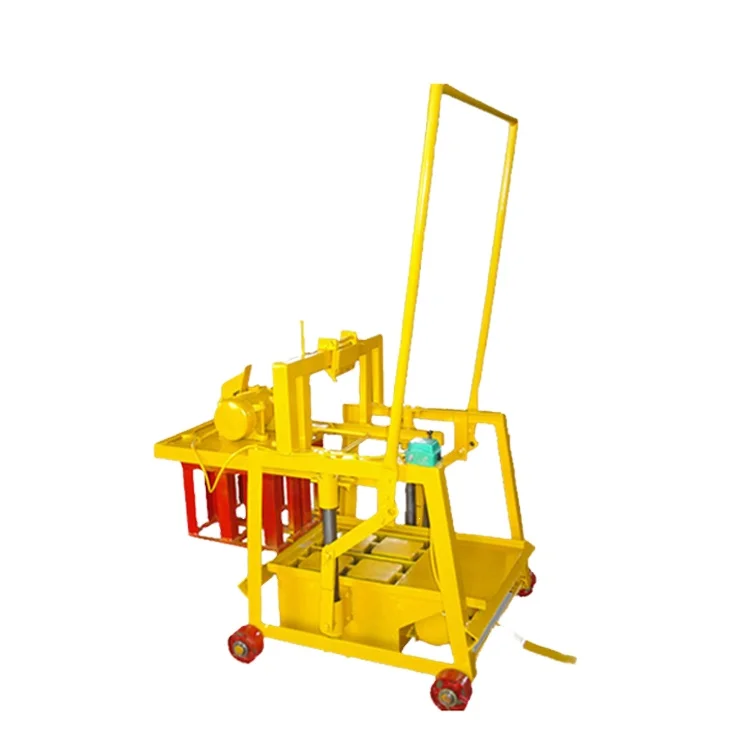 Mobile block machine